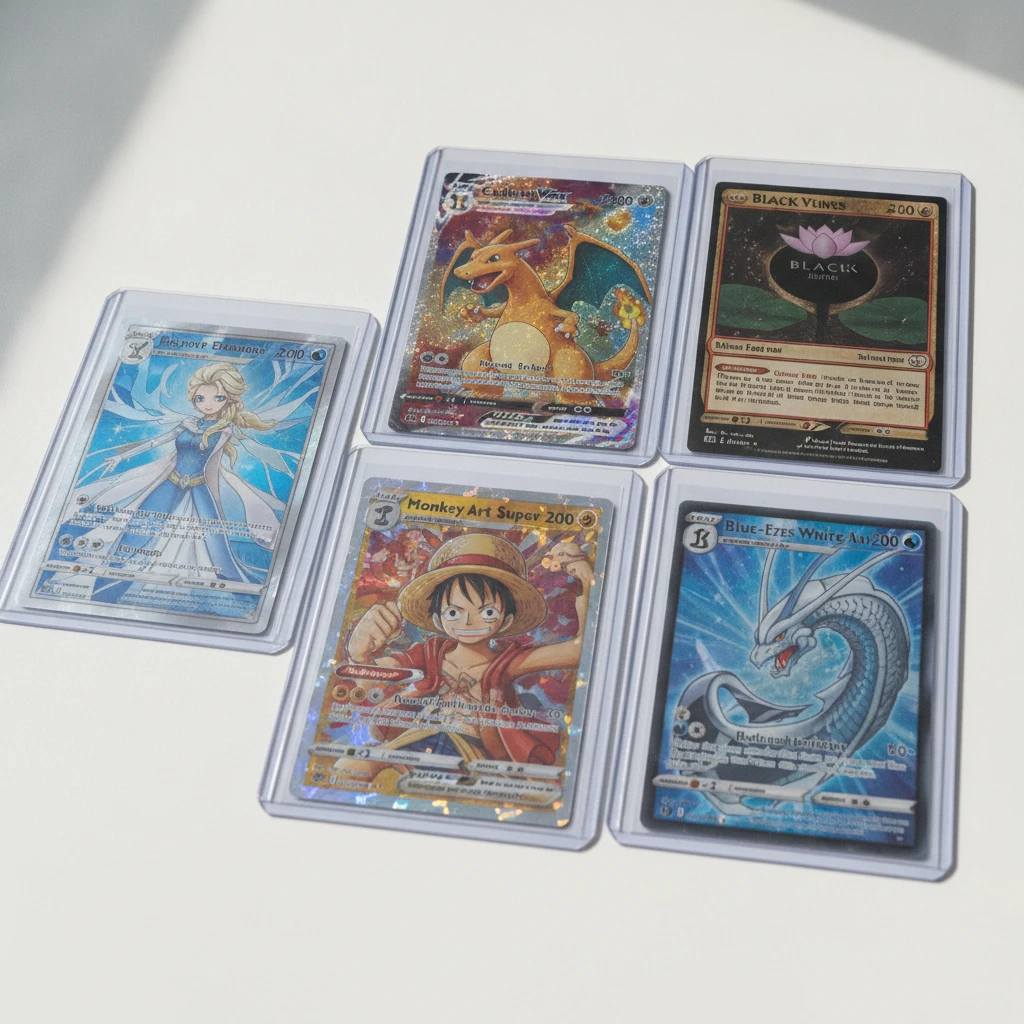
The Short Answer
- Pokémon SAR/alt art chase cards from Mega Evolution—Pitch Black and 30th Celebration lead the 2026 grading profit list.
- Magic serialized cards and Reserved List staples retain value in PSA/CGC/BCS holders even when broader MTG markets soften.
- One Piece alt-art Leaders and Treasure Rares continue to show 10–20x raw-to-PSA-10 multipliers on the right cards.
- Lorcana Enchanted Rares command 3–10x raw value in PSA 10, but back-edge whitening is the silent grade killer.
- Yu-Gi-Oh! Starlight 2.0 and high-end Ghost Rares from Chaos Origins are the headline 2026 targets.
The Modern TCG Grading Profit Framework
Grading profit is not about owning expensive cards. It is about the spread between the cost of grading and the expected value after grading. With PSA Regular at $79.99 per card in 2026, the minimum viable PSA 10 sale price for a modern chase card is roughly $250–$300 once shipping, insurance, and marketplace fees are included. Cards that cannot reliably reach that PSA 10 value should usually be sold raw or held ungraded.
The best modern TCG grading candidates share four traits:
- Low pull rate: Scarcity at the pack level limits supply.
- Strong character or set demand: Collectors actively search for the card even when the broader market cools.
- High PSA 10 multiplier: The PSA 10 copy sells for 4x or more of the raw price, leaving room for fees.
- Condition sensitivity: Cards where minor flaws destroy value make pre-grading essential.
PreGradeCards AI grading helps collectors target only the cards that satisfy all four traits. The rest should be sold raw, traded, or kept for personal collection.
Pokémon: SARs, Alt Arts, and 30th Celebration Inserts
Pokémon remains the volume leader in modern TCG grading. The 2026 chase card list is dominated by three release waves:
Mega Evolution—Pitch Black (July 2026)
Mega Darkrai ex and Mega Zeraora ex headline this set. The SAR versions are the highest-value grading targets, with PSA 10 multipliers that depend heavily on first-month population counts. Full-art and special illustration variants are the next tier. Pre-grade these aggressively — the set release will flood PSA with submissions, and only gem-mint copies will hold premium pricing.
30th Celebration (September 2026)
The all-foil 30th Celebration set introduces 30 unique Pikachu inserts and Futuristic Rare cards with art by YOSHIROTTEN. Limited-run insert cards from anniversary sets historically produce the highest PSA 10 premiums. The risk is condition variance from the special foil stock. AI surface analysis is critical here.
Japanese Abyss Eye / Storm Emeralda
Japanese SARs from Abyss Eye (Mega Darkrai ex) and Storm Emeralda (Mega Rayquaza ex) have smaller PSA 10 populations than English prints and can command higher relative premiums. These are best suited for collectors comfortable with import logistics and Japanese-market price discovery.
Outside of 2026 releases, evergreen Pokémon chase cards like Umbreon VMAX Alt Art, Charizard ex SAR from Obsidian Flames, and Pikachu Illustrator promos remain strong grading targets whenever raw copies in gem condition surface.
Magic: The Gathering: Serialized and Reserved List Cards
MTG grading economics differ from Pokémon. The PSA 10 multiplier is often lower, but the absolute card values can be much higher. Two categories dominate the 2026 grading profit list:
Serialized Cards
Wizards of the Coast introduced serialized cards with limited numbered print runs. These cards have built-in scarcity and are actively tracked by registry collectors. A serialized foil with a low serial number can justify grading even at high PSA fees. Centering and foil curl are the main condition concerns.
Reserved List Staples
Reserved List cards like Black Lotus, Mox Pearl, and Ancestral Recall are protected from reprint. High-grade copies have historically appreciated and are less correlated with standard set release cycles. Grading these is primarily about authentication and condition certification; the ROI math works because the cards are already valuable in raw form.
Modern chase cards to grade include borderless foil variants from Foundations and Special Guests, textured foil treatments in the latest Standard sets, and any card with tournament pedigree. MTG cards generally grade best with CGC or BGS for modern foils, though PSA 10 is the liquidity benchmark for cross-category buyers.
One Piece TCG: Alt-Art Leaders and Treasure Rares
One Piece Card Game has become one of the highest-ROI modern TCGs for grading. The demand is driven by anime fandom, competitive play, and relatively low PSA 10 populations compared to Pokémon.
Alt-Art Leader Cards
Luffy alt-art Leaders remain the flagship chase. Early OP-01 and OP-02 alt-art Leaders in PSA 10 command large premiums. The 2026 OP-17 global release introduces new Treasure Rare cards and is expected to add fresh alt-art Leaders to the grading target list.
Treasure Rares
Treasure Rares are the One Piece equivalent of Pokémon SARs. They feature textured foil, full-bleed art, and low pull rates. PSA 10 Treasure Rares can sell for 10–20x raw value on the right characters. Condition checks should focus on edge chipping on the full-bleed borders and holo texture consistency.
Competitive Staples
Cards used in top tournament decks — such as certain Don!! cards, event-staple characters, and parallel leaders — can spike in value during championship seasons. Grading these during peak demand windows improves sale velocity.
Lorcana: Enchanted Rares and Legendary Foils
Disney Lorcana has matured from a new TCG into a serious grading market. The headline grading targets are Enchanted Rares, which feature alternate full-art illustrations and textured foil.
Enchanted Rares
Enchanted Rares command 3–10x raw value in PSA 10 depending on the character and set. The grading risk is back-edge whitening. Early Lorcana sets are notorious for back-edge issues straight from the pack, which drops otherwise clean cards to PSA 9 or lower. AI surface and edge detection catches this before submission.
Legendary and Foil Rares
Legendary cards and cold-foil rares are the next tier. They do not have the same multiplier as Enchanted Rares, but they are far more commonly pulled and can produce volume profits when submitted in batches of clean copies.
Set-Specific Targets
The Attack of the Vine! set introduced dual-ink Enchanted cards and format-rotation demand. Cards from sets with rotation implications can see price spikes around competitive season transitions. Monitor competitive formats for timing.
Yu-Gi-Oh!: Starlight 2.0, Ghost Rares, and LOB 1st Edition
Yu-Gi-Oh! grading in 2026 is dominated by high-end rarities and nostalgia-driven vintage cards.
Chaos Origins Starlight 2.0
The July 2026 release of Chaos Origins introduced Starlight 2.0 rarities with updated texture and rarity treatment. Starlight cards have historically produced strong PSA 10 multipliers because the pull rates are extremely low. The 300th YCS Dortmund event also spotlighted competitive chase cards from the set.
Ghost Rares
Ghost Rares are among the most visually distinctive Yu-Gi-Oh! cards. Authentic Ghost Rares have a raised, three-dimensional name and artwork that shifts under light. PSA 10 Ghost Rares from any era command strong premiums, but counterfeit risk is high. Authenticate carefully before grading.
LOB 1st Edition
Legend of Blue-Eyes White Dragon 1st Edition cards are the vintage foundation of Yu-Gi-Oh! collecting. Blue-Eyes White Dragon 1st Edition in PSA 10 is a six-figure card. Even common LOB 1st Edition cards in PSA 10 carry nostalgia premiums. Condition sensitivity is extreme due to age.
Submission Filter: Which Cards to Actually Grade
Use this decision tree before sending any modern TCG card to PSA in 2026:
- Raw value under $30? Skip unless sentimental. The PSA fee consumes any realistic profit.
- Raw value $30–$100? Grade only if the AI predicts PSA 10 and the PSA 10 multiplier is 4x or higher.
- Raw value $100–$300? Grade if AI predicts PSA 10 and surface/corner flags are minimal.
- Raw value $300+? Strong grade candidate regardless of TCG, but still run AI to avoid PSA 8/9 disappointments.
- Visible flaw under magnification? Sell raw. PSA 9 values rarely justify the fee on modern chase cards.
The $79.99 PSA floor means you cannot grade speculatively. Every card must be a high-confidence PSA 10 candidate before it enters the submission box.
How to AI Pre-Screen a Chase-Card Batch
The fastest way to filter a modern TCG batch is to upload all candidates to PreGradeCards and sort by predicted grade. Here is the recommended workflow:
- Sort by estimated raw value. Separate cards into $30–$100, $100–$300, and $300+ tiers.
- Run AI grading on every card. Use Batch Grading for volume and Complete Card Grading for high-value singles.
- Review sub-grades, not just the headline grade. A predicted PSA 10 with a surface warning is riskier than a clean PSA 10.
- Check the PSA 10 population. Use the Population Report Lookup to see how many PSA 10 copies already exist. High-pop chase cards can still be profitable, but the premium compresses as supply grows.
- Use the Submit-or-Sell engine. PreGradeCards calculates net profit after PSA/CGC/BGS fees, shipping, insurance, and marketplace fees. Submit only when the engine recommends it.
Modern TCG grading can be one of the most profitable corners of the hobby in 2026, but the winners are collectors who pre-screen ruthlessly. PreGradeCards free credits let you start that screening today on your first batch of chase cards.
Frequently Asked Questions
What are the best TCG cards to grade in 2026?
How much does a TCG card need to be worth to justify PSA grading?
Are Lorcana cards worth grading?
Which One Piece cards are worth grading?
Should I grade Yu-Gi-Oh! cards in 2026?
Can AI pre-grading improve TCG grading ROI?
Sources & Further Reading
- Yahoo Finance — Best Trading Cards to Invest in 2026
- Athlon Sports — Best Pokémon TCG Sets to Buy 2026
- QPMarketNetwork — Most Popular Trading Card Games 2026
Emily Rodriguez analyzes grading cost, population, and pricing data across PSA, BGS, SGC, CGC, and TAG. She built the PreGradeCards ROI calculator and submission planner, and her market reports on grading backlog, turnaround times, and slab premiums are cited by collectors and dealers worldwide.
Create a free account and get 1 free credit — enough for 1 complete AI grading with market pricing. No credit card required.
Sign Up Free →