The Short Answer
- One Piece TCG is one of the fastest-growing TCG grading categories — major share of PSA's June 2026 record volume.
- Luffy alt art Leader raw copies sold for $4,600 — PSA 10 premiums are significant.
- OP-17 Treasure Rares (global release August 26, 2026) are the upcoming highest-value grading targets.
- Alt art Leaders use a matte-texture finish that requires careful lighting for AI surface analysis.
- AI centering analysis catches the print variance common in One Piece's global simultaneous release runs.
One Piece TCG Grading in 2026: The Fastest-Growing Category
Bandai's One Piece Card Game launched globally in late 2022 and has grown into one of the top three most-graded TCGs in 2026. PSA's June 2026 record month of 2.5 million graded cards included a significant One Piece component — the TCG category (Pokémon, One Piece, and Magic) accounted for 71% of all PSA grades that month.
One Piece's grading appeal comes from several converging factors:
- Global simultaneous releases — One Piece TCG introduced globally simultaneous English and Japanese release starting with OP-05, eliminating the traditional JP-early-adopter advantage and creating unified market demand.
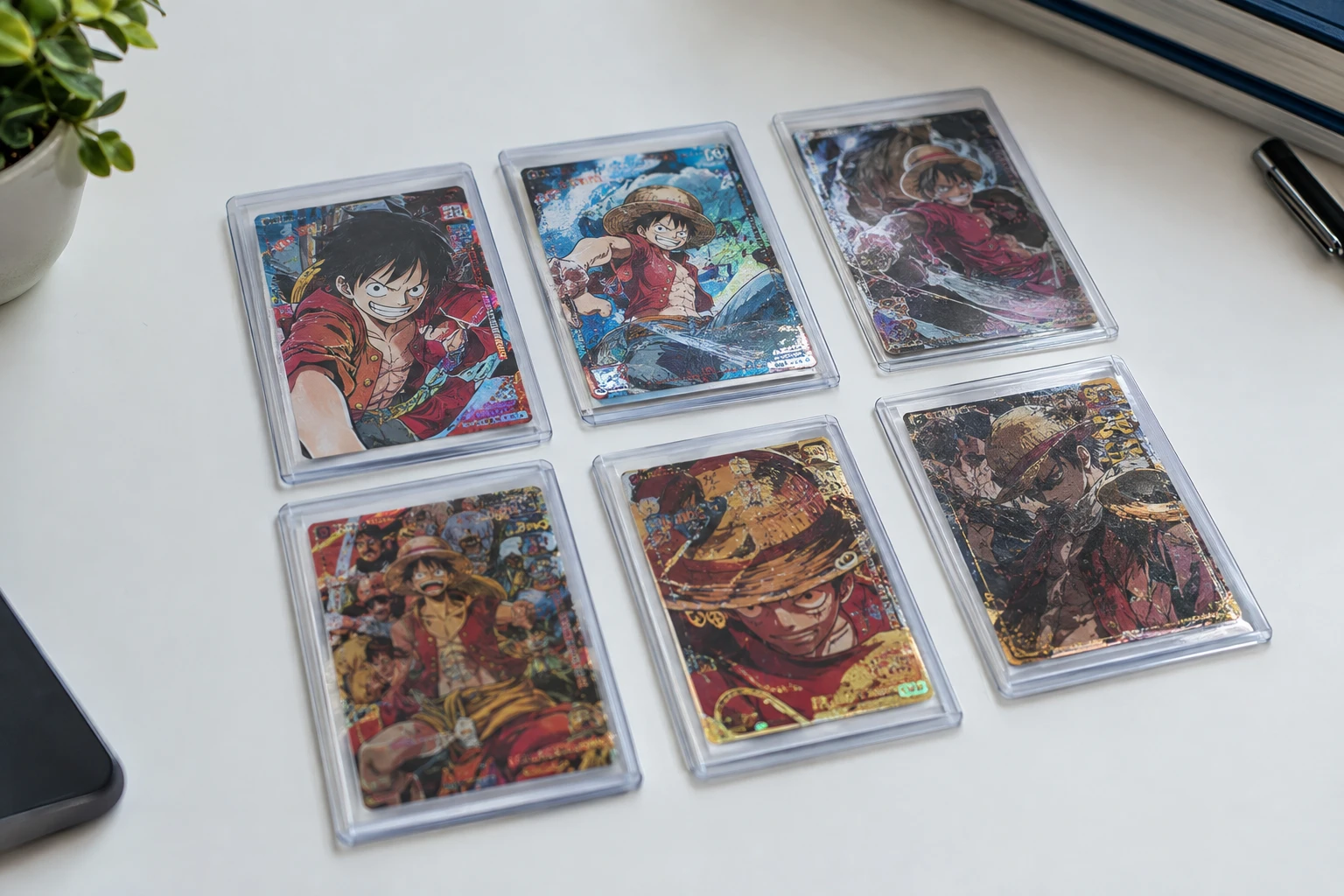
- Alt art Leader cards — Leaders are required for deck construction and come in standard and alternate art variants. Alternate art Leaders feature unique artwork not seen in Japanese exclusive releases, creating collector demand independent of competitive playability.
- Treasure Rares — introduced in OP-07, Treasure Rares are the premium pull of each set (roughly 1 per 12 boxes) featuring a distinct treatment applied over the full card art.
- Crossover collector appeal — One Piece's manga/anime fanbase overlaps strongly with the collector market. Characters like Luffy, Zoro, Nami, and Law appeal to fans who may never have collected a TCG before.
The result: high per-card values on premium pulls, sustained submission volume, and a rapidly building PSA population report that makes early PSA 10 submissions especially valuable.
Luffy Alt Art Leader: Why This Card Is Worth Pre-Grading
The alternate art version of Monkey D. Luffy as a Leader card has become one of the single most valuable One Piece TCG cards. Raw copies of specific Luffy alt art Leader variants have sold for $4,600 — a price that makes the PSA grading ROI question straightforward: a PSA 10 copy could be worth $10,000–$20,000+ based on typical gem-mint multipliers.
Which Luffy Alt Art Cards to Target
Multiple Luffy alt art versions exist across different set releases. The most valuable combine three factors: low PSA 10 population, high raw demand price, and artwork that resonates with both TCG collectors and anime fans. Key Luffy alt art targets include:
- OP-02 Luffy alt art Leader (Paramount War)
- OP-04 Luffy alt art (Kingdoms of Intrigue)
- OP-07 Luffy Treasure Rare variant
- PRB-01 Premium Booster Luffy alt art
Luffy Alt Art Grading Challenges
Luffy alt art Leaders face two primary grading challenges:
Surface handling marks — alt art cards have a matte-finish surface treatment that differs from standard One Piece card stock. This matte finish is more prone to showing fine handling marks and micro-abrasions from pack opening. Even careful openers sometimes introduce fine scratches from the internal pack foil.
Centering variance — One Piece global print runs have documented centering inconsistency. The alt art border design, which often features colored artwork extending close to the card edge, makes any centering deviation more visually apparent than on standard cards with white borders.
AI pre-grading both these factors before a $79.99+ PSA submission is essential for any Luffy alt art candidate.
Treasure Rares: One Piece's Premium Pull Explained
Introduced in OP-07 (500 Years in the Future), Treasure Rares are the highest rarity pull in the One Piece Card Game — approximately one Treasure Rare per 12 booster boxes. The finish features a distinctive treatment applied over the full card art that creates a luminous, textured appearance unlike standard holofoil or Secret Rare finishes in other TCGs.
Treasure Rare Visual Characteristics
The Treasure Rare finish has three visual layers:
- Base artwork layer — full-bleed art extending to the card edges (similar to alt art treatment)
- Foil layer — a holographic foil overlay that creates shimmer across the art
- Texture layer — a physical texture treatment that creates a tactile three-dimensional effect on certain art elements
This multi-layer finish creates unique challenges for AI surface analysis. The texture layer can register as surface defects in standard AI algorithms if not properly calibrated. PreGradeCards AI applies Treasure Rare-specific surface analysis that distinguishes between the intentional texture treatment and actual scratches or damage.
Treasure Rare Grading Targets by Set
- OP-07 Treasure Rares — first-ever Treasure Rares; earliest PSA submissions; some of the lowest pop numbers
- OP-08 Treasure Rares — Two Legends; Law and Kid character variants
- OP-09 Treasure Rares — Emperors in the New World; Big Mom and Kaido variants
- OP-17 Treasure Rares — August 26, 2026 global simultaneous release; expected to be the highest-volume Treasure Rare submission wave yet
OP-17 Global Simultaneous Release: What to Pre-Grade Before August 26, 2026
One Piece TCG OP-17 releases globally and simultaneously on August 26, 2026. Global simultaneous releases have become the standard for One Piece sets, creating immediate unified market demand across all regions rather than the Japanese-early-adopter premium seen in earlier sets.
Why OP-17 Matters for Grading
The simultaneous global release means:
- Immediate PSA submission wave — collectors who pull Treasure Rares and alt art Leaders from OP-17 will submit to PSA immediately. The first PSA 10 slabs back (6–8 weeks after submission) will capture the highest market prices before the pop report builds.
- Competition for low pop numbers — the first grader to return a PSA 10 on an OP-17 Treasure Rare captures the early-low-pop premium. Speed of submission matters.
- AI pre-grading before submission is urgent — with PSA at $79.99 minimum, only gem-mint OP-17 pulls should be submitted. AI pre-grading on pull day separates gem-mint candidates from near-mint cards before any fees are paid.
Confirmed OP-17 Chase Cards
Full OP-17 set details are not yet available, but based on the One Piece story arc covered and Bandai's release pattern, expect Treasure Rares for key characters from the arc and alt art Leader variants of Luffy and one or two supporting characters. Pre-configure your PreGradeCards batch upload workflow before release day so you can process pulls immediately.
One Piece Card Finish and AI Analysis: Standard vs Alt Art vs Treasure Rare
One Piece TCG uses three distinct card finishes that require different AI analysis approaches:
Standard Cards
Standard One Piece cards use a semi-gloss finish similar to modern Pokémon cards. AI surface analysis works straightforwardly on standard cards — scratches, print lines, and surface haze register clearly in standard diffuse lighting. These are the most accurate AI analysis targets.
Alt Art Leaders and Character Cards
Alt art variants use a matte-finish coating over the full-bleed artwork. This matte surface:
- Hides some types of surface defects more than glossy surfaces
- Shows fingerprints and oil smudges more clearly
- Can show micro-abrasions from sleeve friction that don't register as clearly on glossy cards
For accurate AI analysis of alt art cards, photograph under diffuse natural light — not artificial light, which can create directional shadows on matte surfaces that resemble surface defects.
Treasure Rares
As described in the Treasure Rare section above, the multi-layer foil-plus-texture finish requires the most careful photography. Use diffuse lighting from two 45-degree angles and photograph multiple times. When uploading to PreGradeCards, select "One Piece Treasure Rare" as the card type for the correct surface analysis algorithm.
Centering Variance in One Piece TCG Print Runs
Centering is the most common reason One Piece cards fail to reach PSA 10. Multiple factors contribute to One Piece centering variance:
Global Print Runs Are Larger
Global simultaneous releases produce larger print runs than regional releases — and in card manufacturing, larger print runs often correlate with higher centering variance due to paper feed and die-cut tolerance accumulating across the run.
Full-Bleed Art Amplifies Off-Centering
Standard One Piece cards have a visible white border on all four edges. Alt art cards and Treasure Rares have a full-bleed art edge. Off-centering is significantly more visible on full-bleed cards — a 62/38 center on a standard card may look acceptable to the naked eye, but on an alt art card the uneven border color exposes the off-centering immediately.
PSA's Centering Standard for One Piece
PSA applies the same centering standard to One Piece as to other standard-sized TCGs: 60/40 or better left-to-right, 75/25 or better top-to-bottom. Cards failing this standard on either axis cannot receive PSA 10. AI centering tools provide exact pixel ratios — any card showing worse than 60/40 should not be submitted to PSA Regular at $79.99.
AI Centering Catch Rates on One Piece
Collector data suggests that approximately 35–42% of One Piece alt art and Treasure Rare cards pulled from packs show centering issues that would prevent a PSA 10 grade. AI pre-grading identifies these before the expensive submission decision.
PSA vs CGC for One Piece TCG Cards in 2026
One Piece has a more balanced PSA vs CGC dynamic than older TCGs because the market is younger and both companies entered the space at similar times:
| Card Type | PSA or CGC? | Key Reason |
|---|---|---|
| Luffy Alt Art Leader (high-value) | PSA | Best resale liquidity; highest auction prices |
| Treasure Rares (new set) | PSA (speed matters for early pop) | Early PSA 10 captures maximum premium |
| Alt art Leaders (mid-value) | CGC Standard | Lower fee; growing CGC OP market share |
| Bulk modern One Piece | CGC Bulk | $17/card vs $79.99 PSA; acceptable for non-premium cards |
| Rare/Uncommon pulls | No grading | Fee exceeds graded value at any grade |
AI Pre-Grading Workflow for One Piece TCG Collections
Here is the optimized workflow for AI pre-grading One Piece TCG before professional submission:
- Identify pull list immediately after opening. Sort Treasure Rares, alt art Leaders, and Secret Rares into the AI pre-grade pile. Everything else stays raw or goes into play.
- Do not sleeve or handle premium pulls. Treat Treasure Rares and Luffy alt arts as fragile artifacts from the moment of opening. Drop directly into a clean semi-rigid holder without touching the surface.
- Set up photography environment. Diffuse natural light is ideal for matte alt art cards. For Treasure Rares, use two softbox lights at 45-degree angles. Black or dark gray background to contrast white card borders.
- Upload to PreGradeCards selecting correct card type. Standard for regular cards, "alt art" for alt art Leaders, "Treasure Rare" for Treasure Rares. The correct card type activates the appropriate surface analysis algorithm.
- Review centering results first. Centering failures eliminate the card from PSA 10 consideration regardless of surface quality. Cards with centering worse than 60/40 should not go to PSA Regular.
- Check surface and corner flags. For Treasure Rares especially, read every surface flag. AI confidence on multi-layer finishes can vary — low-confidence surface flags may warrant a human second opinion.
- Submit confirmed AI 9–10 to PSA or CGC based on card value. High-value Treasure Rares and premium alt arts go to PSA Regular. Mid-value alt arts go to CGC Standard.
Frequently Asked Questions
What is the most valuable One Piece TCG card for grading?
What are Treasure Rares in One Piece TCG?
When does One Piece OP-17 release?
Can AI accurately grade One Piece TCG cards?
How bad is One Piece centering variance?
Should I use PSA or CGC for One Piece TCG grading?
Sources & Further Reading
- One Piece TCG OP-17 Global Release Guide
- PSA Record June 2026 — SI Collectibles
- Card Grading Backlog 2026 — CardGrade.io
Create a free account and get 1 free credit — enough for 1 complete AI grading with market pricing. No credit card required.
Sign Up Free →