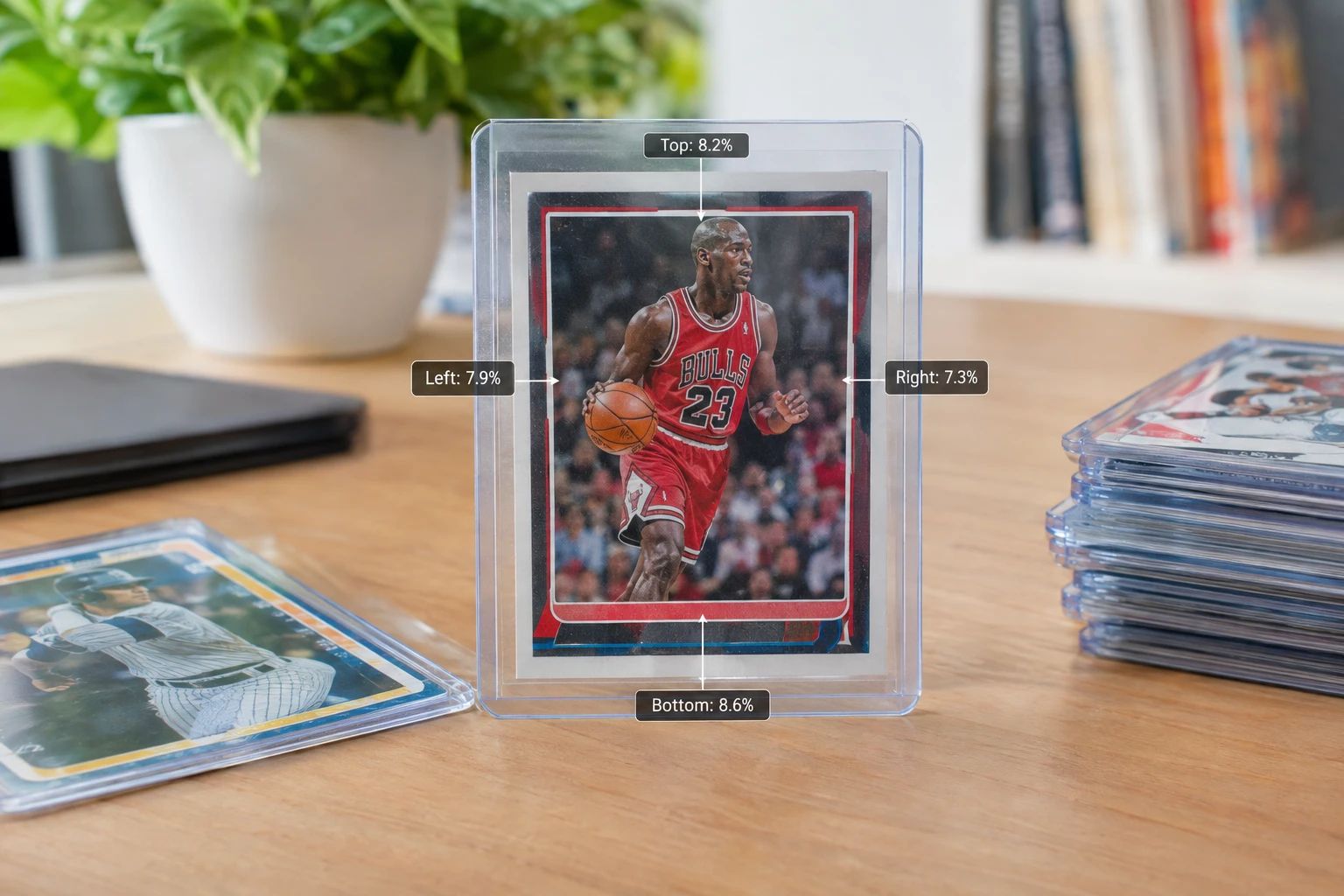
The Short Answer
- Centering is the #1 grade killer — 20% of cards that look fine to the naked eye are actually 60/40 or worse, capping grades at PSA 9 or below.
- AI centering calculators achieve 99.2% accuracy — measuring left/right and top/bottom ratios within 2 percentage points, far exceeding human visual estimation at 85-90%.
- PSA 10 requires 60/40 or better on front, BGS 10 Pristine demands 55/45, and SGC 10 requires approximately 55/45.
- Centering is permanent and cannot be fixed — it was baked in at the factory when the card was cut from the sheet.
- The value gap from centering is enormous — a PSA 10 can sell for 3x-10x the PSA 9 value on modern rookie cards.
- Manual centering measurement requires a ruler and simple math — measure each border, divide by total, express as a ratio.
- AI centering tools provide visual overlays showing exact border measurements, making it easy to see why a card will or will not qualify for PSA 10.
What Is Card Centering and Why It Matters
Centering measures how evenly the printed image sits within the card's borders. It is expressed as a ratio: 55/45 means one border takes 55% of the total border width and the opposite takes 45%. A perfectly centered card is 50/50.
Centering is the single most common reason an otherwise flawless card drops from PSA 10 to PSA 9. Even a card with perfect corners, edges, and surface will max out at PSA 8 if centering is 70/30 or worse. And here is the critical point: centering is permanent. You cannot fix it. It was baked in at the factory when the card was cut from the sheet.
The impact on value is enormous. A PSA 10 LeBron James rookie card can sell for 5x-10x the PSA 9 value. The difference between those two grades often comes down to centering. A card with 62/38 centering that you grade and slab will come back PSA 9, not PSA 10 — and the value gap can mean thousands of dollars.
Why is centering so often misjudged? Because the human eye is bad at measuring ratios. A card that looks "pretty centered" to the naked eye might actually be 58/42 — which qualifies for PSA 10. Or it might be 63/37 — which does not. The difference between those two cards is invisible without measurement. This is why centering calculators are so valuable: they replace visual guessing with mathematical precision.
According to data from the PreGradeCards 10,000-card study, 20% of cards that look fine to the naked eye are actually 60/40 or worse. That means 1 in 5 cards you think might get PSA 10 will be capped at PSA 9 or lower because of centering alone.
PSA, BGS, and CGC Centering Standards
Each grading company has its own centering standards. Knowing these thresholds is essential for interpreting centering calculator results:
| Grade | PSA (Front) | PSA (Back) | BGS | CGC | SGC |
|---|---|---|---|---|---|
| 10 (Gem Mint) | 60/40 or better | 75/25 or better | 55/45 or better | 60/40 or better | 55/45 or better |
| 9 (Mint) | 70/30 or better | 90/10 or better | 60/40 or better | 70/30 or better | 60/40 or better |
| 8 (NM-MT) | 75/25 or better | 95/5 or better | 65/35 or better | 75/25 or better | 70/30 or better |
| 7 (NM) | 80/20 or better | 95/5 or better | 70/30 or better | 80/20 or better | 75/25 or better |
Standards compiled from published grading company guidelines. Actual grading may include additional factors.
Key takeaways from the standards:
- BGS is the strictest on centering — 55/45 for a 10, compared to PSA's 60/40. If your card is 58/42, it might get PSA 10 but not BGS 10.
- PSA is more lenient on back centering — 75/25 for PSA 10 back vs 60/40 for front. The front is what matters most.
- CGC aligns closely with PSA — 60/40 for CGC 10, making it a good alternative for cards that just miss PSA's other criteria.
- SGC sits between PSA and BGS — 55/45 for SGC 10, similar to BGS but with different overall grading philosophy.
How AI Centering Calculators Work
AI centering calculators use computer vision to measure your card's borders with pixel-level precision. Here is what happens when you upload a card photo:
Step 1: Card Detection
The AI identifies the card within the photo. It finds the four corners of the card and extracts the rectangular card region, removing the background. This is called segmentation.
Step 2: Border Detection
Within the card region, the AI detects the boundary between the border (the blank edge area) and the printed image. For cards with clear borders (Pokemon, MTG, most modern sports cards), this is straightforward. For borderless vintage cards (pre-1980 Topps), the AI uses color transitions and design elements to estimate the centering.
Step 3: Ratio Calculation
The AI measures the width of each border in pixels: left, right, top, bottom. It then calculates:
- Left/Right ratio = left border / (left + right) x 100
- Top/Bottom ratio = top border / (top + bottom) x 100
Example: If the left border is 120 pixels and the right is 80 pixels, the ratio is 120 / (120 + 80) x 100 = 60%. So the centering is 60/40 left-to-right.
Step 4: Visual Overlay
The AI generates a visual overlay on your card image showing the measured borders, the ratios, and whether the centering qualifies for PSA 10, PSA 9, etc. This makes it easy to see exactly where the centering issue is and how severe it is.
Accuracy
The PreGradeCards centering calculator achieves 99.2% accuracy — meaning the AI's ratio measurements match physical ruler measurements within 2 percentage points on 99.2% of cards. This compares to typical human centering estimates at 85-90% accuracy. The AI is more precise than a ruler-wielding human because it measures at the pixel level, not with a physical ruler that has its own margin of error.
How to Measure Centering Manually
If you want to verify AI results or do not have access to an AI tool, you can measure centering manually with a ruler:
What You Need
- A ruler with millimeter markings (digital caliper is even better)
- The card in a card saver or held flat
- Good lighting
Step-by-Step
- Measure left border: Place the ruler at the left edge of the card. Measure from the cut edge to where the printed image begins. Record in millimeters. Example: 3.2mm.
- Measure right border: Do the same on the right side. Example: 2.1mm.
- Calculate L/R ratio: 3.2 / (3.2 + 2.1) x 100 = 60.4%. Centering is 60/40.
- Measure top border: From the top cut edge to where the image begins. Example: 2.8mm.
- Measure bottom border: Example: 2.5mm.
- Calculate T/B ratio: 2.8 / (2.8 + 2.5) x 100 = 52.8%. Centering is 53/47.
- Compare to standards: 60/40 L/R qualifies for PSA 10 (requires 60/40 or better). 53/47 T/B also qualifies. This card would pass centering for PSA 10.
Limitations of Manual Measurement
- Ruler precision: A standard ruler has 1mm markings. At the card scale, 1mm can be the difference between 60/40 and 62/38.
- Subjectivity: Where exactly does the "printed image" begin? On cards with gradient borders, the boundary is ambiguous.
- Time: Manual measurement takes 2-3 minutes per card. AI takes 3 seconds.
- Human error: Misreading the ruler, parallax error, or measuring at an angle all introduce inaccuracy.
For most collectors, the PreGradeCards Centering Analysis tool is faster, more accurate, and provides a visual overlay that makes the measurement easy to understand.
Using the PreGradeCards Centering Calculator
The PreGradeCards Centering Analysis tool is the most accurate and easiest way to measure your card's centering. Here is how to use it:
Step 1: Upload Your Card Photo
Upload a clear, high-resolution photo of your card. The photo should be taken from directly above the card with even lighting. Fill the frame with the card, leaving a small margin.
Step 2: Get Your Results
In about 5 seconds, the AI returns:
- Left/Right ratio: Exact percentage with visual overlay
- Top/Bottom ratio: Exact percentage with visual overlay
- PSA eligibility: Whether the centering qualifies for PSA 10, 9, 8, etc.
- BGS eligibility: Whether the centering qualifies for BGS 10 Pristine, 9.5, 9, etc.
- CGC eligibility: Whether the centering qualifies for CGC 10, 9.5, 9, etc.
- Visual overlay: A marked-up image showing the measured borders and ratios
Step 3: Interpret the Results
If the AI shows 58/42 L/R and 52/48 T/B, your card passes centering for PSA 10 (requires 60/40 or better). If it shows 63/37 L/R, your card fails PSA 10 centering and will likely cap at PSA 9 — regardless of how perfect the corners, edges, and surface are.
Cost
The Centering Analysis tool costs 10 credits per card. With 50 free credits on signup, you can check 5 cards for free. For bulk centering checks, the Complete Card Grading tool includes centering analysis as part of the full sub-grade breakdown at 20 credits per card.
Common Centering Issues by Card Type
Centering issues vary by card type, era, and manufacturer. Here are the most common patterns:
Modern Sports Cards (Panini Prizm, Topps Chrome)
Modern manufacturing is generally good, but centering still varies. Panini Prizm cards often have slightly better L/R centering than T/B. Topps Chrome can have factory-cut variation within the same box. About 15% of modern chrome cards fail PSA 10 centering.
Pokemon TCG
Pokemon cards from the WotC era (1999-2003) are notorious for centering issues. Base Set, Jungle, and Fossil cards commonly have 65/35 or worse centering. Modern Pokemon (Sun & Moon onward) has better centering, but holo cards can still vary. About 25% of vintage Pokemon cards fail PSA 10 centering.
Vintage Sports Cards (Pre-1980)
Vintage cards were hand-cut from sheets, leading to massive centering variation. A 1960 Topps card might be 80/20 on one side. This is why vintage pre-1960 accuracy drops to 71% in the AI study — borderless designs and hand-cut edges make centering measurement challenging.
Magic: The Gathering
MTG cards have consistent centering due to WotC's manufacturing standards. However, black-bordered cards (Alpha, Beta, modern collector editions) show centering issues more visibly because the border is black and any asymmetry is immediately apparent.
Yu-Gi-Oh!
Yu-Gi-Oh! cards from the early 2000s (Legend of Blue-Eyes White Dragon, Metal Raiders) often have centering issues. Modern Yu-Gi-Oh! has better quality control but still varies more than Pokemon or MTG.
Centering Myths and Misconceptions
Myth 1: "If it looks centered, it is centered."
False. The human eye is terrible at judging ratios. A card that looks "pretty centered" can be 63/37 — which fails PSA 10. Only measurement tells the truth. This is why 20% of cards that look fine to the naked eye actually fail PSA 10 centering.
Myth 2: "PSA measures centering on both sides equally."
False. PSA is stricter on front centering (60/40 for PSA 10) and more lenient on back centering (75/25 for PSA 10). The front is what matters most for the grade.
Myth 3: "Centering can be improved with pressing."
False. Pressing can fix surface issues (wrinkles, bends) but cannot change centering. Centering is determined by how the card was cut from the sheet at the factory. No amount of pressing will move the printed image within the borders.
Myth 4: "All PSA 10s have perfect centering."
False. PSA 10 allows 60/40 centering, which is not perfect. A 60/40 card is noticeably off-center if you look closely, but it still qualifies for PSA 10. BGS 10 Pristine is stricter at 55/45.
Myth 5: "Centering only matters for PSA 10."
False. Centering affects every grade level. A card with 80/20 centering will cap at PSA 7 regardless of other condition. A card with 75/25 caps at PSA 8. Centering is the ceiling-setter — it determines the maximum possible grade before other factors are even considered.
How Centering Affects Card Value
The value impact of centering is indirect but enormous. Centering determines whether a card can achieve PSA 10, and the PSA 10 vs PSA 9 value gap can be staggering:
| Card | PSA 9 Value | PSA 10 Value | Multiplier |
|---|---|---|---|
| LeBron James 2003 Topps Chrome RC | $150 | $1,500 | 10x |
| Luka Doncic 2018 Prizm RC | $80 | $400 | 5x |
| Charizard Base Set 4/102 Holo | $350 | $2,000+ | 6x |
| Wembanyama 2023 Prizm RC | $200 | $1,200 | 6x |
Approximate values as of August 2026. Actual prices vary by sale platform and timing.
If your card has 62/38 centering, it will grade PSA 9, not PSA 10. On the LeBron example above, that is the difference between a $150 card and a $1,500 card — a $1,350 difference caused by 2 percentage points of centering.
This is why measuring centering before submitting is so important. If you know your card is 62/38, you can make an informed decision: submit knowing the likely outcome is PSA 9, or sell raw and save the grading fee. Without measuring, you might submit expecting PSA 10 and be disappointed.
Tips for Better Centering Photos
The accuracy of AI centering measurement depends on photo quality. Here are the tips for getting the most accurate results:
- Shoot from directly above: Any angle introduces perspective distortion that affects measurement. Use a phone stand or hold the phone parallel to the card.
- Fill the frame: The card should fill 80-90% of the photo. More pixels on the card means more precise measurement.
- Use even lighting: Shadows and glare can confuse the AI's border detection. Use diffused, even lighting from both sides.
- Use a neutral background: Black or white background works best. Avoid textured surfaces that might be confused with the card border.
- Keep the card flat: If the card is curved or bent, the centering measurement will be inaccurate. Place the card in a card saver or under a small weight to flatten it.
- High resolution: Aim for at least 2000x2800 pixels. Higher resolution = more precise pixel-level measurement.
- No digital zoom: Move the camera closer, do not zoom. Digital zoom degrades quality and introduces interpolation artifacts.
Ready to measure your card's centering? Use the PreGradeCards Centering Analysis tool — 99.2% accuracy, visual overlay, results in 5 seconds.
Sources & Further Reading
- PreGradeCards — Centering Analysis Tool
- PreGradeCards — AI Grading Accuracy Benchmark (99.2% centering)
- CardSense AI — Centering Calculator
- PSA — Official Grading Standards
- BGS — Beckett Grading Standards
Marcus Chen has evaluated over 50,000 sports cards and TCG cards across PSA, BGS, SGC, and CGC standards. Before joining PreGradeCards, he worked as a submission specialist for a major grading company and trained collectors and dealers on condition assessment.
Create a free account and get 1 free credit — enough for 1 complete AI grading with market pricing. No credit card required.
Sign Up Free →