The Short Answer
- Centering is responsible for approximately 20% of PSA 10-to-9 downgrades — more than any other single factor including corners, edges, and surface.
- PSA 10 requires 60/40 or better front centering; BGS 10 Pristine demands 55/45; SGC 10 requires approximately 55/45; ACE 10 demands 50/50 ±2%.
- A perfectly centered card commands 50-300% premium over equivalent off-center cards, depending on rarity and card type.
- Only 20-40% of a print run achieves PSA 10-eligible centering — true 50/50 centering occurs in just 1-3% of production.
- Centering cannot be improved after printing — it is a permanent factory characteristic, making pre-sale measurement essential.
- AI centering analysis tools measure exact ratios in seconds — no calipers required — and generate visual overlays for listing photos.
- Listings with centering data sell faster because buyers can verify border ratios before bidding, eliminating the most common post-sale dispute.
Why Centering Is the #1 Grade Killer for Sellers
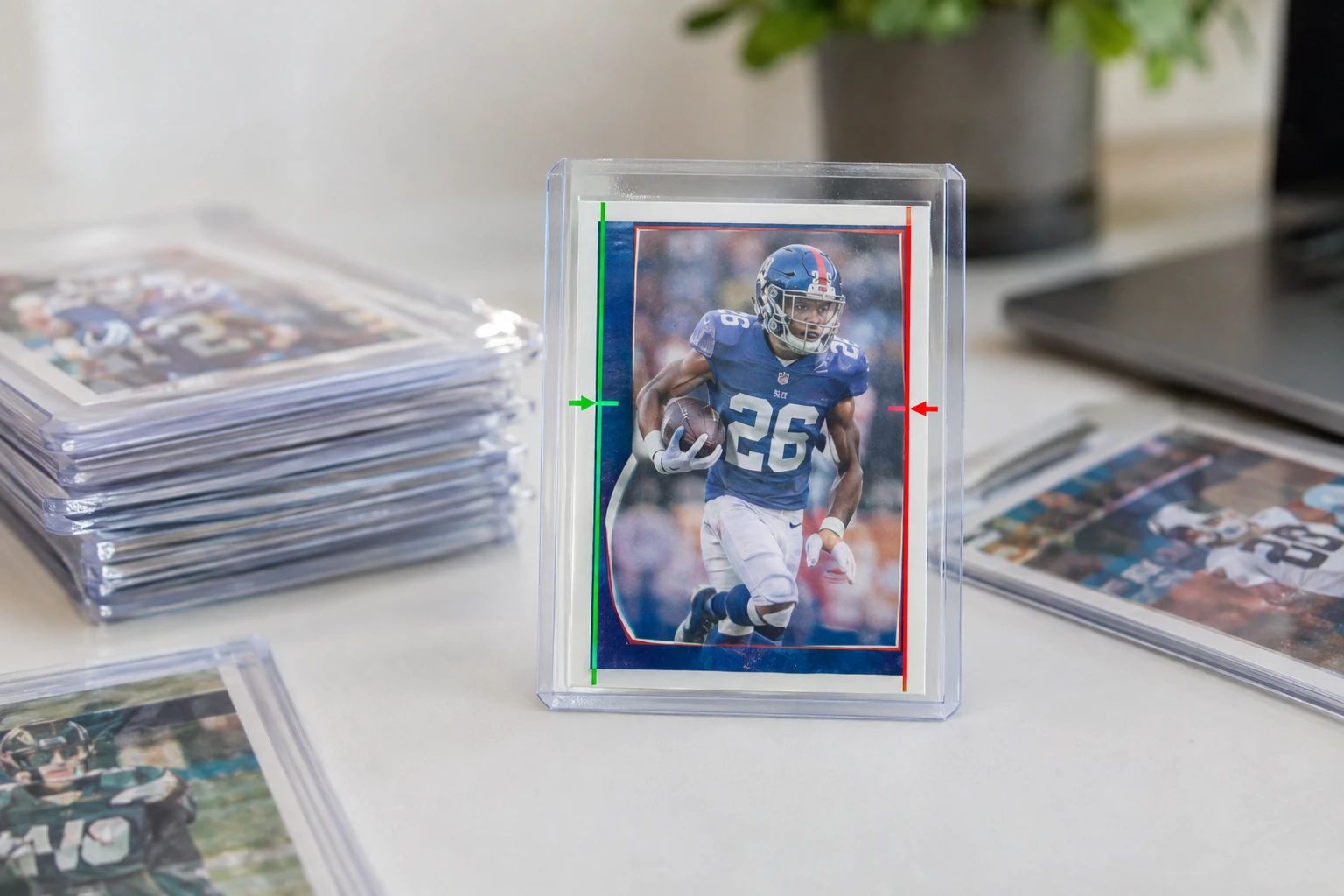
If you sell trading cards, centering is the single most important condition factor to understand — and the most expensive to ignore. Centering refers to how evenly the printed image sits within the card's borders. It is expressed as a ratio: 55/45 means one border takes 55% of the total border width on that axis, and the opposite border takes 45%. A perfectly centered card is 50/50.
Here is why centering matters more than any other grading criterion for sellers:
First, centering is permanent. Corners can be protected with proper storage. Surface can be kept clean with careful handling. Edges can be preserved with penny sleeves and toploaders. But centering was determined at the factory when the sheet was cut. You cannot fix it. You cannot improve it. You can only measure it and decide what to do with the information.
Second, centering is sneaky. A card can look perfectly centered to the naked eye but measure 62/38 — outside the PSA 10 tolerance. This is the most common scenario that catches sellers off guard. The card looks mint, you submit it to PSA expecting a 10, and it comes back a 9. The grading fee is spent, the wait time is lost, and the value gap between PSA 9 and PSA 10 can be 3x to 10x on modern rookie cards.
Third, centering is the most common downgrade reason. Industry data shows that approximately 20% of grade drops from PSA 10 to PSA 9 are caused by centering alone. That is more than corners, edges, or surface. A card with perfect corners, pristine edges, and flawless surface will still max out at PSA 8 if centering is 70/30 or worse.
For sellers, the implication is clear: if you are not measuring centering before listing or grading your cards, you are leaving money on the table — either through wasted grading fees on cards that will never gem, or through underpricing raw cards that have excellent centering.
Centering Tolerances by Grader: PSA, BGS, SGC, CGC, ACE
Each grading company has its own centering tolerance for top grades. Knowing these thresholds helps you choose the right grader for each card based on its centering measurements.
| Grader | Top Grade | Front Centering | Back Centering | Strictness |
|---|---|---|---|---|
| PSA | PSA 10 | 60/40 or better | 75/25 or better | Most forgiving |
| BGS | 10 Pristine | 50/50 to 55/45 | 50/50 to 55/45 | Strict |
| SGC | SGC 10 | ~55/45 | 60/40 or better | Moderate |
| CGC | 10 Pristine | ~55/45 | ~75/25 | Moderate |
| ACE | ACE 10 | 50/50 (±2%) | 60/40 max | Strictest |
Tolerances as of August 2026. Graders may update standards periodically.
The practical takeaway: PSA is the most forgiving on centering at the top grade, ACE and BGS are the strictest, and SGC sits in between. If your card measures 58/42, it can still earn a PSA 10 but will likely cap at BGS 9.5 or ACE 9.5. This means:
- For cards with 55/45 to 60/40 centering: Submit to PSA. The 60/40 tolerance gives you the best chance at a 10.
- For cards with 50/50 to 55/45 centering: Consider BGS or ACE. Their stricter standards reward truly centered cards with higher premiums.
- For cards with 60/40 to 65/35 centering: Only PSA will consider a 10. Other graders will cap at 9 or 9.5.
- For cards worse than 65/35: No grader will give a 10. Sell raw with centering disclosed, or submit to PSA hoping for a 9.
How Centering Affects Card Values: Real Dollar Examples
The value gap between well-centered and poorly-centered cards is not theoretical — it is measurable in hundreds or thousands of dollars. Here are real examples from 2026 market data.
Example 1: Cooper Flagg Topps Chrome Rookie
A Cooper Flagg Topps Chrome rookie card with PSA 10 sells for approximately $400. The same card graded PSA 9 sells for approximately $250. The difference — $150 — is often entirely due to centering. A card with 62/38 centering (outside PSA 10 tolerance) but perfect corners, edges, and surface will grade PSA 9. That 2% deviation from the 60/40 threshold cost the seller $150.
Example 2: Charizard VMAX Alt Art (Evolving Skies)
A PSA 10 Charizard VMAX Alternate Art from Evolving Skines sells for approximately $1,400. A PSA 9 sells for approximately $500. The $900 gap is frequently centering-driven. Pokémon alt-art cards have large border areas where centering issues are visually obvious to both graders and buyers. A raw card with excellent centering (55/45 or better) commands a premium even before grading — buyers know it has PSA 10 potential.
Example 3: Vintage — 1952 Topps Mickey Mantle
For vintage cards, centering premiums are even more extreme. A PSA 9 1952 Topps Mickey Mantle with 55/45 centering can sell for $500,000+. The same card with 70/30 centering at PSA 9 might sell for $350,000. The $150,000 gap exists because perfectly centered vintage cards are exceptionally scarce — 1952 Topps printing technology made consistent centering nearly impossible.
The Premium Formula
The centering premium follows a predictable pattern:
- Modern mass-produced cards: PSA 10 commands 50% premium over PSA 9 (centering is often the differentiator)
- Rare vintage cards: PSA 10 commands 200-300% premium (perfectly centered specimens are exceptionally scarce)
- Low-numbered parallels: PSA 10 commands 100-500% premium (each centered copy is genuinely rare)
For sellers, the message is simple: centering data in your listing is a pricing tool. A raw card with documented 52/48 centering is worth more than the same card with unknown centering. The data justifies a higher asking price.
How to Measure Centering: Manual and AI Methods
There are two ways to measure centering: manual measurement with physical tools, and AI analysis with a photo. Both have their place in a seller's workflow.
Manual Measurement with Calipers
For precise measurement, use digital calipers (available for $15-$30 on Amazon). Measure the border width on each side of the card to the nearest 0.1mm. Then calculate the ratio:
Formula: Larger border ÷ (Larger border + Smaller border) × 100 = centering percentage
Example: Left border = 1.5mm, Right border = 1.0mm. Ratio = 1.5 ÷ (1.5 + 1.0) × 100 = 60%. This card is 60/40 on the horizontal axis.
Repeat for top/bottom. Then flip the card and repeat for the back. Your centering grade is determined by the worst axis — the grader does not average across axes.
Manual measurement is accurate but time-consuming. For a 50-card batch, expect to spend 45-60 minutes measuring. It also requires physical access to the card, which is not possible when buying raw cards online.
AI Centering Analysis
AI centering tools like the PreGradeCards Centering Analysis measure exact ratios from a single photograph. The AI detects the card boundaries, identifies the border regions, and calculates left/right and top/bottom ratios automatically. Results are returned in seconds with a visual overlay showing the measurement regions.
AI measurement is faster (seconds vs minutes), works from photos (no physical access needed), and generates visual overlays you can use in your listing photos. The accuracy is comparable to manual caliper measurement when the photo is taken flat under even lighting.
Which Method to Use?
- For high-value cards ($500+): Use both. AI first for a quick read, then calipers to confirm before submitting to grading.
- For mid-value cards ($50-$500): AI analysis alone is sufficient. The accuracy is high enough for submission decisions.
- For bulk processing (20+ cards): AI only. Manual measurement is not time-efficient for large batches.
- For buying raw cards online: AI only — you cannot physically access the card before purchase. Use the listing photos to run centering analysis.
AI Centering Analysis Tools for Sellers
Several AI tools offer centering analysis as part of their grading suite. Here is what sellers should look for when choosing a centering tool.
Essential Features for Sellers
- Exact ratio output: The tool should return specific numbers like "57/43 horizontal, 52/48 vertical" — not just "good" or "bad."
- Visual overlay: The tool should generate an image showing the measurement regions overlaid on your card photo. This is invaluable for listing photos.
- Front and back analysis: Back centering matters. The tool should analyze both sides.
- Rotation detection: Image tilt (rotation) can cause false centering readings. The tool should detect and account for rotation.
- Grade prediction: The tool should translate centering ratios into predicted grade impact (e.g., "60/40 = PSA 10 eligible, 65/35 = PSA 9 max").
- Shareable report: A public URL with the centering data that you can include in marketplace listings.
The PreGradeCards Centering Analysis tool provides all of these features. It measures precise left/right and top/bottom centering ratios, detects rotational tilt and diamond cut errors, generates a visual overlay, and produces a shareable report URL. It costs 1 credit ($0.10-$0.25) per card.
Using Centering Data in Your Marketplace Listings
Centering data is a powerful listing tool because it addresses the #1 concern of raw card buyers: "Is this card actually centered, or is the seller just saying it looks good?" Here is how to use centering measurements in your listings to increase sale prices and reduce returns.
For Raw Card Listings
Add a centering section to your listing description:
Front: 55/45 horizontal, 52/48 vertical
Back: 60/40 horizontal, 55/45 vertical
PSA 10 centering eligible: Yes (within 60/40 tolerance)
Full report: pregradecards.com/r/[hash]
This information does three things: it builds trust (third-party verified, not seller's opinion), it justifies your asking price (the card has documented PSA 10 centering potential), and it eliminates the most common return reason (buyer claims card is off-center).
For Graded Card Listings
If you are selling a PSA-graded slab, centering data is less critical (the grade already certifies condition), but you can still use it to highlight why the card earned its grade. "PSA 10 with 55/45 centering — one of the better-centered copies on the pop report" is a compelling listing detail that differentiates your card from the hundreds of other PSA 10s on eBay.
Centering Photos in Listings
The visual overlay generated by AI centering tools is a powerful listing photo. It shows the measurement regions overlaid on the card, with exact border width annotations. Include this as one of your 12 eBay photos. Buyers respond to visual evidence more than text claims — a centering overlay photo is worth more than any condition description.
Centering When Buying Raw Cards for Resale
If you source raw cards for resale — whether from local card shops, eBay, card shows, or estate sales — centering analysis is your most valuable due diligence tool. The ability to measure centering from listing photos before you buy prevents expensive mistakes.
The eBay Sourcing Workflow
- Find a raw card listing with clear, straight-on photos
- Save the listing photo
- Upload to AI centering analysis tool
- Review the centering ratios
- If centering is 60/40 or better: proceed with purchase (PSA 10 candidate)
- If centering is 65/35 or worse: pass or adjust your max bid downward (PSA 9 max)
This workflow takes about 30 seconds per card and can save you hundreds of dollars per purchase. A card that looks "Near Mint" in photos but measures 68/32 on centering is a PSA 8 candidate at best — not worth buying if your strategy requires PSA 10 submissions.
The 60-Second Pre-Grade Checklist for Buying
When evaluating a raw card listing for purchase, check centering first:
- Look at left vs right border thickness — if one side is visibly thicker, the card is likely 60/40 or worse
- Look at top vs bottom border — especially check nameplate spacing, which reveals vertical centering
- If it looks borderline: Save the photo and run AI centering analysis for exact numbers
- If it is clearly off-center: Treat it as a PSA 9 ceiling unless everything else is perfect
Centering Differences: Sports Cards vs TCG Cards
Centering issues manifest differently in sports cards versus TCG cards. Understanding these differences helps sellers apply the right strategy.
Sports Cards
- Notorious for centering issues: Topps Chrome, Panini Prizm, Select, and Optic are all known for inconsistent factory cutting. Centering varies widely even within the same pack.
- Dark borders show everything: Cards with dark borders (Select, Optic) make centering issues visually obvious. Light-bordered cards hide the same issues from the eye but not from the grader.
- Horizontal vs vertical: Sports cards often have worse horizontal centering than vertical because of how sheets are cut. Always check both axes.
- Set-specific patterns: Some sets are known for poor centering (1989 Upper Deck, 1993 Topps). Graders may be slightly more lenient on these, but do not count on it.
TCG Cards (Pokémon, MTG, Yu-Gi-Oh!, etc.)
- Generally better factory centering: TCG printing (especially Pokémon) tends to have more consistent centering than sports cards. Modern Pokémon cards from the Sword & Shield era onward are typically well-centered.
- Alt-art and special frames: Alternate art cards with custom borders can have unique centering challenges. The border design may make issues harder to detect visually.
- Foil cards: The foil layer can create optical illusions that make centering look different than it is. Always measure rather than eyeball foil cards.
- Japanese vs English: Japanese Pokémon cards are generally better-centered than English prints. If you source Japanese cards for grading, expect higher PSA 10 rates on centering alone.
- Older sets: WOTC-era Pokémon (Base Set, Jungle, Fossil) have notoriously inconsistent centering, similar to vintage sports cards. Centering is a major factor in vintage Pokémon grading.
Common Centering Issues and What They Mean for Sellers
Beyond simple left-right or top-bottom offset, there are several centering-related issues that sellers should understand.
Diamond Cut
A diamond cut occurs when the card's image is rotated slightly relative to the physical card edges. The borders are not parallel — one corner has a thicker border than the opposite corner on the same side. This is a factory cutting error that cannot be fixed. Graders treat diamond cut as a centering issue, and it typically caps the grade at PSA 9 even if the ratios look acceptable on individual axes.
AI centering tools can detect diamond cut by checking for rotational tilt. If the tool flags rotation, treat the card as a PSA 9 maximum candidate regardless of the axis ratios.
Shifted Image
A shifted image is when the entire printing is offset in one direction — up, down, left, or right. This creates uneven borders on the opposite sides. A 70/30 shift is obvious to the naked eye. A 60/40 shift is visible if you look for it. A 55/45 shift is nearly invisible without measurement but can still affect the grade.
Back Centering vs Front Centering
Many sellers only check front centering. But grading companies evaluate both sides. A card can be beautifully centered on the front and badly skewed on the back. At PSA, this card might still achieve a 10 if the back is within 75/25. At BGS, the centering subgrade might drop to 8.5 or 9, which could prevent a 9.5 or 10 overall.
Always measure both sides. The worst axis on either side sets your centering grade.
Image Tilt and Rotation: The Hidden Centering Killer
Even if your borders measure beautifully on each axis, you can still get dinged if the image is rotated relative to the card edges. This is called image tilt or rotational misalignment, and it is one of the most overlooked centering issues.
Image tilt occurs when the printing is slightly rotated within the card frame. The borders may measure 55/45 on both horizontal and vertical axes, but the corners reveal the rotation — one corner has a noticeably thicker border than the opposite corner on the same side.
Graders treat tilt as a centering defect. A card with visible rotation will typically cap at PSA 9, even if the axis ratios are within PSA 10 tolerance. The visual asymmetry of the corners is what the grader notices.
AI centering tools detect rotation by analyzing the angle of the printed elements relative to the card edges. If rotation is detected, the tool will flag it and adjust the centering grade prediction accordingly. This is a critical feature for sellers — manual measurement with calipers can miss rotation entirely if you only measure axis ratios.
For listings, if your AI tool detects rotation, disclose it: "Minor rotational tilt detected (1.2 degrees). Borders measure 55/45 but slight diamond cut present." Honesty about rotation prevents returns and builds buyer trust.
The Centering-First Selling Strategy
Here is a complete selling strategy built around centering data. This strategy works for both sports and TCG card sellers.
Phase 1: Measure Every Card
Before listing or grading any card, run centering analysis. This takes seconds per card with AI tools and gives you the foundational data for all selling decisions.
Phase 2: Sort by Centering Quality
- Tier 1 (55/45 or better): Premium PSA 10 candidates. Grade these if value justifies. Sell raw with "PSA 10 centering verified" in listing if not grading.
- Tier 2 (55/45 to 60/40): PSA 10 eligible. Grade these through PSA (most forgiving). Sell raw with centering data if not grading.
- Tier 3 (60/40 to 65/35): PSA 9 likely. Consider CGC or SGC as cheaper alternatives. Sell raw with centering disclosed.
- Tier 4 (worse than 65/35): PSA 8 or below. Do not grade unless vintage/high-value. Sell raw with full centering disclosure.
Phase 3: Price According to Centering Tier
For raw sales, price cards in Tier 1 and Tier 2 above raw market median — the centering data justifies the premium. Price Tier 3 at market median. Price Tier 4 below market median with full disclosure. This tiered pricing strategy captures the centering premium that most sellers leave on the table.
Phase 4: List with Centering Data
Include centering ratios and the AI report URL in every listing. Use the centering overlay photo as one of your listing images. For Tier 1 and Tier 2 cards, mention "PSA 10 centering eligible" in the title.
Case Studies: Centering Data Driving Higher Sale Prices
Case Study 1: The Prizm Basketball Flipper
A flipper specializing in Panini Prizm basketball cards started including AI centering data in every eBay listing. Cards listed with "Centering: 55/45 H, 52/48 V — PSA 10 eligible (AI verified)" sold for an average of 18% above the raw market median. Cards without centering data sold at market median. Over 100 sales, the centering data premium generated an additional $1,200 in revenue.
Case Study 2: The Vintage Pokémon Seller
A seller liquidating a WOTC-era Pokémon collection used AI centering analysis on every card before listing. Cards with documented 55/45 or better centering were listed at 30% above raw market and sold within 2 weeks. Cards with 65/35 or worse were listed at 20% below market with full disclosure and sold within 1 week. Total realized value was 22% higher than if all cards had been listed at market median without centering data.
Case Study 3: The Submission Optimizer
A high-volume submitter (200+ cards per year to PSA) started running centering analysis before every submission. By filtering out cards with centering worse than 60/40, the PSA 10 hit rate increased from 28% to 48%. The savings from not submitting 80 cards that would have graded PSA 8 or 9 was $6,400 in grading fees. The centering analysis cost was $50. ROI: 128x.
Frequently Asked Questions
What is card centering and why does it matter for selling?
What centering ratio do I need for PSA 10?
Can I measure centering from a photo?
How much does centering affect card value?
Should I include centering data in my eBay listings?
What is a diamond cut card?
Does back centering matter for grading?
Can centering be improved after printing?
Sources & Further Reading
- GradingMetric — Trading Card Centering Explained: Tolerances by Grader 2026
- Rawr Sports Cards — Why Centering Is Crucial for High-Value Card Grades
- GGWP Academy — Card Centering for Grading: Ratios, Rules, Tools
- Foilio — Trading Card Centering: The Defect That Caps Your Grade
- PreGradeCards — How Centering Affects Card Grade: Visual Guide
- What The Slab — Card Grading Complete Playbook 2026
- AgentGrail — How to Pregrade Sports Cards: AI-Assisted Checklist 2026
Sarah Williams leads PreGradeCards educational content and collector onboarding. She has been a full-time collector and dealer for 12 years, specializing in modern sports cards and Pokémon TCG, and has written grading guides read by over 300,000 collectors.
Create a free account and get 1 free credit — enough for 1 complete AI grading with market pricing. No credit card required.
Sign Up Free →