The Short Answer
- CGC is the only major grader with its full submission ladder open in August 2026 — Bulk, Economy, Standard, Express, and WalkThrough are all accepting cards.
- While PSA paused Value tiers, TAG closed regular tiers, and BGS paused Base/Standard, CGC chose to stay open and let turnaround times stretch instead.
- CGC has been publicly emphasizing its open status, hiring more staff, adding a second shift at its Sarasota HQ, and expanding to Munich and Shanghai.
- CGC graded 600,000+ cards per month for three consecutive months, with 78% year-over-year growth. PSA graded 2.5 million in June alone.
- CGC's Pristine 10 designation can command a 10-40% premium over PSA 10 for flawless cards, though standard CGC 10s still trade 10-30% below PSA 10s.
- The tradeoff for staying open: Bulk turnaround is 150 working days (about 7 months) and Economy is 90 working days (about 4 months).
The Last Grader Standing
In the summer of 2026, the card grading industry experienced something unprecedented: nearly every major grading company either paused submission tiers or closed them entirely. PSA paused its four Value tiers on June 2. TAG closed its Basic, Standard, and Express tiers throughout May. Beckett (BGS) paused Base and Standard on August 5. Even SGC, while technically open, saw its turnaround times balloon from 15-20 days to 40-50 days.
And then there is CGC. As of August 2026, CGC is the only major grading company with its full submission ladder open. Bulk, Economy, Standard, Express, and WalkThrough are all accepting cards. No tiers have been paused. No services have been suspended. The doors are open.
This is not an accident. It is a strategic decision — and one that CGC has been leveraging publicly. While PSA was announcing its Value tier pause and TAG was closing tiers at capacity, CGC was quietly reminding collectors that it was still accepting submissions across all price points. The company did not make a flashy "we're still open" campaign, but the contrast was impossible to ignore, and hobby media coverage consistently noted CGC's open status as the key differentiator in the 2026 grading landscape.
CGC's Marketing Response to the Crisis
CGC's approach to the 2026 capacity crisis has been different from every other grader. Rather than restricting what collectors can submit, CGC chose to accept everything and let its published turnaround times tell the story. The message is implicit but clear: "We're open. Everyone else is closed. Send us your cards."
This positioning has been amplified by hobby media. Coverage from SI.com Collectibles, TCG Talk, The Card Shop Finder, and other outlets consistently highlighted CGC as the best alternative for collectors displaced by PSA's Value tier pause. Articles with titles like "CGC is currently the best alternative for most cards" and "CGC is the only major service with everything open" effectively became free marketing for the company.
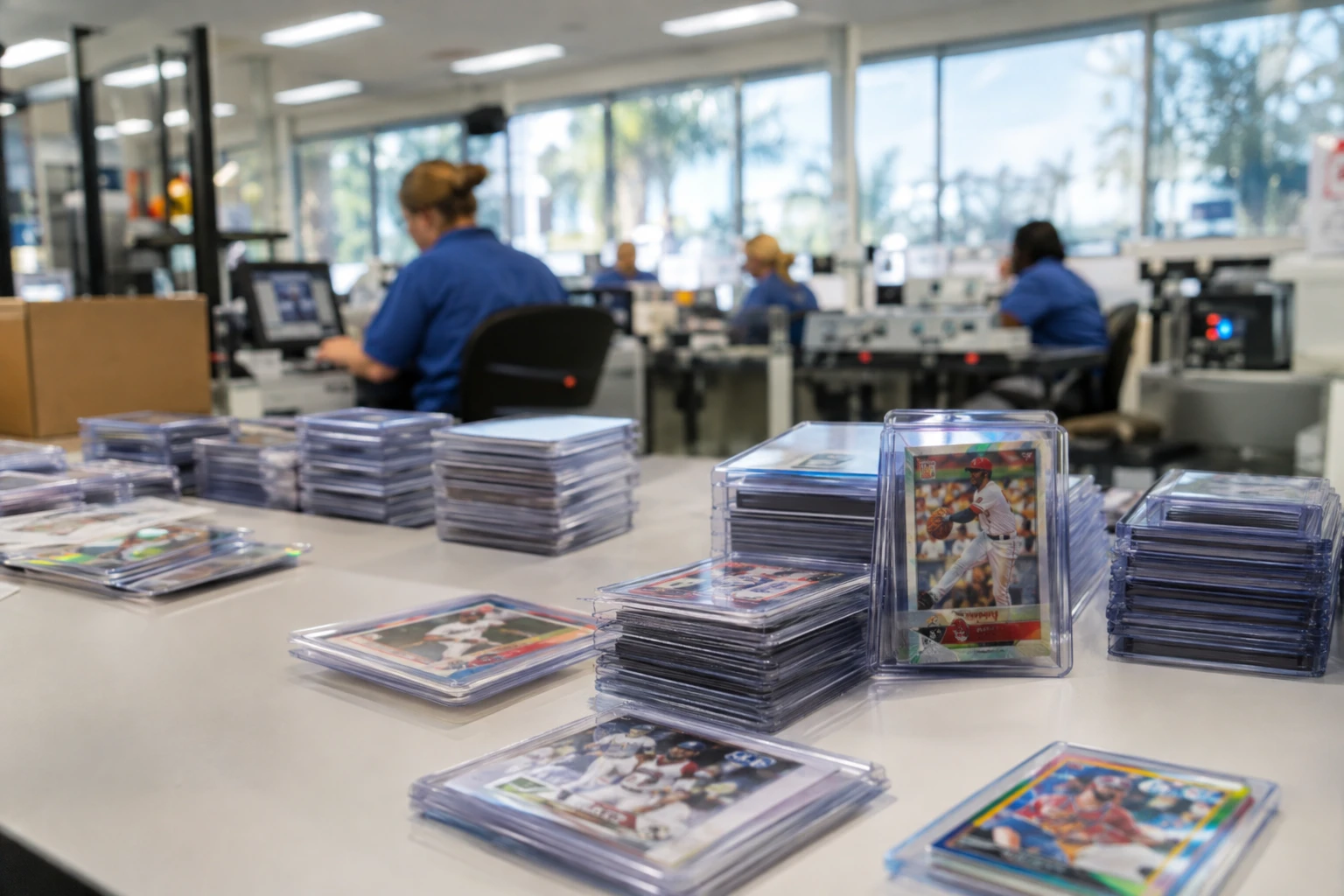
CGC also made operational announcements that reinforced the message. The company announced it was hiring more employees for its card services team, launched a second shift at its Sarasota headquarters, and expanded international grading operations in Munich and Shanghai with a Hong Kong facility on the horizon. Each announcement was a signal: we are growing, not retreating.
The contrast with PSA was stark. PSA was telling collectors to wait. CGC was telling collectors to send. In a market where the dominant emotion is frustration over closed tiers and extended timelines, CGC's open-door stance is a powerful customer acquisition tool.
The Operational Bet: Stay Open, Stretch Times
CGC's decision to keep all tiers open is not without cost. The company's published turnaround times have stretched dramatically under the weight of PSA's overflow:
| CGC Tier | Price | Jan 2026 Estimate | Aug 2026 Estimate | Change |
|---|---|---|---|---|
| Bulk | $17 | ~40 days | 150 working days | +275% |
| Economy | $20 | ~40 days | 90 working days | +125% |
| Standard | $55 | ~10 days | 10 working days | No change |
| Express | $100 | ~5 days | 5 working days | No change |
| WalkThrough | $300 | ~2 days | 2 working days | No change |
The pattern reveals CGC's strategy: absorb the overflow at the cheap tiers, protect the premium tiers. Bulk and Economy have stretched enormously, but Standard, Express, and WalkThrough remain at their original estimates. This means collectors who pay for mid-tier and above service still get fast turnaround, while the budget tiers absorb the PSA spillover.
It is a different philosophy from PSA's. PSA chose to close cheap tiers to protect the system. CGC chose to keep them open and let the timeline be the deterrent. Reasonable people can argue about which approach is more honest. Closing a tier is blunt but clear. Keeping it open at 150 days at least gives submitters a choice.
Capacity Expansion: Second Shifts and International Growth
CGC is not just sitting still and absorbing overflow. The company has been aggressively expanding capacity to handle the surge. Here is what CGC has done operationally in 2026:
- Second shift at Sarasota HQ: CGC launched a second shift at its Sarasota, Florida headquarters, meaning cards are now being graded nearly 24 hours a day, five days a week. This effectively doubled the company's daily grading capacity without requiring a new facility.
- International expansion: CGC spun up grading operations in Munich, Germany and Shanghai, China, with a Hong Kong facility on the horizon. These international offices serve local collectors directly, reducing transit times and creating regional grading capacity that takes pressure off the Sarasota facility.
- Hiring surge: CGC announced it was hiring more employees for its card services team that inspects cards before they reach a grader. This pre-grading inspection step is a bottleneck in the grading pipeline, and adding staff here speeds up the entire process.
- Robotics and AI: CGC executive Matthew Spiegel noted that the company has "robotics built throughout the entire operation" and is "looking at opportunities to deploy AI to speed up the process." This is not AI replacing graders — it is AI making the intake, imaging, and sorting steps more efficient.
- Fanatics partnership: CGC has embedded itself directly at Fanatics' facility in Portland, grading on-site. This creates new avenues for liquidity that bypass traditional bottlenecks and positions CGC as the preferred grader for Fanatics-produced cards.
The scale of this expansion is significant. CGC has strung together three consecutive months of grading over 600,000 cards. That is roughly 20,000 cards per day from a company that was grading a fraction of that volume just two years ago. It is still well behind PSA's 2.5 million monthly output, but the growth rate — 78% year over year — is the fastest in the industry.
The Turnaround Reality at CGC
While CGC's doors are open, the reality of submitting at the cheap tiers is sobering. 150 working days for Bulk is approximately 7 calendar months. That means a card submitted to CGC Bulk today would come back in roughly March 2027. 90 working days for Economy is about 4.5 calendar months, putting a return in late December or early January.
For collectors who are used to PSA's pre-pause Value Bulk timeline of 140-160 business days, CGC's 150-day Bulk estimate is comparable. The difference is that CGC's Bulk is actually open, while PSA's Value Bulk is paused. A 7-month wait is long, but it is shorter than waiting indefinitely for a tier that may not reopen until 2027.
The bright spot is CGC's mid-tier and above. Standard at $55 with a 10-working-day estimate is genuinely fast — faster than any PSA tier except Walk-Through. Express at $100 with a 5-working-day estimate is even faster. For collectors willing to pay $55 or more per card, CGC offers turnaround times that PSA cannot match at any price.
This creates a natural segmentation. Budget collectors use CGC Bulk or Economy and accept the long wait. Mid-tier collectors use CGC Standard and get fast turnaround at a reasonable price. Premium collectors use CGC Express or WalkThrough for near-instant grading. Every price point is served, which is the advantage of keeping the full ladder open.
CGC vs PSA: The Resale Premium Question
Here is the elephant in the room: CGC slabs still sell for less than PSA slabs on the secondary market. This is the single biggest factor preventing collectors from switching to CGC, and it is the reason PSA's backlog is still 11.85 million cards despite the Value tier pause.
The premium gap varies by category:
| Card Category | PSA 10 vs CGC 10 Premium | Notes |
|---|---|---|
| Modern Pokémon | PSA 10 sells 10-20% higher | Gap is narrowing; CGC gaining recognition |
| Vintage Sports | PSA 10 sells 15-20% higher | PSA dominance strongest here |
| Modern Sports Rookies | PSA 10 sells 10-30% higher | Varies by player and card |
| One Piece TCG | PSA 10 sells 5-15% higher | CGC has strong TCG recognition |
| CGC Pristine 10 | 10-40% ABOVE PSA 10 | Only for flawless cards (all subgrades 10) |
For most collectors, the PSA premium is the deciding factor. If a card is worth $500 in a PSA 10 and $400 in a CGC 10, the $100 difference is larger than the $60 fee gap between PSA Regular ($79.99) and CGC Economy ($20). In that scenario, PSA is still more profitable despite costing more to submit.
But the math shifts for lower-value cards. If a card is worth $100 in a PSA 10 and $80 in a CGC 10, the $20 premium difference is smaller than the $60 fee gap. In that scenario, CGC is more profitable. This is why CGC is the recommended grader for cards in the $50-$250 range: the fee savings outweigh the resale discount.
The Pristine 10 Phenomenon
There is one area where CGC not only matches PSA but exceeds it: the CGC Pristine 10. This designation is awarded to cards that receive a perfect 10 in all four subgrades — centering, corners, edges, and surface. It is CGC's equivalent of the BGS Black Label, and it commands a significant premium.
According to CGC executive Matthew Spiegel, CGC Pristine 10 grades have been exceeding the sales prices of PSA 10s in some cases. Market data supports this: CGC Pristine 10s can command a 10% to 40% premium over a standard PSA 10 for the same card. The premium is driven by the fact that a Pristine 10 is rarer than a PSA 10 — it requires perfection across all four subgrades, not just an overall 10 grade.
However, Pristine 10s remain the exception, not the rule. Most cards that grade CGC 10 do not achieve Pristine status. The standard CGC 10, which does not require perfect subgrades, still trades below PSA 10. So the Pristine 10 premium is real but narrow — it applies to a small fraction of submissions and is most relevant for high-end cards where flawless condition is the whole point.
For collectors chasing the Pristine 10 premium, CGC is actually the better choice over PSA. PSA does not print subgrades on its labels, so there is no way to distinguish a "perfect" PSA 10 from a "borderline" PSA 10. CGC's subgrade transparency creates the opportunity for a Pristine premium that PSA's label design cannot offer.
CGC's Push Into the High-End Market
CGC is not content being the "budget alternative." The company has been making a deliberate push into the high-end market, and the 2026 capacity crisis is accelerating that push.
The strategy has several components. First, CGC has been grading on-site at major conventions, including The National, where it had a significant presence. Second, the Fanatics partnership puts CGC graders inside Fanatics' Portland facility, giving the company direct access to newly produced cards before they reach the secondary market. Third, CGC has been highlighting high-value slabs — including Mantle, Wagner, and other grail cards — in its marketing to demonstrate that the company handles premium cards, not just bulk.
The international expansion also serves the high-end push. Munich and Shanghai offices give CGC credibility in European and Asian markets where PSA's dominance is less entrenched. A collector in Germany or Japan may be more willing to use CGC if there is a local facility, reducing transit risk for valuable cards.
Spiegel noted that "over the five to six years that we've been in business, the price gap between a CGC card and, let's say, a PSA card is continuing to shrink." This is the key long-term play: if CGC can narrow the resale premium gap, the company becomes not just the budget alternative but a genuine first-choice grader. The 2026 crisis, which has forced collectors to try CGC because PSA is unavailable, is accelerating that familiarity.
Where CGC Wins: Pokemon and TCG
CGC's strongest category is trading card games — particularly Pokémon, but also Magic: The Gathering, One Piece, and other TCG properties. In these categories, CGC's resale discount is smallest, and in some cases CGC slabs match or exceed PSA slabs for specific cards.
There are several reasons for this. First, the TCG collector base skews younger and more digitally native than the sports card base, which means less brand loyalty to PSA and more openness to alternative graders. Second, CGC's clean slab design appeals to TCG collectors who display their cards. Third, CGC's subgrade transparency is valued in TCG communities where condition debates are common.
For Pokémon cards in the $50-$300 range, CGC is genuinely competitive with PSA, not a compromise. The fee savings ($20 CGC Economy vs $79.99 PSA Regular) combined with a smaller resale discount make CGC the better financial choice for most Pokémon submissions. The CGC 10 may sell for 10-20% less than a PSA 10, but the $60 fee savings more than compensates on lower-value cards.
One Piece TCG is another bright spot. CGC's grading premiums for One Piece have been growing, and the collector base is less entrenched in PSA habits. For One Piece alt-art leaders and treasure rares, CGC is a legitimate first choice, not just an alternative.
Where CGC Struggles: Sports Cards
Sports cards are CGC's weak spot. In the sports card market, PSA and BGS have decades of brand equity, and SGC has carved out a niche with vintage collectors. CGC is seen as a TCG grader that also does sports, not as a sports card specialist.
The resale discount is largest in sports. A CGC 10 for a modern sports rookie typically sells 10-30% below a PSA 10, and the gap widens for vintage. Sports card buyers have strong slab preferences, and PSA's dominance in this category is deeply entrenched. A PSA 10 is the gold standard, and anything else is seen as a compromise.
This means CGC is not the best choice for most sports card submissions, even during the PSA pause. For high-value sports cards where the PSA premium is critical, collectors are better off paying $79.99 for PSA Regular and waiting 70-80 business days. For mid-value sports cards ($50-$250), CGC Economy at $20 may make sense if the collector is willing to accept the resale discount. For vintage sports cards, SGC is a better alternative than CGC — the black-tuxedo SGC slab has genuine collector preference in the vintage community.
CGC is aware of this weakness and is working to address it through the high-end push, the Fanatics partnership, and marketing that emphasizes CGC-graded sports cards. But changing brand perception in the sports card market is a multi-year project, and the 2026 crisis may not be enough to shift it meaningfully.
CGC vs Every Competitor in August 2026
Here is how CGC stacks up against every major grader in August 2026:
| Grader | Cheapest Open Tier | Turnaround | Tiers Paused? | Best For |
|---|---|---|---|---|
| CGC | Bulk $17 | 150 days | None | TCG, value grading |
| PSA | Regular $79.99 | 70-80 days | 4 Value tiers | High-value, max resale |
| BGS | Express $79.95 | — | Base, Standard | Subgrades, Black Label |
| TAG | Priority $150 | 5 days | Basic, Standard, Express | Tech-driven, objective grading |
| SGC | Standard ~$15-25 | 40-50 days | None | Vintage, fast flips |
Data as of August 2026. Check each company's official website before submitting, as availability and pricing change frequently.
CGC's position in this table is unique. It is the only company with no paused tiers, the cheapest open entry point ($17 Bulk), and a full range of turnaround options from 150 days down to 2 days. No other grader offers this combination. The question is whether collectors value openness and choice enough to accept the longer waits at the cheap tiers and the resale discount on the secondary market.
The Risks of Staying Open
CGC's strategy is not without risk. By keeping all tiers open, the company is absorbing an enormous volume of PSA's overflow. That volume is stretching turnaround times to 150 days for Bulk and 90 days for Economy, which are numbers that could damage CGC's reputation if they stretch further.
There is also a quality risk. When a grading company is overwhelmed with volume, the pressure on graders increases. Fatigue, rushing, and corner-cutting are real risks in a high-volume environment. CGC has addressed this by adding a second shift and hiring more staff, but the company is still processing far more cards than it was a year ago. Any grading errors or consistency issues that emerge during this period could hurt CGC's long-term reputation.
Another risk is that when PSA's Value tiers eventually reopen, CGC could see a sharp drop in volume. Collectors who shifted to CGC because PSA was unavailable may shift back, leaving CGC with expanded capacity and reduced demand. This is the "COVID hangover" problem that affected all graders after the 2021 boom subsided. CGC is betting that some fraction of collectors who try CGC during the crisis will stay, but that is not guaranteed.
Finally, there is the Beckett acquisition wildcard. Collectors Holdings, which owns PSA and SGC, announced in December 2025 that it is acquiring BGS. If that acquisition closes, three of the five major graders will be under one owner. CGC and TAG would be the two major independents. This consolidation could reshape pricing and competitive dynamics across the entire industry, and CGC's current strategy of being the "open alternative" may need to evolve.
Should You Send Your Cards to CGC?
The answer depends on what you are grading and why. Here is a practical framework:
Send to CGC if:
- Your cards are Pokémon or TCG in the $50-$300 range. CGC's TCG recognition is strong, and the fee savings outweigh the resale discount.
- You are grading bulk and can wait 7 months. CGC Bulk at $17/card is the cheapest open grading lane in the industry.
- You want subgrade transparency. CGC prints subgrades on the label, which is valuable for condition debates and resale confidence.
- You are chasing a Pristine 10. CGC's Pristine 10 can exceed PSA 10 prices for flawless cards.
- You need fast turnaround and are willing to pay $55+ per card. CGC Standard at 10 working days is faster than any PSA tier.
Do NOT send to CGC if:
- Your cards are high-value sports cards where the PSA premium is critical. Pay $79.99 for PSA Regular instead.
- Your cards are vintage sports. SGC is the better alternative for vintage, with stronger collector preference.
- You need cards back in under 3 months and cannot afford $55/card for Standard. CGC Economy at 90 days is the minimum viable option.
- You are grading to sell immediately and need maximum liquidity. PSA slabs sell faster and for more, which matters if you need cash quickly.
The Bottom Line
CGC's decision to stay open while every competitor pauses is the boldest strategic move in the 2026 grading crisis. It positions CGC as the default alternative for displaced collectors, accelerates familiarity with the brand, and captures market share that may persist even after PSA reopens. The tradeoff — long waits at cheap tiers and a resale discount — is real, but for many collectors, an open door at 150 days is better than a closed door with no timeline.
Frequently Asked Questions
Is CGC still accepting submissions in August 2026?
How long is CGC Bulk turnaround?
How long is CGC Economy turnaround?
Is CGC cheaper than PSA?
Can CGC Pristine 10 sell for more than PSA 10?
Is CGC good for sports cards?
Why did CGC stay open when PSA and BGS paused?
Is CGC expanding capacity?
Sources & Further Reading
- Sports Illustrated — Where Card Grading Companies Stand
- Yahoo Sports — CGC's Push for the High-End Market
- Misprint — Pokemon Card Grading Costs Compared 2026
- The Card Shop Finder — CGC Turnaround Times August 2026
- TCG Talk — PSA Value Pause Guide
- CardGrade — Card Grading Backlog 2026
The PreGradeCards Research Team combines machine-learning engineers, grading analysts, and collector-education specialists to produce accurate, data-driven guides on AI card grading, professional grading standards, and collecting strategy.
Create a free account and get 1 free credit — enough for 1 complete AI grading with market pricing. No credit card required.
Sign Up Free →