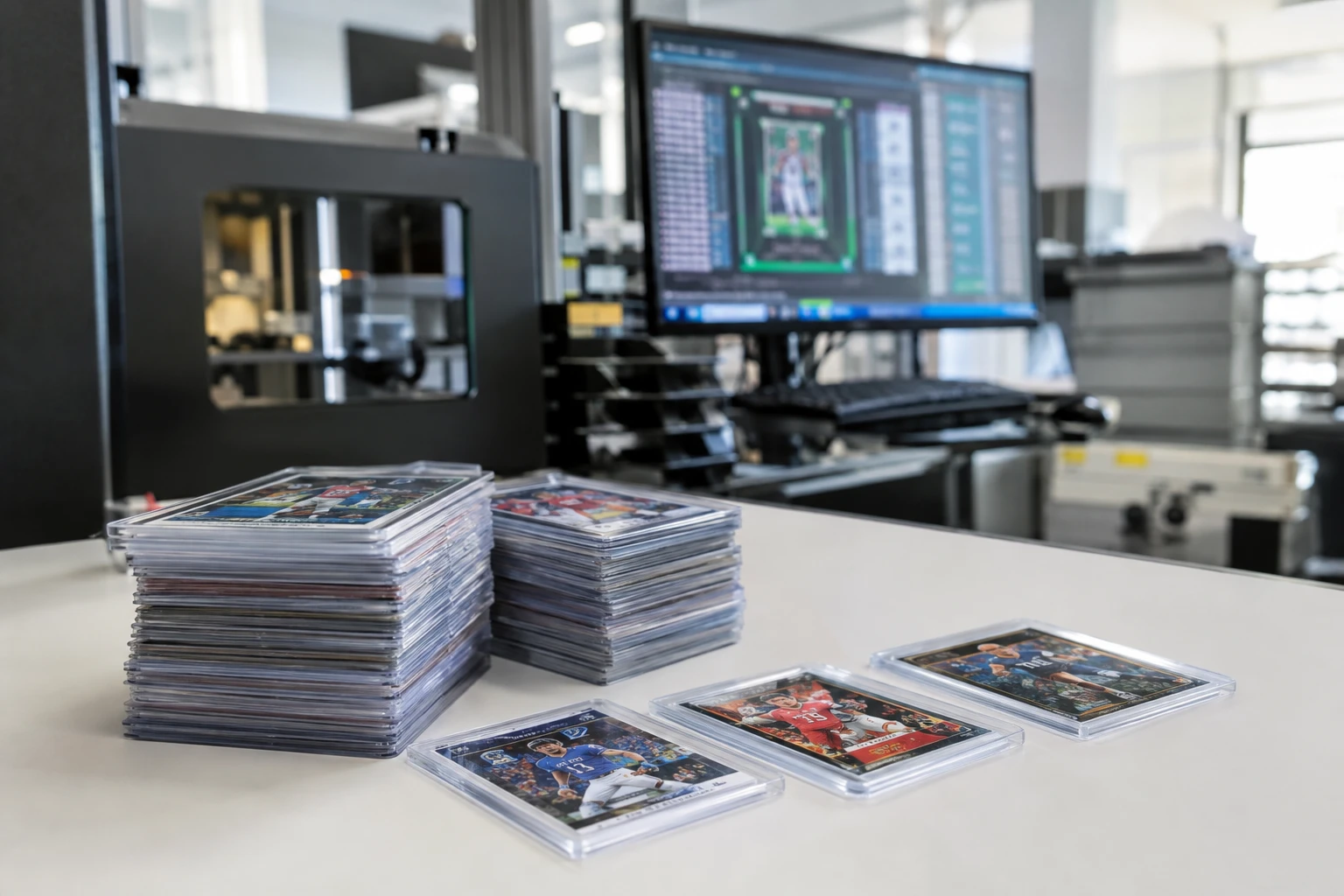
The Short Answer
- Express tier reopened at $60/card (down from $75), with an estimated 15 business day turnaround and up to $1,000 insurance per card.
- The first 10,000 cards submitted via Express and received by August 13 get an expedited 5-10 business day turnaround.
- TAG has graded 500,000 total cards, grown from 30 to 80 staff in six months, and scaled from 18,000 to nearly 50,000 cards graded per month.
- The backlog has fallen 55% from peak — from 420% of monthly processing capacity to 189%.
- Free insurance, card care (cleaning + deionization), and fitted slab sleeves are now included with every submission at every tier.
- TAG Pristine grades (990+) now automatically upgrade to the full 1,000-point TAG Score at no extra cost.
- Value tier minimum reduced from 20 to 10 cards, with per-card price moving from $15 to $20.
Express Tier Reopens at $60
When TAG closed its Express tier earlier in 2026 due to overwhelming submission volume, collectors lost access to the company's most popular mid-tier option. Express was the sweet spot for collectors who wanted TAG's technology-driven grading at a reasonable price without paying Priority rates. Its closure, following the earlier shutdowns of Basic and Standard, left only Priority ($150) and Walkthrough ($300) available — pricing that excluded most of TAG's target audience.
Now Express is back, and at a lower price point than before. TAG reopened Express at $60 per card, down from the previous $75. The estimated turnaround is 15 business days, with up to $1,000 of insurance per card. The tier focuses on what TAG calls "DINGS" — notable defects — and delivers clear, concise insights without the full sub-score breakdowns that come with higher tiers.
To celebrate the relaunch, TAG offered an expedited turnaround for early submitters: the first 10,000 cards submitted via Express and received at TAG's facility on or before August 13 were promised a 5-10 business day turnaround instead of the standard 15. That promotion created a rush of submissions and generated significant social media buzz in the TAG collector community.
The price reduction from $75 to $60 is notable. In an industry where every other grader is either raising prices or pausing tiers, TAG chose to lower its Express price. The company framed this as making the TAG Score "more accessible to all collectors," which aligns with TAG's positioning as the technology-driven, transparency-first grader that wants to differentiate on value, not exclusivity.
TAG's Updated Pricing Structure
Here is TAG's complete updated pricing structure as of the New Era announcement:
| Service | Price | Turnaround | Insurance | Status |
|---|---|---|---|---|
| Value | $20/card | 45+ est. biz days | Up to $200 | PAUSED |
| Regular | $30/card | 30 est. biz days | Up to $500 | PAUSED |
| Express | $60/card | 15 est. biz days | Up to $1,000 | REOPENED |
| Priority | $150/card | 5 est. biz days | Up to $2,500 | LIMITED |
| Walkthrough | $300/card | 1-2 est. biz days | Up to $5,000 | OPEN |
Note: Value and Regular tiers show updated pricing but remain paused for new submissions. Express has reopened. Priority has limited availability. Walkthrough is open. Check TAG's live pricing page before submitting.
The pricing changes tell a story. Value tier went from $15 to $20 per card, but the minimum quantity dropped from 20 to 10 cards, bringing the entry point from $300 down to $200. Regular is now $30 per card with a 30-day estimate. Express dropped from $75 to $60. Priority and Walkthrough remained at $150 and $300 respectively.
Every tier now includes more built-in value than before. Previously, insurance was a premium add-on. Now it is standard at every tier, with coverage scaling from $200 at Value to $5,000 at Walkthrough. Card care — microfiber cleaning and deionization — was also a paid add-on and is now complimentary. Fitted slab sleeves are included with every order. These additions effectively increase the value of each submission without raising the base price (and in Express's case, while lowering it).
Backlog Recovery: 55% Down From Peak
TAG's backlog story is one of the more encouraging narratives in the 2026 grading crisis. The company's public Backlog Tracker tells the story in numbers:
| Date | Backlog Load (% of monthly capacity) | Reduction from Peak |
|---|---|---|
| Peak (May 2026) | 420% | — |
| July 14, 2026 | 237% | ~44% |
| July 29, 2026 | 189% | ~55% |
What does "189% of monthly processing capacity" mean? It means TAG still has nearly two months of work queued up relative to what it can process in one month. That is significant progress from the peak of 420% (over four months of work queued), but it is not fully cleared.
TAG has set milestones for reopening. The company says limited reopening drops are anticipated around 80% recovery — meaning when the backlog load falls to roughly 84% of monthly capacity. TAG's tracker currently points to late August for that stage. Full catch-up is projected by the end of September 2026.
It is important to understand what these milestones mean. A "limited drop" is not the same as every regular tier reopening without restrictions. It means TAG will release a batch of submission slots at certain tiers, and once those slots fill up, they close again until the next drop. This is similar to how sneaker drops or concert ticket releases work — controlled availability that prevents the backlog from spiking again.
The Express tier reopening is the first concrete result of this backlog recovery. TAG felt confident enough in its progress to reopen Express at a lower price point, which signals that the company believes its capacity has grown sufficiently to handle the incoming volume at that tier.
New Features: Insurance, Card Care, and More
The Express reopening is just one part of TAG's "New Era" update. The company bundled several significant feature additions into the announcement, all of which apply to every submission at every tier:
Complimentary Insurance
Previously, insurance was a premium add-on that collectors had to pay extra for. Now, every TAG submission includes complimentary insurance, with coverage scaling by tier: Value up to $200/card, Regular up to $500, Express up to $1,000, Priority up to $2,500, and Walkthrough up to $5,000. This is a meaningful value addition — insurance protects against loss or damage during transit and processing, and having it included removes a friction point from the submission process.
Complimentary Card Care
Every TAG submission now includes free microfiber wipedown (fingerprint removal) and deionization (dust removal). Previously, this was a paid service. TAG says increased scalability of its process made it possible to include this treatment automatically at no added cost. This is not just cosmetic — dust and fingerprints can affect grading accuracy, so removing them before grading benefits both the collector and TAG's computer vision system.
Fitted Protective Slab Sleeve
Every graded card now comes with a fitted protective slab sleeve at no extra cost. This protects the slab from scratches and wear during storage and handling, which is a small but appreciated touch that other graders typically charge for.
360° Slab Video
TAG's signature 360° Slab Video — a rotating video of the graded card in its slab that appears on the DIG Report for public viewing — is now available as an upgrade at all tiers and is included free with Priority and Walkthrough. The video can be downloaded and used on social media, which is valuable for collectors who sell online and want to showcase their graded cards.
TAG Pristines Get Auto-Upgraded
One of the most interesting changes in the New Era update is the automatic upgrade for TAG Pristine grades. Moving forward, any card that scores 990 or higher on TAG's 1,000-point scale will automatically be upgraded to include the full 1,000-point TAG Score — regardless of which tier it was submitted under.
This matters because the full 1,000-point score provides more granular information than the standard grade. It shows the exact score (e.g., 992, 995, 998) rather than rounding to a 1-10 grade, and it ranks the card by score on TAG's leaderboard, breaking grade ties. Previously, this level of detail was only available through an optional premium upgrade.
The upgrade also makes the score visible in the slab's QR code, which means anyone who scans the slab can see the exact 1,000-point score on TAG's website. This creates a verifiable, permanent record of the card's precise grade — something no other grading company offers.
For collectors chasing the highest possible grade, this auto-upgrade adds value without additional cost. A TAG Pristine with a 998 score is objectively more impressive than a TAG Pristine with a 990 score, and the full score makes that distinction visible to buyers. This could help narrow the resale gap between TAG and PSA for high-end cards, where condition precision matters most.
500,000 Cards Graded Milestone
TAG announced that it has officially surpassed 500,000 total cards graded since its launch. For a company that has been operating for roughly six years, the acceleration is remarkable:
- Team growth: From approximately 30 employees to 80 in six months — a 167% increase in staffing.
- Monthly output: From 18,000 cards per month to nearly 50,000 cards per month — a 178% increase in throughput.
- Total graded: 500,000+ cards, a milestone that validates TAG's technology-driven approach at scale.
To put these numbers in perspective, PSA grades roughly 2.5 million cards per month and CGC grades 600,000+. TAG's 50,000 per month is much smaller in absolute terms, but the growth rate is the fastest in the industry. TAG has nearly tripled its monthly output in six months while simultaneously reducing its backlog by 55%.
The 500,000-card milestone also matters for market liquidity. TAG slabs are still less liquid than PSA or CGC slabs, but with 500,000 graded cards in the market, there are enough TAG slabs in circulation for collectors and buyers to become familiar with the brand. Each additional graded card increases the population of TAG slabs on the secondary market, which gradually improves liquidity and price discovery.
Value Tier Changes: Lower Minimum, Higher Price
TAG adjusted its Value tier to make it more accessible overall. The minimum quantity required to submit was reduced from 20 cards to 10 cards, bringing the entry point from $300 down to $200. However, the per-card price increased from $15 to $20.
This is a tradeoff that favors smaller submitters. Under the old pricing, a collector with 10 cards could not use Value tier at all — they had to use Regular at $30/card ($300 total). Under the new pricing, that same collector can use Value at $20/card ($200 total), saving $100. The per-card price went up, but the minimum commitment went down, opening the tier to more collectors.
For bulk submitters with 50+ cards, the price increase from $15 to $20 per card is a meaningful cost increase. A 50-card submission went from $750 to $1,000. But with the added value of free insurance, card care, and slab sleeves, TAG argues the effective value per card is higher than before.
The Value tier remains paused for new submissions, so these pricing changes are planning figures for when the tier reopens. TAG has not announced when Value will reopen, but the backlog recovery trajectory suggests it could be among the tiers included in the limited reopening drops anticipated in late August or September.
Mystery Foil Wrap Now Optional
TAG's signature Mystery Foil Wrap — the opaque foil packaging that conceals the graded card until the collector opens it — has been a polarizing feature. Some collectors love the unboxing experience and the thrill of revealing their grade. Others find it gimmicky and want to see their grade immediately without the extra packaging step.
TAG has made the Mystery Foil Wrap optional and free with every order. Collectors can now select their preference at checkout. Those who want the foil wrap experience get it at no cost, and their protective slab sleeves are packaged separately. Those who prefer a clean reveal can skip the foil and receive their cards in protective slab sleeves directly.
This is a smart move. It removes a point of friction for collectors who were turned off by the foil wrap while preserving the feature for those who enjoy it. It also simplifies TAG's fulfillment process — not every order needs the foil wrapping step, which saves time and materials.
360° Slab Video Available
TAG's 360° Slab Video is a unique feature in the grading industry. The video shows the graded card rotating in its slab, with high-resolution imaging that captures the card's surface, edges, and corners from every angle. The video appears on the public DIG Report (TAG's digital grading report) and can be downloaded for use on social media or marketplace listings.
In the New Era update, TAG made the 360° Slab Video available as an upgrade at all tiers and included it free with Priority and Walkthrough submissions. For Express at $60/card, the video is a $49.95 upgrade — which is nearly as much as the grading fee itself. This pricing suggests TAG views the video as a premium feature aimed at collectors who are selling their graded cards online and want maximum visual proof of condition.
The video is more than a marketing gimmick. For online sellers, a 360° video of a graded card provides far more condition information than static photos. Buyers can see the slab from every angle, verify the grade on the label, and assess the card's condition through the crystal-clear archival acrylic. This can increase buyer confidence and potentially improve sale prices, particularly for high-end cards.
What About Regular Tiers?
The Express reopening is significant, but TAG's Value and Regular tiers remain paused as of mid-August 2026. The company's backlog tracker shows progress, but the regular tiers have not fully reopened.
TAG's approach to reopening appears to be phased. Express came back first because it is a mid-priced tier with moderate volume — it generates revenue without creating the massive inflow that Value or Regular would. Priority has limited availability, and Walkthrough is open but at $300/card, it serves only the highest-end segment.
Based on TAG's stated milestones, limited reopening drops are anticipated around 80% backlog recovery, which the company estimates could happen in late August. Full catch-up is projected by the end of September. If those projections hold, Value and Regular tiers could begin reopening in some form by September or October 2026.
However, TAG has been explicit that these are estimates, not guarantees. The company says submission options can change as capacity changes, and collectors should check the live pricing page before building a submission. The backlog recovery could stall if the Express reopening generates a new surge of submissions that overwhelms the progress made.
TAG vs Competitors in August 2026
Here is how TAG compares to other graders in August 2026, specifically looking at the cheapest available option at each company:
| Grader | Cheapest Open Tier | Price | Turnaround | Insurance Included |
|---|---|---|---|---|
| CGC | Bulk | $17 | 150 days | Yes |
| TAG | Express | $60 | 15 days | Yes ($1,000) |
| BGS | Express | $79.95 | — | Varies |
| PSA | Regular | $79.99 | 70-80 days | Up to $1,500 |
TAG Express at $60 with a 15-day turnaround is actually one of the best value-to-speed ratios in the industry right now. It is cheaper than PSA Regular ($79.99) and BGS Express ($79.95), faster than both, and includes insurance and card care. The tradeoff is TAG's weaker resale recognition, which we address next.
The Resale Reality for TAG Slabs
Here is the hard truth that TAG's marketing does not emphasize: TAG-graded cards typically sell 35-60% below the equivalent PSA grade on the secondary market. The gap is narrower on modern cards and wider on vintage, but it is real and it is large.
For a $300 raw card, a TAG 10-equivalent might sell for $120-$195, while a PSA 10 might sell for $300-$400. Subtract the $60 Express fee plus shipping from the TAG return, and you are looking at $50-$125 in profit. Do the same with PSA Regular at $79.99, and even with the longer wait, you might clear $180-$300. The PSA premium is that significant.
This does not mean TAG is a bad choice. It means TAG is the right choice for specific situations:
- Collectors who value transparency over resale. TAG's DIG Report shows exactly where points were lost, with photographic evidence. No other grader provides this level of detail. If you are grading for personal collection, not resale, TAG's transparency is unmatched.
- High-end cards where the TAG Score matters. A TAG Pristine with a 998 score is a verifiable, objective assessment of card condition. For collectors who want the most precise grade available, TAG's 1,000-point scale is superior to PSA's whole-number system.
- Speed-sensitive submissions. TAG Express at 15 business days is faster than any PSA tier except Walk-Through ($599). If you need a card graded quickly and cannot afford PSA's premium tiers, TAG Express is a viable option.
- Cards that are not PSA-dependent. Some cards have thin PSA premiums — particularly modern TCG commons and uncommons where the graded market is small. For these, TAG's lower fee and faster turnaround may outweigh the resale discount.
The rule of thumb: TAG is worth it when the card's expected graded resale comfortably clears the fee plus shipping plus the resale-gap haircut. That generally means higher-dollar cards where a strong grade adds hundreds, not mid-value cards where the haircut and the fee eat most of the upside.
Should You Use TAG Grading?
TAG's New Era update makes it a more compelling option than it was six months ago. The Express tier reopening at $60, the free insurance and card care, the Pristine auto-upgrade, and the 55% backlog reduction all improve the value proposition. But the decision still comes down to what you are grading and why.
Use TAG if:
- You want the most transparent, objective, and documented grade available. TAG's DIG Report with photographic evidence is the best in the industry.
- You are grading for personal collection and do not plan to sell. The resale discount does not matter if you are not selling.
- You need fast turnaround at a reasonable price. TAG Express at $60 with 15-day turnaround is an excellent speed-to-price ratio.
- You are chasing a TAG Pristine and want the full 1,000-point score. The auto-upgrade for 990+ scores adds value at no cost.
- You want subgrade-level detail without paying BGS prices. TAG's computer vision provides corner, edge, surface, and centering analysis.
Do NOT use TAG if:
- You are grading to sell for maximum profit. PSA's resale premium is still 35-60% higher than TAG's for most cards.
- You are grading vintage sports cards. TAG has minimal recognition in the vintage sports market. Use PSA or SGC instead.
- You want to crossover or reholder an existing slab. TAG only grades raw cards — you cannot send a PSA, BGS, CGC, or SGC slab for TAG grading.
- Your card is mid-value ($100-$300) and you need maximum resale. The TAG resale discount will eat most of your profit. Use CGC or PSA instead.
The Bottom Line
TAG's New Era update is a genuine improvement. The company is recovering from its backlog, reopening tiers, lowering prices, and adding value. For collectors who value transparency, speed, and technology-driven grading, TAG is a stronger option than ever. For collectors who prioritize resale value and market liquidity, PSA remains the default choice. The right answer depends on what you are grading and what you plan to do with the slab once it comes back.
Frequently Asked Questions
Is TAG Express tier open again?
What is TAG's current backlog status?
Are TAG Value and Regular tiers still paused?
Does TAG include insurance now?
What is the TAG Pristine auto-upgrade?
How many cards has TAG graded total?
Do TAG slabs sell for as much as PSA slabs?
Can I submit a PSA or CGC slab to TAG for regrading?
Sources & Further Reading
- TAG Grading — New Era Update Blog Post
- TAG Grading — Pricing Page
- CardGrade — Card Grading Backlog 2026
- TCG Treasury — TAG Paused Value Tiers
- CardGrade — TAG Grading Guide 2026
- PreGradeCards — TAG Closes Core Submission Tiers
The PreGradeCards Research Team combines machine-learning engineers, grading analysts, and collector-education specialists to produce accurate, data-driven guides on AI card grading, professional grading standards, and collecting strategy.
Create a free account and get 1 free credit — enough for 1 complete AI grading with market pricing. No credit card required.
Sign Up Free →