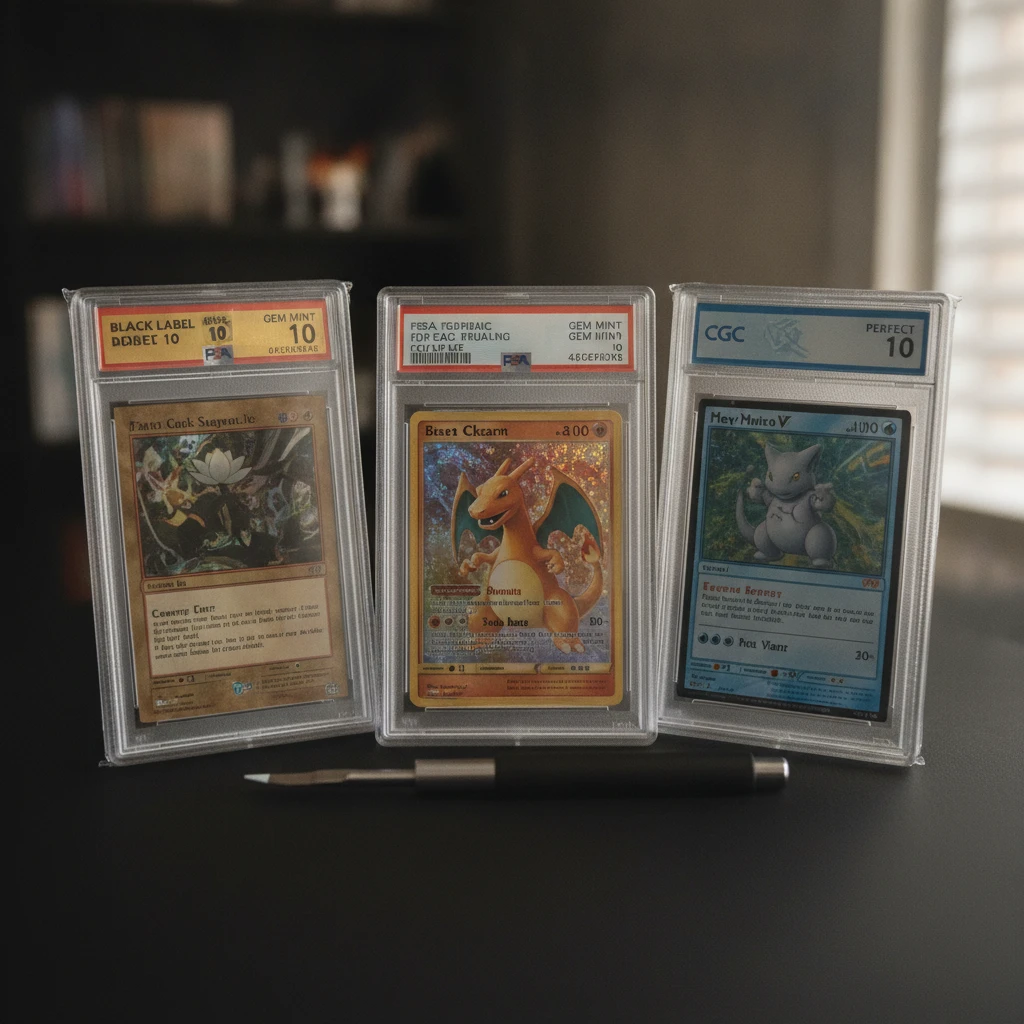
The Short Answer
- PSA 10 generally commands the highest resale premium for TCG chase cards, which is why collectors crack BGS 9.5 and CGC 9.5 slabs to chase it.
- Crossover is not guaranteed. PSA may grade the same card PSA 9, erasing the value boost and costing you two grading fees.
- BGS 9.5 is closer to PSA 10 than BGS 9, but sub-grade distribution matters. A 9.5 with 10 centering has better crossover odds than a 9.5 with 9 edges.
- CGC 9.5 to PSA 10 crossover has become more common in 2026 as CGC tightens standards, but surface still differs between the two companies.
- PreGradeCards AI analysis of the raw card after cracking gives a second opinion before you pay the second grading fee.
What Is Crossover Grading for TCG Cards?
Crossover grading means taking a card that is already encased in one company’s slab, removing it, and submitting the raw card to a different grading company. For TCG collectors in 2026, the most common crossover is from BGS or CGC to PSA, driven by the premium that PSA 10 slabs command on the secondary market.
There are two ways to attempt a crossover. The first is PSA’s official Crossover service: you send the card still inside its BGS or CGC holder, specify a minimum grade, and PSA evaluates the card without removing it from the old slab unless the target grade is achieved. The second is the “crack and resubmit” method: you open the old slab yourself, extract the card, and submit it raw to the new company. Crack-and-resubmit is cheaper but riskier — any damage to the card during extraction can ruin the grade.
Both methods are under increased scrutiny in 2026 because PSA’s backlog and pricing have changed the economics. With Value tiers paused and PSA Regular at $79.99, every crossover attempt must be justified by a clear value increase.
Why PSA 10 Commands the TCG Resale Premium
For most modern TCG chase cards, the market pays the highest prices for PSA 10. This is not because PSA is objectively stricter than BGS or CGC; it is because PSA 10 has become the default search term and liquidity benchmark for online marketplaces. Buyers filter eBay and TCGplayer by “PSA 10” first, which creates a liquidity premium on top of the grade premium.
The gap is especially large in Pokémon, Yu-Gi-Oh!, One Piece, and Lorcana. A modern Pokémon alt art SAR in BGS 9.5 might sell for 60–80% of what the PSA 10 copy brings. A CGC 9.5 can trade at 50–70% of PSA 10. That spread is what makes crossovers tempting, even after accounting for fees and risk.
However, the premium is not universal. Some vintage sports cards and certain BGS Black Label cards command higher prices than PSA 10. Always check recent sales for your specific card before assuming PSA is the best destination.
BGS 9.5 to PSA 10: The Real Conversion Rate
BGS 9.5 is often described as “equivalent to PSA 10,” but the conversion is not automatic. BGS uses four sub-grades: centering, corners, edges, and surface. A BGS 9.5 can be earned with sub-grades of 9.5/9.5/9.5/9.5 or with a mix that includes 10s and 9s. PSA does not see those sub-grades; it re-evaluates the raw card holistically.
Collector-reported crossover data suggests the following rough conversion tendencies for TCG cards:
- BGS 9.5 with at least one 10 sub-grade → PSA 10 roughly 60–75% of the time.
- BGS 9.5 with all 9.5 sub-grades → PSA 10 roughly 45–55% of the time.
- BGS 9.5 with a 9 sub-grade → PSA 10 drops to roughly 30–40%.
- BGS 9.0 → PSA 10 is rare, usually under 15%.
These are estimates based on collector reports and crossover groups, not official PSA statistics. The actual probability depends on the card, the era, and current PSA evaluator strictness.
CGC 9.5 to PSA 10: What Changed in 2026
CGC tightened its grading standards in 2025–2026 and gained credibility in the TCG market. As a result, CGC 9.5 cards have become stronger crossover candidates. The key differences between CGC and PSA evaluation include surface tolerance and centering strictness.
CGC is generally considered stricter on surface issues such as print lines and holo scuffing. PSA is historically stricter on centering, especially for full-bleed alt art cards. A CGC 9.5 with clean surface sub-grades but borderline centering might cross to PSA 10 if PSA evaluates centering generously, or might fall to PSA 9 if centering is the deciding factor.
Practical crossover odds for CGC 9.5 TCG cards in 2026 are estimated at 50–65% to PSA 10 for cards with strong centering, and 35–50% for cards with any centering concern. AI centering analysis can quantify that concern before you crack the slab.
When to Crack a Slab and Resubmit
Crack-and-resubmit makes sense when the expected value increase clearly exceeds the combined cost and risk. Consider cracking a BGS or CGC slab when:
- The PSA 10 value is at least 1.6x the current slab value — this covers the PSA fee, shipping, insurance, and a failed-crossover buffer.
- The card is a high-demand chase card with liquid PSA 10 comparables (Pokémon SARs, One Piece alt-art Leaders, MTG serialized cards, Lorcana Enchanted Rares).
- The existing grade is BGS 9.5 or CGC 9.5 with no weak sub-grades.
- You have inspected the card and believe the original grade understates its condition.
- The PSA pop report shows low enough supply that a PSA 10 copy would retain a meaningful premium.
For example, if a BGS 9.5 Pokémon SAR sells for $400 and PSA 10 copies sell for $900, the gross spread is $500. After PSA Regular ($79.99), shipping/insurance (~$25), and the risk of ending up with a PSA 9 worth $300, the expected value is roughly break-even unless the crossover success rate is above 60%. Run the math before cracking.
When to Leave the Slab Alone
Not every slab should be cracked. Avoid crossover attempts when:
- The card is already in a BGS Black Label, CGC Perfect 10, or similarly elite holder. These can command premiums of their own.
- The PSA 10 premium is small relative to the current slab value — generally under 1.4x.
- The existing grade is BGS 9.0, CGC 9.0, or lower. Crossover success to PSA 10 is statistically poor.
- The card has visible surface, corner, or centering issues that make a higher grade unlikely.
- You need the money quickly. Crossovers add weeks or months to your cash conversion cycle.
- The card is vintage or fragile, increasing damage risk during extraction.
Sometimes the smart move is to sell the BGS 9.5 or CGC 9.5 slab as-is and let the buyer decide whether to chase PSA 10.
How to Crack a Slab Without Damaging the Card
If you decide to crack the slab, follow a safe process. Damage during extraction is the single biggest avoidable risk in crossover grading.
- Work on a clean, padded surface. Use a microfiber cloth or card mat. Have a penny sleeve and semi-rigid holder ready.
- Wear gloves or wash hands thoroughly. Oils transfer easily during extraction.
- Use a slab cracker tool or flat-head screwdriver. Insert the tool into the seam at a corner and apply gentle, even pressure. PSA, BGS, and CGC slabs have different seam designs; watch a video for your specific holder type.
- Stop if the card shifts toward the tool. Re-position and crack the opposite corner first to relieve pressure.
- Remove the card slowly. Avoid touching the face. Inspect for debris from the slab.
- Sleeve and top-load immediately. Do not leave the card exposed.
If you are not comfortable cracking slabs, use a dealer or PSA’s official Crossover service. The Crossover fee is higher, but it eliminates extraction risk.
Crossover ROI Formula for TCG Collectors
Use this expected-value formula before any crack-and-resubmit:
Expected Value = (P10 × V10) + (P9 × V9) + (Pfail × Vraw) − Fee − Shipping − Insurance
Where:
- P₁₀ = estimated probability of PSA 10
- V₁₀ = market value of PSA 10
- P₉ = estimated probability of PSA 9
- V₉ = market value of PSA 9
- P_fail = probability of PSA 8 or lower/authentic only
- V_raw = raw card value
- Fee/Shipping/Insurance = all-in grading cost
If the expected value exceeds the current slab value by a margin you are comfortable with, proceed. If it is close, the safer play is to sell the existing slab. PreGradeCards What’s My Card Worth? tool can help estimate V₁₀ and V₉ from recent market data.
Using AI Pre-Grading After Cracking a Slab
After you extract the card, run it through PreGradeCards AI before sending it to PSA. This gives you a fresh condition assessment that is independent of the BGS or CGC grade. The AI analysis is especially useful for checking:
- Centering: PSA is stricter on centering than many collectors expect. A borderline BGS 9.5 centering sub-grade may predict a PSA 9.
- Surface: Holo scuffing and print lines that the first grader accepted may still be visible to AI.
- Corners and edges: Micro-chips from slab extraction or pre-existing wear can be flagged before submission.
The workflow is simple: crack the slab, sleeve the card, upload front and back to Complete Card Grading, and review the predicted grade. If the AI predicts PSA 10 with no condition warnings, your crossover odds improve. If the AI predicts PSA 9 or lower, reconsider the resubmission.
Crossover grading can be profitable in 2026, but only for collectors who treat it as an expected-value calculation rather than a gamble. PreGradeCards AI reduces the guesswork — use it as your second opinion before you pay the second grading fee.
Frequently Asked Questions
What is crossover grading for TCG cards?
Should I crack my BGS 9.5 to try for PSA 10?
Is CGC 9.5 the same as PSA 10?
How much does crossover grading cost?
Can AI pre-grading predict a successful crossover?
What if my card gets damaged while cracking the slab?
Sources & Further Reading
- PSA — Trading Card Crossover Service
- PokeTrace — Pokémon Card Grades Explained 2026
- TCGTalk — Best TCG Card Grading Companies 2026
Emily Rodriguez analyzes grading cost, population, and pricing data across PSA, BGS, SGC, CGC, and TAG. She built the PreGradeCards ROI calculator and submission planner, and her market reports on grading backlog, turnaround times, and slab premiums are cited by collectors and dealers worldwide.
Create a free account and get 1 free credit — enough for 1 complete AI grading with market pricing. No credit card required.
Sign Up Free →