The Short Answer
- Trimming is the most common form of doctoring — Edges are shaved to improve centering and remove corner wear.
- PSA rejects ~5,000 altered cards per year — Many more slip through to the secondary market.
- UV light reveals alterations — Recolored borders fluoresce differently than original ink under 365nm UV.
- Pressed cards lose texture — Heat/pressure flattening removes the natural texture of card stock.
- When in doubt, do not buy — If a deal seems too good, the card is likely altered.
How Do You Detect Doctored Trading Cards?
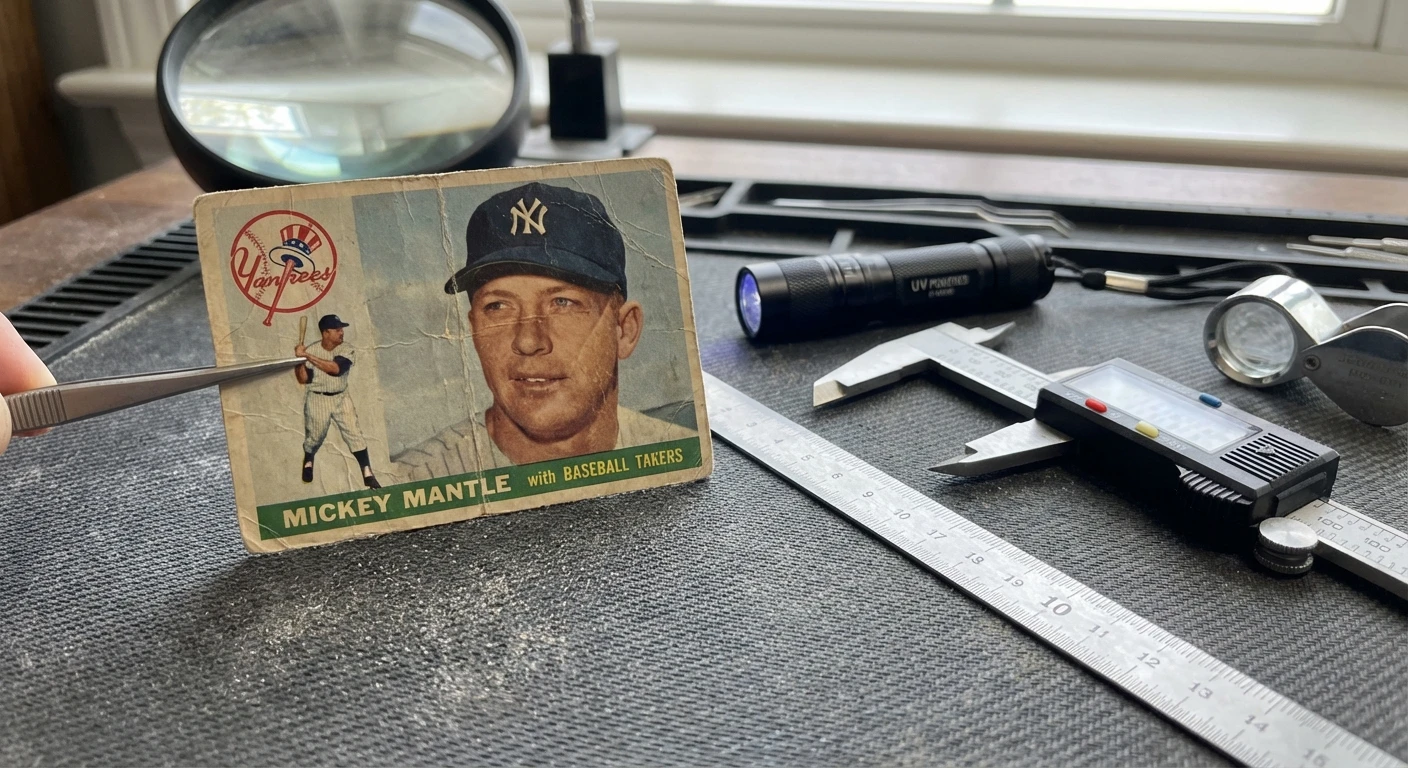
Card doctoring — the practice of altering cards to improve their apparent condition — is a multi-million dollar problem in the trading card industry. PSA rejects approximately 5,000 altered cards each year, but many more make it to the secondary market undetected. This guide teaches collectors how to identify the most common forms of card doctoring before purchasing, using professional-grade detection techniques and red flags.
Trimmed Edges & Borders
Trimming is the most common and profitable form of card doctoring. A trimmer removes worn edges to create the appearance of sharper corners and better centering.
How Trimming Works
- Corner rounding removed — A small amount shaved from each corner creates sharp points
- Centering improved — Uneven borders trimmed to appear more centered
- Edge whitening hidden — Worn edges removed entirely
Red Flags for Trimmed Cards
| Red Flag | How to Detect |
|---|---|
| Card is undersized | Measure with calipers — compare to known authentic examples |
| Perfectly straight edges | Factory cuts have slight irregularities; trimmed edges are unnaturally straight |
| Glossy cut edges | Trimming exposes raw stock that reflects light differently than factory edges |
| Border color mismatch | Trimmed edges may expose different colored stock underneath |
| Vintage cards with PSA 10 corners | 70-year-old cards with impossibly sharp corners are suspicious |
Detection Technique
- Measure dimensions — Compare to PSA's published card dimensions or known authentic examples
- Examine edge texture — Factory edges have slight fuzz; trimmed edges are smooth and glossy
- Check under magnification — Trimmed edges show compression marks from cutting tools
- Compare to population — A PSA 10 vintage card with only 5 others in pop is extremely suspicious
Recolored Borders & Touch-ups
Recoloring involves adding ink or paint to borders to cover whitening and wear:
Recoloring Methods
- Marker touch-up — Sharpie or similar used to color over whitening
- Paint application — Acrylic or model paint applied to borders
- Airbrushing — Fine mist of color sprayed on edges
Red Flags for Recolored Cards
- Perfectly white borders on vintage — 50-year-old cards should not have pristine white borders
- Color inconsistency — Border color slightly different from center of card
- UV fluorescence mismatch — Recolored areas glow differently under UV light
- Texture difference — Recolored borders feel smooth; original borders have slight texture
- Border bleeding — Color applied too heavily bleeds into image area
UV Detection Method
The most reliable way to detect recoloring:
- Darken room and use 365nm UV flashlight
- Scan card borders systematically
- Recolored areas will fluoresce (glow) differently from original ink
- Document any anomalies with photos
Note: Some modern card finishes naturally fluoresce. Always compare to a known authentic example from the same set.
Chemical Treatments
Chemical treatments alter card surfaces to remove stains, improve gloss, or soften corners:
Common Chemical Alterations
| Treatment | Claimed Effect | Red Flag |
|---|---|---|
| Corner softening | Softens rough corners | Corners look worn but smooth unnaturally |
| Stain removal | Removes tobacco/gum stains | UV shows uneven fluorescence where chemicals removed original finish |
| Gloss restoration | Restores factory shine | Surface feels slick or oily; UV reveals coating |
| Whitening removal | Removes edge whitening | Edges have uniform non-white color that looks painted |
Important: All chemical treatments are considered card doctoring by PSA. Even "conservation" treatments designed to "preserve" cards are rejected. PSA wants cards in their original, unaltered state. AI pre-screening can sometimes detect surface anomalies that suggest chemical treatment.
Pressure Sealing & Pressing
Pressing uses heat and pressure to flatten cards, removing warping and softening creases:
What Pressing Does
- Removes waviness — Flattened cards appear smoother
- Softens creases — Crease lines become less visible
- Compresses stock — Card becomes slightly thinner
- Removes texture — Original card surface texture is flattened
Red Flags for Pressed Cards
- unnaturally smooth surface — Vintage cards should have slight texture
- Gloss inconsistency — Pressed areas may have different sheen
- Crease ghosts — Crease lines visible under angled light despite being "removed"
- Card is thinner than standard — Measure with calipers
- Surface feels like cardboard — Pressed cards lose their original coating feel
PSA Detection: PSA graders are trained to detect pressed cards. They examine card stock thickness, surface texture, and look for "crease ghosts" — faint lines where creases were pressed but not fully eliminated. Pressed cards are rejected with "Altered" designation. Vintage cards are particularly susceptible to pressing scams.
Detection Tools & Techniques
| Tool | Cost | Detects |
|---|---|---|
| UV Flashlight (365nm) | $10-20 | Recoloring, chemical treatments, residue |
| Digital Calipers | $15-25 | Trimming (size reduction), pressing (thickness reduction) |
| 10x Jeweler's Loupe | $8-15 | Trim marks, recoloring, texture changes, corner work |
| Scale | $10-20 | Weight changes from treatments or trimming |
| Black Light + Magnifier | $15-30 | Comprehensive surface inspection |
Professional Authentication
If you suspect a card is doctored but cannot confirm:
- Submit to PSA for authentication — $50-100 for opinion only (no grading)
- Beckett Authentication Services — Similar opinion service
- Independent appraisers — Heritage Auctions, Goldin offer evaluation
Protecting Yourself from Doctored Cards
Buying Rules
- Buy graded when possible — PSA, BGS, SGC authentication provides protection
- Verify cert numbers — Always check psacard.com/cert before buying PSA cards
- Buy from reputable sellers — Established dealers with return policies
- Request high-res photos — Inspect corners, edges, and borders before purchase
- Know market prices — If a PSA 10 is selling for half price, it is probably altered or fake
- Use escrow for high-value — For cards $1,000+, use escrow services
Red Flag Sellers
- No returns accepted — Legitimate sellers stand behind their cards
- Stock photos only — Refuses to provide photos of actual card
- New accounts — Zero feedback or recently created
- Pressure tactics — "Someone else is interested" or limited-time urgency
- Vague descriptions — "Looks NM" instead of specific condition details
Bottom Line: Card doctoring is rampant and profitable for scammers. Protect yourself by buying graded cards, verifying cert numbers, inspecting before purchase, and using detection tools. When in doubt, walk away. The money saved by avoiding a doctored card far exceeds any "deal" you might miss. Verify PSA certs, inspect properly, and never let FOMO drive purchase decisions.
Frequently Asked Questions
0
1
2
3
4
5
6
7
Sources & Further Reading
- PSA Altered Card Detection
- PSA Authentication Services
- Beckett Authentication
- Card Doctoring Awareness
Sarah Williams leads PreGradeCards educational content and collector onboarding. She has been a full-time collector and dealer for 12 years, specializing in modern sports cards and Pokémon TCG, and has written grading guides read by over 300,000 collectors.
With submission floors rising, pre-screening is no longer optional. Use our AI Pre-Grade Calculator to score a card's PSA 10 odds before you pay, and the Submission Planner to pick the right tier.