The Short Answer
- F1 card collecting is the fastest-growing motorsport card market, driven by Netflix's Drive to Survive and a global fanbase.
- Topps Chrome F1 is the flagship product — Chrome finish, refractor parallels, and autographs of F1 drivers.
- Max Verstappen is the top grading target — multiple World Championships and global brand appeal.
- Lewis Hamilton is the legacy target — 7 World Championships and the most successful F1 driver of the modern era.
- Charles Leclerc and Lando Norris are the rising stars — young, talented, with growing collector bases.
- The 2026 F1 season features new regulations and driver changes, creating fresh rookie card opportunities.
- PSA is the preferred grader for F1 cards — the global collector base recognizes PSA as the standard.
Why F1 Cards Are Growing
Formula 1 card collecting is the fastest-growing motorsport card market. The growth is driven by several factors: Netflix's Drive to Survive documentary series introduced F1 to millions of new fans, the global expansion of F1 (Las Vegas Grand Prix, Miami Grand Prix) has brought the sport to new markets, and Topps Chrome F1 has established a premium card product that collectors want to grade.
The F1 card market is unique because the collector base is truly global. F1 fans span Europe, Asia, the Americas, and the Middle East, creating 24-hour market activity similar to soccer cards. This global demand supports higher PSA 10 premiums than typical American motorsport cards.
Topps Chrome F1 was introduced in 2020 and has become the flagship product. The Chrome finish, refractor parallels, and driver autographs create a product structure that is ideal for grading. The 2026 F1 season features new regulations (new engine rules, potential new teams) and driver changes, creating fresh rookie card opportunities for collectors.
Top F1 Cards to Grade
Here are the top F1 cards to grade, ranked by PSA 10 value:
| Driver | Card | Raw | PSA 10 | Grade? |
|---|---|---|---|---|
| Max Verstappen | 2020 Topps Chrome RC | $200-$500 | $800-$2,500 | Yes |
| Lewis Hamilton | 2020 Topps Chrome RC | $150-$350 | $600-$1,800 | Yes |
| Charles Leclerc | 2020 Topps Chrome RC | $80-$200 | $300-$800 | Yes |
| Lando Norris | 2020 Topps Chrome RC | $60-$150 | $200-$600 | Yes |
| George Russell | 2020 Topps Chrome RC | $40-$100 | $150-$400 | Yes |
| Carlos Sainz | 2020 Topps Chrome RC | $30-$80 | $100-$300 | If clean |
Values estimated from eBay sold listings and F1 card market data, 2026.
Max Verstappen
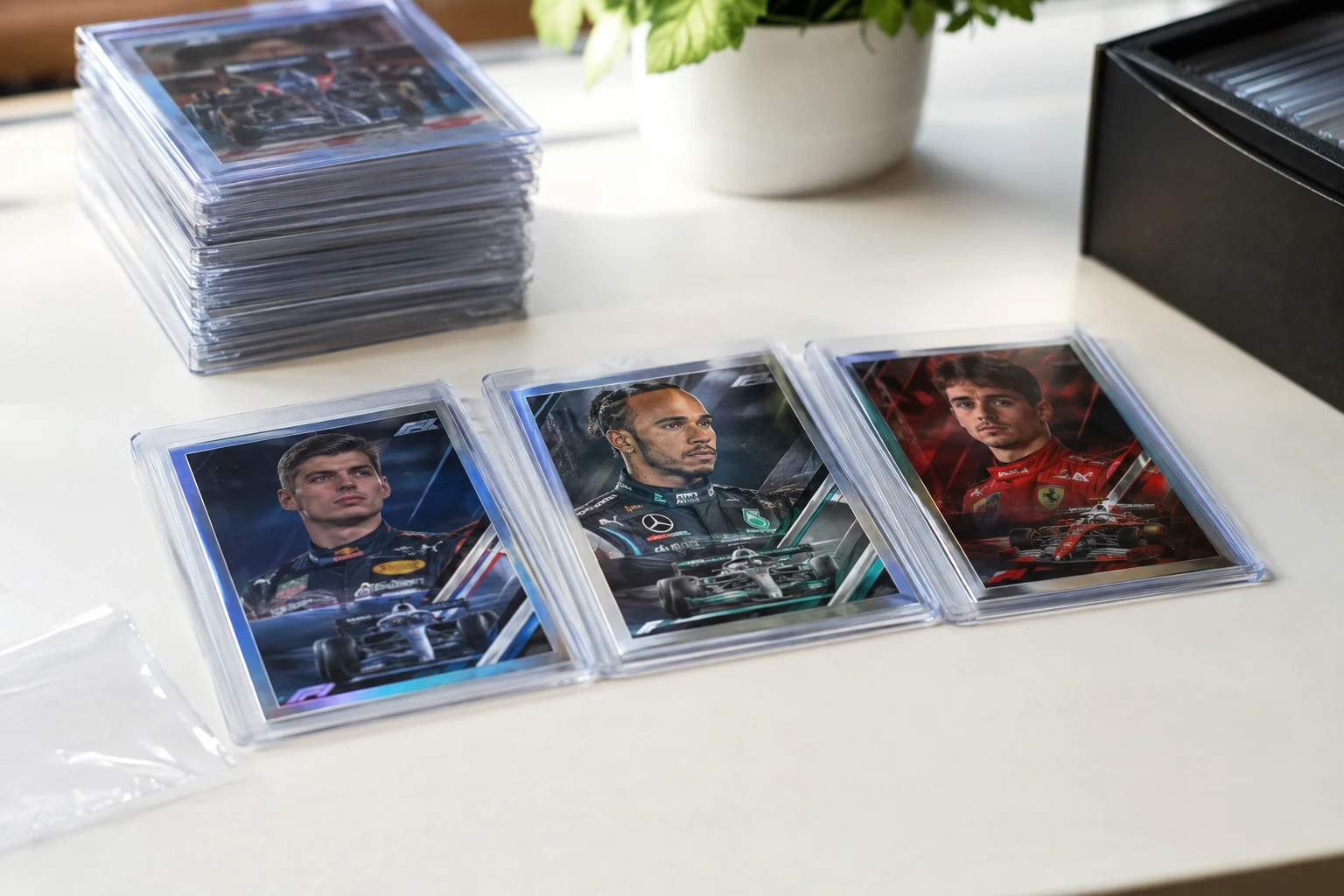
Max Verstappen is the top F1 card grading target. With multiple World Championships (2021-2024+), Verstappen has established himself as one of the most dominant F1 drivers in history. His 2020 Topps Chrome rookie card is the primary grading target, with PSA 10 values of $800-$2,500.
Verstappen's card values are driven by his on-track dominance, his global brand appeal (Red Bull Racing, Dutch fanbase), and his relative youth — he is still in his prime and could win more championships. The 2020 Topps Chrome RC is the first Chrome F1 card of Verstappen, making it the "first Chrome rookie" similar to how 2003 Topps Chrome LeBron is the first Chrome basketball rookie.
For grading purposes, the Verstappen Chrome RC has the same Chrome surface challenges as all Topps Chrome products — pre-screen for scratches under angled light. The refractor parallels are worth significantly more: a Verstappen Refractor PSA 10 can sell for $2,500-$5,000, and a Gold Refractor /50 PSA 10 can reach $10,000-$20,000.
Autograph cards are the premium target. Verstappen autos in PSA 10 with PSA/DNA 10 auto grade can sell for $5,000-$15,000 depending on the parallel. Inspect the auto quality carefully — F1 autos are often sticker autos.
Lewis Hamilton
Lewis Hamilton is the legacy target of F1 card collecting. With 7 World Championships (tied with Michael Schumacher for the most all-time), Hamilton is the most successful F1 driver of the modern era. His 2020 Topps Chrome rookie card has PSA 10 values of $600-$1,800.
Hamilton's card values are driven by his historical significance, his global brand appeal (Mercedes, British fanbase, fashion/lifestyle crossover), and his cultural impact as the first and only Black F1 World Champion. His move to Ferrari in 2025 created a surge in card values as collectors anticipated the Hamilton-Ferrari partnership.
For grading purposes, the Hamilton Chrome RC is a strong target. The refractor parallels are worth more: a Hamilton Refractor PSA 10 can sell for $1,800-$4,000, and a Gold Refractor /50 PSA 10 can reach $8,000-$15,000.
Hamilton's long-term value is secured by his historical legacy. Even after retirement, his cards will remain valuable as collectors seek the rookie cards of the greatest F1 driver of the modern era. The comparison to Michael Jordan's 1986 Fleer rookie is apt — Hamilton's 2020 Topps Chrome RC is the F1 equivalent.
Leclerc, Norris, and Rising Stars
Beyond Verstappen and Hamilton, several younger drivers are rising F1 card targets:
Charles Leclerc (Ferrari)
Leclerc is the face of Ferrari — the most iconic team in F1. His 2020 Topps Chrome RC PSA 10 sells for $300-$800. If Leclerc wins a World Championship with Ferrari, his card values could surge 3-5x. The Ferrari brand creates additional demand from Tifosi (Ferrari fans) who collect anything Ferrari-related.
Lando Norris (McLaren)
Norris is the most popular young driver in F1, with a massive social media following and a charismatic personality. His 2020 Topps Chrome RC PSA 10 sells for $200-$600. If Norris wins a World Championship with McLaren (a resurgent team), his card values could surge significantly. Norris's social media presence creates a younger collector base that other drivers do not have.
Other Rising Stars
- George Russell (Mercedes): Hamilton's teammate at Mercedes. PSA 10 $150-$400. If Russell becomes Mercedes' #1 driver post-Hamilton, values could surge.
- Carlos Sainz (Ferrari to Williams): Leclerc's former teammate. PSA 10 $100-$300. Sainz has a dedicated Spanish collector base.
- Oscar Piastri (McLaren): The Australian rookie sensation. PSA 10 $100-$300. If Piastri becomes a race winner, values could appreciate.
- 2026 F1 Rookies: The 2026 F1 season will feature new drivers and potentially new teams. Watch for rookie cards of any new race winners.
Topps Chrome F1 Product Guide
Topps Chrome F1 is the flagship F1 card product. Here is the product structure:
| Card Type | Rarity | PSA 10 Premium |
|---|---|---|
| Base Chrome | Unlimited | 2-3x |
| Refractor | ~1:3 | 3-5x |
| Green Refractor | /99 | 5-8x |
| Gold Refractor | /50 | 8-15x |
| Orange Refractor | /25 | 15-25x |
| Red Refractor | /5 | 25-40x |
| Superfractor | /1 | 50x+ |
| Autograph | Varies | 5-20x |
The product also includes race-worn memorabilia cards (tire swatches, suit swatches) and short-print variations. The memorabilia cards are unique to F1 and add a dimension that other sports card products do not have.
Condition Issues and Pre-Screening
F1 Chrome cards have the same condition issues as other Topps Chrome products:
- Chrome surface scratches: The #1 grading barrier. Inspect under angled LED light at 45 degrees.
- Centering: Topps Chrome F1 centering is generally moderate. Measure borders for 55/45 front minimum.
- Corner whitening: Chrome corners can show whitening from packaging. Check under 10x magnification.
- Print lines: Manufacturing defects visible under angled light. PSA may downgrade for visible print lines.
- Autograph quality: For auto cards, inspect the auto for smudging or fading. F1 autos are often sticker autos.
Pre-Screening Protocol
- Surface check under angled LED light
- Centering measurement (55/45 front minimum)
- Corner check under 10x magnification
- Edge check for chipping
- Autograph quality check (for auto cards)
- AI pre-grading ($0.19/card)
Submission Strategy
For F1 cards, PSA is the preferred grader. The global F1 collector base recognizes PSA as the standard, and PSA commands the highest resale premium. Here is the submission strategy:
- Base Chrome ($200-$2,500 PSA 10): PSA Regular ($79.99, 70-80 days). The ROI is positive for star drivers.
- Refractor parallels ($600-$20,000 PSA 10): PSA Regular ($79.99) for $600-$2,000. PSA Express ($149) for $2,000+.
- Autograph cards ($1,000-$15,000 PSA 10): PSA Express ($149, 20-30 days).
- Superfractor 1/1 ($10,000+): PSA Walk-Through ($599) with declared value insurance.
Timing
Submit F1 cards before major races (Monaco, British Grand Prix, season finale) when fan interest peaks. PSA Regular's 70-80 day turnaround means you should submit 2-3 months before the target selling window.
Frequently Asked Questions
What is the best F1 card to grade?
Are F1 cards worth grading?
How much is a Lewis Hamilton PSA 10 worth?
What is Topps Chrome F1?
Should I use PSA or CGC for F1 cards?
Who are the rising F1 card stars?
What are the main grading issues for F1 Chrome cards?
When should I submit F1 cards for grading?
Sources & Further Reading
- PreGradeCards — F1 Card Grading Guide
- SportsCardsPro — Topps Chrome F1 Card Prices
- CardGrade — Card Grading Trends April 2026
The PreGradeCards Research Team combines machine-learning engineers, grading analysts, and collector-education specialists to produce accurate, data-driven guides on AI card grading, professional grading standards, and collecting strategy.
Create a free account and get 1 free credit — enough for 1 complete AI grading with market pricing. No credit card required.
Sign Up Free →