The Short Answer
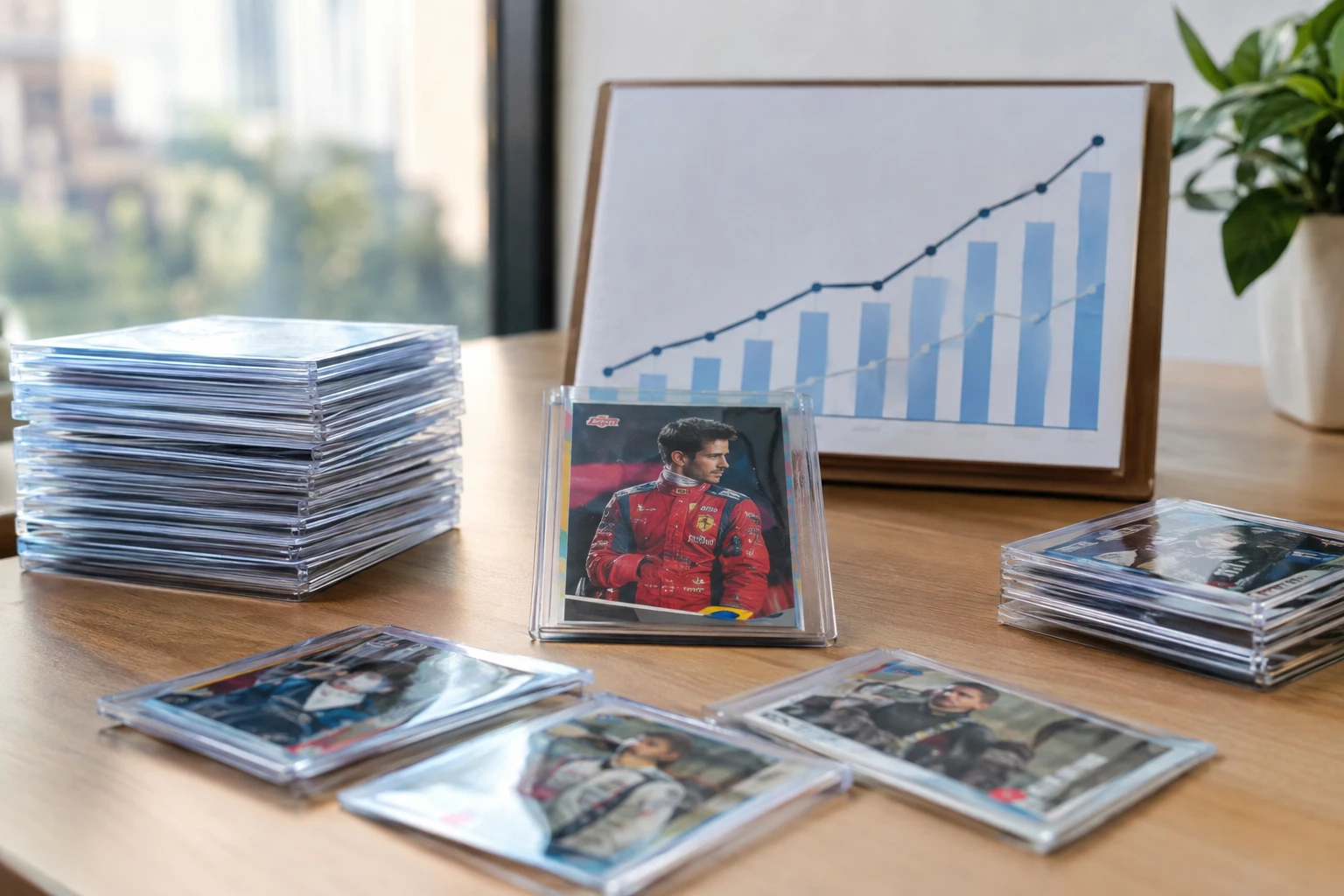
- F1 card collecting has grown 500%+ since 2020, driven by Netflix's Drive to Survive and global F1 expansion.
- The global collector base spans Europe, Asia, the Americas, and the Middle East -- creating 24-hour market activity.
- Topps Chrome F1 (introduced 2020) is the flagship product, with refractor parallels and driver autographs.
- The 2026 F1 season features new regulations, potential new teams, and driver changes -- creating fresh rookie card opportunities.
- Verstappen and Hamilton are the top investment targets -- multiple World Championships and global brand appeal.
- The Drive to Survive effect has introduced F1 to millions of new fans, creating sustained card demand.
- PSA is the preferred grader for F1 cards -- the global collector base recognizes PSA as the standard.
The Drive to Survive Effect
Netflix's Drive to Survive documentary series has been the single biggest driver of F1 card market growth. Since the series premiered in 2019, F1 has seen a massive influx of new fans, particularly in the United States. The series provides behind-the-scenes access to the drivers, teams, and politics of F1, creating personal connections that drive collector demand.
The Drive to Survive effect on F1 cards is measurable: F1 card sales on eBay increased approximately 500% from 2020 to 2025, driven by new fans who discovered the sport through the documentary. The growth is similar to what the Michael Jordan documentary "The Last Dance" did for basketball card demand in 2020.
The key impact of Drive to Survive on the F1 card market: (1) new fans became collectors, (2) the US market -- previously a minor F1 card market -- became a major buyer, (3) driver narratives from the show (rivalries, underdog stories, team politics) created emotional connections that drive card demand, and (4) the global reach of Netflix introduced F1 to markets that had no prior F1 card collecting tradition.
F1 Card Market Size and Growth
The F1 card market has grown from a niche motorsport card market to a significant segment of the sports card industry. Here is the estimated market size and growth trajectory:
| Year | Est. Market Size | YoY Growth | Key Driver |
|---|---|---|---|
| 2020 | $2M | -- | Topps Chrome F1 launched |
| 2021 | $5M | 150% | Drive to Survive S3, Verstappen title |
| 2022 | $8M | 60% | Miami Grand Prix, US expansion |
| 2023 | $12M | 50% | Las Vegas Grand Prix, Drive to Survive S5 |
| 2024 | $15M | 25% | Verstappen dominance, Hamilton to Ferrari |
| 2025 | $18M | 20% | Hamilton at Ferrari, new fans |
| 2026 (est.) | $22M | 22% | New regulations, new teams, new rookies |
Market size estimates based on eBay sold listings, PSA population data, and industry analysis. Actual market size may be larger due to private sales and international marketplaces.
Global Collector Base
The F1 card collector base is uniquely global. Unlike American sports cards (NFL, NBA, MLB) which are primarily collected in North America, F1 cards are collected across Europe, Asia, the Americas, and the Middle East. This creates 24-hour market activity similar to soccer cards.
The key collector markets for F1 cards:
- United Kingdom: The largest F1 card market, driven by British drivers (Hamilton, Norris, Russell) and the British Grand Prix.
- Netherlands: Massive Verstappen collector base. Dutch fans are among the most passionate in F1.
- Italy: Ferrari Tifosi collect anything Ferrari-related, driving demand for Leclerc and Sainz cards.
- United States: The fastest-growing F1 card market, driven by Drive to Survive, Miami Grand Prix, and Las Vegas Grand Prix.
- Germany: Schumacher legacy collectors, plus Vettel fans.
- Australia: Growing market driven by Piastri and Ricciardo fans.
- Middle East: Emerging market driven by Saudi Arabian, Qatar, and Abu Dhabi Grands Prix.
The global collector base supports higher PSA 10 premiums than typical motorsport cards. A PSA 10 Verstappen Chrome RC has demand from Dutch, UK, US, and Asian collectors simultaneously, creating competitive bidding that drives values up.
Topps Chrome F1 Impact
Topps Chrome F1, introduced in 2020, has been the foundational product for the F1 card market. Before Topps Chrome F1, there was no consistent, premium F1 card product. The 1991 Pro Set and Upper Deck sets were one-off products, and the 2003-2006 Topps F1 sets had limited distribution.
Topps Chrome F1 changed the market by providing: (1) a consistent annual product, (2) the Chrome finish that graders prefer, (3) refractor parallels with clear value tiers, (4) driver autographs, and (5) race-worn memorabilia cards. This product structure is identical to Topps Chrome baseball and basketball, making it easy for existing sports card collectors to enter the F1 market.
The 2020 Topps Chrome F1 set is the foundational set -- the first Chrome F1 set. Cards from this set (Verstappen RC, Hamilton RC, Leclerc RC) are the "first Chrome F1 cards" of these drivers, similar to how 2003 Topps Chrome LeBron is the first Chrome basketball rookie. This historical significance drives long-term value.
New Grand Prix Impact
The expansion of F1 to new markets has directly impacted card collecting. Each new Grand Prix brings F1 to a new audience, creating new collectors:
- Miami Grand Prix (2022): Brought F1 to the US East Coast. Created a surge in US-based F1 card collecting.
- Las Vegas Grand Prix (2023): Brought F1 to the US West Coast. The spectacle of F1 on the Las Vegas Strip generated massive media coverage and new fans.
- Saudi Arabian Grand Prix (2021): Brought F1 to the Middle East. Created emerging collector demand in the region.
- Qatar Grand Prix (2023): Further Middle East expansion.
Each new Grand Prix creates a localized collector base that drives demand for F1 cards. The US market is the most significant -- the combination of Drive to Survive, Miami Grand Prix, and Las Vegas Grand Prix has made the US the fastest-growing F1 card market.
2026 Regulation Changes
The 2026 F1 season features major regulation changes that will impact the card market:
- New engine regulations: F1 is introducing new power unit rules in 2026, with a focus on sustainability and hybrid power. This could reshape the competitive order.
- Potential new teams: F1 is expanding the grid, with potential new teams entering in 2026. New teams mean new drivers and new rookie cards.
- Driver changes: The 2026 season will see driver lineup changes, creating fresh rookie card opportunities for new F1 drivers.
- Hamilton at Ferrari: Hamilton's move to Ferrari in 2025 is the biggest driver transfer in F1 history. His Ferrari-era cards will be highly sought after.
For card collectors, the 2026 regulation changes create two opportunities: (1) rookie cards of new F1 drivers entering the sport, and (2) cards of drivers who benefit from the regulation changes (if a new team or driver wins races, their card values will surge).
Investment Outlook 2026-2028
The F1 card market investment outlook for 2026-2028 is positive, driven by sustained fan growth, the Topps Chrome F1 product, and the global collector base:
Bullish Factors
- Continued Drive to Survive effect -- new seasons bring new fans
- Topps Chrome F1 is an established product with consistent annual releases
- Global collector base provides 24-hour market activity
- 2026 regulation changes create fresh rookie card opportunities
- Hamilton at Ferrari creates historical significance cards
- US market growth is still in early stages
Bearish Factors
- Verstappen dominance could reduce interest if the championship is not competitive
- The "Drive to Survive effect" may plateau as the series ages
- F1 card market is still smaller than NBA, NFL, or MLB -- liquidity can be lower
- Topps/Fanatics license changes could impact F1 card production
Net Outlook
The net outlook is positive. The F1 card market is still in a growth phase, with the US market expanding and the global collector base deepening. The 2026 regulation changes and new drivers create fresh collecting opportunities. PSA 10 F1 cards of star drivers (Verstappen, Hamilton, Leclerc, Norris) should appreciate 15-30% over 2026-2028, with refractor parallels appreciating even more.
Grading Strategy for Growth
For collectors looking to capitalize on F1 card market growth, here is the grading strategy:
- Grade 2020 Topps Chrome F1 RCs now: The 2020 set is the foundational set. Grade PSA 10 copies of Verstappen, Hamilton, Leclerc, and Norris. These are the "first Chrome F1 cards" and will appreciate as the market grows.
- Grade refractor parallels: Green /99 and Gold /50 refractors of star drivers have the best ROI. The numbered scarcity creates demand that grows with the collector base.
- Watch for 2026 rookies: New drivers entering F1 in 2026 could become the next Verstappen or Hamilton. Grade their rookie cards early.
- Hold for 3-5 years: The F1 card market is still growing. Holding PSA 10s of star drivers through the growth phase maximizes appreciation.
- Use PSA for all grading: PSA is the global standard for F1 cards. The PSA 10 premium is consistent across all global markets.
Frequently Asked Questions
How fast is the F1 card market growing?
What is the Drive to Survive effect on F1 cards?
Is the F1 card market a good investment?
Who is the biggest F1 card collector base?
What is the 2020 Topps Chrome F1 set?
How do 2026 F1 regulation changes affect card values?
Should I hold or sell F1 PSA 10 cards?
What is the best F1 card to invest in?
Sources & Further Reading
- PreGradeCards -- F1 Card Grading Guide
- SportsCardsPro -- Topps Chrome F1 Prices
- CardGrade -- Card Grading Trends April 2026
- Forbes -- F1 Growth and Netflix Impact

The PreGradeCards Research Team combines machine-learning engineers, grading analysts, and collector-education specialists to produce accurate, data-driven guides on AI card grading, professional grading standards, and collecting strategy.
Create a free account and get 1 free credit — enough for 1 complete AI grading with market pricing. No credit card required.
Sign Up Free →