The Short Answer
- Cold Foil is FAB's premium foil treatment, trading at a median 8.3x the non-foil price of the same card — with 42% of Cold Foils at 10x or higher.
- PSA 10 Cold Foil First Edition cards can reach $6,000-$12,000 for chase cards like Invoke Azvolai and Heart of Fyendal.
- LSS has committed to never reprinting Cold Foil versions, creating a hard supply cap that supports long-term appreciation.
- First Edition Cold Foils from Welcome to Rathe and Arcane Rising are the most valuable FAB cards in existence.
- PSA is the recommended grader for FAB Cold Foils destined for resale, though CGC is a cost-effective alternative for cards under $500.
- Marvel cards (full-bleed art, Cold Foil by default) are the newest chase tier, with top cards reaching $500+.
- AI pre-grading at $0.19/card identifies which Cold Foils have PSA 10 potential before you spend $79.99 on grading fees.
What Is a Cold Foil in Flesh and Blood?
Flesh and Blood has more foil treatments per card than any TCG except Magic: The Gathering. Understanding these treatments is essential for making grading decisions. Here is the complete hierarchy:
- Normal (non-foil): Standard non-foil printing. Baseline price. Most commons and rares are Normal only.
- Rainbow Foil (RF): Holofoil treatment with a rainbow shimmer. Typically 1.5-3x the Normal price. The common foil treatment that appears regularly in packs.
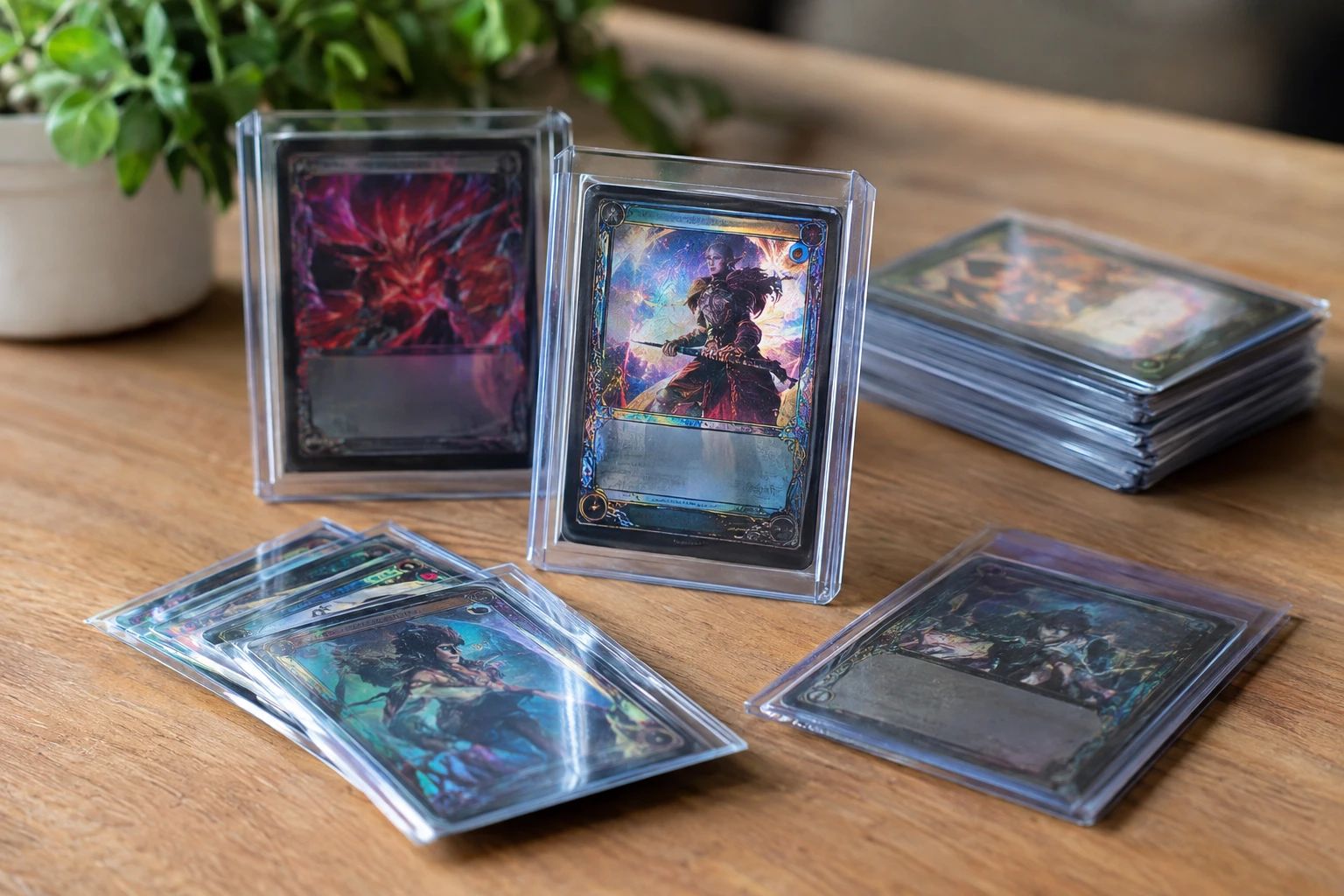
- Cold Foil (CF): Premium foil with a distinctive matte, frost-like texture. Applied to Majestic and Legendary rarity cards in booster sets. Pull rates are dramatically rarer than Rainbow Foil — often 1 per 4-6 booster boxes for the most desirable cards. This is where the big money is in FAB.
- Extended Art (EA): Variants with extended artwork beyond the standard frame. Available in some sets.
- Ultra Rare: Special rarity treatment in some sets, with unique visual effects.
Cold Foil is the key treatment for grading. The distinctive frost-like texture is visually striking and highly sought after by collectors. Unlike Rainbow Foil, which is a modest upgrade, Cold Foil is a different market entirely — the premium is so large that it fundamentally changes the economics of grading.
LSS (Legend Story Studios, the publisher of Flesh and Blood) has made a commitment that Cold Foil versions of cards will never be reprinted. This creates a hard supply cap that does not exist in most other TCGs. In Pokemon, anything can be reprinted. In Magic, the Reserved List only covers a specific era. In Flesh and Blood, Cold Foils are treated as permanent collectors' items — once a Cold Foil print run is complete, it is final.
This no-reprint policy is the foundation of Cold Foil grading value. A PSA 10 Cold Foil of a key card is not just a graded card — it is a permanently scarce collectible that can only become rarer as cards are lost, damaged, or locked in personal collections.
Why Grade Flesh and Blood Cards?
The grading scene for Flesh and Blood is less mature than for Pokemon or Magic, but it is growing rapidly — and that creates opportunity. Here is why grading FAB cards, especially Cold Foils, is worth considering:
- Enormous grade multipliers: PSA 10 copies of FAB Cold Foils often sell for 3-10x the raw price. A $300 raw Cold Foil might grade PSA 10 and be worth $800-$1,500. The multiplier is larger than in most TCGs because the grading population is still small.
- No reprint risk: LSS's commitment to never reprinting Cold Foils means the supply of any given Cold Foil is fixed. As more collectors enter FAB, demand for a fixed supply drives prices up — and graded copies are the most desirable form of that fixed supply.
- Growing competitive scene: Flesh and Blood has a dedicated competitive circuit with World Championship events. Tournament relevance drives demand for playable cards, and Cold Foil versions of playable cards are the most sought after.
- Small grading population: Because FAB grading is less common than Pokemon or MTG grading, the population of PSA 10 FAB Cold Foils is small. Low pop = high value, especially for key cards.
- Cross-game collector interest: Collectors who grade Pokemon and MTG are increasingly branching into FAB as they seek new markets with upside potential. This brings new buyers and new grading volume into the FAB ecosystem.
The main risk with FAB grading is the same as with any growing TCG: if the game loses popularity, card values could decline. However, LSS has shown strong commitment to the game with regular set releases, organized play support, and a growing player base. The no-reprint policy on Cold Foils provides a floor on values that most TCGs cannot offer.
Cold Foil Values: The 8.3x Premium Explained
The data on Cold Foil premiums is remarkable. According to a comprehensive study by Foilio that analyzed 409 Cold Foil / non-foil pairs using TCGplayer market data:
Cold Foil Premium Statistics
- Median Cold Foil premium: 8.3x the non-foil price
- Cold Foils at 5x or higher: 74% of cards
- Cold Foils at 10x or higher: 42% of cards
- Cold Foils at 25x or higher: 18% of cards
- Typical Cold Foil price: $2.01 (vs $0.16 non-foil median)
- Top Cold Foil prices: $200-$750+
For comparison, Rainbow Foil (the common foil treatment) trades at a median 2x the non-foil — a modest bump. Cold Foil at 8.3x is roughly 4.1x the Rainbow Foil premium. Same card, three prices: non-foil, Rainbow Foil, Cold Foil.
The most extreme ratios come from Cold Foils whose non-foil is bulk. Refraction Bolters, a card whose non-foil trades at $0.38, has a Cold Foil at $290 — a 763x premium. Barkbone Strapping, a Common-rarity card with a $0.21 non-foil, has a Cold Foil 1st Edition at $140 — a 668x premium. These examples show that in FAB, the foil treatment matters more than the card's base rarity.
For grading purposes, this means that Cold Foil cards are almost always worth grading if they have PSA 10 potential. The raw Cold Foil value is high enough to justify the $79.99 PSA Regular fee, and the PSA 10 premium (3-10x raw) makes the ROI compelling.
First Edition Premium: The Holy Grail of FAB Collecting
First Edition (1st Ed.) cards from Welcome to Rathe (WTR) and Arcane Rising (ARC) are the most valuable FAB cards in existence. First Edition cards have a special 1st Ed. set symbol and significantly lower print runs than Unlimited Edition. The scarcity gap is largest for high-rarity cards (Legendary, Majestic) in Cold Foil.
The ultimate combination in Flesh and Blood is Cold Foil + First Edition. This is where the collector market lives. Here are the current top Cold Foil 1st Edition cards from the flagship early sets:
| Card | Set | Raw NM | PSA 10 Est. |
|---|---|---|---|
| Arcanite Skullcap (1st Ed CF) | Arcane Rising | $750 | $1,500-$3,000 |
| Achilles Accelerator (1st Ed CF) | Arcane Rising | $165 | $400-$800 |
| Bloodsheath Skeleta (1st Ed CF) | Crucible of War | $158 | $400-$800 |
| Barkbone Strapping (1st Ed CF) | Welcome to Rathe | $140 | $350-$700 |
| Alpha Rampage (1st Ed RF) | Welcome to Rathe | $230 | $500-$1,000 |
Note that Barkbone Strapping is a Common-rarity card — its non-foil version is worth about $0.50. The Cold Foil 1st Edition from Welcome to Rathe is worth 280x more. This illustrates the formula that matters in FAB: Rarity x Variant x Edition. A Common in Cold Foil 1st Edition can be worth more than a Majestic in Normal Unlimited.
For grading, First Edition Cold Foils are the top priority. Always grade these if the card has PSA 10 potential. The combination of low print run, no reprint risk, and growing collector demand makes these the most secure long-term holds in the FAB market.
Top Flesh and Blood Cards to Grade in 2026
Here are the most valuable Flesh and Blood cards that are worth grading, ranked by PSA 10 potential and resale value:
| Card | Variant | Raw NM | PSA 10 | Grade? |
|---|---|---|---|---|
| Invoke Azvolai | CF 1st Ed | $3,000-$6,000 | $6,000-$12,000 | Always |
| Heart of Fyendal | CF 1st Ed | $2,500-$5,000 | $5,000-$10,000 | Always |
| Command and Conquer | CF 1st Ed | $1,500-$3,500 | $3,500-$7,000 | Always |
| Channel Lake Frigid | CF 1st Ed | $1,200-$3,000 | $3,000-$6,000 | Yes |
| Channel Mount Heroic | CF 1st Ed | $1,200-$3,000 | $3,000-$6,000 | Yes |
| Warmonger's Diplomacy | CF | $800-$2,000 | $2,000-$4,500 | Yes |
| Fyendal's Spring Tunic | CF 1st Ed | $600-$1,500 | $1,500-$4,000 | Yes |
| Tales of Aria CF Legendaries | CF | $400-$1,500 | $1,000-$3,500 | If $400+ raw |
| Any Cold Foil Legendary | CF | $100-$500 | $300-$1,500 | If $150+ raw |
The grading rule for FAB: If the raw Cold Foil value is above $100, grade it. The PSA 10 premium (3-10x) justifies the $79.99 PSA Regular fee on any card worth $100+ raw. Below $100, consider CGC Economy at $18/card — the lower fee makes the math work on lower-value Cold Foils.
Choosing the Right Grader for Flesh and Blood Cards
For FAB Cold Foil cards, the grader choice depends on the card's value and your goals:
PSA (Recommended for High-Value Cold Foils)
PSA is the recommended grader for FAB Cold Foils valued above $300 raw. PSA 10 slabs command the highest resale premium and have the largest buyer pool. For a $1,000 Cold Foil, the PSA 10 premium over a CGC 10 Pristine can be 20-40% — easily justifying the $79.99 PSA Regular fee. PSA is also the most recognized brand for TCG resale on eBay and auction platforms.
CGC (Recommended for Mid-Value Cold Foils)
CGC is the best value choice for FAB Cold Foils valued $100-$500 raw. CGC Economy at $18/card is less than one-quarter the PSA Regular fee. CGC 10 Pristine is increasingly respected by FAB collectors, and the crystal-clear CGC slab shows off Cold Foil textures beautifully. For cards where the PSA 10 premium is not large enough to justify the $80 fee difference, CGC is the better ROI choice.
BGS (For Sub-Grade Enthusiasts)
BGS is an option for FAB Cold Foils if you want sub-grades on the label. A BGS 10 Black Label (quad 10s) would be the ultimate FAB collectible — but the odds are approximately 1 in 500-600 submissions. BGS is best for thick FAB cards (some equipment cards are thicker than standard) where BGS's thick-card handling is superior. However, BGS tiers have been paused in 2026, limiting availability.
SGC (Not Recommended for FAB)
SGC is not recommended for FAB cards. SGC's TCG resale values trail PSA and CGC by 20-40%, and SGC's brand recognition in the FAB community is minimal. Stick with PSA or CGC for FAB Cold Foils.
Quick Decision Guide
- Raw value $500+: PSA Regular ($79.99) — maximum resale premium
- Raw value $100-$500: CGC Economy ($18) — best ROI
- Raw value under $100: Consider selling raw — grading fee may eat the margin
- Thick cards: BGS if tiers are open, otherwise PSA
- Personal collection display: CGC — clearest slab for Cold Foil textures
FAB-Specific Grading Challenges
Flesh and Blood cards have some unique characteristics that affect grading outcomes. Understanding these challenges helps you select the right cards to submit:
Cold Foil Surface Sensitivity
The Cold Foil treatment creates a distinctive matte, frost-like texture that is beautiful but sensitive. The texture can show micro-scratches more readily than standard foil treatments. When handling Cold Foil cards for grading submission:
- Wear clean cotton gloves — fingerprints and oils are more visible on Cold Foil surfaces
- Use a microfiber cloth designed for delicate surfaces — avoid rough cleaning materials
- Inspect under direct LED light at multiple angles — Cold Foil scratches can be invisible under ambient light but obvious under direct light
- Do not rub the surface — gently wipe from center outward in one direction
Edge Whitening on Early Sets
Welcome to Rathe and Arcane Rising cards are known for edge whitening, particularly on the back edges. The factory die-cutting process on early sets was not as refined as later sets, and many "pack-fresh" cards have microscopic edge wear. This is the most common reason FAB Cold Foils grade below 10.
Centering Variations
FAB cards from early sets (WTR, ARC, CRU) have more centering variation than later sets. 55/45 centering is common, which is acceptable for PSA 10 but may prevent CGC 10 Pristine. Later sets (Monarch, Tales of Aria, Outsiders) have generally better centering quality control.
Thick Card Handling
Some FAB equipment cards and token cards are thicker than standard FAB cards. For thick cards, use thick penny sleeves and thick top loaders (not Card Saver I, which can pinch thick card corners). PSA and BGS both handle thick cards well. CGC also accepts thick cards but check their thickness limits before submitting.
Print Lines on Cold Foils
Cold Foil cards can have print lines from the manufacturing process. These are not damage — they are production artifacts — but graders may count them against the surface score. Inspect your Cold Foil under direct light for print lines before submitting. If print lines are visible, the card is unlikely to grade 10 regardless of other condition factors.
Marvel Cards: The New Chase Tier in Flesh and Blood
Marvel cards are the newest and most exciting chase tier in Flesh and Blood. Introduced in recent sets, Marvel cards feature:
- Full-bleed art (no borders) with custom extended artwork different from the base card
- Cold Foil treatment by default
- Extreme pull rates — often 1 per case (~12 booster boxes)
- Top-tier prices on almost every set they appear in
Marvel cards are the FAB equivalent of Pokemon's Secret Rares or Magic's Mythic Edition cards. They are the cards that everyone chases and few pull. The combination of Cold Foil treatment, unique artwork, and extreme scarcity makes them the most valuable FAB cards being produced today.
Current notable Marvel cards and their values:
- Codex of Frailty (Marvel, Outsiders): ~$537 raw, estimated $1,000-$2,000 PSA 10
- Other Marvel cards: $20-$550+ depending on the card and set
For grading, Marvel cards should always be graded if they have PSA 10 potential. The extreme scarcity (1 per case) means the grading population will always be small, and the Cold Foil treatment ensures strong demand from collectors. Use AI pre-grading to assess centering and surface before submitting — Marvel cards' full-bleed artwork makes centering particularly important, as any asymmetry is immediately visible without borders to frame it.
Omens of the Third Age: Grading the Newest FAB Set
Omens of the Third Age is the latest Flesh and Blood expansion, released in 2026. The set introduces new Cold Foil chase cards and continues the Marvel card program. For grading purposes, new set releases are important because:
- Low initial grading population: New set cards have very few graded copies, meaning the first PSA 10s on the market can command premium prices from collectors who want to be first.
- Tournament relevance: New set cards that see competitive play immediately become valuable, and Cold Foil versions of playable cards are the most sought after.
- Set rotation effects: As older sets rotate out of competitive play, cards from the newest legal sets see increased demand. Omens of the Third Age cards will be tournament-legal for the full rotation cycle.
- World Championship timing: The FAB World Championship season creates demand for playable cards from the newest legal sets. Cold Foil versions of tournament staples from Omens of the Third Age are prime grading candidates.
When grading cards from a new set like Omens of the Third Age, speed matters. Getting your Cold Foils graded and listed before the market fills with competing PSA 10s can mean the difference between a $500 sale and a $200 sale. Consider using SGC Turbo ($150/card, 2-3 days) or CGC Express ($80/card, ~15 days) for time-sensitive new set submissions if PSA's 40-50 business day turnaround is too slow.
AI pre-grading is especially valuable for new set cards because there is limited grading history to inform your grade predictions. PreGradeCards' AI evaluates the card's physical condition — corners, edges, surface, centering — using the same criteria as professional graders, giving you a reliable grade prediction even for cards from sets that have never been graded before.
FAB Submission Strategy and ROI Calculation
Here is a practical strategy for maximizing ROI on FAB Cold Foil grading submissions:
Step 1: Sort Your Cold Foils by Value
Separate your Cold Foils into three tiers:
- Tier 1 ($500+ raw): Submit to PSA Regular ($79.99). The PSA 10 premium justifies the higher fee.
- Tier 2 ($100-$500 raw): Submit to CGC Economy ($18). Best ROI for mid-value Cold Foils.
- Tier 3 (under $100 raw): Sell raw or hold. Grading fees eat the margin on low-value Cold Foils.
Step 2: AI Pre-Grade Every Card
Before submitting, run every Cold Foil through PreGradeCards' AI grading tool. At $0.19/card, it costs less than 1% of the PSA Regular fee. The AI will:
- Predict the PSA, CGC, BGS, and SGC grade for each card
- Identify disqualifying flaws (print lines, edge whitening, surface clouding)
- Measure centering precisely — critical for Cold Foils where centering is often the difference between 9 and 10
- Help you decide between PSA and CGC based on which grader is likely to give the higher grade
Step 3: Calculate Expected ROI
Example: Command and Conquer CF 1st Ed
| Raw value (NM): | $2,000 |
| PSA Regular fee: | $79.99 |
| Shipping + insurance: | $30 |
| AI pre-grading: | $0.19 |
| Total cost: | $110.18 |
| PSA 10 resale (est.): | $5,000 |
| PSA 9 resale (est.): | $2,500 |
| ROI if PSA 10: | 4,443% |
Even if the card grades PSA 9 instead of PSA 10, the ROI is still 2,172% — the raw value is high enough that the grading fee is a small percentage of the total value. This is why high-value Cold Foils are always worth grading.
Step 4: Batch Submit for Efficiency
If you have multiple Cold Foils to grade, batch them into a single submission to save on shipping costs. A 10-card PSA submission costs $799.90 in grading fees plus ~$30 shipping — the per-card shipping cost drops to $3. For CGC, a 5-card Economy submission costs $90 in grading fees plus ~$20 shipping — $4/card for shipping.
Step 5: Sell Quickly After Grading
For FAB Cold Foils, selling quickly after grading is generally the best strategy. The FAB market is still developing, and prices can be volatile. Listing your PSA 10 Cold Foil on eBay with clear photos of the slab and a competitive price based on recent sold comps will typically result in a sale within 1-4 weeks. For very high-value Cold Foils ($2,000+), consider auction format through PWCC or a specialized TCG auction platform.
Use our AI Card Grading tool to get PSA, CGC, BGS, and SGC grade predictions on your Flesh and Blood Cold Foils before you submit. Identify PSA 10 candidates and avoid wasting grading fees on cards with disqualifying flaws. Get 50 free credits on signup.
Frequently Asked Questions
What is a Cold Foil in Flesh and Blood?
Should I grade my Flesh and Blood Cold Foil cards?
Which grading company is best for Flesh and Blood cards?
What are the most valuable Flesh and Blood cards?
What is a Marvel card in Flesh and Blood?
Are First Edition Flesh and Blood cards worth more?
How does AI pre-grading help with FAB Cold Foil submissions?
What are common grading issues with Flesh and Blood cards?
Sources & Further Reading
- TCG Price Lookup — Most Expensive FAB Cards
- Foilio — FAB Cold Foil Premium Study
- TCG Price Lookup — FAB Card Prices 2026
- Guardian TCG — FAB Card Prices
- PreGradeCards — FAB Grading Guide
The PreGradeCards Research Team combines machine-learning engineers, grading analysts, and collector-education specialists to produce accurate, data-driven guides on AI card grading, professional grading standards, and collecting strategy.
Create a free account and get 1 free credit — enough for 1 complete AI grading with market pricing. No credit card required.
Sign Up Free →