The Short Answer
- GameStop accepts PSA submissions in-store — $15.99/card for cards valued $200 or less plus a $4.99 flat shipping fee, with no PSA membership or 20-card minimum required.
- The same tier at PSA direct costs $14.99 — but requires a Collector's Club membership ($199/year) and bulk minimums, so GameStop is cheaper for small submissions.
- Turnaround runs about 45–60 days from drop-off, but you do not get a carrier tracking number — status only updates through your GameStop account once PSA scans the order.
- Insurance caps matter: max insured value is $1,000 per card for submissions created on or after September 9, 2026 (was $1,500 before that date).
- GameStop also buys graded cards — PSA 8, 9, and 10 slabs only, up to $1,500 in cash or store credit at participating locations.
- Pre-grade before you drop off. An AI pre-grade that predicts PSA 8 or lower means you're paying $15.99 to make a card worth less — screen first, submit only the gem candidates.
How GameStop PSA Grading Works
GameStop is an authorized PSA dealer. When you drop cards off at a participating store, GameStop handles the paperwork, packaging, consolidated shipping to PSA, and return shipping back to your store — PSA does the actual authentication and grading. You're paying GameStop for the logistics layer and PSA for the grade.
The pitch is simple: PSA's cheapest tiers have historically required a Collector's Club membership ($199/year) and/or bulk minimums of 20+ cards. GameStop lets you walk in with a single card. For casual submitters — the person holding five Pokémon cards or three rookie cards they pulled from retail — it removes the two biggest barriers to professional grading.
Cards submitted through GameStop get the identical PSA grading service, the same PSA slab, and the same cert verification. There is no difference in the final product — only in how the card travels to and from PSA.
Which cards are eligible
GameStop accepts trading cards for PSA grading — Pokémon, sports cards, MTG, Yu-Gi-Oh!, and most standard TCG and sports issues. Autographed items, memorabilia, and oversized collectibles are generally excluded from the standard retail drop-off program. The insured-value ceiling is the real constraint: GameStop caps declared value per card (currently $1,000 for submissions created on or after September 9, 2026, down from $1,500 and $500 before June 1, 2026). A card worth more than the cap should go direct to PSA at an appropriate tier.
The Real Cost Breakdown
GameStop's advertised price is $15.99 per card for cards valued at $200 or less, plus a $4.99 flat shipping fee per submission (not per card). Cards above the $200 threshold are charged at standard PSA rates for the appropriate tier.
| Submission size | GameStop total | PSA Value direct* | Winner |
|---|---|---|---|
| 1 card | $15.99 + $4.99 = $20.98 | N/A (membership + minimums) | GameStop |
| 5 cards | $79.95 + $4.99 = $84.94 | N/A below bulk minimums | GameStop |
| 20 cards | $319.80 + $4.99 = $324.79 | ~$499.80 + shipping + $199 membership** | GameStop (without membership) |
| 50+ cards/year | $15.99/card | Bulk tiers from $24.99/card with membership | Depends on volume |
*PSA's entry tiers require an active Collector's Club membership and fluctuate with service pauses — as of late September 2026, PSA's Value-family tiers remain paused and Standard ($59.99) is the cheapest open direct tier. **Direct pricing shown for comparison using the last published Value Bulk rate.
Two hidden costs to budget: supplies (GameStop requires cards in penny sleeves and semi-rigid Card Savers — stores sell them, roughly $1–2/card if you don't bring your own) and PSA upcharges. If PSA determines your card's fair value exceeds the tier's insured maximum, they upcharge the difference — payable in-store when you pick up the slabbed card.
Step-by-Step: The In-Store Drop-Off Process
- Create a free GameStop account online first. You can technically submit without one, but you won't be able to track your submission through the grading pipeline — the tracker lives in your account's order details.
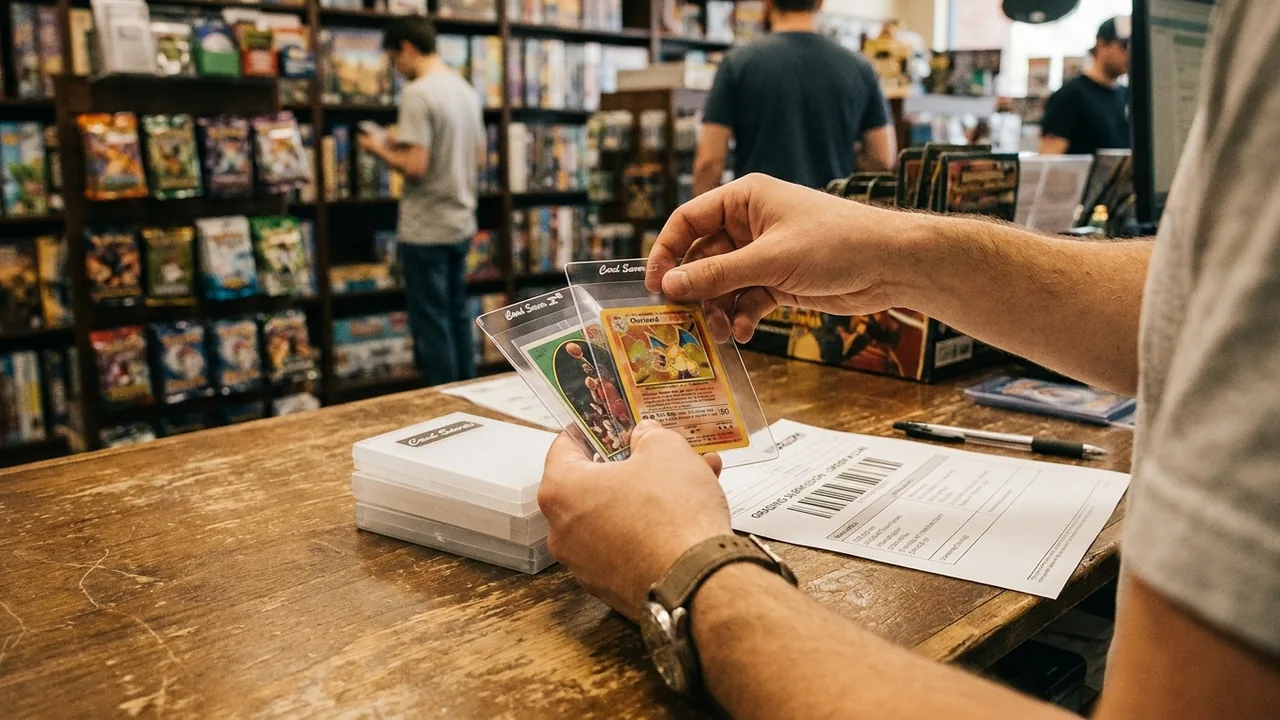
- Prep your cards before you go. Each card needs a penny sleeve inside a semi-rigid Card Saver (PSA's required holder — not a toploader). Stores sell them if you forget, but bringing your own saves $1–2 per card.
- Tell the associate your card count. There's no research or card identification done in-store — you declare the quantity, they print a label per card plus a master label for the submission.
- Cards are batched and photographed. Associates sort cards into batches (typically 8), photograph fronts, then photograph backs with labels applied. This is your paper trail if anything is damaged or lost.
- Sealed for shipment. The submission goes into a tamper-resistant bag with the master label and is held until the store's next consolidated shipment to PSA.
- Pay at drop-off. All fees are due upfront — grading fee plus the flat shipping charge. PSA upcharges, if any, are settled at pickup.
- Track via your GameStop account. Order details show pipeline status. See the tracking caveats below.
- Pick up in-store. Slabbed cards return to the same store; you pay any upcharges at pickup.
A store-training quirk worth knowing
Collector reports note that some GameStop locations rubber-band batches of cards together as part of official training — the concern being edge pressure on sleeved cards. The batches are supposed to be small enough that the band doesn't bend the cards, and associates generally let you opt out. If you're submitting anything you'd be upset to see dinged, politely decline the band and confirm cards stay flat and unbanded.
Turnaround Time and the Tracking Gap
GameStop quotes roughly 45 days for the base tier, though real-world turnaround floats with PSA's backlog — 45–75 days is a realistic planning range in late 2026 as PSA works through a backlog approaching 10 million cards. PSA's turnaround clocks don't start until your order is entered into their system, and GameStop consolidates shipments — so your drop-off date is not your PSA start date.
The tracking gap catches people off guard
You do not get a carrier tracking number. Store submissions are consolidated into shared shipments, so the GameStop tracker can't show the card's transit leg. Status typically sits unchanged until PSA receives and scans the batch — meaning a card can be "in limbo" on paper while it's physically already at PSA. This is normal, but it's the #1 source of anxiety in collector reports. If status hasn't moved in 3+ weeks past drop-off, contact the store, not PSA — GameStop owns the logistics relationship until PSA scans the order.
Does PSA grade GameStop cards faster?
No — and this is one of the most common misconceptions. GameStop submissions enter the same PSA queue at the same service tier as direct submissions. There's no preferential treatment. The timeline difference between GameStop and direct is in the consolidation step (a few days at the store), not in PSA's grading room.
The Other Half: Trading In Graded Cards
GameStop runs a parallel program worth knowing about: trade-ins of already-graded cards. Participating stores accept official PSA-graded cards — and here's the strict part — only in PSA 8, 9, or 10 holders. They authenticate the slab, scan the cert, and generate an instant quote using a real-time pricing model, paying up to $1,500 in cash or store credit.
The practical takeaway: GameStop has quietly become both an entry ramp into PSA grading and an exit ramp out of slabs. For sellers, the trade-in quote is instant and local — no eBay fees, no shipping risk — but expect wholesale-style offers below eBay sold comps, since GameStop resells the inventory. For a quick liquidation of mid-grade slabs it's legitimate; for maximizing value on a $500+ card, selling yourself still wins.
Why the 8/9/10 restriction matters to submitters
It's a market signal worth internalizing: GameStop only wants slabs that retail customers will actually buy. Cards graded 7 and below have thin demand — which is exactly why submitting low-probability cards is a bad deal. The retailer's own buy list tells you where the value floor is.
GameStop vs PSA Direct: Which Should You Use?
| Factor | GameStop drop-off | PSA direct |
|---|---|---|
| Minimum cards | 1 | Bulk tiers historically 20+ |
| Membership required | Free GameStop account only | Collector's Club for cheapest tiers |
| Entry price | $15.99/card + $4.99/order | $59.99/card Standard (Value tiers paused) |
| Declared value cap | $1,000/card (post-Sep 9, 2026) | Tier-dependent, up to $250K+ |
| Tracking | GameStop account, no carrier tracking | Full PSA order tracking |
| Card handling | Store associates (varies by location) | You pack and ship yourself |
| Best for | 1–15 modest-value cards, no membership | Volume submitters, high-value cards, control |
The crossover math: at roughly $15.99/card all-in through GameStop versus PSA's cheapest open direct tier at $59.99, GameStop is the budget answer for small batches right now — as long as your cards fit under the declared-value cap and you can live with the tracking gap. Once you're submitting 50+ cards a year or cards worth $1,000+, a Collector's Club membership and direct submissions win on control, tier choice, and insured value.
Five Mistakes That Cost Money at the Counter
- Submitting above the insured cap. Declared value is capped at $1,000/card for new submissions (as of Sep 9, 2026). Anything pricier belongs in a direct PSA submission at an appropriate tier — not a retail drop-off.
- Ignoring upcharge risk. If PSA values your card above the tier's max insured value, you pay the difference at pickup. Know the realistic PSA 10 value before you submit — a card that could 10 into a $400 card can trigger a higher tier's pricing.
- Wrong holders. Cards must arrive in penny sleeves inside Card Savers or PSA-approved semi-rigids. Toploaders get repacked or rejected; tape on the sleeve is a classic rookie error that slows intake.
- Skipping the account. No GameStop account = no submission tracking. Set it up before you drive over.
- Submitting blind. The $15.99 fee is cheap per card — until you multiply it by the cards that come back PSA 7. Submitting a stack of "maybe" cards is how a $100 experiment turns into a $300 lesson.
Pre-Grade Before You Drop Off — The 60-Second Filter
Everything above this line is logistics. This is the part that actually determines whether GameStop grading makes you money or costs it: PSA 8s and 9s of modern cards frequently sell for raw price or less. At $15.99 a card, a PSA 8 result on a $30 card is a guaranteed loss. The only outcome that pays is a high grade on a card with a real graded premium.
Run every candidate through an AI pre-grade before the store trip — it costs cents instead of $15.99 and flags the three things that kill modern grades: centering outside 55/45, corner whitening, and surface print lines. If the pre-grade predicts PSA 8 or below, keep the card raw or sell it raw. If it flags a likely 9–10 with a graded premium above your all-in cost, that's your drop-off pile.
The grade calculator runs the exact submit-or-sell math — fee, expected grade value, break-even point — and the submission planner tells you whether GameStop's tier or a direct PSA tier fits each card's value. Two minutes of screening is the difference between a profitable submission and funding someone else's pack luck.
Frequently Asked Questions
How much does it cost to grade a card at GameStop?
$15.99 per card for cards valued at $200 or less, plus a $4.99 flat shipping fee per submission. Higher-value cards are charged at standard PSA tier pricing. Cards must be in penny sleeves and Card Savers (sold in-store if needed).
How long does GameStop card grading take?
GameStop quotes roughly 45 days for the base tier, but real-world turnaround floats with PSA's backlog — plan on 45–75 days in late 2026. The clock doesn't start until PSA receives and scans the consolidated store shipment, not your drop-off date.
Does PSA grade GameStop cards faster?
No. GameStop submissions enter the same PSA queue at the same service tier as direct submissions — there is no preferential treatment. The only timing difference is GameStop's store-level consolidation before shipment.
Can I trade in graded cards at GameStop?
Yes — participating stores buy PSA-graded cards, but only slabs graded 8, 9, or 10. You'll get an instant cash or store-credit quote, capped at $1,500 per transaction.
Do I need a PSA membership to grade through GameStop?
No — that's the main appeal. A free GameStop account handles submission tracking; no PSA Collector's Club membership or bulk minimums required.
What is the maximum card value I can submit at GameStop?
$1,000 declared/insured value per card for submissions created on or after September 9, 2026 (it was $1,500 before that). Higher-value cards should go directly to PSA at an appropriate service tier.
Sources & Further Reading
- GameStop Card Grading Service Terms & Conditions
- GameStop PSA Graded Cards FAQ
- PSA Service Levels & Pricing
- PokeBeach: GameStop Now Offering PSA Drop-Off Submissions
- Elite Fourum: GameStop PSA submission experience report

Sarah Williams leads PreGradeCards educational content and collector onboarding. She has been a full-time collector and dealer for 12 years, specializing in modern sports cards and Pokémon TCG, and has written grading guides read by over 300,000 collectors.
With submission floors rising, pre-screening is no longer optional. Use our AI Pre-Grade Calculator to score a card's PSA 10 odds before you pay, and the Submission Planner to pick the right tier.