The Short Answer
- Don't sell anything until you've sorted — the most common heir mistake is bulk-selling a collection with hidden hits.
- Vintage (pre-1980s) and star-rookie cards carry most of a collection's value.
- Only a small fraction of any collection is worth grading — the chase cards, not the bulk.
- Estate tax and sale documentation matter on high-value collections.
- AI pre-grading is the fastest way to triage a large inherited collection for grading candidates.
Step 1: Don't sell anything yet
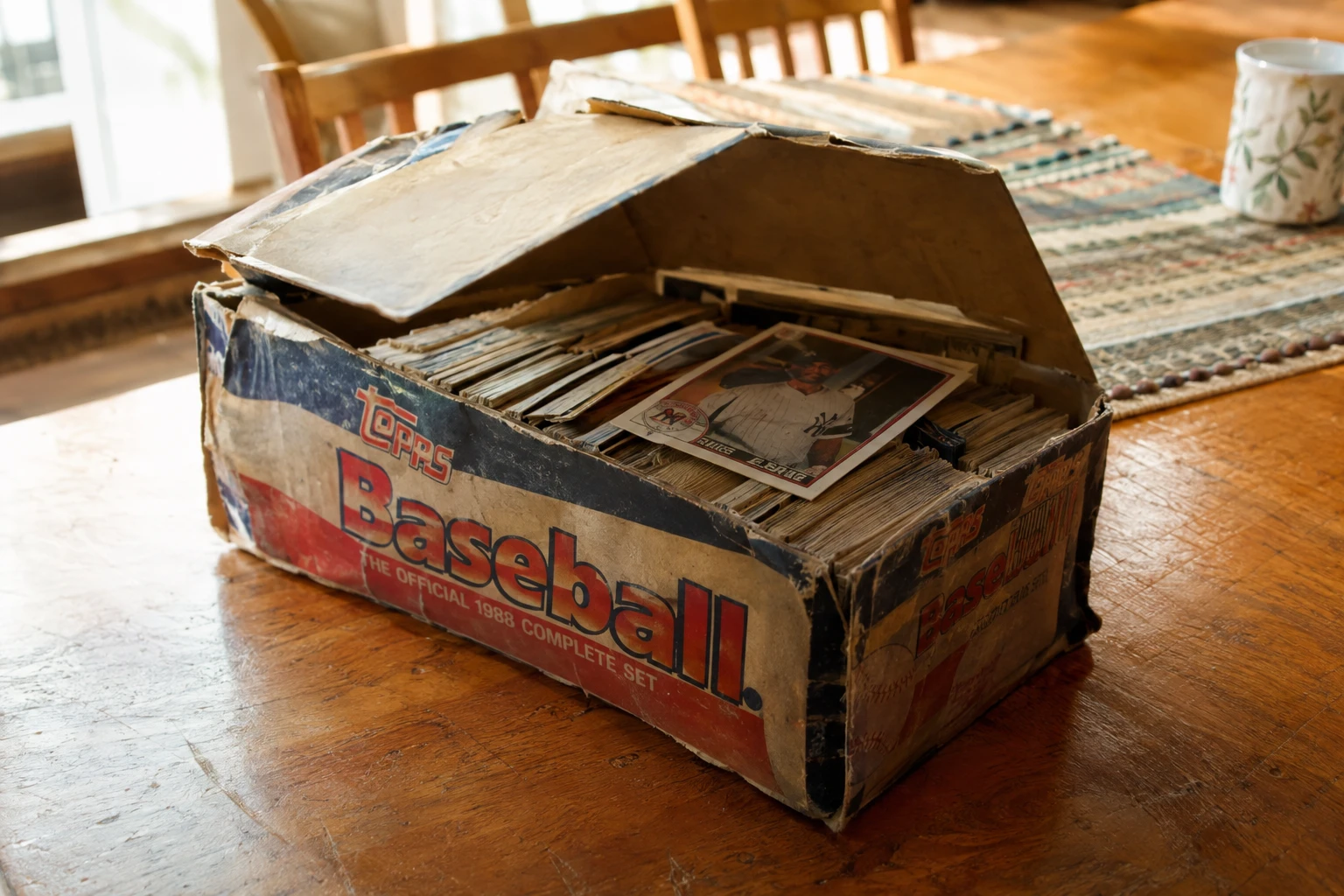
The single most expensive mistake heirs make is the same every time: selling the whole collection to the first buyer who offers. Card shops, “cash for collections” buyers and pawn brokers all know that an inherited collection is priced by someone who doesn't know what's in it — and they price accordingly. A collection with a $400 Mantle inside gets sold as “a box of old cards” for $80.
The rule: nothing leaves the house until you've sorted and identified the contents. Even a rough sort beats a blind sale. The cards aren't going anywhere; the urgency to move them is self-imposed.
AI identification tells you what the card is and roughly what it's worth.
Step 2: Sort before you value
Most inherited collections are 95% bulk and 5% value — the value just doesn't announce itself. Sort into piles first:
- Star players/rookies — the names everyone knows (Jordan, Mantle, Mays, Brady, Ohtani) plus any rookie cards. These are where the money concentrates.
- Vintage (pre-1980s) — old cards carry value even in mediocre condition if they're of the right names.
- Graded/slabbed cards — already-graded cards have known values; check the cert lookup to see the pop report.
- Sets and near-sets — complete vintage sets are worth more than their singles added up.
- Bulk commons — the thousands of cards that are the collection's volume but not its value.
Sort by era then star power: a 1980s binder of commons is worth less than a single 1950s star. The goal isn't precision yet — it's separating the cards that need real valuation from the bulk that doesn't.
Step 3: Find the actual hits
Once sorted, the question shifts from “what's here” to “what's valuable.” The fastest tool for this is identification: an AI card scanner identifies the card, its set and year, and gives a rough value in seconds — no expertise required. Scan the star pile and the vintage pile; the bulk doesn't need it.
What to look for specifically:
- Rookie cards of major stars — the single most valuable card type in most collections.
- Low-numbered vintage — pre-1970s cards in any condition.
- Anything with a serial number — /99, /25 etc. Numbered cards have real scarcity.
- Autographed or game-used cards — autos and relics carry premiums.
- Error/variant cards — print errors are occasionally valuable.
If the collection is large, an AI scanner turns the “find the hits” step from a weekend into an hour.
Step 4: Get real values, not asking prices
Card values come from sold prices, not listings. Check eBay's sold filter (or a comps tool) for the exact card in similar condition — not the asking price someone hopes for. A card listed at $200 that last sold for $45 is a $45 card.
For the high-value hits, consider a professional appraisal if the collection might be worth real money — a dealer or auction house will appraise a significant collection, and estate documentation often requires it anyway. For the mid-value cards, the comps from a scanner plus sold listings are close enough to make the sell/keep decision.
The documentation matters beyond curiosity: on a collection worth thousands, the value records are needed for the estate and for your own records if you sell.
Step 5: What actually deserves grading
Most of an inherited collection shouldn't be graded — the fee only pays on the chase cards. Grade candidates:
- Vintage stars in decent condition — a 1950s–1970s star card in presentable shape grades well because vintage premiums are real even at mid-grades.
- Modern star rookies in clean condition — a pack-fresh-looking star rookie is a grading candidate.
- Numbered parallels and autos — scarcity plus grade compounds value.
The triage that matters: pre-grade the candidates before paying fees. An AI pre-grader checks centering, corners, edges and surface in ~30 seconds and tells you whether a card is a likely 8, 9 or 10 — which decides whether the grading fee pays. On a vintage card, a likely 7-8 still grades into a real premium; on a modern card, only the 10s usually pay.
Everything else — the bulk commons, mid-tier cards, worn cards — sells raw in lots or at card shows. Grading bulk is how heirs burn the collection's value on fees.
Step 6: How to actually sell
Options in order of value-per-effort:
- eBay individually: best per-card prices on the hits, most work. Worth it for cards worth $50+.
- Consignment/auction houses: for high-value collections — they handle listing for a cut (10–20%), worth it on cards worth $100+ where their buyer reach matters.
- Card shows: sell lots and mid-tier cards to dealers in person; prices are lower than eBay but instant and honest if you find a reputable dealer.
- Local card shop: fastest, lowest prices — they need margin, so this is the convenience trade.
- Keep: the sentimental cards — some of the collection isn't for sale, and that's the right call.
Sell the hits individually or consign them; sell the bulk in lots to dealers or at shows. Never bulk-sell the whole collection to a single buyer unless you've verified there's nothing valuable inside.
Estate and tax considerations
A valuable card collection is an estate asset, which brings paperwork:
- Value documentation: keep records of what you found and its estimated value — appraisals for significant collections.
- Estate tax: a collection worth over a few thousand dollars may need to be valued for estate purposes; consult the executor.
- Sale records: if you sell, keep records of proceeds — taxable events on inherited property have basis rules a tax professional should advise on.
- Insurance: a valuable unsold collection should be insured; standard homeowner's policies often under-cover collectibles.
This isn't legal or tax advice — it's the checklist of questions to bring to the estate attorney or accountant handling the estate. The collection's value affects more than its sale price.
The sentimental side — and why it's okay to keep some
There's a part of this nobody talks about: the cards aren't just assets, they're a person's collection — often years of a loved one's hobby. It's completely reasonable to keep the cards that matter — the ones with a story, the ones that remind you of them, the ones that are just cool to have. Not everything needs to be liquidated.
The healthy approach most heirs settle on: sell the value, keep the meaning. The chase cards fund whatever the collection's proceeds need to do; the sentimental cards stay because their value isn't the price. Some heirs keep a few graded pieces as display; others keep the cards that meant something and sell the rest. There's no wrong answer — the only wrong move is selling blindly out of impatience and discovering later that a card with meaning went in the bulk lot.
If you're sorting through it with family, the sort itself is part of it — going through someone's collection is going through part of them, and there's no need to rush that. The cards will still be there when you're ready.
The bottom line
An inherited collection is a project, not a windfall — sort it, find the hits, get real values, grade only the candidates, and sell through the right channel for each tier. The heirs who lose money are the ones who bulk-sell blind; the ones who do it right turn the same boxes into real value. Take the time to sort before you sell.
Scan any card — AI identifies it, its set, and a rough value.
Frequently Asked Questions
0
1
2
3
4
5
Sources & Further Reading
Emily Rodriguez analyzes grading cost, population, and pricing data across PSA, BGS, SGC, CGC, and TAG. She built the PreGradeCards ROI calculator and submission planner, and her market reports on grading backlog, turnaround times, and slab premiums are cited by collectors and dealers worldwide.
Create a free account and get 2 free credits — enough for 2 complete AI gradings with market pricing. No credit card required.
Get Your Free Credits →