The Short Answer
- Japan's government launched a parliamentary taskforce in July 2026 to regulate the trading card market, citing scalping, counterfeiting, and money laundering concerns.
- Pokemon Center Online now requires Japanese government ID (My Number Card) for certain 30th Celebration product purchases, effectively restricting sales to Japanese residents.
- A Pikachu Illustrator sold for $22.6 million in 2026, highlighting the financial scale that triggered regulatory attention.
- The taskforce is considering authentication methods and anti-counterfeiting technology, which could increase demand for professional grading and authentication services.
- Counterfeits and fraudulent sales are rising — the regulation push may benefit collectors by improving market transparency and authentication standards.
What is Japan's trading card regulation taskforce?
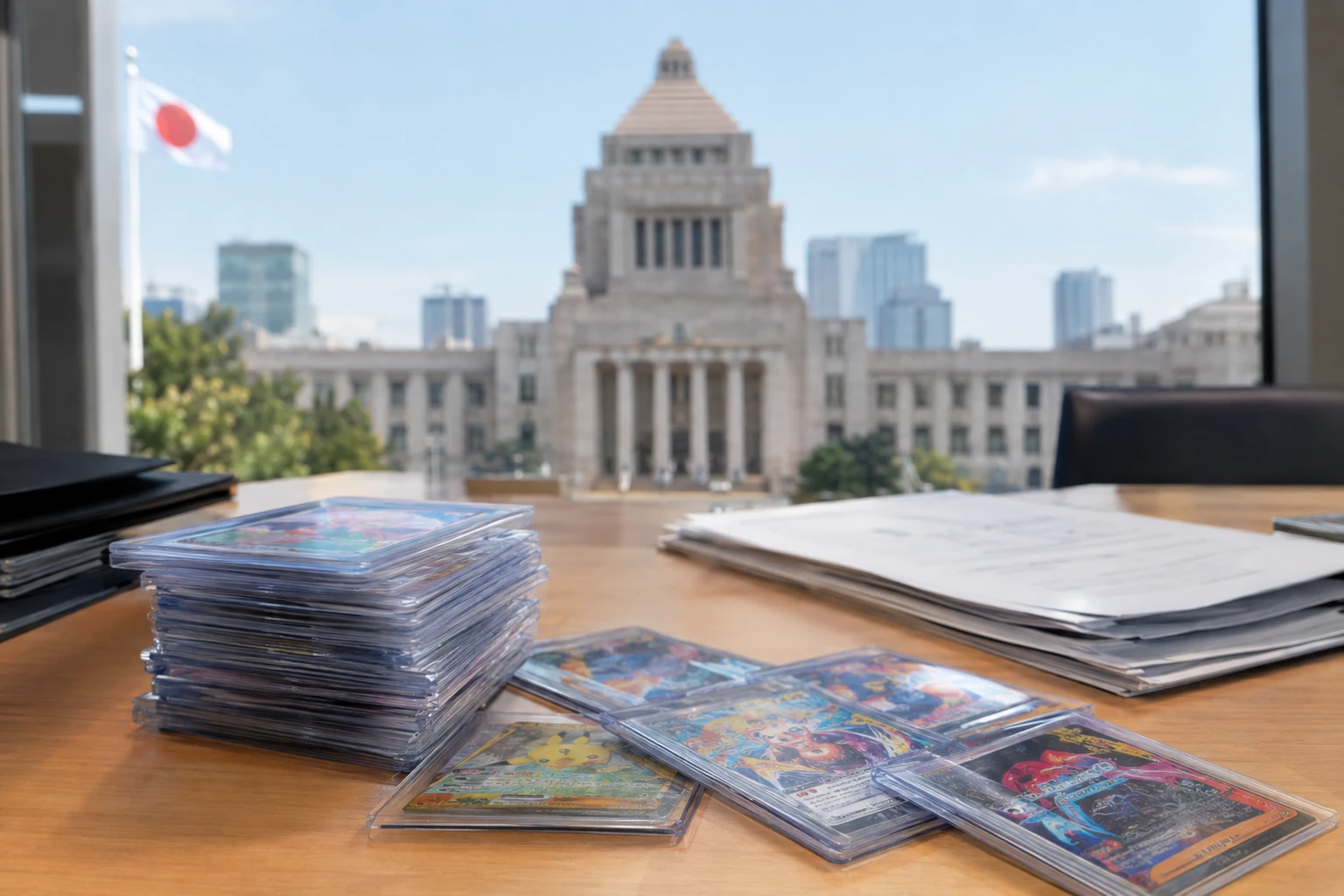
In July 2026, lawmakers from Japan's ruling Liberal Democratic Party (LDP) launched a parliamentary group focused on the rapidly growing trading card industry. The group consists of approximately 20 lawmakers and is tasked with formulating policy recommendations on "appropriate rule-making" and industry promotion. The taskforce held its first meeting on July 23, 2026, hearing from industry organizations and Japan's Ministry of Economy, Trade and Industry (METI).
The taskforce was created in response to a market that has grown far beyond its schoolyard origins. Trading cards — particularly Pokémon and Yu-Gi-Oh! — have become a multi-billion-dollar global industry. A rare Pikachu Illustrator card was sold by YouTuber Logan Paul for approximately $22.6 million in 2026, setting a record that crystallized the financial scale of the market. Japanese lawmakers noted that card values are largely determined by a U.S. company (PSA), despite the Japanese origins of Pokémon and Yu-Gi-Oh!.
The caucus chair, Kihara Seiji, has stated that the group must "not strengthen regulations to the point of destroying the market." The focus is on supporting Japan-originated intellectual property and content while addressing specific problems: counterfeit cards, fraudulent sales, bulk purchases for resale (scalping), and the potential use of card transactions for money laundering. The group plans to hear from manufacturers and industry participants as it develops recommendations.
According to the LDP group's statement: "Trading cards are no longer simply consumer products. The market's rapid expansion and the growing asset value of trading cards have given rise to problems that cannot be ignored."
How does the Pokemon Center ID requirement work?
On August 5, 2026, the Pokémon Center Online announced the first items that will require Japanese government-issued ID verification for purchase. The system uses Japan's My Number Card (a government-issued ID used for social services) in tandem with the Digital Identification App, created by the Digital Agency under the prime minister's cabinet.
The first restricted items are all part of the Pokémon Card Game's 30th Celebration series, scheduled for release in September 2026:
- Pokémon Card Game Mega Expansion Pack 30th Celebration Box (pre-orders open August 10, ships September 15)
- 30th Celebration Futuristic Box
- 30th Celebration Espeon and Umbreon Premium Deck Set
- Pokémon Card Game Mega 30th Celebration Card Sets (pre-orders August 28 and October 15)
The practical effect: non-residents of Japan cannot obtain a My Number Card or use the Digital Identification App. By requiring verification through this system, the Pokémon Center Online is effectively restricting sales of these items to Japanese residents only. The stated goal is combating scalpers who use bulk purchases for resale at inflated prices.
It is not yet clear whether physical Pokémon Center stores in Japan will also require ID verification, or whether other retailers will implement similar systems. The Pokémon Company has been testing anti-scalping measures for months, including a lottery system where customers apply using official Japanese IDs for special releases. Some Japanese card shops have implemented their own measures: quizzes to prove fandom, facial recognition scans for entry, and even cutting opened booster pack wrappers to prevent return fraud.
How big is the counterfeit Pokemon card problem in 2026?
Counterfeiting is one of the primary concerns driving Japan's regulatory push. Lawyer Fukui Kensaku, from Kotto Dori Law Office, identified several criminal activities that have increased alongside soaring card prices: people swapping out cards and repackaging sealed products, creating counterfeit cards, and straight theft of valuable cards. He also flagged the risk of trading card transactions being "exploited for illicit overseas money transfers, such as money laundering."
The scale of the counterfeit problem has grown with the market. In 2026, the trading card market is larger than ever — the industry graded a record 3.5 million cards in June 2026, with PSA alone at 2.5 million. As card values have risen, the incentive to produce convincing fakes has increased proportionally. High-value cards like the Pikachu Illustrator (sold for $22.6 million) and vintage Base Set Charizard cards (PSA 10 values exceeding $420,000) are prime targets for counterfeiting.
The taskforce is considering ways to prevent illegal resales and counterfeiting, including authentication methods and improved technology to detect fakes. This is where professional grading services play a critical role. PSA, BGS, CGC, and SGC slabs serve as authentication — the encapsulation process verifies that the card is genuine before it is graded. AI pre-grading services like PreGradeCards also include card identification, which can flag suspected counterfeits by comparing card scans against a database of known authentic cards.
For collectors, the rise in counterfeiting makes authentication more important than ever. Buying raw cards from unverified sellers carries real risk, especially for vintage and high-value cards. Graded slabs from reputable companies provide a layer of protection that raw cards do not. The Japanese government's interest in authentication technology could lead to industry-wide standards that benefit all collectors.
Can trading cards really be used for money laundering?
Yes, and the Japanese government is taking the risk seriously. Trading cards have characteristics that make them attractive for money laundering: high value, portable, easily transferable, and largely unregulated. A $50,000 Pokémon card can be mailed internationally in a small envelope, making it a more practical vehicle for moving illicit funds than traditional assets.
The mechanism is straightforward: illicit funds are used to purchase valuable trading cards, the cards are then sold through legitimate marketplaces (eBay, auction houses, TCGPlayer), and the proceeds appear as legitimate income from a card sale. The original source of the funds is obscured by the card transaction. With Pokémon card values reaching into the millions, a single transaction can move a significant amount of money.
Fukui Kensaku specifically raised this concern in his comments to the taskforce. He noted that the market's "bubble-like" price growth creates conditions attractive to financial crime. The parliamentary group is considering whether trading card transactions above certain thresholds should be subject to reporting requirements, similar to those applied to precious metals and art transactions in some jurisdictions.
However, Fukui also cautioned that regulation alone is not the answer. "If we were to pursue legal regulation alone, the first hurdle would be that even if a law were enacted, it would only apply within Japan," he said. International cooperation would be essential, as the trading card market is inherently global — cards manufactured in Japan are graded in the United States and sold worldwide.
The taskforce chair has emphasized the need for a "comprehensive" approach working with industry and resale platforms, rather than heavy-handed regulation that could stifle the market. The goal is "fostering the healthy development of the market" — ensuring trading cards remain something everyone can enjoy.
How will Japan's regulation affect the global Pokemon card market?
The global impact of Japan's regulatory push will be felt in three areas: supply, authentication, and market structure.
Supply Constraints
The Pokémon Center ID requirement for 30th Celebration products effectively removes international direct-to-consumer sales for the restricted items. Collectors outside Japan who previously imported Japanese-language products from Pokémon Center Online will need to use proxy services or secondary markets. This could increase secondary market prices for Japanese-language 30th Celebration products, while potentially reducing scalper-driven inflation within Japan.
Authentication Standards
If the taskforce recommends industry-wide authentication standards, it could accelerate the adoption of technologies that already exist in the grading industry. PSA, BGS, CGC, and SGC already authenticate cards through their grading processes. AI-based authentication tools like PreGradeCards' card identification service can detect counterfeits from photos. Government-endorsed authentication standards would increase trust in these services and could drive more collectors toward professional grading.
Market Structure
The taskforce's concern about card values being "largely determined by a U.S. company" (PSA) reflects a broader tension: Japanese-originated IP (Pokémon, Yu-Gi-Oh!) is graded and valued primarily through American companies. If Japan develops its own authentication or grading standards, it could create a parallel market structure. However, this is speculative at this stage — the taskforce is in its early phases and has not announced specific policy recommendations.
In the short term, the most likely impact is increased demand for authentication and grading services. As counterfeiting concerns rise and governments take notice, collectors and resellers will increasingly seek third-party verification. This benefits the existing grading industry (PSA, CGC, BGS, SGC) and AI pre-grading services that can identify counterfeits before purchase.
What does Japan's regulation mean for individual collectors?
For most collectors outside Japan, the immediate impact is limited but growing. Here is what changes and what does not:
What Changes
- Japanese Pokemon Center purchases: Collectors outside Japan can no longer directly purchase the restricted 30th Celebration items from Pokémon Center Online. Proxy services or secondary markets are the alternatives.
- Authentication awareness: The regulatory spotlight on counterfeiting means collectors should be more vigilant about buying raw cards from unverified sources. Graded slabs provide authentication that raw cards do not.
- Market transparency: If the taskforce recommends disclosure or reporting standards for high-value card transactions, the market could become more transparent — benefiting collectors who rely on price data.
What Does Not Change
- International grading: PSA, CGC, BGS, and SGC continue to operate normally. The Japanese regulation does not affect how non-Japanese collectors submit cards for grading.
- English-language product availability: The 30th Celebration set releases worldwide on September 16, 2026. English-language products are not affected by the Japanese ID requirement.
- Card values: The fundamental drivers of card value — rarity, condition, demand — are unchanged. Regulation may improve market integrity, which is generally positive for long-term value.
The best advice for collectors in 2026: buy from reputable sources, prefer graded slabs for high-value purchases, and use AI card identification tools to verify authenticity before buying raw cards. The PreGradeCards auto card identification service can identify Pokémon, Yu-Gi-Oh!, One Piece, Lorcana, and 10+ other TCGs from a photo, helping collectors verify what they are buying before they pay.
Will regulation increase demand for card grading and authentication?
Almost certainly yes. The Japanese taskforce's focus on counterfeiting, fraud, and authentication directly aligns with what professional grading services provide. Three factors point toward increased grading demand:
1. Authentication as a regulatory response. If the taskforce recommends authentication standards, graded slabs from PSA, CGC, BGS, and SGC become the obvious compliance mechanism. A PSA-graded card is authenticated, condition-verified, and encapsulated in a tamper-evident holder. That is exactly what a regulated market would require.
2. Counterfeit detection technology. The taskforce is considering "improving technology to try to detect fakes." AI-based card identification tools already exist and can flag suspected counterfeits from photos. Government endorsement of authentication technology would drive adoption of these tools among collectors and resellers who currently do not use them.
3. Market transparency demands. As the market becomes more regulated, price discovery improves. Collectors and investors will have better data on what cards are worth, which supports the economic case for grading — you can calculate the grading premium more accurately when you have reliable price data.
The grading industry is already at capacity. PSA graded 2.5 million cards in June 2026 (a record), and the backlog is 12.4 million cards. Beckett paused Base/Standard submissions on August 5 due to capacity constraints. If Japanese regulation drives even a modest increase in grading demand from Japanese collectors and resellers, the capacity crunch will intensify further. This makes AI pre-grading even more valuable — it helps collectors submit only the right cards to the right grading company, reducing wasted submissions and easing the backlog.
What comes next for Pokemon card regulation in Japan and globally?
The Japanese taskforce is in its early phases. No specific regulations have been enacted, and the group has stated its intention to work with industry rather than impose heavy-handed rules. The timeline for concrete policy recommendations is likely months, not weeks.
Several outcomes are possible:
- Voluntary industry standards: The taskforce may recommend that trading card companies, resale platforms, and grading services adopt voluntary authentication and transparency standards, rather than imposing legal requirements. This is the lightest-touch approach and aligns with the chair's stated preference for not "destroying the market."
- Platform-level anti-fraud measures: Marketplaces like eBay Japan, Yahoo Auctions, and Mercari may be asked to implement enhanced verification for high-value card sales, similar to eBay's authenticated guarantee program for trading cards above certain price thresholds.
- International cooperation: Fukui Kensaku emphasized that regulation within Japan alone would be insufficient. The taskforce may seek cooperation with international grading companies and marketplaces to address cross-border fraud and money laundering risks.
- Expanded ID verification: The Pokémon Center's My Number Card requirement may expand to additional products beyond the initial 30th Celebration items. Other Japanese retailers and TCG publishers (Bandai for One Piece, Konami for Yu-Gi-Oh!) may implement similar systems.
For the global market, the most significant long-term outcome would be the normalization of authentication as a standard part of trading card transactions. In the same way that certified coins and graded comics are expected in those markets, graded and authenticated trading cards could become the default for any transaction above a modest value threshold. This would be a net positive for collectors — it reduces fraud risk, improves price transparency, and increases confidence in the market.
The collectors who are already using AI pre-grading and professional grading services are ahead of this curve. As regulation increases the importance of authentication, the tools and services that provide it become more valuable — not just for condition assessment, but for market participation itself.
Frequently Asked Questions
Is Japan banning Pokemon cards?
Can I still buy Japanese Pokemon cards if I do not live in Japan?
Will Japan's regulation affect PSA, CGC, or other grading companies?
Why is the Japanese government concerned about trading cards now?
Does the Pokemon Center ID requirement apply to English-language products?
How can I protect myself from counterfeit Pokemon cards?
Sources & Further Reading
- Japan considers crackdown on Pokémon cards as 'skyrocketing' interest sparks crime fears (ABC News, Aug 15, 2026)
- Japan weighs regulating Pokemon cards amid trading mania (The Japan Times, Jul 23, 2026)
- Japan ruling party lawmakers form group to promote trading card industry (The Mainichi, Aug 1, 2026)
- Pokémon Center Online designates first items requiring Japanese ID (SoraNews24, Aug 5, 2026)
- Japan launches taskforce to crack down on trading card scalpers and fakes (Dexerto)

Marcus Chen has evaluated over 50,000 sports cards and TCG cards across PSA, BGS, SGC, and CGC standards. Before joining PreGradeCards, he worked as a submission specialist for a major grading company and trained collectors and dealers on condition assessment.
With submission floors rising, pre-screening is no longer optional. Use our AI Pre-Grade Calculator to score a card's PSA 10 odds before you pay, and the Submission Planner to pick the right tier.