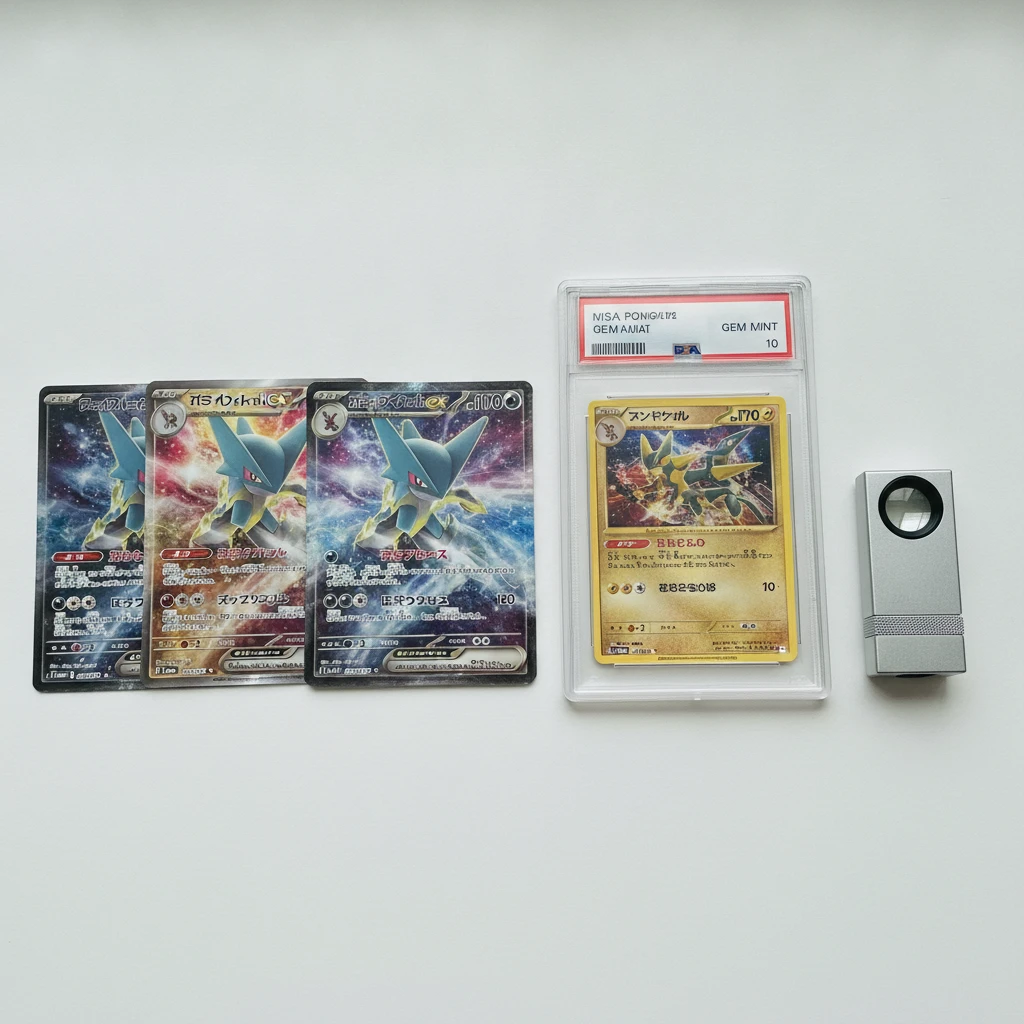
The Short Answer
- Japanese Pokémon cards typically earn higher raw-to-graded premiums because PSA 10 populations are much smaller than their English counterparts.
- PSA uses the same 1–10 scale for Japanese cards, but gem-rate expectations differ by era and set.
- 2026 chase sets include Mega Evolution—Pitch Black (Abyss Eye), Storm Emeralda, and 30th Celebration preview cards.
- AI pre-grading catches centering and holo issues before you pay international shipping plus the $79.99 PSA Regular fee.
- Free credits on PreGradeCards let you screen Japanese Pokémon cards at no cost.
How PSA Grades Japanese Pokémon Cards Differently
PSA applies the same 1–10 numerical scale to Japanese Pokémon cards, but experienced collectors know the grading environment is meaningfully different from English cards. Japanese cards generally have better stock consistency, sharper corners from the factory, and more uniform holo textures. That sounds like an automatic PSA 10 advantage, yet the reality is nuanced.
Because Japanese print runs are smaller and the domestic market keeps many cards in Japan, fewer high-grade copies reach Western graders. The result is a smaller PSA 10 population even though the underlying card quality is often superior. A PSA 10 Japanese Charizard ex SAR from Super Electric Breaker recently sold for roughly $516 on eBay, while the same card ungraded traded near ¥55,000 (~$375). That single slab added about $140 in value — a premium ratio that mirrors English cards in percentage terms but sits on a much smaller population base.
PSA graders evaluate Japanese cards for the same four criteria: centering, corners, edges, and surface. However, collectors report that Japanese vintage (1996–2003) can be stricter on surface because the early holo foil is more brittle. Modern Japanese cards from the Sword & Shield and Scarlet & Violet eras usually center better than English prints, but silvering along foil edges and microscopic print dust are common PSA 9 killers.
Why Japanese PSA 10 Populations Command Premiums
The investment case for grading Japanese Pokémon cards rests on scarcity at the top end. English chase cards often have PSA 10 populations in the thousands. Comparable Japanese cards may have PSA 10 populations measured in the low hundreds or even double digits. That population gap translates directly to liquidity and price premiums in the secondary market.
For example, Japanese special art rares (SARs) from sets like VSTAR Universe and Shiny Treasure ex routinely command 20–40% premiums over English equivalents in PSA 10, according to price-tracking data cited by Delightful TCG. The premium is not just collector preference; it reflects genuine scarcity in the gem-mint holder.
The dynamic is strongest for:
- High-end SARs and CSR (character super rare) cards with full-bleed art and low pull rates.
- Vintage holos from 1996–2002 that survived two decades of domestic play and storage.
- Promotional cards tied to movie releases, championship events, or limited retail campaigns.
- Box toppers and lottery prizes that never had large English equivalents.
The counter-risk is liquidity. English cards have deeper buyer pools on eBay and TCGplayer. Japanese cards often sell best through specialized marketplaces, Yahoo Auctions Japan, and collector communities. Grade Japanese cards when the PSA 10 premium justifies a narrower but more motivated buyer base.
Best Japanese Pokémon Sets to Grade in 2026
Three major release waves dominate Japanese Pokémon grading demand in 2026. Each has distinct chase cards, print characteristics, and value curves:
1. Mega Evolution—Pitch Black / Abyss Eye (released May 22, 2026 in Japan)
The Japanese Abyss Eye set introduced Mega Darkrai ex and the Pitch Black mechanic ahead of the English Mega Evolution—Pitch Black release. Japanese collectors had first access to Mega Darkrai ex full-art and special illustration variants. Because the set launched first in Japan, Western buyers began importing gem-mint copies immediately, creating cross-market demand. PSA 10 copies of the SAR Mega Darkrai ex are already tracking at a premium to English pre-order prices.
2. Storm Emeralda (releases July 31, 2026 in Japan)
Storm Emeralda brings Mega Rayquaza ex back to the TCG. Rayquaza is historically one of the most graded Pokémon characters, and Japanese Rayquaza chase cards have a track record of outsized PSA 10 premiums. The set also features Mega Latias ex and Mega Latios ex, giving dragon collectors multiple chase targets.
3. 30th Celebration (releases September 16, 2026 globally)
The 30th Celebration expansion is a global simultaneous release, but Japanese print quality and earlier distribution channels may still create population advantages. The set features 30 unique Pikachu insert cards and Futuristic Rare cards with art direction by YOSHIROTTEN. For grading purposes, the insert-heavy nature of the set means condition sensitivity will be extreme — every small imperfection will matter on a limited-run commemorative card.
Abyss Eye / Mega Evolution—Pitch Black: Cards to Pre-Grade
Abyss Eye is the Japanese name for the set Western collectors know as Mega Evolution—Pitch Black. Released May 22, 2026, it introduced the Mega Evolution mechanic for the Scarlet & Violet era and immediately became a grading hotspot. Key cards to evaluate:
- Mega Darkrai ex SAR — the marquee chase. Dark-themed full-bleed art makes edge condition critical.
- Mega Darkrai ex full art — slightly more common than the SAR but still a top-ten grading target from the set.
- Mega Zeraora ex — electric-type alt art with strong competitive and collector crossover demand.
- Pitch Black special illustration supporters and energies — lower individual values but consistent PSA 10 candidates for set registry builders.
AI pre-grading is especially valuable here because the set released first in Japan. Many collectors bought raw Japanese copies before English price discovery stabilized. Pre-grading lets you decide which raw imports are worth the full PSA submission cost versus which should be sold raw to English buyers.
Storm Emeralda: Mega Rayquaza ex and Dragon Chase Cards
Storm Emeralda launches July 31, 2026 in Japan and is expected to be one of the most-opened Japanese sets of the year. Rayquaza has one of the strongest track records in Pokémon card investing, and Mega Rayquaza ex is the headline card.
Graders should watch for three Storm Emeralda chase patterns:
- Rayquaza SAR — historically the highest-value variant in any Rayquaza set. Centering variance on full-bleed dragon art is the primary PSA 9/10 differentiator.
- Mega Latias ex / Mega Latios ex — twin dragon cards popular with set registry and Eevee-adjacent collectors.
- Special illustration energy and trainer cards — often overlooked but can carry strong registry premiums when populations stay low.
PreGradeCards AI can screen these cards before you ship them internationally. Surface checks are particularly important: Japanese foil on dragon-themed cards tends to show silvering along the right and bottom edges where the cutter contacts the holo layer.
30th Celebration: Futuristic Rares and Pikachu Inserts
The Pokémon 30th Celebration expansion is scheduled for September 16, 2026, and represents the biggest commemorative release in years. The set will include Futuristic Rare cards with art direction by YOSHIROTTEN and 30 unique Pikachu insert cards — a direct callback to Pikachu-centric promotions from the franchise history.
For grading, two dynamics matter:
- Commemorative inserts often have unique foil stocks that differ from standard Scarlet & Violet prints. Early collector reports suggest centering variance may be higher on these special inserts.
- 30 Pikachu inserts create 30 distinct grading markets. Some inserts will have massive print runs; others may be short-printed. Population reports will reveal the true scarcity hierarchy within weeks of release.
The safest approach is to pre-grade every 30th Celebration pull before deciding on submissions. With PSA Regular at $79.99, you cannot afford to submit borderline cards from a set where only the rarest inserts will justify the fee.
Common Condition Issues on Japanese Pokémon Cards
Japanese Pokémon cards have a reputation for better factory quality, but several condition issues appear repeatedly at PSA:
Silvering and Foil Chipping
Modern Japanese holo cards use foil layering that can silver along the edges. The silvering is often visible only under direct light and is a leading cause of PSA 9 instead of PSA 10 on otherwise perfect cards.
Print Dust and Surface Specks
Japanese printers occasionally leave tiny white or dark specks on the card surface. These are not scratches but they can be flagged as surface defects. A careful wipe with a microfiber cloth before imaging can prevent unnecessary PSA 9 grades.
Corner Rounding
Vintage Japanese cards from the late 1990s have softer corners than modern prints. Even cards that appear mint in sleeves can show corner rounding under magnification. AI corner analysis is effective at catching this before submission.
Back Edge Whitening
The blue-card back of Japanese Pokémon cards shows whitening easily. Back-edge inspection is critical because PSA evaluates both sides, and a pristine front can be dragged down by a single whitening spot on the reverse.
Shipping and Submission Tips for Japanese Pokémon Cards
Submitting Japanese cards to PSA involves extra logistics compared to domestic English cards. Here is the practical workflow:
- Consolidate imports before grading. If you buy raw Japanese cards from multiple Yahoo Auctions or proxy sellers, combine them into one shipment to reduce per-card shipping cost.
- Use a forwarding service that understands collectibles. Declare full value and request reinforced packaging. PSA submissions require your cards to arrive in the same condition they left Japan.
- Currency-hedge your ROI math. A card that looks profitable at ¥55,000 may look different after yen/dollar conversion fees, forwarding charges, and the $79.99 PSA fee.
- Insure the shipment for full declared value. Japanese chase cards can exceed $500–$2,000 in transit.
- Submit under PSA Regular or higher as of July 2026; Value tiers remain paused. Budget $79.99 per card plus return shipping.
PreGradeCards AI lets you screen cards while they are still in Japan in many cases — just upload the seller photos or proxy inspection images before committing to the international shipment.
How to AI Pre-Grade Japanese Pokémon Cards
The complete workflow for AI pre-grading Japanese Pokémon cards before a PSA submission:
- Capture both sides in neutral light. Japanese holo textures can reflect differently under warm bulbs. Use diffuse daylight or a softbox.
- Upload to PreGradeCards Complete Grading. The AI handles English and Japanese card identification, set matching, and rarity lookup.
- Check centering first. Japanese cards usually center well, but borderline 60/40 cards still lose the PSA 10.
- Read the surface report carefully. Silvering and print dust are the hidden PSA 9 culprits on Japanese foils.
- Batch-screen low-value cards. Use Batch Grading for common Japanese holos and only submit confident AI 9.5–10 cards.
- Compare predicted value to total cost. Factor in purchase price, forwarding, PSA fee, return shipping, and marketplace fees. If the AI-predicted PSA 10 net return is thin, sell raw instead.
Japanese Pokémon card grading can be highly profitable in 2026, but only when condition is verified before money is committed. PreGradeCards free credits make that verification step cost-free for your first batch.
Frequently Asked Questions
Are Japanese Pokémon cards worth grading in 2026?
Does PSA grade Japanese Pokémon cards differently?
What is the best Japanese Pokémon set to grade in 2026?
How much does it cost to grade Japanese Pokémon cards?
Can AI pre-grading handle Japanese Pokémon cards?
Should I grade Japanese cards in Japan or the US?
Sources & Further Reading
- Delightful TCG — Japanese Pokémon Card Grading 2026
- Samurai Sword Tokyo — Best Japanese Pokémon Cards to Grade PSA 2026
- Hall of Cards — Pokémon Card Value Guide 2026
Create a free account and get 1 free credit — enough for 1 complete AI grading with market pricing. No credit card required.
Sign Up Free →