The Short Answer
- On-site grading = booth drop-off at shows — cards graded during the event (express) or accepted into the mail-in pipeline at show rates (drop-off).
- PSA suspended on-site grading at the 2026 National in Rosemont — the highest-profile pullback yet; show services now vary company-by-company and show-by-show.
- Same-day express pricing runs $100–300/card at major shows — worth it only on high-value cards where the liquidity window is tight.
- KSA offers Canada's only everyday same-day service (CA$150/card Ontario walk-through) — the rest of the industry does same-day only at show booths.
- The booth has a built-in conflict of interest: it profits when you submit everything — which is why the pre-grade-before-the-show strategy exists.
- Best strategy: AI pre-grade your candidates at home, walk up with only the 9/10 candidates, and let the booth reject nothing.
What On-Site Card Grading Actually Is
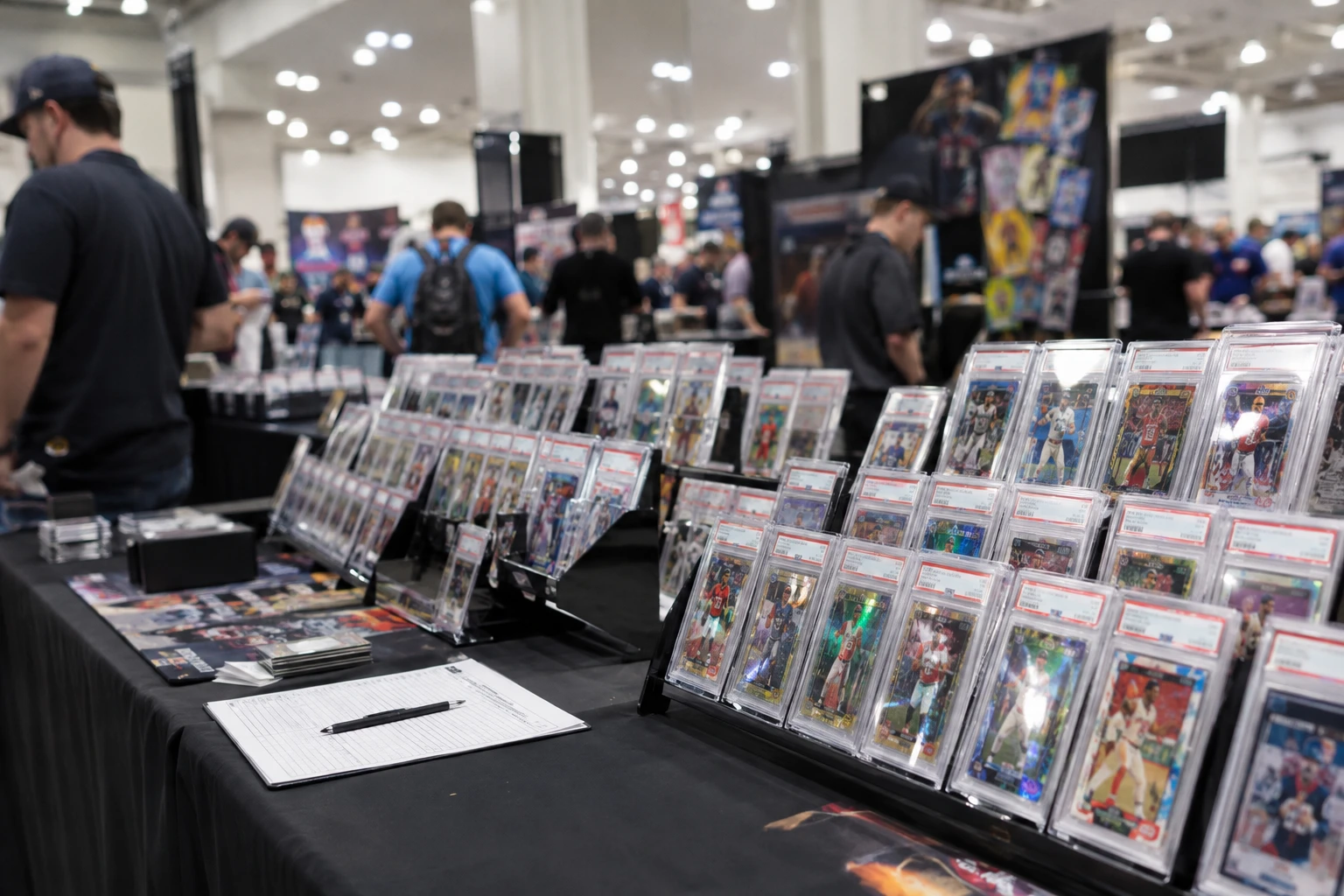
'On-site grading' covers two different services that get conflated at show booths:
- Same-day / in-show grading: your card is graded during the event and handed back slabbed — hours to a day. This is the premium product, priced at express rates ($100–300/card at majors), and it's what collectors mean when they say 'graded on-site.'
- Show drop-off submissions: the booth accepts your cards into the regular grading pipeline at show-adjacent pricing — you skip shipping to the facility, but cards return in weeks, not hours. Cheaper, but functionally a mail-in with a booth receipt.
Both matter because shows have become the industry's biggest submission funnel — the National alone moves hundreds of thousands of cards through grading-company booths over its five days. When show services get cut, as PSA's 2026 pause proved, thousands of collectors' show plans change overnight.
Who Actually Grades at Shows in 2026
The landscape after a chaotic year:
| Company | Show Status (Oct 2026) | Notes |
|---|---|---|
| PSA | On-site grading suspended at the 2026 National | Booth still accepted submissions into the mail pipeline; the suspension drew real backlash — covered in our Rosemont report |
| CGC | Active at major shows | The biggest full-service booth presence now that PSA pulled back — express tiers available at majors |
| TAG | Show submissions active | TAG's show footprint has grown through the National and regional shows; its digital reports work well for booth service |
| SGC | Selective | Boutique post-acquisition; verify presence for the specific show |
| BGS | Reduced | Turbulent 2026 — paused tiers, site instability, new Collectors ownership; check before planning around a BGS booth |
| KSA | Canadian shows + Ontario same-day | Canada's only everyday same-day service — CA$150/card walk-through at the Ontario office, plus show booths at major Canadian events |
| ACE | UK show circuit | Booth presence at UK TCG and sports shows |
The takeaway: 'grading at the show' now means which company at which show — there is no universal 'the booth will grade my cards' assumption anymore. Check the show's exhibitor list and the company's own announcements in the two weeks before you travel.
What On-Site Grading Costs vs Mail-In
Express show pricing exists because the graders bring lab infrastructure to you — and the premium is steep:
- Same-day/in-show express: typically $100–300/card at major shows — several times the standard mail-in rate. Historical National-show express pricing has clustered near the top of that range for headline cards.
- Show drop-off (into the regular pipeline): usually standard-tier pricing, ~$25–60/card, occasionally with show-exclusive discounts or waived extras.
- Declared-value and upcharge rules still apply — an express card that grades into a high-value result can trigger the same value surcharges mail-ins face.
When the express premium is justified: high-value cards where time is money. A case-hit SSP pulled at the show, a card needed slabbed for a same-weekend sale or auction, a card where two days of market movement exceeds the $200 express premium. For everything else, drop-off or mail-in wins on price — you're paying for the hour count, not a better grade.
How a Booth Submission Works
The mechanics, once you're at the booth:
- Join the submission line — at majors, express lines move slowly; arrive early in the day for same-day service.
- Declare your cards and service level. Express (graded during the show) or drop-off (into the mail pipeline). Declared value matters — it sets the insurance tier and, at some companies, the price tier.
- Pay at the booth. Express premium + declared value + any add-ons (autograph authentication, oversized, thick stock).
- Get the receipt/tracking. Booth submissions generate order numbers immediately — photograph the receipt before you walk away.
- Express: return for pickup same-day or next-day at the booth. Drop-off: cards ship to the facility with the show's batch and return via normal turnaround.
Prep your cards before the line: penny sleeves + semi-rigid holders, a written card list, and ID. A booth line at the National is not where you want to be re-sleeving 40 cards while the queue waits.
The Pre-Grade-Before-the-Show Strategy
Here's the dynamic nobody at the booth will explain: the booth profits when you submit everything. Every card you hand over is revenue — whether it earns a 10 or a 6. Your best filter isn't at the show; it's at home, before you pack.
The optimal workflow:
- Two weeks before the show: run your candidate stack through an AI pre-grade. The output splits your stack into three piles: probable 10s, probable 9s, and everything else.
- Walk up with only pile one. These are the cards where the express premium actually pays back — high-probability 10s on cards with real 9-to-10 price gaps.
- Pile two goes to drop-off, not express. Likely 9s are worth slabbing at standard rates, not at $200/card — pay express only on cards where the speed itself has value.
- Pile three stays raw. The cards the AI flags at 8-and-below were going to lose you money at the booth — the pre-grade just saved you the fee on each one.
The math at show pricing makes this brutal math obvious: at $150–250 express fees, every card you submit that comes back below a 9 is a $150+ donation. On a 20-card stack where pre-grading filters out 12 losers, you just saved $1,800+ at the booth — which is why pre-grading before a show trip is the single highest-ROI move in the hobby right now.
The Best Shows for Grading Access
Where booth coverage is strongest:
- The National Sports Collectors Convention — the industry's biggest show and its biggest submission funnel; multiple grader booths even with PSA's on-site grading suspended. Our card show calendar tracks the full schedule and our 2026 National recap covers what actually happened there.
- Regional majors — East Coast National, the big Texas/California shows, Toronto Sportscard Expo (Canada's biggest — KSA and ACE-tier regional presence), and the UK TCG show circuit.
- TCG-specific events — Pokémon Regionals and major TCG conventions where CGC, ACE, and regional graders staff submission tables.
Two weeks before any show, verify three things on the show's exhibitor page: which graders are actually attending, whether they're offering express or drop-off only, and whether express requires a pre-booked slot. Some express services sell out appointment slots before the doors open — the collectors turned away are always the ones who assumed walk-up meant walk-up.
Show-Submission Mistakes That Cost Real Money
- Submitting under booth pressure. The line is loud, the pitch is easy, the fee is a blur — and you just paid express rates on cards that were never candidates. Decide the submission list at home, not at the table.
- Assuming 'on-site' means same-day. Show drop-off returns in weeks. If you need the card slabbed this weekend, only express delivers — confirm the service level on the receipt.
- Ignoring declared value. Under-declare and your card travels underinsured; over-declare and you pay tier surcharges. Know each card's honest market value before the booth asks.
- Re-sleeving in line. Cards submitted in top-loaders or binders get rejected or re-sleeved by staff (sometimes for a fee). Penny sleeve + Card Saver, done before you queue.
- Skipping the receipt photo. Your only proof of submission at a busy booth is that paper. Photograph it, the card list, and the order number before walking off.
Preparing Your Cards Before You Ever Reach the Booth
The collectors who get value from show grading treat the show as the last step of a process that started at home. The prep checklist:
- Pre-grade everything at home first. Run every candidate through an AI pre-grade days before the show. The booth queue is the worst place to make a $100-per-card decision — you want to walk in with a submit list, not a maybe pile.
- Know the card ID cold. On-site fees get wasted on misidentified cards — the wrong variant, a reprint, a trimmed card. If identification is fuzzy, resolve it with card ID tooling before the show, not in line.
- Holder them correctly. Penny sleeve + semi-rigid (Card Saver) is the standard every company expects. Cards in toploaders, screwdowns, or binders slow the intake line and some services reject non-standard holders outright.
- Bring the paperwork pre-filled where possible. Most on-site services have downloadable submission forms — filling them at a quiet table beats filling them in a queue while the line grows behind you.
- Budget the tier, not just the card. Know the per-card on-site price for the service level you want (express vs same-day vs drop-off mail-back) and set the submit list to fit the budget — not the other way around.
- Sort by service. If you're submitting to multiple booths (a PSA-destined card and a TAG-destined card), separate them physically before you leave home. Re-sorting at the show is how cards end up at the wrong company.
After the Show: What Actually Happens to Your Submission
Understanding the post-booth pipeline prevents the classic show-submission anxieties:
Same-day grading means literally that — your cards are graded on-site in a portable lab and returned before you leave (or occasionally next morning for late submissions). You walk out with slabs. The throughput is limited — expect caps, early sellouts on big show days, and priority given to higher-tier subs.
Drop-off submissions are the more common reality: the booth intake feeds the company's normal grading queue back at the lab. Your 'show submission' is really a mail-in with free shipping and a face-to-face receipt — turnaround follows the standard published timeline, not the show weekend. SGC's show submissions, CGC show-graded tiers, and most PSA booth intakes work this way.
Chain of custody is the underrated benefit. Handing a card to a human and receiving a numbered receipt in return eliminates the two scariest parts of mail-in: the package arriving damaged, and the package not arriving at all. For high-value cards, the receipt + on-site intake alone justifies the premium — your submission is tracked from handoff, not from a post office counter.
Follow-up. If a drop-off submission goes quiet past the quoted window, your receipt's submission number is the tracking key — companies can locate a show-sub intake faster than a mail-in because the intake batch is smaller and better logged. Keep the receipt photo on your phone permanently.
The Verdict
On-site grading is a luxury product pretending to be a service: the same grade you'd get by mail, delivered in hours, priced accordingly. It's worth it exactly when the hours are worth money — a card selling this weekend, a case hit that needs to move, a high-value card where the express fee is a rounding error on the flip.
For everyone else, the show booth is the industry's best submission drop-off point — skip the express premium, bank the shipping savings, and never hand a card to a booth that your own pre-grade already told you was a 7.
Frequently Asked Questions
0
1
2
3
4
5
6
Sources & Further Reading
- PreGradeCards — PSA National 2026: On-Site Grading Suspended
- PreGradeCards — Card Show Calendar 2026
- KSA Certification — Same-Day Walk-Through Service
- PreGradeCards — National Card Show 2026 Recap
- PreGradeCards — Card Grading Near Me: Local Services Guide
Sarah Williams leads PreGradeCards educational content and collector onboarding. She has been a full-time collector and dealer for 12 years, specializing in modern sports cards and Pokémon TCG, and has written grading guides read by over 300,000 collectors.
Create a free account and get 1 free credit — enough for 1 complete AI grading with market pricing. No credit card required.
Sign Up Free →