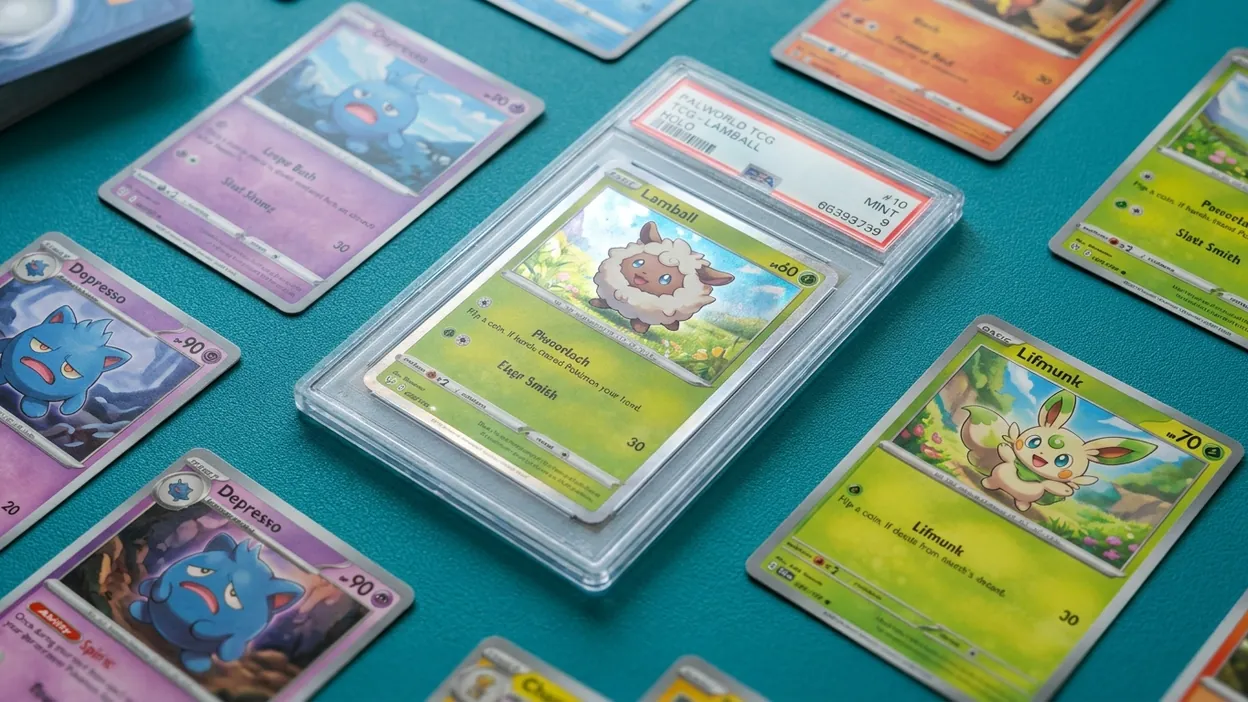
The Short Answer
- Graded populations start at zero — the game launched July 30, 2026; early PSA 10s will be pop-1 through pop-10 items.
- Dawn of Palpagos (BP01) — 100 base cards (RR/R/U/C) plus 61 parallel treatments including the set's chase cards.
- 3.5 million packs sold within weeks of launch — real distribution means real collector demand for graded singles.
- Zoe, Lily, and 50+ original Pal illustrations anchor the first set's character chase.
- Legends Awaken (BP02) lands October 30, 2026 — five colors and another full parallel wave.
- First-mover economics — in brand-new TCGs, the earliest gem-mint slabs of top characters historically capture permanent low-pop premiums.
Palworld Official Card Game Grading in 2026: A True Ground-Floor Opportunity
Palworld Official Card Game launched worldwide on July 30, 2026 — a Bushiroad-produced TCG based on Pocketpair's global hit video game. The first booster, Dawn of Palpagos, sold 3.5 million packs within weeks, putting it among the fastest-starting new TCGs of the decade.
For grading, the story is pure first-mover economics: the graded population starts at literally zero. There are no PSA 10 Palworld cards. No CGC Pristine 10s. Every early gem-mint slab of a top character will be a population-1-to-10 item in the game's permanent record. In the TCG grading market, those first-of-kind low-pop slabs historically become a game's most sought-after pieces.
Compare to other 2025–2026 launches: Riftbound chase cards hit $5,000+ raw within a year; Gundam LR+ cards reached $6,666. Palworld has the same ingredients — a massive existing fanbase (tens of millions of game players), Bushiroad's proven TCG infrastructure, and a collector-first parallel system.
Why Palworld OCG Is a Grading Opportunity
- Zero existing graded population — every early PSA/CGC 10 is a low-pop record piece
- Massive IP base — Palworld sold tens of millions of game copies; the collector funnel is huge
- 3.5M packs sold fast — real distribution, not a niche Kickstarter trickle
- Simultaneous worldwide launch — English and Japanese markets developed together
- BP02 already announced — Legends Awaken (October 30, 2026) confirms a committed product line
Palworld OCG Rarity Structure Explained
Dawn of Palpagos uses a four-tier base rarity plus a large parallel wave — Bushiroad's standard modern structure (compare Weiss Schwarz and hololive OCG).
Rarity Hierarchy
| Rarity | Role | Grade Worth It? |
|---|---|---|
| Common (C) | Base cards | No |
| Uncommon (U) | Base cards | No |
| Rare (R) | Higher-tier base | Only top-Pal foils |
| Double Rare (RR) | Top base rarity | If raw > $30 |
| Parallels (61 in BP01) | Premium treatments — the chase tier | Yes — always |
| Trial Deck exclusives | Starter-deck parallel versions | If raw > $30 |
The 61 parallel cards are the grading population. Bushiroad's parallel systems (learned from Weiss Schwarz and hololive) typically include signature-stamped, alternate-art, and premium-foil variants — in a brand-new game, the top parallels of headline Pals become the first set's lasting chase cards.
Set Structure
- BP01 Dawn of Palpagos (July 30, 2026) — 100 types + 61 parallels; 50+ Pal cards; Zoe and Lily character cards
- Trial Decks — Dawn of Palpagos Red・Blue and Green・Purple starter sets with deck-exclusive parallels
- BP02 Legends Awaken (October 30, 2026) — 100 types + parallels across all five colors
Which Palworld OCG Cards Deserve Grading
In a zero-population market, the grading strategy is about picking tomorrow's grails today:
Automatic Grade Candidates
- All BP01 parallels — the 61-card parallel wave is the chase tier; top-Pal parallels will define the set.
- Character cards — Zoe and Lily — named human characters historically outperform creature cards in collector markets.
- Headline Pals — the game's mascot-tier creatures in parallel treatment are the display-card population.
- Trial-deck exclusive parallels — lower print visibility than booster cards, often overlooked early.
- Sealed/parallel promos — Anime Expo presale promos and launch-event cards have built-in scarcity.
Conditional Candidates
- RR cards of top Pals — grade if raw settles above $30.
- First-print wave product — early-manufacture cards of a sold-out-first-week set age well.
The First-Mover Playbook
The highest-EV move in a zero-pop market: AI pre-grade your best 5–10 parallels immediately, submit the clean candidates fast, and own pop-1/pop-2 slabs before the graded market exists. When the first PSA 10 of a top Pal parallel sells publicly, it sets the pricing anchor for the entire graded market.
PSA vs CGC vs BGS for Palworld OCG
Palworld is Bushiroad stock — same manufacturer family as Weiss Schwarz, Shadowverse Evolve, and hololive OCG.
| Grader | Tier | Cost | Best For |
|---|---|---|---|
| PSA | Regular | $79.99 | Top parallels — first-mover pop-1 slabs |
| CGC | Economy | $15 | Volume screening, $30–$400 cards |
| BGS | Express | $79.95 | Premium chase where subgrades help |
| TAG | Standard | $18 | Speed + digital documentation |
Unusual recommendation here: PSA first for your best pulls. In a zero-population game, the label premium on the earliest slabs is worth far more than the fee difference — the first PSA 10 of a top Pal parallel will define the market. CGC Economy is the right tool for volume screening the rest of your parallels.
AI Pre-Grading for Palworld OCG Cards
In a first-mover market, speed matters — but so does accuracy. Submitting flawed cards wastes the early-population window on 8s and 9s. AI pre-grading lets you move fast and selective.
Palworld-Specific Analysis Points
- Bushiroad parallel foils: the same foil-aware surface analysis used for Weiss Schwarz and hololive applies directly.
- New-print quality variance: launch-window sets can show first-run printing inconsistencies — the AI flags print lines and roller marks before they become grading surprises.
- Colorful full-frame art: Pal cards use bright, saturated art — the AI's artwork-boundary centering measurement handles frameless treatments.
- Volume efficiency: at $0.19/card you can screen an entire booster case's pulls and submit only the true gem candidates.
The Speed Play
Case-open a box, pull your parallels, photograph them immediately, AI-screen all of them (~$2 for 10 cards), and same-day ship the 60%+ candidates to PSA. In a zero-pop market, the difference between pop-1 and pop-50 can be weeks. AI pre-grading is how you move at that speed without gambling on unscreened cards.
Palworld OCG Cardstock and Centering: What to Check
Palworld cards are printed on Bushiroad's standard TCG stock — consistent with Weiss Schwarz and hololive production lines. Expect generally good quality control with typical launch-window caveats.
What to Check on Launch-Window Cards
- Centering: measure all four borders — new product lines occasionally run wider centering variance in early print waves.
- Edge quality: Bushiroad die-cutting can leave micro-burr on one corner — usually the bottom-left in our scans of their other games.
- Foil surface: parallel cards should be checked under raking light for roller lines from the foil-stamping process.
- Surface dimples: check for small indentations, especially on high-foil parallels.
- Pack damage: launch-window boxes opened fast — verify corners on every pull before sleeving.
Photography Tips
Diffuse light, overhead angle, dark background. Palworld's saturated colorful art photographs well; parallels benefit from a second tilted shot so the AI can separate foil texture from real defects.
Palworld OCG Grading ROI: First-Mover Economics
Worked example for a top-Pal parallel in a zero-population market.
Worked Example: BP01 Parallel Chase ($80 raw)
| Variable | Value |
|---|---|
| Raw card cost | $80 |
| P(10) from AI | 60% |
| P(9) | 28% |
| P(≤8) | 12% |
| PSA 10 (low-pop est.) | $300+ (3.75x) |
| PSA 9 value | $130 |
| PSA 8 value | $85 |
| Grading + shipping | $85 |
| Selling fee | 13.25% |
Expected Value = (0.60 × $300) + (0.28 × $130) + (0.12 × $85) = $180 + $36.40 + $10.20 = $226.60
Net = $226.60 − $85 − (13.25% × $226.60) = $226.60 − $85 − $30.02 = $111.58
Profit = $111.58 − $80 = $31.58 (39% return)
The low-pop premium does the heavy lifting — and it only exists for the earliest slabs. If you're the 50th person to grade the card, the PSA 10 value deflates toward 2x and the math flattens. First-mover ROI is a speed game: AI-screen fast, submit the winners fast.
Complete AI Pre-Grading Workflow for Palworld Cards
The first-mover workflow for a brand-new TCG.
Step 1: Open Fast, Sort Faster
Separate all 61 parallels, RR cards, character cards (Zoe, Lily), and trial-deck exclusives from bulk the moment you open.
Step 2: Edge and Surface Check
Quick loupe pass: Bushiroad corner burr, foil roller lines, edge whitening on dark frames. Cull obvious misses before photographing.
Step 3: AI Pre-Grade Everything That Passed
Run all remaining candidates through PreGradeCards AI grading — at $0.19/card, screening a whole case's pulls costs a few dollars.
Step 4: Ship the Winners Same-Week
Submit 55%+ candidates to PSA for the top parallels (the pop-1 premium justifies the fee), CGC for the volume tier. Speed is the strategy.
Step 5: Set the Anchor
When your PSA 10s return as pop-1/pop-2 items, list them visibly — the first public sales of a new game's top slabs set the pricing anchor everyone else follows.
Frequently Asked Questions
Is Palworld Official Card Game worth grading?
What are the rarities in Palworld Official Card Game?
What is the best Palworld card to grade?
Should I use PSA or CGC for Palworld cards?
When does the next Palworld set release?
How do I know which Palworld cards are valuable?
Sources & Further Reading
- Palworld Official Card Game — Official Site
- Dawn of Palpagos Product Page — Bushiroad
- Legends Awaken Product Page — Bushiroad
- Palworld OCG 3.5M Pack Milestone — Official News
Marcus Chen has evaluated over 50,000 sports cards and TCG cards across PSA, BGS, SGC, and CGC standards. Before joining PreGradeCards, he worked as a submission specialist for a major grading company and trained collectors and dealers on condition assessment.
Create a free account and get 1 free credit — enough for 1 complete AI grading with market pricing. No credit card required.
Sign Up Free →