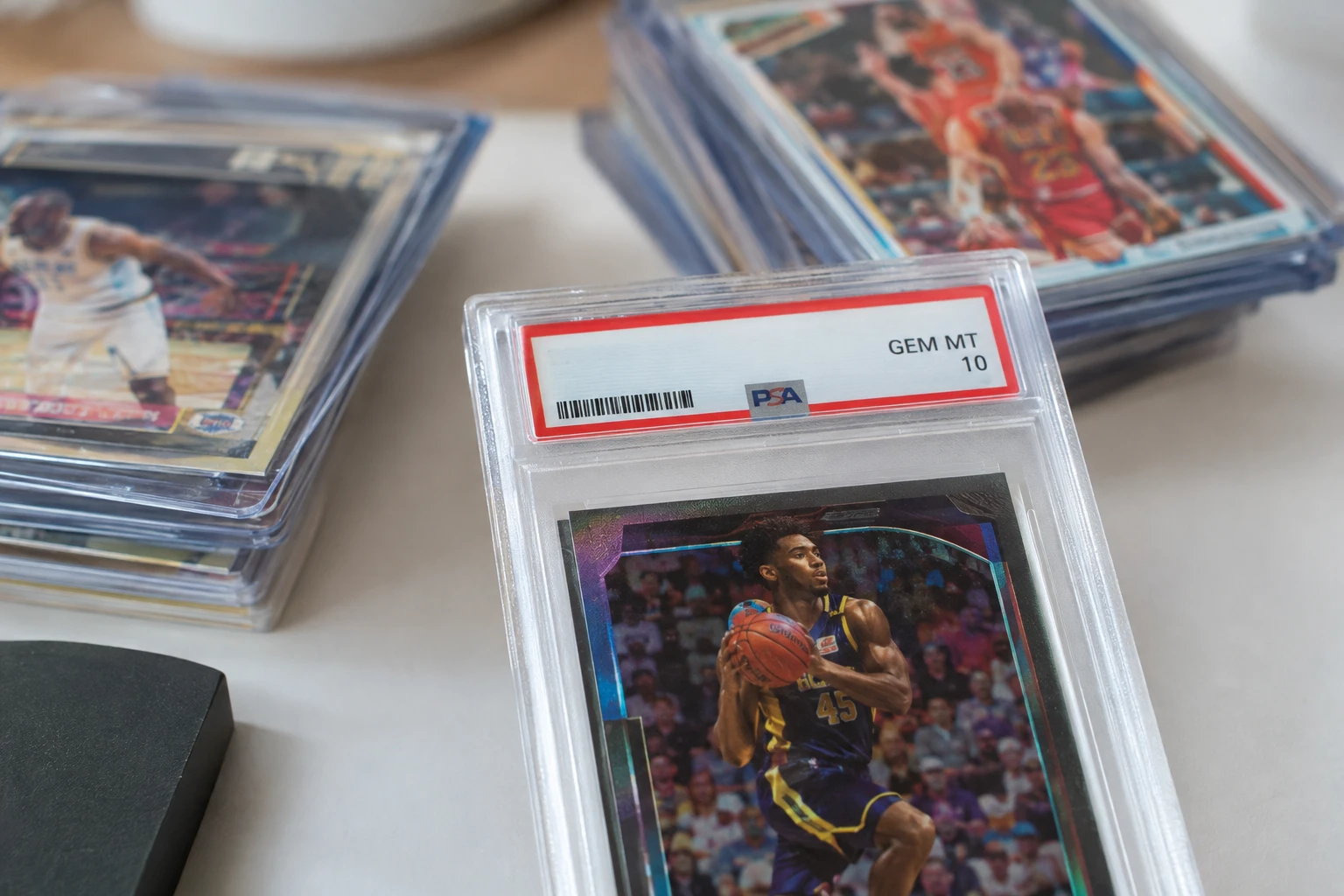
The Short Answer
- Gem rate = PSA 10 count divided by total graded for a specific card
- Ultra-modern premium cards often run 30-60% gem rates; vintage cards frequently under 5%
- A high gem rate means the card is easy to grade — and usually carries a smaller PSA 10 premium
- Low gem rate + high demand is where the biggest grading profits live
- Your personal odds beat the average if you pre-screen: the gem rate includes every no-hope card people sent anyway
- Check population data free at psacard.com/pop or via the PreGradeCards population tool
The One Number That Predicts Your Grading Outcome
A card's PSA 10 gem rate is the percentage of all submitted copies that came back Gem Mint 10. If a card has 1,200 PSA 10s out of 8,000 total graded, its gem rate is 15% — meaning 15% of everyone who submitted that card got the top grade.
Gem rate is the closest thing grading has to published odds. It compresses everything that matters — print quality, pack-fresh condition, centering tolerance, surface fragility — into a single probability you can check before spending $59.99+ per card.
This guide explains where to find gem rates, what's normal for different card categories, and — critically — why your personal odds are better than the published number if you screen your cards first.
What Is a Gem Rate?
Every card in PSA's Population Report shows two key numbers: total graded (all copies ever submitted) and the count at each grade. The gem rate is simply:
Gem Rate = (PSA 10 count ÷ Total graded) × 100
Example: a modern chase card with 3,400 PSA 10s out of 12,000 graded has a 28.3% gem rate. A vintage rookie with 180 PSA 10s out of 14,000 graded runs 1.3%.
Gem rate is card-specific, not set-specific — within the same set, a condition-sensitive holo and a forgiving common can have wildly different rates. Always look up the exact card.
Typical Gem Rates by Category
| Card Category | Typical Gem Rate | Why |
|---|---|---|
| Ultra-modern premium (Sapphire, select inserts) | 40-65% | Excellent pack-fresh condition; most submissions are already clean |
| Modern flagship (Prizm, Topps Chrome, S&V Pokemon) | 25-45% | Good print quality; centering is the main filter |
| Modern dark-bordered (some Pokemon, Yu-Gi-Oh!) | 15-35% | Edge whitening shows instantly on dark borders |
| 1990s-2000s chromium/inserts | 5-20% | Print lines, refractor lines, era handling |
| Vintage (pre-1980) | 1-8% | Survival rate + era print quality + decades of handling |
| Pre-war / tobacco era | Under 1% | PSA 10s are generational events |
The counterintuitive insight: a high gem rate is actually a warning sign for graders, not a green light. If 50% of submissions come back 10, the PSA 10 premium over raw is usually thin — everyone else found the same easy cards. The money lives in low-gem-rate cards you can confidently screen.
How to Look Up a Card's Gem Rate
Two free routes:
1. PSA Population Report (psacard.com/pop). Navigate sport → year → set → card. The "10" column divided by "Total" is your gem rate. PSA-only data.
2. PreGradeCards Population Tool. Search the card name to see PSA, BGS, SGC, and CGC populations side by side — useful because gem rates differ by company. BGS 10s are far rarer than PSA 10s (no subgrade flexibility on a Pristine 10), and CGC Pristine 10 rates differ again.
Quick sanity checks while you're in the report:
- PSA 9 count vs 10 count: a 9-heavy distribution means the card usually falls just short — often a centering or surface pattern.
- Total graded trend: a card with 50,000 graded and 40% gem rate is a solved commodity; 800 graded at 8% is a harder, more interesting target.
What Gem Rate Doesn't Tell You
Gem rate is a population statistic — it has blind spots:
- Selection bias. The submitted pool isn't random. For hot modern releases everyone submits everything, inflating denominators; for vintage, mostly condition-confident collectors submit, understating how rare a 10 truly is among all surviving copies.
- Era drift. Early submissions of a vintage card predate modern scrutiny; a card graded in 2005 may have faced looser standards than today.
- It says nothing about YOUR copy. A 10% gem rate doesn't mean your specific card has a 10% chance — a pack-fresh, perfectly centered copy is far better than the blended average, and a binder-worn one is far worse.
- Pop growth can lag. A brand-new set has a thin denominator that moves fast in the first months.
Using Gem Rate to Make Submit-or-Don't Decisions
Combine gem rate with the value math:
Step 1 — Get the numbers. PSA 10 price, PSA 9 price, raw price, all-in grading cost (~$65-75 at Standard once shipping's included).
Step 2 — Compute the blend. Expected value ≈ (gem rate × PSA 10 price) + ((PSA 9 rate) × PSA 9 price) + (rest × lower grade values).
Step 3 — Compare to raw + fee. Only grade when expected value clearly exceeds raw value plus total cost — our ROI calculator automates this.
Real-world read: a card at 35% gem rate where PSA 10 = $250, PSA 9 = $60, raw = $40 → expected outcome ≈ 0.35×250 + 0.45×60 + 0.20×~$20 ≈ $118 — barely above $40 raw + ~$70 cost. Marginal. The same card screened to only gem-candidate copies (your conditional rate jumps to maybe 60-70%) becomes clearly profitable. That's the entire business case for pre-screening.
How to Beat the Published Gem Rate
The published rate includes every pack-ripper who shipped a card they never examined. Your effective rate is better if you filter:
- Centering first. It's the most common killer — measure against PSA's tolerances (~60/40 front, ~90/10 back for a 10) with our centering checker.
- Surface under tilted light. Print lines, holo scratches, and dimples are invisible head-on. Tilt the card under a bright lamp.
- Edges and corners at magnification. Whitening on dark borders kills gems; a $5 jeweler's loupe catches what the naked eye misses.
- AI pre-grading. Upload front and back photos for an instant grade prediction with per-defect mapping — the practical equivalent of pre-filtering your pool down to the submissions that actually have 10 potential.
Screened submissions routinely run 2-4x the published gem rate for the same card — because you're no longer submitting the 8s and 9s that drag the average down.
Frequently Asked Questions
What is a gem rate in card grading?
What is a good PSA 10 gem rate?
Where can I check a card's PSA 10 gem rate?
Does a low gem rate mean I shouldn't grade the card?
Is BGS 10 rarer than PSA 10?
Sources & Further Reading

The PreGradeCards Research Team combines machine-learning engineers, grading analysts, and collector-education specialists to produce accurate, data-driven guides on AI card grading, professional grading standards, and collecting strategy.
With submission floors rising, pre-screening is no longer optional. Use our AI Pre-Grade Calculator to score a card's PSA 10 odds before you pay, and the Submission Planner to pick the right tier.