The Short Answer
- Sealed product grading is up 200%+ YoY — the fastest-growing segment in the card grading market, outpacing single-card grading by 3x.
- PSA-graded Pokémon booster packs can reach $10,000+ for vintage packs like Base Set, Fossil, and Jungle.
- Sealed box grading is emerging as a premium category — sealed booster boxes in PSA-graded cases are commanding extraordinary premiums.
- Vintage pack grading is the most profitable sealed product category — unopened 1990s packs in gem-mint condition are extraordinarily rare.
- PSA is the dominant grader for sealed products — their slab design and population report are the industry standard for sealed product values.
- Sealed product +37% appreciation — sealed TCG product has outperformed graded single cards (+32%) in 2026 market data.
Sealed Product Grading in 2026: The Fastest-Growing Grading Segment
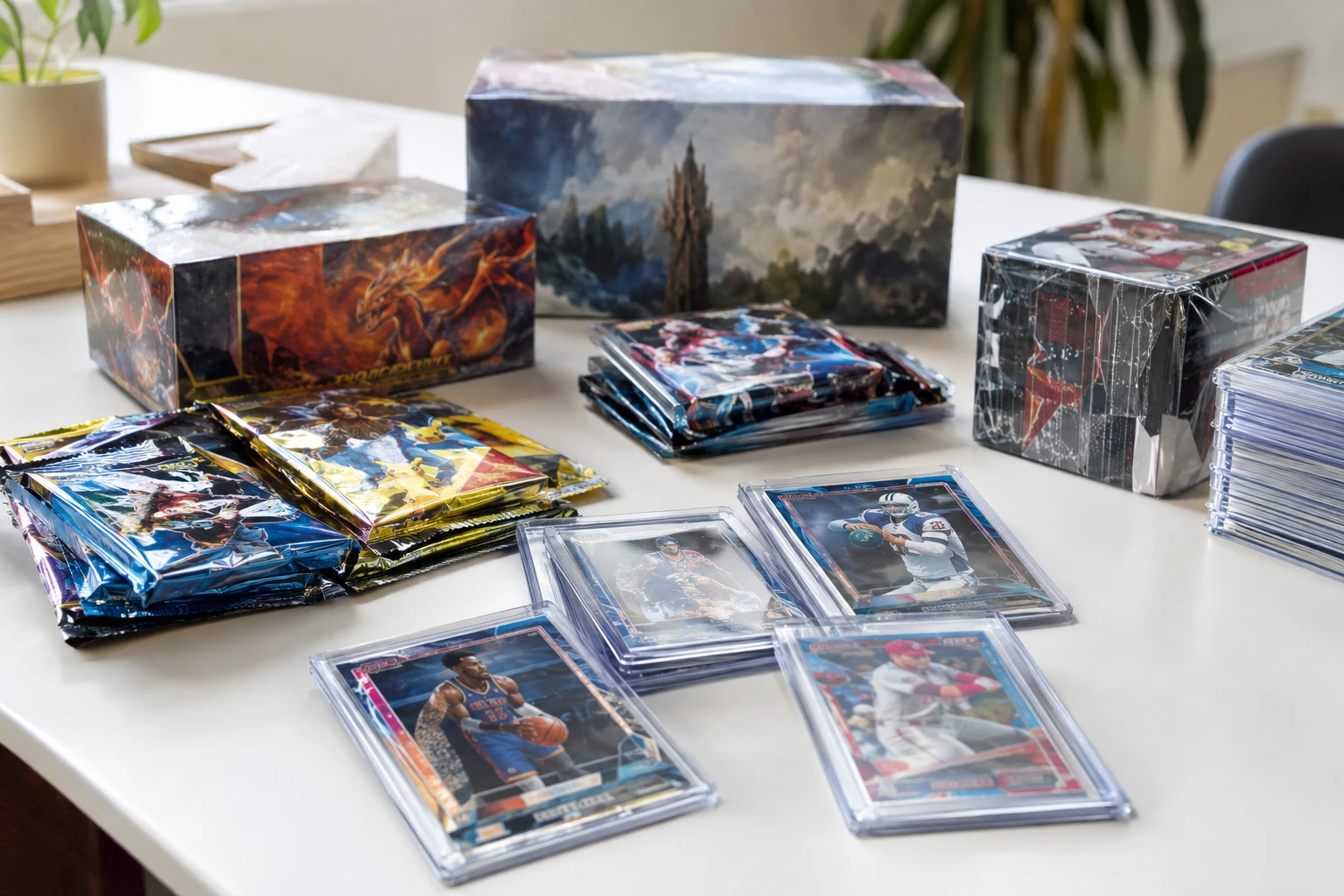
Sealed product grading — the practice of submitting unopened booster packs, sealed boxes, and sealed cases to professional grading companies — is the fastest-growing segment of the card grading market. In 2026, sealed product grading submissions are up over 200% year-over-year, outpacing the growth of single-card grading by a factor of three.
This growth is driven by several factors: the increasing recognition that sealed product is an asset class in its own right, the scarcity of vintage unopened product in gem-mint condition, and the emergence of PSA-graded sealed products as a premium collector category. A PSA 10-graded Pokémon Base Set booster pack can sell for $10,000+, and sealed booster boxes in PSA-graded cases are commanding extraordinary premiums.
Why Sealed Product Grading Is Surging
- Sealed product appreciation: Sealed TCG product has appreciated +37% year to date in 2026, outpacing graded single cards (+32%)
- Vintage pack scarcity: Unopened 1990s Pokémon, Magic, and sports card packs in gem-mint condition are extraordinarily rare
- PSA pack grading acceptance: PSA has been grading sealed packs since 2020, and the market has fully embraced PSA-graded packs as a legitimate collector category
- Investment-grade asset: Sealed and graded product is increasingly viewed as an investment-grade asset, similar to rare coins or vintage wine
- Social media showcase: PSA-graded packs and boxes are visually striking display pieces that perform well on social media
- Cross-category appeal: Sealed product collectors come from TCG, sports cards, and investing backgrounds
The Sealed Product Asset Class
Sealed trading card product has emerged as a distinct asset class within the broader alternative investment market. The 2026 market data shows sealed product appreciation of +37% year to date, outpacing graded single cards (+32%), raw single cards (+18%), and the S&P 500 (+12%). This performance has attracted attention from investors who previously focused on traditional collectibles like rare coins, vintage comic books, and fine art.
Grading sealed product adds another layer of value: a PSA-graded sealed pack is not just an unopened pack — it is a certified, authenticated, condition-graded collectible that can be traded with confidence. The PSA holder provides protection, authentication, and a population report that establishes scarcity.
What Sealed Products Can Be Graded: Packs, Boxes, and Cases
Professional grading companies will grade several types of sealed products. Understanding what can be graded is the first step in identifying grading opportunities.
Types of Graded Sealed Products
| Type | Description | Typical Value Range | Grading Fee |
|---|---|---|---|
| Booster Pack | Single unopened pack | $50–$10,000+ | $50–$200 |
| Booster Box | Sealed box of packs | $200–$50,000+ | $100–$500 |
| Booster Case | Sealed case of boxes | $1,000–$100,000+ | $300–$1,000 |
| Blaster Box | Retail blaster box | $30–$500+ | $50–$100 |
| Hobby Box | Sealed hobby box | $100–$10,000+ | $100–$300 |
| Fat Pack / Bundle | Sealed bundle product | $50–$1,000+ | $75–$200 |
| Tin / ETB | Sealed tin or Elite Trainer Box | $50–$2,000+ | $75–$250 |
Booster packs are the most common graded sealed product, followed by booster boxes. Case grading is the rarest and most expensive category, typically reserved for vintage product that is extraordinarily rare in sealed case form.
Pack Grading vs Box Grading vs Case Grading: Which Is Best?
Each type of sealed product grading has different risk/reward characteristics. Understanding these differences is essential for making profitable grading decisions.
Pack Grading — Highest Risk, Highest Reward
Grading individual booster packs is the highest-risk, highest-reward sealed product category. A PSA 10-graded vintage pack can command extraordinary premiums — but the condition requirements for PSA 10 on a pack are extremely strict. Even minor pack edge wear, creasing, or wrapper imperfections will prevent a PSA 10 grade.
Key considerations for pack grading:
- Condition sensitivity: Packs are more condition-sensitive than boxes — the thin foil wrapper is easily damaged
- PSA 10 rarity: Very few vintage packs achieve PSA 10 — the pack must be in essentially perfect condition
- Value multiplier: A PSA 10 pack can sell for 5–20x the value of an ungraded pack
- Authentication: PSA authenticates the pack, confirming it is a genuine factory-sealed product
- Best for: Vintage packs (1990s Pokémon, Magic, sports) in apparently flawless condition
Box Grading — Moderate Risk, Strong Reward
Grading sealed booster boxes is a moderate-risk, strong-reward category. Boxes are less condition-sensitive than packs because the cardboard box provides some protection to the contents, and the box itself is more durable than a foil pack wrapper.
- Condition tolerance: Boxes can have minor shelf wear and still achieve high grades
- Value multiplier: A PSA 9 or 10 box can sell for 2–5x the value of an ungraded box
- Authentication: PSA authenticates the box, confirming it is factory-sealed and untampered
- Best for: Vintage and modern sealed boxes of desirable products
Case Grading — Low Risk, Premium Reward
Grading sealed booster cases is the rarest category. A sealed case represents the original factory packaging and is the rarest form of sealed product. Case grading is low-risk because the case provides maximum protection, and the reward is premium because sealed cases are extraordinarily rare.
- Extreme rarity: Most cases were opened by distributors — sealed cases are very rare
- Authentication: PSA authenticates the case, confirming it is the original factory packaging
- Best for: Vintage cases of iconic products (Pokémon Base Set, MTG Alpha/Beta)
Top Sealed Products to Grade: From Pokémon Base Set to Modern Prizm
The most valuable sealed products for grading span TCGs and sports cards, from vintage 1990s product to modern premium releases.
Top TCG Sealed Products to Grade
| Product | Type | Ungraded Value | PSA 10 Est. |
|---|---|---|---|
| Pokémon Base Set Pack | Pack | $2,000–$5,000 | $10,000–$25,000+ |
| Pokémon Base Set Box | Box | $15,000–$30,000 | $40,000–$80,000+ |
| Pokémon Fossil Pack | Pack | $500–$1,500 | $3,000–$8,000+ |
| Pokémon Jungle Pack | Pack | $400–$1,200 | $2,500–$6,000+ |
| MTG Alpha Booster Pack | Pack | $5,000–$15,000 | $20,000–$50,000+ |
| MTV Beta Booster Pack | Pack | $2,000–$5,000 | $8,000–$20,000+ |
| Yu-Gi-Oh LOB Pack | Pack | $300–$800 | $1,500–$4,000+ |
| Pokémon Scarlet & Violet Box | Box | $120–$200 | $300–$600 |
Top Sports Card Sealed Products to Grade
| Product | Type | Ungraded Value | PSA 10 Est. |
|---|---|---|---|
| 1986 Fleer Basketball Pack | Pack | $5,000–$15,000 | $20,000–$50,000+ |
| 1989 Upper Deck Baseball Pack | Pack | $200–$500 | $1,000–$3,000+ |
| 2026 Panini Prizm Football Hobby Box | Box | $200–$400 | $500–$1,000 |
| 2026 Topps Chrome Baseball Box | Box | $150–$300 | $400–$800 |
The 1986 Fleer Basketball pack is the holy grail of sports card sealed product grading — it contains the Michael Jordan rookie card, and a PSA 10-graded pack can sell for $50,000+. The pack itself is worth grading because the sealed pack is rarer than the individual Jordan rookie card.
PSA vs BGS vs CGC for Sealed Products: Which Grader Is Best?
PSA is the dominant grading company for sealed products, but other companies are entering the market.
PSA for Sealed Products — Recommended
PSA is the clear market leader for sealed product grading. They have been grading packs since 2020 and have the most established population report for sealed products. PSA's slab design is well-suited for displaying sealed packs and boxes. PSA charges $50–$200 per pack and $100–$500 per box, depending on the declared value.
BGS for Sealed Products
BGS has begun grading sealed products, particularly for modern products. BGS's subgrade system is less relevant for sealed products (since the "card condition" criteria don't apply in the same way), but BGS authentication and slab protection are still valuable.
CGC for Sealed Products
CGC has also entered the sealed product grading market, offering competitive pricing. CGC Economy for sealed products starts at $30–$50 per pack.
| Grader | Pack Fee | Box Fee | Best For |
|---|---|---|---|
| PSA | $50–$200 | $100–$500 | All sealed products — market leader |
| BGS | $50–$150 | $100–$300 | Modern sealed products |
| CGC | $30–$50 | $75–$150 | Budget option |
PSA is recommended for all sealed product grading. Their population report is the industry standard, and PSA-graded sealed products command the highest resale premiums. For budget-conscious collectors, CGC offers the most affordable option.
AI Pre-Grading for Sealed Products: Pack and Box Analysis
AI pre-grading for sealed products is a newer capability that analyzes the condition of packs, boxes, and cases before professional submission. PreGradeCards achieves approximately 80% accuracy within ±1 PSA grade for sealed packs.
How AI Analyzes Sealed Packs
The AI grading process for sealed packs evaluates:
- Wrapper condition: Checks for creasing, tearing, punctures, and edge wear on the foil wrapper
- Seal integrity: Verifies that the factory seal is intact and untampered
- Surface gloss: Assesses the wrapper's surface for scratching, scuffing, and gloss loss
- Corner condition: Inspects the pack corners for crushing, bending, or dinging
- Print clarity: Checks the wrapper printing for fading, smudging, or registration issues
- Authenticity indicators: Verifies pack characteristics that confirm authenticity (wrapper type, seal pattern, print style)
How AI Analyzes Sealed Boxes
For sealed boxes, the AI evaluates:
- Box condition: Corner integrity, edge wear, surface scratching, and shelf wear
- Factory seal: Verifies the factory shrink wrap or seal is intact
- Box structure: Checks for crushing, denting, or structural damage
- Print clarity: Assesses box printing for fading, smudging, or damage
- Authenticity indicators: Verifies box characteristics that confirm authenticity
Photography for Sealed Product AI Analysis
- Packs: Photograph front and back at 300+ DPI with diffuse lighting. The foil wrapper creates reflection — use a polarizing filter or extra-diffuse lighting.
- Boxes: Photograph all six sides of the box at 300+ DPI. Pay special attention to corners and edges.
- Cases: Photograph all sides of the case. The case exterior condition is the primary grading factor.
Cost Savings Example
Consider a collector with 5 vintage Pokémon packs worth $500–$2,000 each. Without AI pre-grading, submitting all 5 to PSA at $100/pack (declared value rate) costs $500 plus $30 shipping = $530. If 3 come back PSA 8 or 9 instead of PSA 10, the grading premium on those 3 may be minimal.
With AI pre-grading at $0.50/pack (higher rate for sealed product analysis), screening all 5 costs $2.50. The AI identifies 2 packs with 60%+ PSA 10 probability. You submit only the 2 strong candidates: $200 + $30 = $230. You save $300 and avoid 3 likely sub-10 returns. Net savings: $297.50.
Sealed Product Condition Guide: What PSA Looks For
PSA evaluates sealed products on different criteria than single cards. Understanding these criteria is essential for identifying which sealed products are worth grading.
PSA Grading Criteria for Sealed Packs
| Criteria | PSA 10 Requirement | Common Issues |
|---|---|---|
| Wrapper surface | No scratches, scuffs, or gloss loss | Micro-scratches from handling |
| Corners | Sharp, no crushing or bending | Corner crushing from storage |
| Edges | Clean, no wear or fraying | Edge wear from shelf contact |
| Seal | Factory seal intact, no tampering | Re-sealed or tampered packs |
| Creasing | No creases whatsoever | Creasing from handling/storage |
| Crisp, no fading or smudging | Fading from UV exposure |
The PSA 10 Pack Rarity
Achieving PSA 10 on a sealed pack is extraordinarily difficult. The foil wrapper is thin and fragile — even minimal handling can cause micro-scratches, edge wear, or creasing that prevents PSA 10. For vintage packs from the 1990s, finding a pack in PSA 10 condition is like finding a needle in a haystack. This is why PSA 10 vintage packs command such extraordinary premiums — the supply is almost non-existent.
How to Store Sealed Products for Grading
- Packs: Store in individual pack sleeves (BCW or similar) inside a rigid toploader or magnetic holder
- Boxes: Store in box shields or acid-free boxes in a climate-controlled environment
- Cases: Store in the original shipping carton if possible, in a climate-controlled environment
- Environment: Keep all sealed products away from direct sunlight (UV causes wrapper fading), high humidity (causes wrapper degradation), and temperature fluctuations
- Handling: Handle sealed products with clean cotton gloves to avoid transferring oils to the wrapper
Sealed Product Grading ROI Calculator
Here are worked ROI examples for sealed product grading.
Worked Example 1: Pokémon Base Set Pack ($3,000 raw)
P(10) = 15% (vintage pack — very hard to get 10)
P(9) = 35%
P(≤8) = 50%
PSA 10 value = $15,000 (5x raw)
PSA 9 value = $6,000
PSA 8 value = $3,500
Grading fee (PSA) = $150
Expected Value = (0.15 × $15,000) + (0.35 × $6,000) + (0.50 × $3,500) = $2,250 + $2,100 + $1,750 = $6,100
Net ROI = $6,100 − $150 − $10 − (13.25% × $6,100) = $6,100 − $160 − $808.25 = $5,131.75
Profit = $5,131.75 − $3,000 = $2,131.75 (71% return)
Even with only 15% PSA 10 probability, the 5x PSA 10 premium for a Base Set pack makes this a highly profitable submission. The scarcity of PSA 10 vintage packs means any PSA 10 that comes back will likely appreciate further.
Worked Example 2: Modern Pokémon Booster Box ($150 raw)
P(10) = 45% (modern box — better condition)
P(9) = 35%
P(≤8) = 20%
PSA 10 value = $450 (3x raw)
PSA 9 value = $250
PSA 8 value = $175
Grading fee (PSA) = $100
Expected Value = (0.45 × $450) + (0.35 × $250) + (0.20 × $175) = $202.50 + $87.50 + $35 = $325
Net ROI = $325 − $100 − $10 − (13.25% × $325) = $325 − $110 − $43.06 = $171.94
Profit = $171.94 − $150 = $21.94 (15% return)
Modern sealed box grading has more modest ROI than vintage pack grading. The 3x PSA 10 premium and the $100 grading fee create a thinner margin. However, the 15% return is still positive, and modern sealed boxes in PSA 10 will likely appreciate over time as the product becomes vintage.
The Vintage Pack Premium
The ROI data clearly shows that vintage pack grading is significantly more profitable than modern sealed product grading. The combination of extreme PSA 10 scarcity, high PSA 10 premium (5–10x), and strong collector demand creates extraordinary ROI for vintage packs. If you have access to vintage packs in apparently flawless condition, grading them is one of the highest-ROI opportunities in the entire card collecting market.
Complete AI Pre-Grading Workflow for Sealed Products
Follow this step-by-step workflow to maximize your sealed product grading ROI.
Step 1: Identify Vintage and High-Value Sealed Products
Pull all vintage packs (1990s Pokémon, Magic, sports), vintage sealed boxes, and high-value modern sealed products. Set aside low-value modern products ($50 or less) — grading fees will likely exceed the premium.
Step 2: Careful Condition Assessment
For packs, inspect under direct light for:
- Wrapper creasing (hold at eye level and look for light reflection breaks)
- Edge wear (examine all four edges under magnification)
- Corner crushing (check all four corners)
- Surface scratching (tilt under direct light)
- Seal integrity (verify the factory seal is intact)
For boxes, inspect for:
- Corner dinging (all eight corners)
- Shelf wear (bottom and sides)
- Box crushing or structural damage
- Factory seal intact
Step 3: Photograph for AI Analysis
Take front and back photos (for packs) or all six sides (for boxes) at 300+ DPI with diffuse lighting. Use a polarizing filter for foil pack wrappers to minimize reflection artifacts.
Step 4: Upload to PreGradeCards AI
Upload each sealed product to PreGradeCards AI grading and receive your pre-grade report with PSA 10 probability and condition assessment.
Step 5: Filter by PSA 10 Probability
Submit sealed products with 40%+ PSA 10 probability to PSA. For vintage packs with high PSA 10 premium (5–10x), submit even at 10% probability — the potential value justifies the risk.
Step 6: Choose PSA for Sealed Products
PSA is the recommended grader for all sealed products. Their population report is the industry standard, and PSA-graded sealed products command the highest resale premiums. For budget-conscious collectors, CGC offers the most affordable alternative.
Step 7: Package, Ship, Track, and Sell
Package sealed products carefully — packs in individual sleeves inside rigid holders, boxes in protective box shields. Ship via USPS Priority Mail Express with full insurance. Once graded, check the PSA population report. A PSA 10 vintage pack may be population-1 or population-5, making it extraordinarily rare and valuable. Consider holding for appreciation — sealed product in PSA 10 is a finite resource that will only become scarcer over time.
The Investment Thesis
Sealed product grading represents a unique intersection of collecting and investing. A PSA 10-graded sealed pack is simultaneously a collectible (appealing to card collectors), an investment (appreciating asset), and a historical artifact (preserving the unopened state of a vintage product). As the card collecting market continues to mature and attract investment capital, sealed product grading will likely become an increasingly important category. Collectors who grade sealed products now — particularly vintage packs in gem-mint condition — are positioning themselves at the forefront of this growing market.
Frequently Asked Questions
Can you grade sealed card products?
What is the most valuable sealed product to grade?
How much does it cost to grade a sealed pack?
Is sealed product grading worth it?
How does AI grading work for sealed products?
What makes a PSA 10 sealed pack?
Sources & Further Reading
- PSA Sealed Product Grading Guide — PSA
- Sealed Product Market Trends 2026 — Sports Card Investor
- State of the TCG Hobby 2026 Mid-Year Report — Collectr
- Vintage Pack Values — PSA Auction Prices
- AI Sealed Product Grading — PreGradeCards
Marcus Chen has evaluated over 50,000 sports cards and TCG cards across PSA, BGS, SGC, and CGC standards. Before joining PreGradeCards, he worked as a submission specialist for a major grading company and trained collectors and dealers on condition assessment.
Create a free account and get 1 free credit — enough for 1 complete AI grading with market pricing. No credit card required.
Sign Up Free →