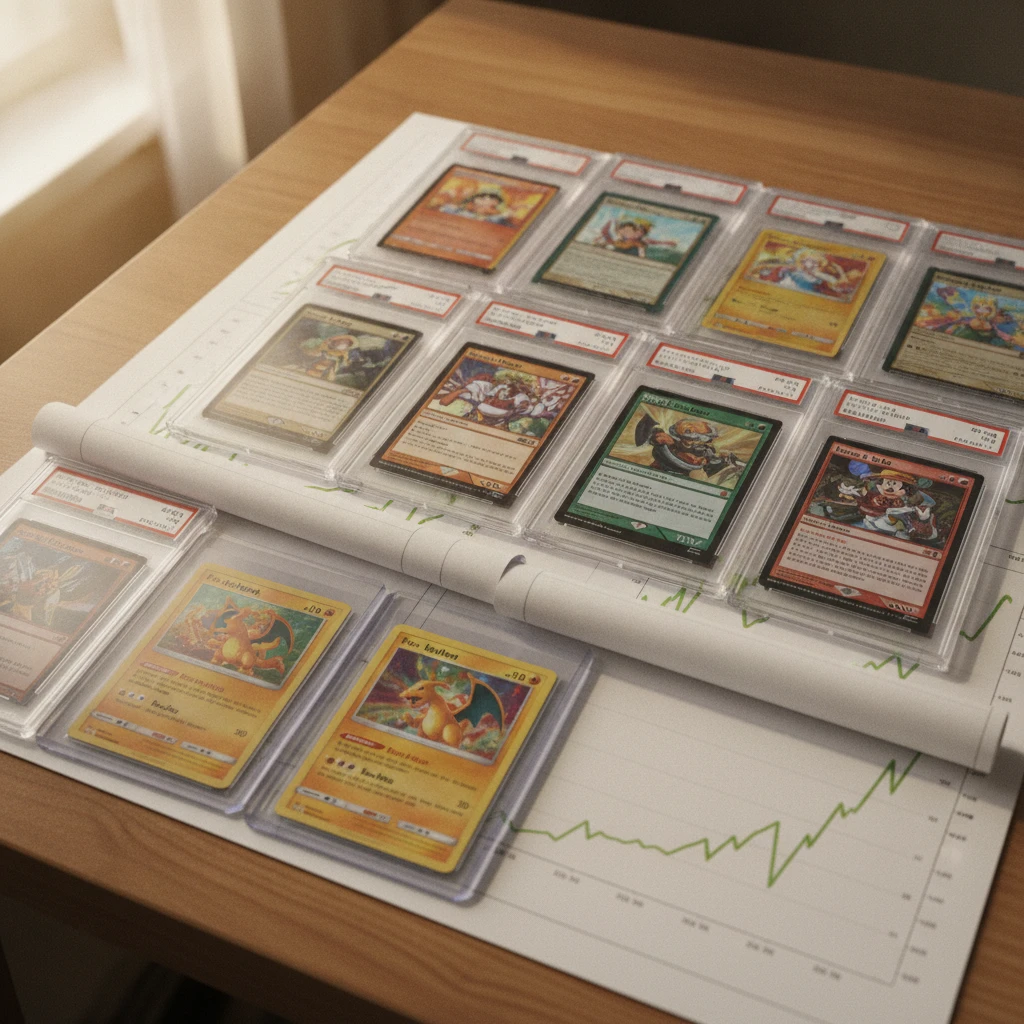
The Short Answer
- Graded TCG cards behave like alternative assets with low correlation to traditional markets but high liquidity variance by franchise.
- The 60/30/10 framework allocates 60% to proven Pokémon/Magic, 30% to growth franchises like One Piece and Lorcana, and 10% to speculative emerging TCGs.
- Vintage provides downside protection through fixed supply; modern chase cards provide upside but carry reprint and pop-report risk.
- PSA 10 is the liquidity benchmark, but BGS/CGC holders can outperform in niche categories like MTG serialized cards.
- Rebalance annually and use AI pre-grading before any new grading commitment to keep fee drag low.
Why Graded TCG Cards Work as an Asset Class
Trading card games have evolved from childhood pastimes into a multi-billion-dollar collectible market. The global TCG market was valued at roughly $8.4 billion in 2025 and is projected to approach $16.9 billion by 2035. Within that market, graded high-end cards function as alternative assets: they have fixed or limited supply, condition-certified scarcity, and global buyer demand.
Pokémon specifically has delivered returns that rival or exceed major equity indices. Academic and market research cite cumulative returns near 3,821% from 2004 to 2025 for a diversified basket of high-grade first-edition Pokémon cards, compared to roughly 483% for the S&P 500 over the same period. Those numbers reflect the top tier of the market, not bulk commons, which underscores the importance of selective portfolio construction.
The risks are equally real. Modern sets can be reprinted, chase-card populations can explode, and liquidity can dry up quickly outside of PSA 10 holders. A thoughtful portfolio diversifies across franchises, eras, and rarities rather than chasing the latest hype card.
The 60/30/10 Graded TCG Portfolio Framework
This framework is designed for a collector-investor with a multi-year horizon and a tolerance for illiquidity. It can be scaled up or down depending on total capital:
- 60% Core Holdings: Proven, liquid franchises with long track records. This sleeve is dominated by Pokémon vintage and select modern, plus Magic: The Gathering Reserved List and serialized cards.
- 30% Growth Holdings: Franchises with rising demand and lower current populations. One Piece TCG and Disney Lorcana fit here in 2026.
- 10% Speculative Holdings: Emerging or niche TCGs with asymmetric upside. This sleeve can include new anime crossover games, limited promo cards, or early sets from franchises that may break out.
The framework intentionally avoids overconcentration in any single card. Even a $50,000 portfolio should hold dozens of graded cards rather than two or three high-value slabs. Diversification protects against population spikes, reprints, and franchise-specific demand shocks.
Pokémon Allocation: Vintage vs Modern
Pokémon is the largest and most liquid TCG investment market. Within the 60% core sleeve, consider a 70/30 split between vintage and modern:
Vintage Pokémon (70% of Pokémon sleeve)
Vintage cards from the Wizards of the Coast era (1999–2003) have fixed supply and deep collector demand. Key targets include:
- Base Set 1st Edition holos — Charizard, Blastoise, Venusaur. PSA 10 copies are six-figure assets.
- Shadowless Base Set cards — the pre-1st Edition print run with thinner shadow borders.
- Jungle and Fossil 1st Edition holos — lower absolute prices than Base Set but strong liquidity.
- Japanese vintage promos — such as the Pikachu Illustrator family, which has produced seven-figure auction sales.
Modern Pokémon (30% of Pokémon sleeve)
Modern cards carry reprint and population risk, but they also drive current grading volume. Allocate to:
- Alt art SARs from Scarlet & Violet era sets with demonstrated PSA 10 multipliers.
- 2026 release chase cards from Mega Evolution—Pitch Black, 30th Celebration, and Abyss Eye/Storm Emeralda.
- Sealed product as a hedge against single-card volatility, if you have secure storage.
Vintage provides downside protection; modern provides growth. Rebalance as market cycles shift between the two.
Magic: The Gathering Allocation: Reserved List and Serialized
Magic offers a different risk profile than Pokémon. The player base is older and more competitive, and card value is supported by both collectibility and tournament demand. The MTG sleeve should focus on two categories:
Reserved List Staples
The Reserved List is a Wizards of the Coast policy承诺 not to reprint certain older cards. That policy creates supply certainty. Black Lotus, Mox cards, and Ancestral Recall are the blue chips, but high-grade Reserved List cards across many colors and sets provide exposure. The downside case is policy risk — if Wizards ever revisits the Reserved List, values could reset.
Serialized Cards and Premium Products
Serialized cards and limited-run collector products have introduced scarcity-based investing to modern MTG. These cards have serial numbers and low print runs, making them attractive to registry collectors. Grading serialized cards with CGC or BGS is common, and PSA 10 copies appeal to cross-category buyers.
Modern Standard-legal chase cards can be profitable but are more sensitive to reprints, bans, and format rotations. Limit this portion of the MTG sleeve to cards with clear long-term casual or Commander demand.
Growth Allocation: One Piece and Lorcana
The 30% growth sleeve targets franchises with expanding collector bases and relatively low current PSA 10 populations.
One Piece TCG
One Piece has the strongest anime-driven demand growth of any TCG in 2025–2026. The growth thesis rests on:
- Global anime popularity driving new collectors into the TCG.
- Low PSA 10 populations on early alt-art Leaders compared to Pokémon equivalents.
- Competitive tournament support creating recurring demand for playable chase cards.
Target alt-art Leaders, Treasure Rares, and early OP-01/OP-02 high-end cards in PSA 10. Be aware that Bandai can reprint, so focus on cards where the rarity structure limits supply.
Disney Lorcana
Lorcana’s growth is driven by Disney IP recognition and a collector base that overlaps with Disney pin and vinyl collectors. Enchanted Rares are the flagship graded asset. The risk is that Lorcana is still proving long-term competitive staying power; the opportunity is that early Enchanted Rares could become iconic if the game endures.
Within the growth sleeve, a 60/40 One Piece/Lorcana split reflects current demand and liquidity differences.
Speculative Sleeve: Emerging TCGs
The 10% speculative sleeve is where high risk meets high reward. This allocation is not about grading every new TCG; it is about identifying early signals of breakout demand before the broader market prices them in.
Candidates for the speculative sleeve in 2026 include:
- Dragon Ball Super high-end SCR and God Rare cards, especially around championship seasons.
- Flesh and Blood Cold Foil and Fabled cards, which have loyal competitive and collector followings.
- Digimon Ultimate Rare and alt-art cards from BT-25 Dual Revolution and related sets.
- Weiss Schwarz, Grand Archive, and Union Arena limited signed cards and event promos with small English populations.
- Star Wars: Unlimited early sets and hyperspace foil variants as the franchise expands.
Rules for the speculative sleeve: never allocate more than 2% of the portfolio to any single speculative card, grade only when the AI predicts gem condition, and be willing to hold through illiquidity.
Liquidity and Rebalancing Rules
Liquidity varies dramatically across a graded TCG portfolio. PSA 10 Pokémon chase cards can sell in days; a BGS 9.5 Flesh and Blood Fabled card may take weeks to find the right buyer. Manage liquidity with these rules:
- Keep 10–20% of the portfolio in “cash-equivalent” cards — liquid PSA 10 Pokémon or MTG cards that can be sold quickly if needed.
- Rebalance annually. Sell portions of sleeves that have grown beyond target allocation and redeploy into underweight categories.
- Take profits on spikes. If a modern chase card jumps 300% after a set release, consider selling a portion to fund vintage acquisitions.
- Track population reports. A sudden population increase in your PSA 10 card is a warning sign that supply may overwhelm demand.
- Insure the collection for replacement value, not purchase price. Graded TCG values can appreciate faster than standard collectibles policies.
Rebalancing is not market timing. It is a disciplined way to maintain the risk profile you chose when building the portfolio.
Managing Grading Fee Drag With AI Pre-Screening
Grading fees are the silent killer of TCG portfolio returns. At $79.99 per PSA Regular submission, grading ten borderline cards and getting six PSA 9s can turn a profitable year into a breakeven one. The solution is to pre-screen every card before submission.
PreGradeCards AI grading lets you:
- Batch-screen acquisitions and reject cards that will not reach PSA 10.
- Estimate raw vs graded value with the What’s My Card Worth tool to decide whether to grade or sell raw.
- Compare grading companies to see whether PSA, BGS, CGC, or SGC offers the best expected net value for each card.
- Document condition with timestamped reports for insurance or buyer confidence.
A well-run portfolio treats AI pre-grading as an operating expense, not an optional step. The cost of a few AI credits is trivial compared to the cost of a failed PSA submission. PreGradeCards offers free credits to start, so new portfolio builders can integrate pre-screening from day one.
Building a graded TCG investment portfolio in 2026 is as much about discipline as it is about card selection. Diversify across franchises, balance vintage and modern, manage liquidity, and pre-grade every candidate. The collectors who follow that framework will be positioned to benefit from the long-term growth of the TCG market while surviving its inevitable corrections.
Frequently Asked Questions
Are graded TCG cards a good investment in 2026?
What percentage of a TCG portfolio should be Pokémon?
Should I invest in One Piece TCG cards?
Is Lorcana a good long-term investment?
How often should I rebalance my graded card portfolio?
Can AI pre-grading save money on a large portfolio?
Sources & Further Reading
- Caleb Nichols — Pokémon TCG Investment Outlook 2026
- Zenodo — Pokémon TCG as an Alternative Investment Asset Class
- QPMarketNetwork — Most Popular Trading Card Games 2026
Marcus Chen has evaluated over 50,000 sports cards and TCG cards across PSA, BGS, SGC, and CGC standards. Before joining PreGradeCards, he worked as a submission specialist for a major grading company and trained collectors and dealers on condition assessment.
Create a free account and get 1 free credit — enough for 1 complete AI grading with market pricing. No credit card required.
Sign Up Free →