The Short Answer
- Topps Chrome is the most graded baseball product — Ohtani's 2018 Topps Chrome #150 has an 87.5% PSA 10 gem rate, one of the highest in the hobby.
- The #1 reason Topps Chrome cards miss PSA 10 is surface scratches — Chrome finish is highly reflective and shows every defect under grading light.
- Refractor parallels have additional surface challenges: refractor lines, print dots, and coating defects that are invisible under normal light but visible under 10x magnification.
- Centering is generally consistent on Topps Chrome but can vary — always measure front centering to confirm 55/45 or better before submitting.
- The 2026 Topps Chrome set features Ohtani #1 ($75 PSA 10) and Aaron Judge Minions Variation #100 ($15,744 PSA 10) — the premium chase card.
- AI pre-grading is essential for Topps Chrome — the $0.19/card cost saves $80 per rejected submission by detecting surface issues before you pay.
- PSA is the clear choice for Topps Chrome baseball — the resale premium over BGS and CGC is 15-25% for Chrome cards.
Why Topps Chrome Dominates Grading
Topps Chrome is the most popular baseball card product for grading, and the reasons are clear: Chrome cards have high gem rates, strong PSA 10 premiums, and broad collector demand. The Chrome finish gives cards a premium feel and appearance that translates to higher resale values.
The data supports this. Ohtani's 2018 Topps Chrome #150 has an 87.5% PSA 10 gem rate — meaning nearly 9 out of 10 clean copies come back PSA 10. The #HMT32 Highlights insert has an 84.5% gem rate. These are among the highest gem rates in the entire sports card market.
Topps Chrome also has the broadest product range. The base Chrome card is the entry point, followed by Refractor parallels (/199, /150, /99, /75, /50, /25, /10, /5, /1), and autograph variations. Each parallel tier has its own value proposition and grading considerations.
Chrome Surface Issues
The #1 reason Topps Chrome cards miss PSA 10 is surface defects. The Chrome finish is highly reflective, which means every scratch, print line, and surface imperfection is visible under grading lights. Here are the most common surface issues:
Surface Scratches
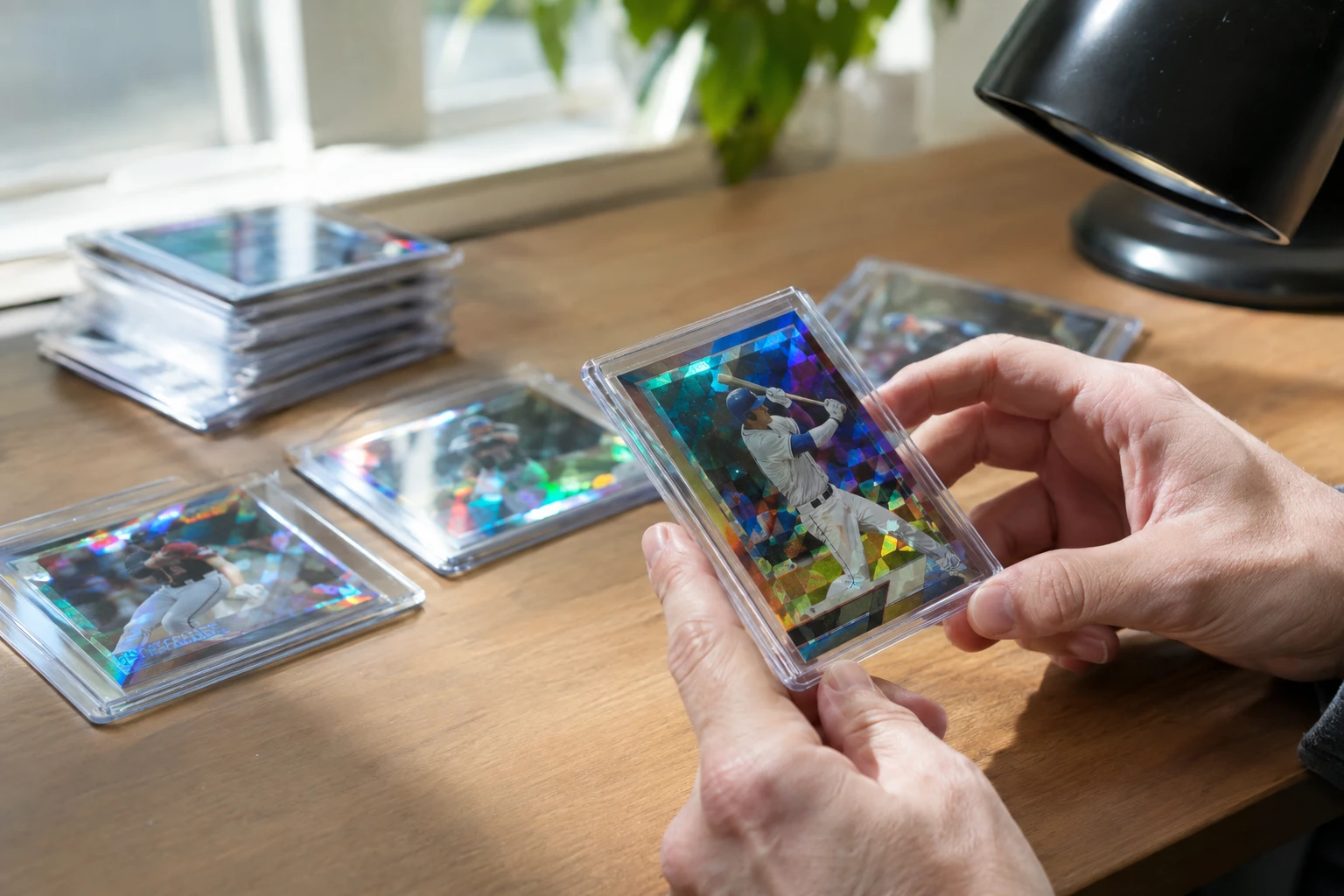
The most common Chrome surface issue. Scratches can occur during the packaging process, during handling, or from card sleeves with rough interiors. Even light scratches that are invisible under normal lighting can be visible under the angled LED lights used by PSA graders. To detect: hold the card under a bright light at a 45-degree angle and tilt slowly — scratches will appear as bright lines against the reflective Chrome surface.
Print Lines
Print lines are manufacturing defects that appear as thin horizontal or vertical lines on the card surface. They are caused by printing head inconsistencies during the Chrome coating process. Print lines are not damage — they are production defects — but PSA will still downgrade for them if visible under 10x magnification.
Print Dots
Print dots are small circular defects in the Chrome coating. They appear as tiny dark or light spots on the card surface. Like print lines, they are manufacturing defects, not handling damage. PSA may or may not downgrade for print dots depending on their visibility and quantity.
Fingerprints and Residue
Chrome surfaces are notorious for showing fingerprints. Even clean hands can leave oils on the Chrome surface that appear as cloudy spots under grading lights. Always handle Chrome cards by the edges with clean, dry hands or cotton gloves. If you see residue, clean gently with a microfiber cloth before submitting.
Refractor Parallel Grading
Refractor parallels add another layer of complexity to Chrome grading. The refractor coating creates a rainbow effect that is visually striking but also introduces unique surface challenges:
- Refractor lines: The refractor coating can have lines or waves that are visible under direct light. These are manufacturing artifacts and may or may not affect the grade.
- Coating defects: The refractor coating can have thin spots or bubbles that appear as dark or light spots.
- Edge coating: The refractor coating extends to the card edges, and edge wear is more visible on refractors than on base Chrome cards.
Despite these challenges, refractor parallels are worth grading because the PSA 10 premium is higher. An Ohtani 2018 Topps Chrome #150 Refractor PSA 10 sells for $2,450 — 3.3x the base Chrome PSA 10 value of $735. The gem rate is 69.1% (vs. 87.5% for the base), but the higher value more than compensates.
| Parallel | Print Run | Raw Premium | PSA 10 Premium |
|---|---|---|---|
| Base Chrome | Unlimited | 1x | 1x |
| Refractor | ~1:3 packs | 3x | 3.3x |
| Green Refractor | /99 | 8x | 10x |
| Orange Refractor | /25 | 20x | 25x |
| Gold Refractor | /50 | 15x | 20x |
| Red Refractor | /5 | 50x | 60x |
| Superfractor | /1 | 100x+ | 150x+ |
Premium multipliers are approximate and based on Ohtani 2018 Topps Chrome #150 values. Actual premiums vary by player and set year.
Centering on Chrome Cards
Centering on Topps Chrome baseball cards is generally more consistent than on Topps flagship paper cards. The Chrome printing process uses higher-quality control, resulting in better centering across the sheet. However, centering issues still occur, especially on high-volume print runs.
For PSA 10, the centering requirement is 55/45 front and 75/25 back. Most Topps Chrome cards meet this standard, but you should always measure before submitting. The easiest way to measure centering is to use a centering tool or ruler:
- Measure the left and right borders (in millimeters)
- Measure the top and bottom borders
- Calculate the ratio: smaller border / larger border
- If the ratio is 55/45 or better (0.55/0.45 = 1.22 or less), the card meets PSA 10 centering
For Refractor parallels, centering is typically the same as the base Chrome since they are from the same print sheet. However, low-numbered parallels (/25, /10, /5, /1) may have more centering variance because they are printed on different sheet positions.
2026 Topps Chrome Breakdown
The 2026 Topps Chrome baseball set is the current flagship Chrome release. Here are the key cards and their values:
| Card | Raw | PSA 9 | PSA 10 |
|---|---|---|---|
| Shohei Ohtani #1 | $9 | $25 | $75 |
| Aaron Judge #100 | $2 | $13 | $38 |
| Aaron Judge [Image Variation] #100 | $132 | $236 | $700 |
| Aaron Judge [Minions Variation] #100 | $3,175 | $5,310 | $15,745 |
| Shohei Ohtani [Prism Refractor] #1 | $31 | $78 | $231 |
Values from SportsCardsPro, August 2026 data.
The Aaron Judge Minions Variation is the premium chase card of the 2026 Topps Chrome set. At $3,175 raw and $15,745 PSA 10, it is one of the most valuable modern baseball cards. If you pull this card, grade it immediately — the PSA 10 premium is 5x the raw value.
Pre-Screening Protocol
Before submitting any Topps Chrome card to PSA, follow this pre-screening protocol:
Step 1: Surface Check (2 minutes)
Hold the card under a bright LED light at a 45-degree angle. Tilt the card slowly in all directions. Look for: scratches (bright lines), print lines (dark lines), print dots (dark/light spots), and fingerprints (cloudy areas). If you see any of these under angled light, PSA will likely see them too.
Step 2: Centering Check (1 minute)
Measure the left/right and top/bottom borders. Calculate the ratio. If front centering is worse than 55/45, the card will not grade PSA 10. If centering is 60/40 or worse, the card may not grade PSA 9.
Step 3: Corner Check (1 minute)
Examine all four corners under 10x magnification. Look for whitening, fraying, or dinging. Chrome cards can have corner whitening from the packaging process. Any visible corner damage under 10x will prevent PSA 10.
Step 4: Edge Check (1 minute)
Examine all four edges under 10x magnification. Look for chipping, roughness, or wear. Chrome edges are generally clean, but pack-fresh cards can have edge roughness from the cutting process.
Step 5: AI Pre-Grading (30 seconds)
Upload a high-quality scan to AI pre-grading. The AI will assess centering, corners, edges, and surface, and predict the PSA grade. Cost: $0.19 per card. If the AI predicts PSA 9 or lower, do not submit — the $0.19 cost saved you $80 in grading fees.
Submission Strategy
For Topps Chrome baseball cards, PSA is the clear choice. The PSA resale premium for Chrome cards is 15-25% over BGS and CGC, which more than justifies the similar or slightly higher grading fee.
For Base Chrome Cards ($5-$50 PSA 10)
Only grade if the card is a star player rookie or short-print variation. Common base Chrome cards are not worth the $79.99 grading fee. Use PSA Regular ($79.99) for cards worth $50+ in PSA 10.
For Refractor Parallels ($50-$2,000 PSA 10)
Use PSA Regular ($79.99) for refractors worth $100-$500 in PSA 10. Use PSA Express ($149) for refractors worth $500+ — the faster turnaround allows you to sell sooner and reinvest.
For Premium Variations ($2,000+ PSA 10)
Use PSA Express ($149) or Walk-Through ($599) for premium variations like the Judge Minions ($15,745 PSA 10). The premium service ensures careful handling and faster turnaround for high-value cards.
ROI Calculator for Chrome Cards
Here is the ROI calculation for key Topps Chrome baseball cards:
| Card | Raw | PSA 10 | Gem Rate | Exp. Profit | ROI |
|---|---|---|---|---|---|
| Ohtani Chrome #150 | $350 | $735 | 87.5% | $254 | 73% |
| Ohtani Chrome #150 Refractor | $1,140 | $2,450 | 69.1% | $584 | 51% |
| Ohtani Chrome 1983 #83T-6 | $295 | $1,050 | 33.2% | $133 | 45% |
Expected profit = (Gem Rate × PSA 10) + ((1-Gem Rate) × PSA 9) - Raw - $79.99. Data from Business of Card Grading, February 2026.
Frequently Asked Questions
What is the PSA 10 gem rate for Topps Chrome baseball cards?
Why do Topps Chrome cards miss PSA 10?
Are Refractor parallels worth grading?
Should I use PSA or BGS for Topps Chrome?
What is the most valuable 2026 Topps Chrome card?
How do I pre-screen Topps Chrome cards for PSA 10?
Is it worth grading common Topps Chrome base cards?
What is the best Topps Chrome baseball card to grade for profit?
Sources & Further Reading
- Business of Card Grading — Grading Shohei Ohtani for Profit
- SportsCardsPro — 2026 Topps Chrome Card Prices
- PreGradeCards — Baseball Card Grading Guide 2026
- CardGrade — Card Grading Trends April 2026
The PreGradeCards Research Team combines machine-learning engineers, grading analysts, and collector-education specialists to produce accurate, data-driven guides on AI card grading, professional grading standards, and collecting strategy.
Create a free account and get 1 free credit — enough for 1 complete AI grading with market pricing. No credit card required.
Sign Up Free →