The Short Answer
- The T206 Honus Wagner is the most famous baseball card: PSA 9 sold for $12.6M. Authentic low-grade copies exist at $4M-$9M. Only ~60 known copies.
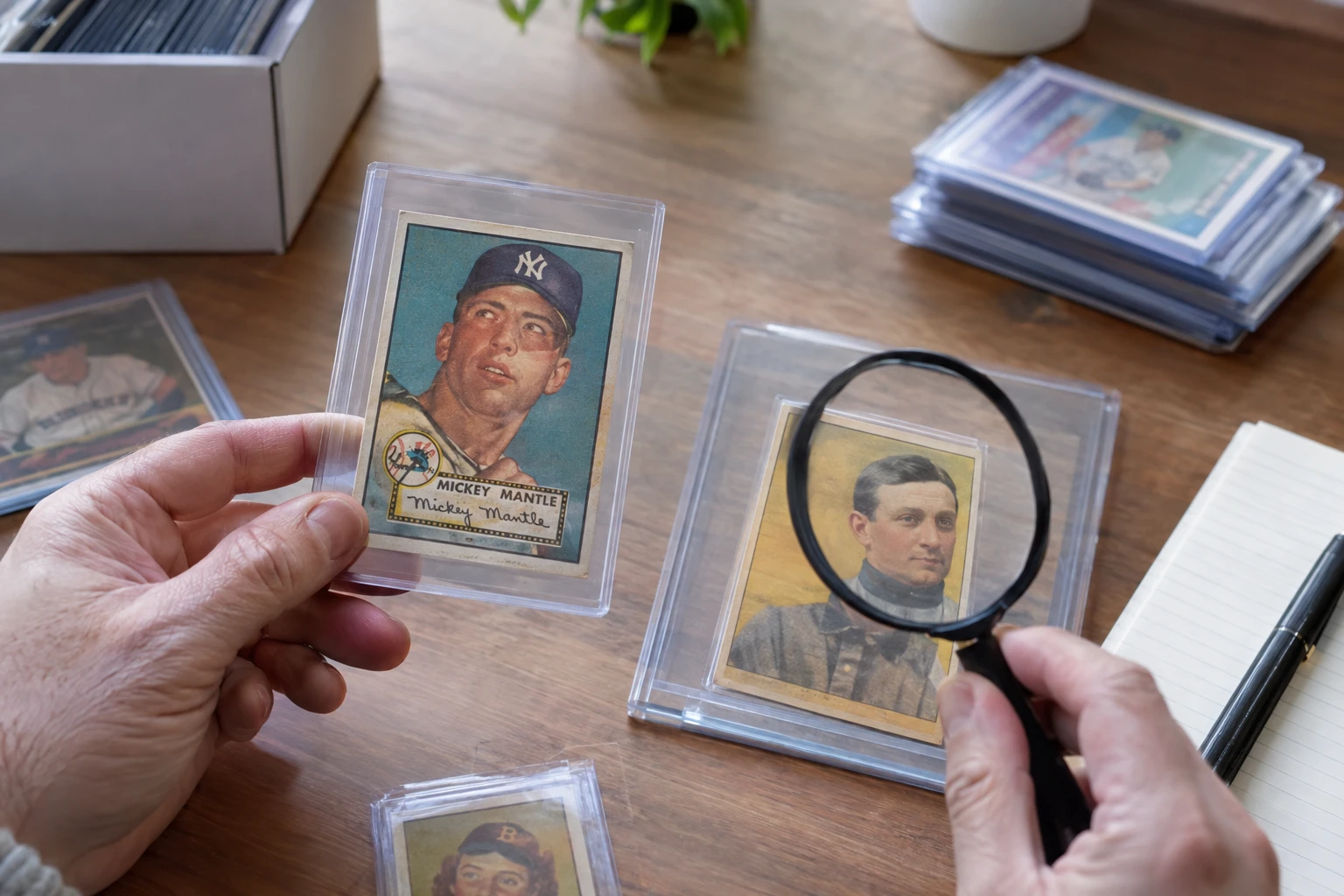
- The 1952 Topps Mickey Mantle #311 is the post-war grail: PSA 9 sold for $12.6M. PSA 5 copies trade at $80K-$150K. Even played examples command mid-five figures.
- Vintage grading uses era-appropriate standards: PSA 5-6 is strong for pre-1960, PSA 7-8 is exceptional. Centering is more forgiving (75/25 allowed for PSA 8 pre-1960).
- PSA dominates vintage resale with the highest premiums, but SGC is the vintage specialist with a strong pre-war reputation and $15/card pricing.
- The 1955 Topps Roberto Clemente RC PSA 9 sold for $1.1M. The 1954 Topps Hank Aaron RC PSA 9 is around $200K.
- Authentication is critical — the 1952 Mantle is the most counterfeited card in history. PSA authentication alone justifies the grading fee.
- Pre-war PSA 10s are nearly impossible — hand-cutting and 70+ years of aging make Gem Mint pre-1970 cards statistically improbable.
Pre-War Era (1880s-1948)
The pre-war era is the foundation of vintage baseball card collecting. These cards were produced from the 1880s through the 1940s, primarily as tobacco and candy inserts. The condition challenges are extreme — these cards are 75-140 years old, were handled by children or stored in cigarette packs, and were produced with rudimentary printing and cutting technology.
T206 Honus Wagner (1909-1911)
The T206 Honus Wagner is the most famous and most valuable baseball card in existence. PSA 9 sold for $12.6 million in 2022. The T206 price guide shows grade-by-grade values: PSA 1 at $4M, PSA 5 at $9M, PSA 9 at $10.5M+. Only approximately 60 known copies exist, and high-grade examples rarely appear at auction.
For context, the Wagner is not just a baseball card — it is a cultural artifact. The card was pulled from production early, likely because Wagner objected to tobacco products being marketed to children. This created the scarcity that drives its value. Any Wagner, in any grade, is a seven-figure card.
Other Pre-War Key Cards
- 1933 Goudey #92 Lou Gehrig: PSA 9 sold for $1.3M. The premium Gehrig card.
- 1933 Goudey #181 Lou Gehrig: Alternate Gehrig, PSA 9 around $900K.
- 1914 Baltimore News Babe Ruth: Ruth's true pre-rookie. Under 10 confirmed copies. Sold $7.2M in 2021.
- 1933 Goudey #53 Babe Ruth: More accessible Ruth at PSA 7 ($30K-$60K).
Pre-war cards should always be graded — the authentication alone is worth the grading fee. Counterfeit pre-war cards are common, and PSA authentication provides confidence that the card is genuine. For any pre-war card worth $500+, grading is mandatory.
Post-War Era (1950s-1960s)
The post-war era is where vintage baseball card collecting becomes accessible to more collectors. Topps began producing annual sets in 1951, and the 1952 Topps set is the most iconic in hobby history.
1952 Topps Mickey Mantle #311
The 1952 Topps Mickey Mantle is the defining post-war baseball card. PSA 9 sold for $12.6 million. PSA 5 copies trade at $80K-$150K. Even played examples with visible wear command mid-five figures. The card is the most counterfeited card in history — authentication through grading is essential for any copy.
The 1952 Topps set was produced in high volume but many unsold cases were dumped into the ocean, creating scarcity for the high-number series (including the Mantle). This is why the Mantle is rare in high grade — most surviving copies were handled by children and show significant wear.
Other Post-War Key Cards
- 1954 Topps Hank Aaron RC: PSA 9 around $200K, PSA 8 $60K+. Aaron's true rookie card.
- 1955 Topps Roberto Clemente RC: PSA 9 sold for $1.1M. PSA 8 around $200K. Clemente's only mainstream rookie.
- 1955 Topps Sandy Koufax RC: PSA 9 around $500K, PSA 8 $80K. Koufax's rookie card.
- 1968 Topps Nolan Ryan RC (shared with Jerry Koosman): PSA 10 around $150K, PSA 9 $12K-$18K. Ryan's rookie card.
- 1969 Topps Reggie Jackson RC: PSA 9 $30K-$40K. Jackson's rookie card.
Post-war cards are graded with more lenient standards than modern cards but stricter than pre-war. A 1955 Topps Clemente with 70/30 centering and slight corner rounding might grade PSA 5 — the same condition on a 2024 card would grade PSA 2-3. Era context is everything.
1970s-1980s Vintage
The 1970s and 1980s represent the transition from vintage to modern. Cards from this era are more common than pre-war and post-war issues, but key rookie cards of Hall of Famers still command significant premiums in high grade.
Key 1970s-1980s Cards
- 1975 Topps George Brett RC / Robin Yount RC: Both on the same card (#228). PSA 9 around $200-$400.
- 1978 Topps Eddie Murray RC: PSA 9 around $150-$250. Murray is a 500-home-run club member.
- 1980 Topps Rickey Henderson RC: PSA 9 around $200-$350. Henderson is the all-time stolen base king.
- 1982 Topps Cal Ripken Jr. RC: PSA 9 around $100-$200. Ripken is the Iron Man.
- 1983 Topps Tony Gwynn RC: PSA 9 around $80-$150. Gwynn is a .338 career hitter.
- 1985 Topps Mark McGwire RC: PSA 9 around $50-$100. Olympic Team card.
- 1986 Topps Bo Jackson RC: PSA 9 around $50-$100. Two-sport star.
- 1987 Topps Barry Bonds RC: PSA 9 around $30-$60. Bonds is the all-time home run king.
- 1989 Upper Deck Ken Griffey Jr. RC #1: PSA 9 around $80-$120, PSA 10 $400-$600. The iconic Upper Deck rookie.
The 1989 Upper Deck Griffey is a special case — it is the first card of the premium card era and is collected as both vintage and modern. PSA 10 copies are relatively common (the card was produced with better quality control than earlier Topps issues), but the demand is sustained by Griffey's Hall of Fame status and the card's iconic status.
Vintage Grading Standards
PSA applies era-appropriate grading standards for vintage cards. This means the same physical condition can result in different grades depending on the card's age:
| Era | PSA 10 Rate | Strong Grade | Exceptional Grade | Centering (PSA 8) |
|---|---|---|---|---|
| Pre-1960 | <0.1% | PSA 5-6 | PSA 8 | 75/25 |
| 1960-1969 | ~0.5% | PSA 7 | PSA 8-9 | 70/30 |
| 1970-1979 | ~2-5% | PSA 8 | PSA 9 | 65/35 |
| 1980-1985 | ~5-10% | PSA 9 | PSA 10 | 65/35 |
| 1986-1995 | ~5-15% | PSA 9-10 | PSA 10 | 60/40 |
Data from PSA grading standards analysis. Centering refers to front centering allowed for PSA 8 grade.
Key Principle
A 1952 Topps card with slight corner rounding and 70/30 centering might grade PSA 5 — and still be worth $50,000+ for the Mantle. The same condition on a 2024 card would grade PSA 2-3 and be worth $5. Era context is everything in vintage grading. This is not "easy grading" — it is acknowledging historical manufacturing realities.
PSA vs SGC for Vintage
For vintage baseball cards, the grading company choice is between PSA and SGC. BGS and CGC are less relevant for vintage. Here is the comparison:
| Factor | PSA | SGC |
|---|---|---|
| Resale Premium | Higher | Slightly lower |
| Price | $19.99 bulk (currently paused) | $15/card |
| Pre-War Specialty | Strong | Market leader |
| Set Registry | Yes (drives demand) | No |
| Turnaround | 70-80 days (Regular) | ~10 business days |
| Slab Quality | UV protection, tamper-proof | Basic, easier to tamper |
| Qualifiers | Uses (mk, oc, etc.) | No qualifiers (lower grade) |
Recommendation
For vintage cards worth $1,000+, use PSA — the resale premium and set registry demand justify the higher cost. For vintage cards worth $100-$1,000, use SGC — the $15/card pricing and 10-day turnaround make it the better value, and the SGC resale gap is narrowing. For pre-war cards specifically, SGC has a strong reputation and many high-value pre-war cards are in SGC slabs.
Complete Value Guide
Here is the complete value guide for key vintage baseball cards across all eras:
| Card | Year | PSA 9 Value | PSA 8 Value | PSA 5 Value |
|---|---|---|---|---|
| T206 Honus Wagner | 1909 | $10.5M+ | N/A | $9M |
| 1952 Topps Mantle #311 | 1952 | $12.6M | $1M+ | $80K-$150K |
| 1955 Topps Clemente RC | 1955 | $1.1M | $200K | $15K-$25K |
| 1954 Topps Aaron RC | 1954 | $200K | $60K | $8K-$15K |
| 1955 Topps Koufax RC | 1955 | $500K | $80K | $5K-$10K |
| 1968 Topps Ryan RC | 1968 | $12K-$18K | $3K-$5K | $500-$1K |
| 1989 UD Griffey Jr. RC | 1989 | $80-$120 | $30-$50 | $5-$10 |
Values from CardMarks, T206 Baseball Cards price guide, and PSA auction data, 2026.
Authentication and Counterfeits
Authentication is the single most important reason to grade vintage baseball cards. Counterfeit vintage cards are common, and the most valuable cards are the most counterfeited:
- 1952 Topps Mickey Mantle #311: The most counterfeited card in history. High-quality fakes exist that can fool inexperienced collectors.
- T206 Honus Wagner: High-value tobacco card with known counterfeits.
- 1986-87 Fleer Michael Jordan #57: The most counterfeited modern card.
- 1951 Bowman Mickey Mantle #253: Early Mantle rookie with counterfeit copies.
PSA authentication provides confidence that a vintage card is genuine. For high-value vintage cards, the authentication service alone justifies the grading fee — buyers pay significant premiums for PSA-authenticated vintage over raw cards of unknown origin.
When buying raw vintage cards, look for these red flags: incorrect card stock thickness, modern printing artifacts, glossy finish on cards that should be matte, incorrect font styles, and card dimensions that do not match known originals. When in doubt, buy graded or have the card authenticated before purchasing.
Submission Strategy
For vintage baseball cards, the submission strategy depends on the card's value and the grading company choice:
For Cards Worth $10,000+
Use PSA Walk-Through ($599) or Super Express ($300). The premium service ensures careful handling and faster turnaround. For seven-figure cards, use PSA's highest tier with declared value insurance. SGC is also acceptable for pre-war cards at this value level.
For Cards Worth $1,000-$10,000
Use PSA Express ($149, 20-30 days) or PSA Regular ($79.99, 70-80 days). The PSA resale premium justifies the cost. For pre-war cards, SGC at $15/card with 10-day turnaround is a strong alternative.
For Cards Worth $100-$1,000
Use SGC ($15/card, 10 business days) for the best value. The SGC resale gap is narrowing for vintage, and the $15 pricing with fast turnaround makes it the clear choice for mid-value vintage cards. Use PSA if set registry participation is important.
For Cards Worth Under $100
Consider whether grading is worth it at all. For common vintage cards in low grade, the grading fee may exceed the card's value. Only grade if the card has sentimental value, if you are building a set registry, or if the card is a rookie of a Hall of Famer that might grade higher than expected.
Frequently Asked Questions
What is the most valuable vintage baseball card?
How does vintage card grading differ from modern?
Should I use PSA or SGC for vintage cards?
How much is a 1952 Topps Mickey Mantle worth?
Are pre-war baseball cards worth grading?
What is the PSA 10 rate for vintage baseball cards?
How do I spot a counterfeit vintage baseball card?
What vintage baseball cards should I buy in 2026?
Sources & Further Reading
- T206 Baseball Cards — Price Guide
- CardMarks — Baseball Card Values Guide 2026
- PreGradeCards — Baseball Card Grading Guide 2026
- PreGradeCards — Vintage Card Grading Pre-1980 Guide
- Cardhound Vintage — PSA vs SGC for Vintage Grading
The PreGradeCards Research Team combines machine-learning engineers, grading analysts, and collector-education specialists to produce accurate, data-driven guides on AI card grading, professional grading standards, and collecting strategy.
Create a free account and get 1 free credit — enough for 1 complete AI grading with market pricing. No credit card required.
Sign Up Free →