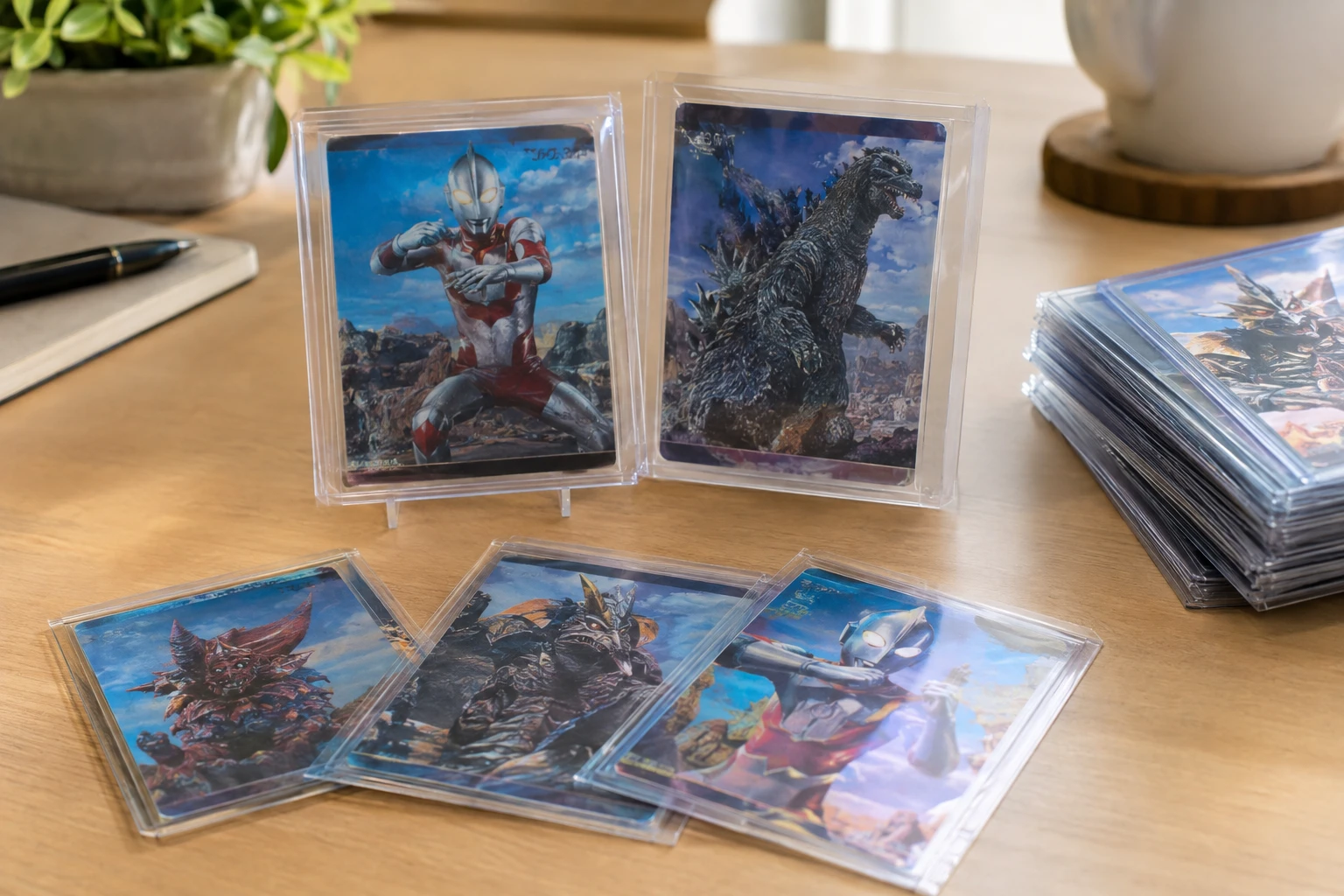
The Short Answer
- AI pre-grading is the most cost-effective way to filter Ultraman cards before professional submission.
- PSA Gem Mint 10 is rare; only 8.88% of submitted cards earn the top grade.
- Converging Bonds and the first World Championship are key 2026 Ultraman grading drivers.
- Four criteria determine grades: corners, edges, surface, and centering.
- PreGradeCards AI matches PSA grades within one point 89% of the time.
Why Grade Ultraman Cards in 2026?
The Ultraman Card Game has reached a new milestone in 2026. After the first World Championship and the release of Booster Pack 08: Converging Bonds, the game is attracting competitive players and nostalgic collectors alike. Ultraman is also celebrating its 60th anniversary, adding extra collector interest to premium cards and promos.
Grading protects condition and can increase resale value. However, professional grading is expensive. PSA Regular is $79.99 per card, BGS runs $20-35, and CGC starts at $15. AI pre-grading is the smarter first step. At roughly $0.19 per card, AI tools evaluate corners, edges, surface, and centering to predict whether a card is worth professional submission.
What Makes Ultraman Cards Valuable?
Several factors drive Ultraman card values:
- Character Recognition: Ultraman, Tiga, Zero, and classic kaiju are the most collectible characters.
- World Championship Prize Cards: The first World Championship produced extremely limited prize cards.
- Converging Bonds Chase Cards: BP08 introduced new high-rarity cards that are top collector targets.
- 60th Anniversary Promos: Anniversary cards celebrating six decades of Ultraman carry nostalgia premiums.
- Condition Scarcity: True gem-mint copies are rare, especially for foil-heavy cards.
The combination of competitive growth, nostalgia, and limited supply makes Ultraman a strong candidate for AI pre-grading.
How AI Pre-Grading Saves Money
AI pre-grading uses computer vision to analyze a card's condition before professional submission. It scans front and back, measures centering, detects corner wear, edge chipping, surface scratches, and print defects, then provides a predicted grade.
The cost advantage is clear. PSA Regular costs $79.99 per card. PreGradeCards AI pre-grading is about $0.19 per card. If you pre-screen 30 Ultraman cards, you spend $5.70 instead of $2,399.70 on blind submissions. The AI filters out the cards unlikely to earn premium grades, letting you submit only the best.
PreGradeCards AI matches PSA grades within one point on 89% of cards in internal testing. This accuracy makes it a reliable tool for Ultraman collectors.
Grading Criteria for Ultraman
Professional graders evaluate Ultraman cards on four criteria.
Corners
Corners must be sharp and free of whitening. TCG cards with thin stock are vulnerable to corner dings. Even a small imperfection can drop a grade.
Edges
Edges should be smooth and clean. Many Ultraman cards have foil borders that show edge wear clearly.
Surface
Surface is the most important factor for foil cards. Look for scratches, print lines, holo clouding, and fingerprints. Use a bright LED at an angle to reveal hidden defects.
Centering
Centering measures border symmetry. PSA allows 60/40 on the front for a Gem Mint 10. Always check both front and back centering.
PSA vs BGS vs CGC for Ultraman
The best grading company depends on your goals.
| Company | Cost | Turnaround | Best For |
|---|---|---|---|
| PSA | $79.99+ | 40-90 days | Highest resale value |
| BGS | $20-35 | 30-75 days | Subgrades and detail |
| CGC | $15+ | 30-120 days | Budget-friendly TCG grading |
| SGC | $15-25 | 10-30 days | Fast turnaround |
PSA is the best choice for high-end chase cards and championship prizes. BGS is ideal for collectors who want subgrades. CGC is a strong budget option. AI pre-grading helps you allocate your cards to the right company.
Top Ultraman Cards to Pre-Grade in 2026
These Ultraman cards are the best pre-grading targets in 2026:
- World Championship prize cards: Extremely limited cards from the first Ultraman Card Game World Championship.
- Converging Bonds chase cards: High-rarity cards from BP08 are top collector targets.
- 60th Anniversary promos: Anniversary cards celebrating Ultraman's 60th anniversary.
- Signature Ultraman cards: Premium foils featuring Ultraman, Tiga, and Zero.
- Classic kaiju cards: Iconic monsters like Zetton and Gomora have nostalgic collector demand.
AI pre-grading helps you identify which of these cards are truly worth the cost of professional grading.
AI Pre-Grading Workflow
Follow this workflow for Ultraman:
- Identify candidates. Pull championship prizes, BP08 chase cards, anniversary promos, and signature foils.
- Clean carefully. Use a dry microfiber cloth. Avoid chemicals and water.
- Scan front and back. Upload high-resolution images with even lighting.
- Review the AI report. Focus on surface, corners, and centering.
- Submit selectively. Send only the best candidates to PSA. Use BGS or CGC for strong but imperfect cards.
- Track results. Compare AI predictions to final grades to refine your eye.
Cost Savings Breakdown
For an Ultraman collector with 25 cards under consideration:
- Without AI: 25 × $79.99 = $1,999.75. If 5 earn PSA 10, you paid $1,999.75 for 5 premium slabs and 20 lower grades.
- With AI: 25 × $0.19 = $4.75 for screening. The AI recommends 8 submissions. 8 × $79.99 = $639.92. Total = $644.67. You save $1,355.08.
AI pre-grading scales with collection size. Collectors who grade hundreds of cards per year can save thousands.
Common Mistakes to Avoid
Avoid these mistakes when grading Ultraman:
- Missing surface defects on foils: Foil cards hide scratches. Use proper lighting.
- Submitting played cards: Only submit pristine cards.
- Ignoring centering: Always check border symmetry.
- Over-cleaning: Thin stock can scratch easily. Be gentle.
- Grading bulk commons: Most common cards are not worth the grading fee.
Conclusion
Ultraman collectors in 2026 can use AI pre-grading to build better graded collections while spending less money. By filtering cards before professional submission, you avoid wasted fees, improve your average grade, and focus on the cards that truly deserve a slab. Whether you are chasing World Championship prizes, Converging Bonds cards, or 60th Anniversary promos, start with AI analysis.
Frequently Asked Questions
Is Ultraman worth grading in 2026?
How much does it cost to grade Ultraman cards?
What is the best grading company for Ultraman?
How accurate is AI pre-grading for Ultraman?
What are the top Ultraman cards to grade in 2026?
How do I clean Ultraman cards before grading?
Sources & Further Reading
The PreGradeCards Research Team combines machine-learning engineers, grading analysts, and collector-education specialists to produce accurate, data-driven guides on AI card grading, professional grading standards, and collecting strategy.
Create a free account and get 1 free credit — enough for 1 complete AI grading with market pricing. No credit card required.
Sign Up Free →