The Short Answer
- Raw 1976 Topps #148 copies list at $279–$350, and the raw market is thin — only a handful appear in a given week.
- PSA 8 copies list around $2,550 and PSA 9 copies around $10,500, with a gem-centered 9 at $16,726.
- No PSA 10 of #148 was listed on 14 November; published values are $150,000+. A 1976 Topps Bears checklist #454 in PSA 10 listed at $101,976.34.
- The 1977 Topps #360 is the second-year card and costs about $20 raw — the cheapest way to own a vintage Payton.
- The 1978 Topps #200 All-Pro card is under $10 raw and captures him at his MVP peak.
- Payton is second all-time in rushing (16,726 yards) with 110 rushing touchdowns and a Super Bowl XX ring.
Why Walter Payton Cards Still Matter
Walter Payton ran for 16,726 yards and 110 touchdowns, won Super Bowl XX with the 1985 Bears, was named NFL MVP in 1977, and made nine Pro Bowls. He set the single-game rushing record with 275 yards against the Vikings in 1977, a mark that stood for 23 years. When he died in 1999, the NFL renamed its Man of the Year award after him.
His rookie card is the 1976 Topps #148, and it sits in a strange spot in the market. It is a genuine vintage rookie of a top-five all-time player, but the supply is thin in the US compared with baseball vintage because football cards of the 1970s were printed and collected in smaller numbers. On 14 November only a handful of raw copies were listed, starting around $279 and reaching $350.
The grade ladder is steep and clean: PSA 8 around $2,550, PSA 9 around $10,500, and a PSA 10 in six figures. There is no cheap slab tier. That makes the raw card the entry point and the PSA 8 the first realistic slab.
For a Bears collector or a vintage football investor, Payton is the anchor. The 1985 team made him a pop-culture figure, and the 1976 card is the only true rookie.
Walter Payton Card Prices at a Glance
Payton's ladder has almost no middle. It jumps from a $300 raw rookie to a $2,550 PSA 8, then to five figures. Plan accordingly: this is a card you buy once, not a card you trade.
| Card | Raw | Graded | Top end | Tier |
|---|---|---|---|---|
| 1976 Topps #148 | $279–$350 | PSA 8 ~$2,550 | PSA 9 $10,500–$16,726 | Core |
| 1977 Topps #360 | ~$20 | — | — | Entry |
| 1978 Topps #200 All-Pro | ~$9.99 | — | — | Entry |
| 1976 Topps #148 PSA 10 | — | — | $150,000+ | Grail |
Asking prices and published values. The raw market is thin; if you see a clean #148 under $250 from a reputable seller, that is a strong buy.
No. 1 — 1976 Topps #148 Rookie (Raw)
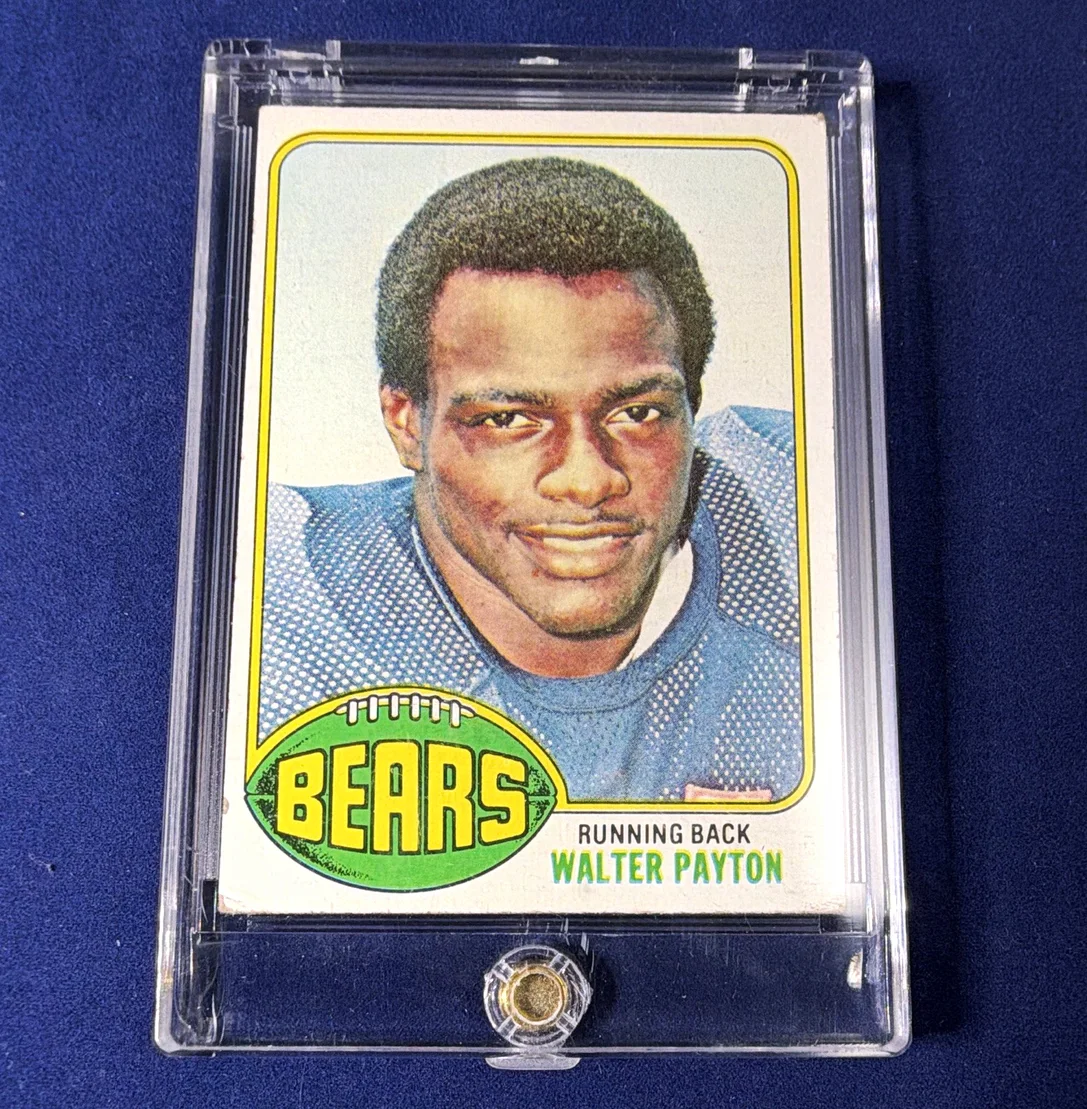
This is the only Walter Payton rookie. The 1976 Topps #148 shows a young Payton in a Bears uniform, printed on the thin stock and rough-cut sheets that defined mid-1970s Topps football. Raw copies on 14 November listed at $279–$350, and even those had visible corner and edge wear.
The raw card is the honest entry point. A 5.5-grade example is typical: 1976 Topps cards were cut with dull blades, so factory rough edges, off-centering and soft corners are the norm. That is also why the high-grade population is so small and why a PSA 9 is a five-figure card.
If you want a Payton rookie you can actually hold, buy raw. Look for a card with no creases, no paper loss on the front and centering that is close to 60/40. Those three things separate a $300 card from a $3,000 card.
Check recent eBay sold prices for the 1976 Topps #148 →
No. 2 — 1976 Topps #148 in PSA 8
The PSA 8 is the first slab most collectors can realistically buy. Listings cluster around $2,550, which is roughly eight times a raw copy and a quarter of a PSA 9. The 8 usually has good eye appeal and honest corners, which is exactly what a vintage football collection needs.
This grade is also the safest hold in the Payton market. It is expensive enough to matter, common enough to trade, and far enough below the 9 that a market correction will not wipe out the value. If you want one Payton rookie in a holder, buy the 8 and stop.
Watch for two things: card stock toning (brown spots on the border) and wax stains on the back. Both are common on 1976 Topps and both cap the grade.
Check recent eBay sold prices for a PSA 8 #148 →
No. 3 — 1976 Topps #148 in PSA 9
The PSA 9 is the serious collector's grade. Listings on 14 November clustered around $10,500, with one gem-centered example asking $16,726. For a card printed in 1976 on thin stock with rough factory edges, a 9 is a genuine survivor.
Payton 9s are scarce enough that they rarely sit on the market. When one appears with good centering and no print dots, it usually sells quickly at or near the ask. That makes this a buy-and-hold grade rather than a trading card.
At this price, verify the cert, check the holder for scratches, and ask for a photo of the card under angled light. Surface indentations that are invisible straight-on are the most common reason a 9 looks like an 8 in person.
Check recent eBay sold prices for a PSA 9 #148 →
No. 4 — 1977 Topps #360 (Second Year)
The 1977 Topps #360 is Payton's second-year card and the cheapest vintage Payton you can buy. Raw copies list around $20, and even graded examples stay under $100.
It is also a historical card: 1977 was the season Payton won NFL MVP and set the single-game rushing record with 275 yards against the Vikings. The card itself is plain, but the story is enormous.
Buy this card if you want a Payton rookie-adjacent card for a binder or a display. It is not an investment, and it does not need to be. Not every card in a collection has to be a slab.
Check recent eBay sold prices for the 1977 Topps #360 →
- Sports Card Auto and Mem and Graded cards pack — $10.00 on eBay →
- sports cards graded 10 — $150.00 on eBay →
- $100 Sports Mystery Graded Card | NFL, NBA, or MLB — $100.00 on eBay →
- sports card singles graded — $35.00 on eBay →
Ad · Listings shown are from eBay. We may earn a commission when you buy through these eBay links. Prices and availability are set by eBay sellers and change often.
No. 5 — 1978 Topps #200 All-Pro
The 1978 Topps #200 is an All-Pro subset card, which makes it slightly more interesting than a base card and slightly scarcer. Raw copies list at about $9.99.
It captures Payton at his peak, one season after the MVP and two years before the Bears became a national story. For a set builder, the 1978 All-Pro is a nice companion to the 1977 base card and the 1976 rookie.
There is no financial angle here. The value is in the story and the price: under $10 for a 48-year-old card of a top-five all-time running back is one of the last bargains in vintage football.
Check recent eBay sold prices for the 1978 Topps #200 →
No. 6 — Bonus: 1976 Topps #148 in PSA 10
The bonus card is the six-figure gem. No PSA 10 copy of the 1976 Topps #148 was listed on 14 November, and published values sit above $150,000. For context, a 1976 Topps Bears team checklist (#454) that pictures Payton in PSA 10 was listed at $101,976.34 — a checklist card, not the rookie.
That gap tells you everything about vintage football supply. The rookie is rare in gem grade because the card was printed on thin stock, cut roughly and rarely preserved. The few PSA 10s that exist are effectively off-market.
If one comes to auction, expect a specialist sale rather than an eBay transaction. Verify the cert, inspect the holder, and use an auction house with a vintage football track record.
Check recent eBay sold prices for a PSA 10 #148 →
How to Buy Payton Rookies Without Overpaying
Payton is a one-card market. The 1976 Topps #148 is the only rookie, and everything else is a season card. Decide which tier you want — raw, PSA 8 or PSA 9 — and buy that tier rather than trying to grade your way up.
For most collectors, a raw copy at $279–$350 is the right first purchase. If you want a slab, the PSA 8 at $2,550 is the fair-value choice. The PSA 9 is a five-figure commitment and should be treated like any other illiquid asset: verify, insure, hold.
The biggest risk in this market is fake or altered vintage. Trimming, recoloring and counterfeit 1976 Topps cards exist. Buy from established dealers, avoid raw cards with suspiciously sharp corners, and never buy a high-grade card without a cert lookup.
- 1976 Topps #148 is the only rookie: 1977 and 1978 cards are second-year and All-Pro issues.
- Expect rough factory edges: 1976 Topps was cut with dull blades — sharp, uniform edges are a counterfeit red flag.
- Check for toning and wax stains: both are common and both cap the grade.
- Buy the grade you want: regrading is negative expected value at every tier.
- Verify certs at five figures: match the PSA number to the card and holder.
- Insure and escrow: standard practice above $10,000.
Run a free AI pre-grade on your card →
Watch & Learn: Sweetness in Motion
The NFL's Payton feature is the best three minutes you can spend before buying his rookie. Watch the running style that made a 1976 base card a six-figure item.
Video: Walter Payton Career Highlight Feature | NFL — NFL
The Full NFL Card Series
The modern side of the series starts with the 2026 rookie class, where most base cards still cost less than a Payton grading fee.


Ad · Listings shown are from eBay. We may earn a commission when you buy through these eBay links. Prices and availability are set by eBay sellers and change often.
Frequently Asked Questions
What is Walter Payton's rookie card?
The 1976 Topps #148 is his only rookie card. It was printed on thin stock with rough factory edges, which is why high-grade copies are so rare.
How much is a Walter Payton rookie card worth in 2026?
Raw copies list at $279–$350, PSA 8 around $2,550, PSA 9 around $10,500 (a gem-centered 9 asked $16,726), and PSA 10 above $150,000.
Is it worth grading a raw Walter Payton rookie?
Only for a genuinely sharp copy. The 8-to-9 jump is roughly $2,550 to $10,500, but rough factory edges mean most raw copies grade 5–7.
Why is there no PSA 10 Payton rookie for sale?
Because the card is extremely rare in gem grade. The few PSA 10s are effectively off-market, and a 1976 Topps Bears checklist in PSA 10 alone listed at $101,976.34.
What is the most valuable Walter Payton card?
A PSA 10 of the 1976 Topps #148, published above $150,000.
Sources & Further Reading
- PSA Population Report — football
- eBay sold listings — Walter Payton rookies
- Pro Football Hall of Fame — Walter Payton
- CardValueFinder — most valuable football cards 2026
- Chicago Bears — Walter Payton career retrospective
Create a free account and get 1,5 free credits. No credit card required.
Get Your Free Credits →