The Short Answer
- eBay dominates Pokémon card sales with 58% of total transaction volume in 2026, but charges 13.25% final value fees. Best for graded cards, vintage, and anything priced $100+.
- TCGPlayer is the best platform for raw modern singles in the $2-$100 range, with 10.25% commission and a massive buyer pool of competitive players.
- Whatnot has the lowest fees at ~8% and is ideal for sealed product and live auctions, but requires seller approval and consistent streaming.
- Always grade vintage WOTC cards before selling — raw vintage takes a 30-50% authentication discount because buyers do not trust ungraded WOTC cards.
- Use free AI pre-grading from PreGradeCards to identify which cards are worth grading before selling. A PSA 10 can sell for 5-25x the raw price, easily covering the $79.99 grading fee.
Short Answer: Where to Sell Pokémon Cards
The best platform to sell Pokémon cards depends on what you have and how much it is worth. eBay is the default choice for graded cards and anything priced above $100. TCGPlayer is the best option for raw modern singles under $100. Whatnot offers the lowest fees for sealed product and live auctions. Facebook Marketplace works for local sales with zero fees. PWCC Marketplace specializes in high-end cards ($500+).
The Pokémon TCG secondary market reached $2.1 billion by mid-2026, with PSA submissions climbing 22% following the 30th Anniversary celebration. More buyers mean more demand, but also more platforms, more fees, and more complex pricing decisions. Choosing the right marketplace can mean the difference between a 6% and 16% fee bite on your sale.
Before selling, always check sold prices (not asking prices) on the platform you plan to use. Use free AI grading from PreGradeCards to determine if your card is worth grading first — a PSA 10 can multiply your selling price by 5-25x, far exceeding the $79.99 grading fee on any card worth more than $30 raw.
Platform Comparison: Fees & Payouts
Here is how the major Pokémon card selling platforms compare on fees, speed, and best use cases in 2026:
| Platform | Total Fees | Speed to Sale | Best For |
|---|---|---|---|
| eBay | ~15-16% | Days to weeks | Graded, vintage, $100+ cards |
| TCGPlayer | ~13% | Hours to weeks | Raw modern singles $2-$100 |
| Whatnot | ~11% | Real-time (live) | Sealed product, live auctions |
| 0-5% | Varies | Local sales, mid-range cards | |
| PWCC | 8-12% | Weeks (auctions) | High-end cards $500+ |
| Local Shop | 40-60% of value | Same day | Bulk, quick cash |
The fee difference matters. Selling a $500 PSA 10 on eBay costs ~$80 in fees. Selling the same card on PWCC costs ~$50-60. Selling a $50 raw card on TCGPlayer costs ~$6.50 vs ~$8 on eBay. For high-volume sellers, these differences add up to thousands of dollars over a year.
eBay: Best for Graded, Vintage & High-Value Cards
eBay remains the dominant marketplace for Pokémon card sales, holding roughly 58% of total transaction volume in 2026. It is the most liquid market for PSA 10s, vintage holos, and any card priced above $100. Here is what you need to know:
Fees: eBay charges a 13.25% final value fee on the total sale amount (including shipping), plus $0.30 per order. Payment processing is included. Promoted listings are optional but increasingly necessary for visibility, adding 2-15% on top. Total effective fee: 15-16% for most sales.
Best for: PSA/CGC/BGS graded cards, vintage WOTC-era cards, auction-format chase cards (Charizards, Lugias, modern alt arts), and anything priced $100+. eBay's massive audience means your card reaches the most potential buyers.
Listing tips: Use the title formula: Year + Set + Player/Pokémon + Card Number + Parallel/Variant + Grade. Example: "1999 Pokemon Base Set 1st Edition Charizard #4/102 PSA 10 Gem Mint." Take clear photos of the front, back, and all four corners. For graded cards, photograph the slab front and back. Price against 30-day sold comps, not active listings.
Auction vs Buy It Now: Use auctions for hyped/rare cards where bidding competition can drive prices up. Use Buy It Now for common cards where you want a predictable sale price. Auctions on hyped cards can close within 7 days at strong prices, while BIN listings for less popular cards can sit for months.
TCGPlayer: Best for Raw Modern Singles
TCGPlayer is the go-to platform for moving raw modern singles at volume. Its standardized condition tiers (NM, LP, MP, HP, DMG) and integrated pricing tools make it the preferred marketplace for competitive players buying staples — which means fast sales for sellers.
Fees: 10.25% commission for standard sellers, 8.95% for Pro sellers (requires $500+/month in sales), plus $0.30 per transaction. Payment processing is included. Total effective fee: ~13% for standard sellers.
Best for: Modern singles in the $2-$50 range, playsets of competitive cards, bulk lots of commons/uncommons, and sellers with 100+ cards to list. TCGPlayer's buyer pool for raw Pokémon cards is massive — if your price is competitive, popular cards sell within hours.
Pricing tip: TCGPlayer's algorithm rewards listings priced at or just below the current market price. If you are 10%+ above market, your card buries on page 5 and never sells. Use the price history charts to see whether prices are trending up (hold firm) or down (undercut to move quickly).
Advantage over eBay: You do not need to take photos of every card on TCGPlayer. The catalog system handles card identification — you just select the set, card number, condition, and price. This saves hours when listing 50+ cards. The Cart Optimizer also routes buyers to your listings even if you are not the cheapest seller, as long as you are close.
Whatnot: Best for Sealed Product & Live Auctions
Whatnot's live auction format has exploded in 2026, particularly for sealed product and pack openings. Sellers go live, viewers bid in real time, and the energy of a live audience often pushes final prices above static marketplace listings.
Fees: 8% seller fee plus ~3% payment processing. Total effective fee: ~11% — the lowest of any major platform.
Best for: Sealed booster boxes and ETBs, live break/pack-opening shows, mystery packs and repacks, and sellers comfortable on camera. Whatnot buyers respond to scarcity and urgency — setting low starting bids ($1) on desirable items often generates higher final prices than fixed BIN pricing.
The catch: Whatnot requires a 1-2 week seller approval process, and successful sellers typically need to commit to consistent streaming schedules to build an audience. It is not a "list it and forget it" platform — you need to show up, engage with viewers, and build a following.
Sealed product strategy: Whatnot is the best venue for selling sealed booster boxes during release windows. The live auction format creates FOMO that drives prices above what static eBay listings achieve. For hot sets like Prismatic Evolutions or 30th Celebration product, Whatnot live sales consistently outperform eBay BIN pricing by 10-20%.
Facebook, PWCC & Local Card Shops
Beyond the big three platforms, several other options serve specific selling needs:
Facebook Marketplace & Groups: Zero fees for local pickup, ~5% for shipped items. Facebook Groups dedicated to Pokémon trading operate via PayPal, Venmo, or Zelle between buyer and seller. Best for sellers with established reputation in groups, local sales, and mid-range cards ($20-$200) where saving on platform fees makes a real difference. Sell a $50 card via Facebook Groups with PayPal and you keep ~$47.53 after PayPal's 2.89% + $0.49 fee — vs ~$42 on eBay.
PWCC Marketplace: The preferred venue for cards priced $500 and above. Tiered fee structure starts at 12% and decreases for higher-value items, making them increasingly competitive on cards above $2,500. PWCC's monthly Premier Auctions attract serious collectors and investors, and consigned cards routinely realize 10-15% higher final prices than equivalent eBay listings. Best for vintage Charizards, high-grade modern alt arts ($500+), and sealed vintage product.
Local Card Shops: No platform fees, but shops typically offer 40-60% of market value for raw cards and 60-75% for graded cards. Some shops offer 10-20% more in store credit than cash. Best for bulk modern (commons, uncommons, low-end rares at $0.01-$0.05 per card) and when you need cash the same day. Not recommended for valuable cards — you will lose 40-60% of the value for the convenience of an instant sale.
COMC (Check Out My Cards): For sellers with a few hundred mid-tier Pokémon cards who do not want to list one by one. COMC processes, photographs, and lists everything; you collect proceeds as cards sell over weeks/months. Fees are higher than TCGPlayer but the hands-off approach saves significant time.
How to Price Pokémon Cards for Sale
Pricing is the single most important factor in how fast your Pokémon cards sell and how much money you keep. Here is the proven pricing framework:
1. Find the real market price. Search eBay for your card, filter to "Sold Items," and look at the last 5-10 sales. Ignore outliers (auctions with single bidders, BIN sales that sat for months). Average the middle 5 sales. This is your market price.
2. Match condition accurately. If your card has edge whitening, soft corners, or surface scratches, it is not near-mint. Price it as lightly played (30% below NM) or moderately played (50-60% below NM). Overpricing a played card as near-mint leads to returns, negative feedback, and wasted listing time.
3. Price to sell, not to dream. If you want a fast sale, price 5-10% below the market average. If you can wait, price at market and accept offers. Never price 20%+ above market — the card will sit indefinitely and you will end up relisting at a lower price anyway.
4. Factor in fees. If your card sells for $100 on eBay, you keep ~$84 after fees. On TCGPlayer, you keep ~$87. On Facebook, you keep ~$97. Calculate your net payout, not just the listing price, to compare platforms.
5. Check the trend. Is the card's price rising, flat, or falling? If rising, hold firm on price. If falling, undercut to sell quickly before the price drops further. Use PriceCharting or Card Ladder to see 30-day and 90-day trends.
When to Grade Before Selling
One of the most important selling decisions is whether to grade your card before listing it. Grading can multiply your selling price by 5-25x, but it costs $79.99 per card and takes 2-6 months. Here is the decision framework:
Always grade before selling if:
- The card is vintage WOTC-era (1999-2003) in near-mint or better condition. Raw vintage takes a 30-50% authentication discount — buyers simply do not trust ungraded WOTC cards. A PSA 5 vintage Charizard is worth more than a raw one.
- The PSA 10 sold price is at least 3x the raw price plus $100 grading cost. For example, a $50 raw card with a $400 PSA 10 value is clearly worth grading.
- The card is worth $100+ raw and appears to be in gem-mint condition. The grading premium on a $100 card that becomes a $500 PSA 10 easily justifies the fee.
Sell raw if:
- The card is worth less than $25 raw. Grading costs more than the card is worth, even at PSA 10.
- The grading premium is less than 2x. Some modern cards with 15,000+ PSA 10s have minimal grading premiums.
- You need cash now. Grading takes 2-6 months — if you need liquidity, sell raw.
Use free AI pre-grading first. PreGradeCards offers 30 free credits on signup. Upload photos of your card and the AI predicts the PSA grade with 89% accuracy within ±1 point. If the AI predicts PSA 9.5-10, grade it. If it predicts PSA 7-8, sell raw. This simple step saves the average collector 40-60% on wasted grading fees.
Shipping & Packaging Guide
Proper shipping protects your cards and prevents disputes. Here is how to ship Pokémon cards safely:
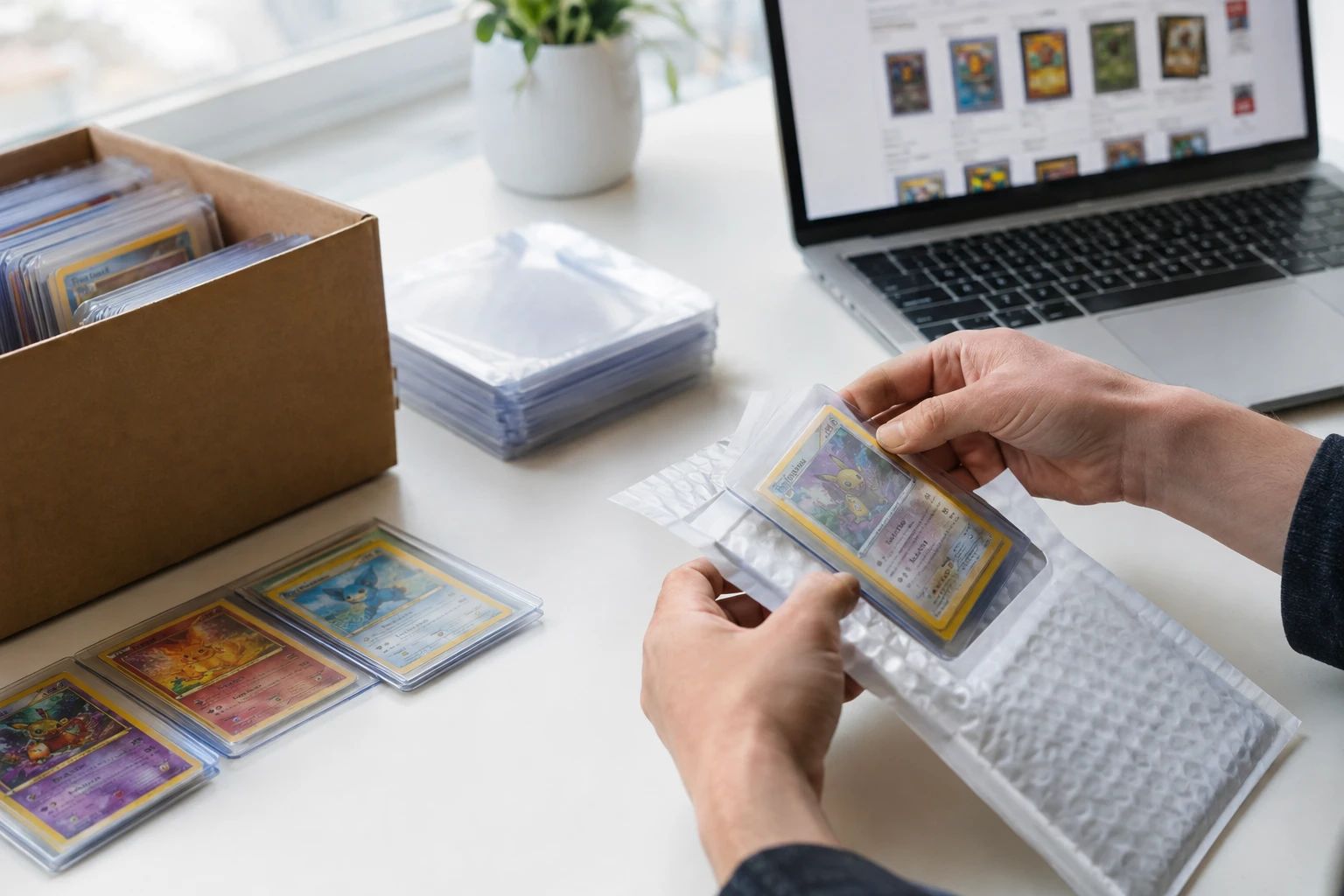
For raw cards under $20: Place the card in a penny sleeve and top loader. Wrap in a piece of thin cardboard or a team bag. Ship in a plain white envelope (PWE) with a stamp. Cost: ~$1. Always include a tracking number for sales above $10.
For raw cards $20-$100: Place in penny sleeve, top loader, and team bag. Wrap in bubble wrap. Ship in a bubble mailer via USPS First Class Package with tracking. Cost: ~$3-4.
For graded slabs: Wrap the slab in bubble wrap (2-3 layers). Place in a small box with packing material. Ship via USPS Priority Mail with insurance and signature confirmation. Cost: ~$8-15 plus insurance ($2.50 per $100 of declared value).
For high-value sales ($500+): Always use USPS Priority Mail Express with full insurance and signature confirmation. Photograph the card before shipping, during packaging, and the sealed package for insurance proof. Require direct signature (not just delivery confirmation).
International shipping: Use eBay's Global Shipping Program for hassle-free international sales. The program handles customs, tracking, and buyer protection. For direct international shipping, use USPS First Class Package International with tracking where available.
Frequently Asked Questions
Where is the best place to sell Pokémon cards in 2026?
How much does it cost to sell Pokémon cards on eBay?
Should I grade my Pokémon cards before selling?
Can I sell Pokémon cards locally for cash?
What fees does TCGPlayer charge sellers?
How do I price Pokémon cards for sale?
Is Whatnot good for selling Pokémon cards?
Sources & Further Reading
- eBay Seller Fees & Policies 2026
- TCGPlayer Seller Program
- Whatnot Seller Guide
- PWCC Marketplace
- PreGradeCards Free AI Card Grading
The PreGradeCards Research Team combines machine-learning engineers, grading analysts, and collector-education specialists to produce accurate, data-driven guides on AI card grading, professional grading standards, and collecting strategy.
Create a free account and get 1 free credit — enough for 1 complete AI grading with market pricing. No credit card required.
Sign Up Free →