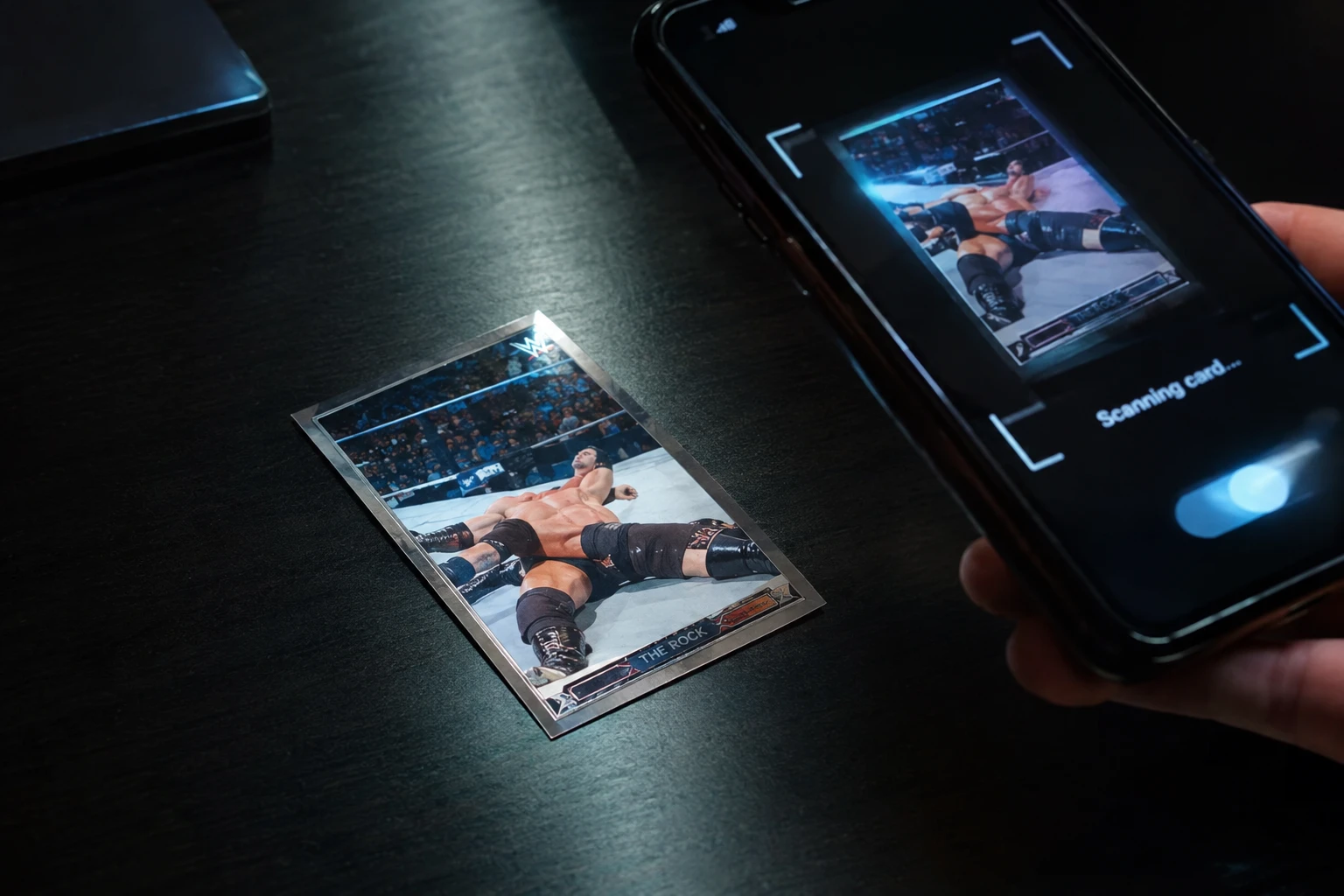
The Short Answer
- WWE Prizm/Select rookies of top stars and legend autos carry the graded premiums.
- Panini's modern stock centers well; surface print lines are the most common 10-killer.
- Legend rookie cards (Rock '96, Austin '97, Undertaker '98 era reprints/inserts) have real collector demand.
- The wrestling market is thinner than NBA/NFL — check sold comps on the exact parallel before grading.
- Pre-grade first: wrestling graded premiums are real but concentrated on a few cards per set.
The wrestling card market in 2026
Wrestling cards were a novelty until Panini acquired the WWE license in 2022 and applied the same Prizm/Select/Donruss playbook that made NBA and NFL cards into graded commodities. By 2026 it's a real market: Roman Reigns, Cody Rhodes, Rhea Ripley, Bianca Belair and the current champions have liquid rookie and parallel markets, while the legend inserts — Undertaker, Rock, Stone Cold, Hogan, Flair — pull collector demand that predates the modern card era.
The market is thinner than mainstream sports — fewer transactions, wider bid-ask spreads, and premiums that concentrate harder on a smaller set of chase cards. That makes grading decisions both higher-variance and more sensitive to the specific parallel: a PSA 10 on a popular Cody Rhodes parallel is a real sale; a 10 on a mid-carder's insert might have almost no buyers at any price.
The structural thing to understand about wrestling cards is that the buyer pool splits in two: card collectors who treat wrestling like any other sport, and wrestling fans who buy cards of their favorite performers without caring about the card market at all. The second group is what pushes the premiums on the top names — a wrestling fan will pay for a graded Undertaker card in a way a card-only collector wouldn't, because they're buying the wrestler not the cardboard. That crossover demand is why the top stars' graded premiums hold up despite the thin market.
It also means the market is more sentiment-driven than mainstream sports: a wrestler's card value moves with their storyline relevance and WWE push, not just performance. A mid-carder who gets a main-event run can see their card market appear overnight, which is why keeping an eye on the wrestling calendar matters more than on a stat-driven sport.
2 free credits — check the grade before the fee.
Which wrestling cards are actually worth grading
Grade the top stars' flagship rookies and numbered parallels; skip almost everything else:
- Top-star Prizm/Select rookies — Reigns, Rhodes, Ripley, Belair and current champions. Raw $50–300; PSA 10 carries a real premium on the names buyers actually want.
- Numbered color parallels — /99 and below on the top names. Serial-numbered wrestling parallels are genuinely scarce.
- Legend autos and relics — Undertaker, Rock, Austin autographs and memorabilia cards. The auto premium plus grade premium compounds.
- Legend rookie-era reprints/inserts — modern reissues of '80s/'90s legends, which pull both card collectors and nostalgia buyers.
- First-of-their-kind cards — debut rookies of wrestlers who became main-eventers after printing.
Skip: mid-carder base cards, non-numbered inserts of lower-tier wrestlers, and anything where the raw price is under ~$40. The market doesn't pay premiums on names that don't move the needle.
Print quality: where modern wrestling cards lose the 10
Panini's wrestling stock is the same modern stock it uses for basketball — generally clean, tight centering, glossy Prizm finish. The defect profile is similar too:
- Surface print lines — the most common 10-killer. Faint production lines across the glossy surface that hide at arm's length and show under raking light.
- Corner softness — Panini corners carry the same slight softness as its NBA stock; microscopic fraying costs the 10.
- Edge whitening — present but less common than on TCG stock; check the dark-bordered parallels hardest.
- Centering drift — usually fine on Panini, but verify before assuming.
- Dimples — small surface marks on the thicker Select cards.
The handling note that matters on wrestling cards specifically: the market is younger, so more cards come to grading via casual collectors who didn't sleeve immediately. Pull-condition varies more than on basketball, where the base of submissions skews more careful.
Wrestling collectors also handle cards differently — they're often fans first and card collectors second, which means the cards circulate more before anyone thinks about grading. That makes pull-condition verification even more important: a card that sat in a drawer for two years will have the shelf wear to prove it, and submitting it for a 10 is a fee loss from the start.
Legend cards and vintage wrestling
The vintage wrestling market is different. Cards from the '80s/'90s — the original Wrestling All Stars, OPC sets, and early WCW cards — grade on vintage standards: centering and era-appropriate wear matter differently than on modern stock, and the collector base values different things. A 1991 Rock rookie-adjacent card in a 9 is a different animal than a 2024 Reigns in a 9.
For the modern legend inserts — the Panini-issued Undertaker/Austin/Rock parallels — the grading math is the same as the modern stars: grade the numbered parallels and autos, skip the base. These cards pull crossover demand from wrestling fans who don't collect cards, which is why their premiums can surprise on the high end.
The caution on all wrestling grading: the market is thinner, so comps matter more. A card can be worth grading on paper but have almost no graded buyers in practice. Check sold comps for the exact card, not the set average, before paying the fee.
Pre-grading wrestling cards
Wrestling cards reward the pre-grade more than most niches because the market is concentrated — you can't hide a bad submission behind volume. The checklist:
- Confirm the specific card sells graded. Check sold comps for the exact wrestler + parallel at PSA 10. If there's no graded market for it, the card doesn't get graded.
- Run the grade check. An AI pre-grader catches the surface print lines and corner softness that decide between a 9 and a 10 — the difference that matters on a steep premium curve.
- Check the 9-vs-10 gap. On wrestling cards the 10 premium is often 3× raw while the 9 is 1.3× — a likely 9 is usually a fee loss, so only true 10-candidates go to PSA.
That third step is where wrestling punishes sloppy submissions harder than mainstream sports: the thin market means a card that comes back a 9 sits unsold for months while a 10 of the same card moves in days.
Free scan — know whether it's a 10-candidate before the fee.
The bottom line
Wrestling cards are a real but narrow graded market — the top stars' flagship rookies and legend autos justify fees, while the midcard doesn't. The premium curve is steep enough that grade accuracy decides whether the fee pays, which makes the pre-grade the most valuable step: confirm the card is a genuine 10-candidate, verify the specific parallel has graded buyers, then submit. Everything else is a fee bonfire on a thin market.
Frequently Asked Questions
0
1
2
3
4
5
6
7
8
9
10
11
Sources & Further Reading
Emily Rodriguez analyzes grading cost, population, and pricing data across PSA, BGS, SGC, CGC, and TAG. She built the PreGradeCards ROI calculator and submission planner, and her market reports on grading backlog, turnaround times, and slab premiums are cited by collectors and dealers worldwide.
Create a free account and get 2 free credits — enough for 2 complete AI gradings with market pricing. No credit card required.
Get Your Free Credits →