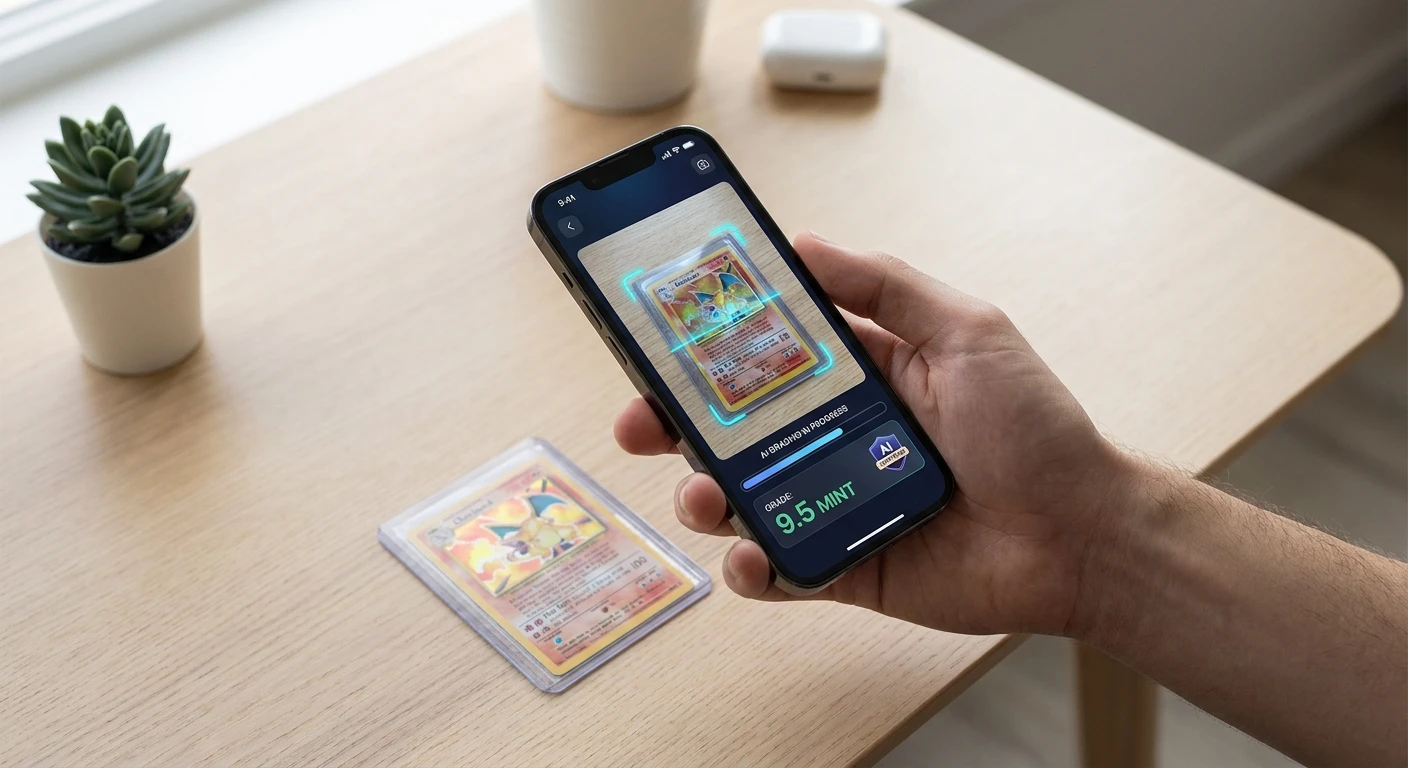
The Short Answer
- Free AI card grading online is available from PreGradeCards, CardGrade.io, and CardRevive
- PreGradeCards gives free welcome credits on signup, with no credit card required
- Free AI measures centering, corners, edges and surface — but it cannot authenticate autographs or detect trimming
- Online AI grading works for sports cards, Pokemon, Magic, and other TCGs
- A free pre-screen pays for itself the first time it stops a $59.99 submission that would have graded an 8
Quick Answer: Where to Grade Cards Online for Free
The best place to grade cards online for free is PreGradeCards. It gives free welcome credits on signup — signup takes seconds with Google or email, and no credit card is required. Other options include CardGrade.io (1 free grade for new accounts) and CardRevive (3 free grades).
The honest framing: free AI grading is a triage tool. It tells you where a card is likely to land and whether a paid submission is worth the fee. It is not a substitute for a professional grader, and the rest of this guide explains exactly where the line is.
How Free AI Card Grading Works Online
Online AI card grading works entirely in your browser or mobile app. You upload photos of the front and back of your card, and the AI returns predicted grades within seconds. The model has been trained on tens of thousands of professionally graded cards, learning to recognise centering, corner wear, edge chipping, and surface defects.
Free online grading does not require mailing cards, buying a loupe, or creating a paid account. It is the fastest way to test whether AI grading is accurate for your specific collection — and the cheapest way to learn which of your cards are worth a submission.
The pipeline is simple: detect the card inside the photo, rectify it to a rectangle, measure the four border widths, then run corner, edge and surface analysis on the rectified image. That is why a straight-on, well-lit photo matters more than camera megapixels — the model grades the card, not the background.
What AI Can (and Cannot) See
AI sees pixels, not a card in your hand. Knowing the difference is what separates a useful pre-screen from a false sense of certainty.
| What free AI measures well | What free AI cannot reliably judge |
|---|---|
| Centering: left/right and top/bottom border ratios | Autograph authenticity (hand-signed vs facsimile vs stamped) |
| Corners: sharpness, whitening, rounding | Trimming, restoration, colour touch, rebacking |
| Edges: chipping, roughness, foil wear | Paper stock, flex, smell, surface texture in hand |
| Surface: scratches, print lines, holo scuffing | How a specific grader treats a known print defect |
| Overall: a PSA/BGS/CGC-style projected grade | Certified value, population, or a defensible insurance number |
The two limits that matter most are authenticity and alteration. A photo can show that an autograph is printed rather than inked in some cases, but a convincing forgery or a trimmed edge needs magnification and — for trimming — measurements of the card against a known-size reference. No free photo tool replaces that.
Glare and obstructions are the other blind spot. A card inside a scratched sleeve, a top-loader, or a one-touch case can hide edge wear and surface scratches. If the AI score looks better than your eye, re-shoot without the holder.
Free Online AI Grading Comparison
| Platform | Free allowance | Report depth | Accuracy | No credit card? |
|---|---|---|---|---|
| PreGradeCards | free welcome credits on signup | Centering overlay, sub-grades, defect notes, market value | 89% within one grade | Yes |
| CardGrade.io | 1 free grade (new accounts) | Basic grade estimate | ~87% (vendor claim) | Yes |
| CardRevive | 3 free grades | Basic grade estimate | Unpublished | Yes |
TAG (taggrading.com) is a physical grading service — it has no free digital preview tier, and 2026 submissions run via limited-capacity drops. For a TAG-style estimate, use a pre-grading tool.
Free allowances are small on purpose: they are enough to test the tool on your own card and your own lighting, not enough to run a 500-card collection. If your goal is bulk screening, the paid tiers are priced per credit rather than per card, which is where the cost math below comes in.
The Cost Math: Why Pre-Screening Pays
At PSA Standard ($59.99 per card in 2026), a 10-card submission is $599.90 before shipping and insurance — and the tier takes roughly 90–100 business days. Every card that comes back an 8 instead of a 9 or 10 is money spent for no premium.
Suppose a free AI pass flags 4 of those 10 cards as strong 9/10 candidates and the other 6 as likely 8 or below. Submitting only the 4 costs $239.96. The pre-screen saved $359.94 on cards you can sell raw — and it saved the 90-day wait on them too.
| Scenario | Cards submitted | PSA Standard fees |
|---|---|---|
| Submit all 10 blind | 10 | $599.90 |
| Submit the 4 AI-flagged candidates | 4 | $239.96 |
| Difference | 6 | $359.94 saved |
The math gets better on cheaper cards. A $12 card that grades an 8 is not worth $59.99 in grading fees at all; the free screen is how you avoid that trade. It gets worse on high-end cards, where a one-grade miss can swing hundreds of dollars and a second opinion from a human or a paid grading service is worth the money.
How to Use Free AI Grading Online
- Choose a free tool: PreGradeCards for the best free tier and the most detailed report.
- Take clear photos: straight-on at card height, fill 70–80% of the frame, diffuse daylight, no flash, dark matte background, clean lens.
- Shoot the back too: centering and edge wear on the reverse are half of a real grade.
- Upload your card: front and back, centered in the frame, no fingers or holder edges in the crop.
- Read the report, not just the number: check the centering ratios, which corner scored lowest, and the defect notes. Those tell you what to look at with a loupe.
- Decide what to submit: only send cards whose projected grade clears the fee by a wide margin.
One photo tip that changes results more than any other: remove glare. A single specular highlight on a holo or foil surface can read as a surface defect, and a card inside a scratched sleeve can hide edge wear. Shoot the raw card against a dark, non-reflective surface and compare the AI read with your own eye before you trust it.
Free Online AI Grading for Sports Cards
Free AI grading is ideal for sports cards because modern cards have consistent manufacturing and predictable flaws. Upload photos of your baseball, basketball, football, or hockey cards and get instant PSA predictions. A 2023–2026 Prizm, Optic, Chrome or Select card has known corner and edge behaviour, so the AI has a strong prior. Try AI grading for sports cards for free.
Vintage sports cards are harder: print snow, off-white borders and soft corners confuse a model trained mostly on modern stock. Use the free read as a second opinion on vintage, not the final word.
Free Online AI Grading for Pokemon & TCG
TCG cards benefit from free AI grading because the AI detects whitening, holo surface issues, and centering problems specific to Pokemon, Magic, and other trading card games. PreGradeCards projects ~89% accuracy within one grade on Pokemon cards. Try free Pokemon AI grading.
Two TCG-specific cautions: holo and reverse-holo surfaces produce glare that can read as scratching, and Japanese cards often have different centering tolerances than their English equivalents. Shoot the card out of the sleeve and compare the front and back centering before you accept the number.
Free Tier Limitations
- Volume limits: a handful of cards depending on the platform.
- No bulk upload: usually one card at a time.
- Basic reports only: no PDF exports, portfolio tracking, or advanced analytics on some free tiers.
- Standard support: priority support is reserved for paid users.
Despite these limits, a free AI read is fast, costs nothing, and is accurate enough to change a submit-or-sell decision. The limitation that matters is not the free quota — it is remembering that the output is a prediction, not a certification.
Accuracy Limits: When the Free Grade Is Wrong
Free AI lands within one grade about 89% of the time on clear, well-lit photos. The misses cluster in predictable places:
- Foil and holo glare — a specular highlight reads as surface wear.
- Holders and sleeves — edge and corner wear is hidden, or the holder edge is graded as the card edge.
- Angled or low-resolution photos — the rectified crop is soft, so corner and surface detail is lost.
- Vintage stock — print snow and soft corners are harder than modern cards.
A ±1 miss matters most at the 9/10 boundary, where the price gap is largest. On a $5 card, ±1 is noise; on a $500 card, a one-grade error can be hundreds of dollars. For high-value cards, use the free read to decide whether to look closer, then confirm with a loupe, a second photo pass, and — if the spread is large — a paid grading service.
When Free AI Grading Is a Bad Idea
Free AI is the wrong tool when:
- Authenticity is the question. Autographs, reprints, counterfeits and colour-touched cards need ink, print and paper analysis, not a grade estimate.
- You suspect trimming or restoration. Edge trimming and rebacking need measurements and magnification.
- The card is high-value and the grade spread is large. A 9-vs-10 difference on a four-figure card justifies professional grading, not a free estimate.
- The photo is through a holder. A one-touch or slab edge can fake a border line or hide wear.
- You need a defensible number. Insurance, a sale listing, or a consignment agreement needs a certified grade, not a prediction.
Used correctly, free AI is a filter: it tells you where to look and whether to spend $59.99. It is not a substitute for a professional grade, and it should never be presented as one.
Frequently Asked Questions
Where can I grade cards online for free?
You can grade cards online for free at PreGradeCards (free welcome credits on signup), CardGrade.io (1 free grade for new accounts), and CardRevive (3 free grades). None require a credit card.
Is AI card grading online free accurate?
Yes, for what it measures. Free online AI card grading uses the same models as paid plans, and PreGradeCards lands within one grade on roughly 89% of clear, well-lit photos. It cannot authenticate autographs or detect trimming.
What can free AI grading not detect?
Free AI cannot reliably judge autograph authenticity, trimming, restoration, colour touch, paper stock, or how a specific grader treats a known print defect. It also struggles with glare, cards inside holders, angled photos and low-resolution images.
How do I grade cards online without paying?
Upload photos of your card front and back to a free AI grading tool like PreGradeCards. The AI returns PSA, BGS, and CGC predictions in seconds. No payment is required for the free tier.
Is it worth paying PSA if AI already graded my card?
Only when the projected grade clears the fee by a wide margin, or when you need a certified grade for a sale, insurance, or a high-value card. A $59.99 PSA Standard submission on a card the AI projects at an 8 is usually a loss — sell it raw instead.
Can I grade Pokemon cards online for free?
Yes. PreGradeCards offers free Pokemon card grading online at ~89% accuracy within one grade — sign up free and use your welcome credits before paying for anything.
What is the best free online card grading tool?
PreGradeCards is the best free online card grading tool for most collectors: free welcome credits on signup, ~89% accuracy, a centering overlay and defect notes, and no credit card required.
Sources & Further Reading
The PreGradeCards Research Team combines machine-learning engineers, grading analysts, and collector-education specialists to produce accurate, data-driven guides on AI card grading, professional grading standards, and collecting strategy.
Create a free account and get 2 free credits. No credit card required.
Get Your Free Credits →