The Short Answer
- Raw 1986 Topps #161 copies list at $55–$200; the card is cheap because it is common, not because it is unimportant.
- PSA 9 copies list at $5,499–$6,500 — the 9-to-10 gap on this card is the widest in the GOAT market.
- The 1986 Topps set had 396 cards and a green border that chips easily, which is why high-grade copies are so rare.
- PSA had graded 14,669 copies of #161 with just 49 PSA 10s when its set registry profile was published; a PSA 10 sold for $4,026 back in 2012.
- Signed copies of the rookie sell for $500–$1,500, and PSA/DNA authentication is the difference between an asset and a novelty.
- Most eBay listings that say “Gem 10” on this card are reprints or no-name graders — check the holder before you bid.
Why the Jerry Rice Rookie Still Anchors Football Cards
Jerry Rice retired with 1,549 receptions, 22,895 receiving yards and 197 touchdown catches — records that have survived every rule change, every passing boom in NFL history. He won three Super Bowls, was named Super Bowl XXIII MVP, and made 13 Pro Bowls. The hobby has spent four decades looking for the next Jerry Rice and has not found one.
His rookie card, the 1986 Topps #161, is the receiver equivalent of the 1986 Fleer Jordan: not scarce in absolute terms, but almost impossible in top condition. The 1986 Topps set used a green border with white diagonal stripes that acts like a scratch detector. Chipping, print dots, rough cuts and the set's chronic centering problems mean most copies grade between a 6 and an 8. PSA's own set registry profile recorded 14,669 submissions and just 49 PSA 10s; one of those gems sold for $4,026 back in October 2012.
That is the whole market in one sentence: a raw Rice rookie costs about the same as a nice dinner, and a genuinely perfect one is a five-figure baseball-card-sized slab. Everything in this guide sits between those two points.
The 2026 market has also re-learned a lesson about legends. When Brady posted $5.9 million in July sales across 4,682 graded submissions, it confirmed that the money still follows players whose careers are finished and whose cards cannot be reprinted. Rice is the receiving side of that trade.
Jerry Rice Card Prices at a Glance
Rice has one card that matters and a long tail of cheap season issues. The ladder below is ordered by how much of the market each tier represents, not by card number.
| Card | Raw | Graded | Top end | Tier |
|---|---|---|---|---|
| 1986 Topps #161 | $55–$200 | PSA 9 $5,499–$6,500 | PSA 10 $50K–$80K | Core |
| 1986 Topps #161 signed | $500–$1,500 | PSA/DNA auto 9 ~$600 | Inscribed $1,500 | Premium |
| 1987 Topps All-Pro #115 | $2.58–$3.99 | PSA 9 $149.99 | — | Entry |
| 1988 Topps #43 | $1.25–$2.09 | #6 Record Breaker 9 $25 | — | Entry |
| 1986 Topps #161 PSA 10 | — | — | 49 copies in census | Grail |
Asking prices, not completed sales. On this card the gap between an ask and a sale is often 20–30%, so negotiate.
No. 1 — 1986 Topps #161 Rookie (Raw)
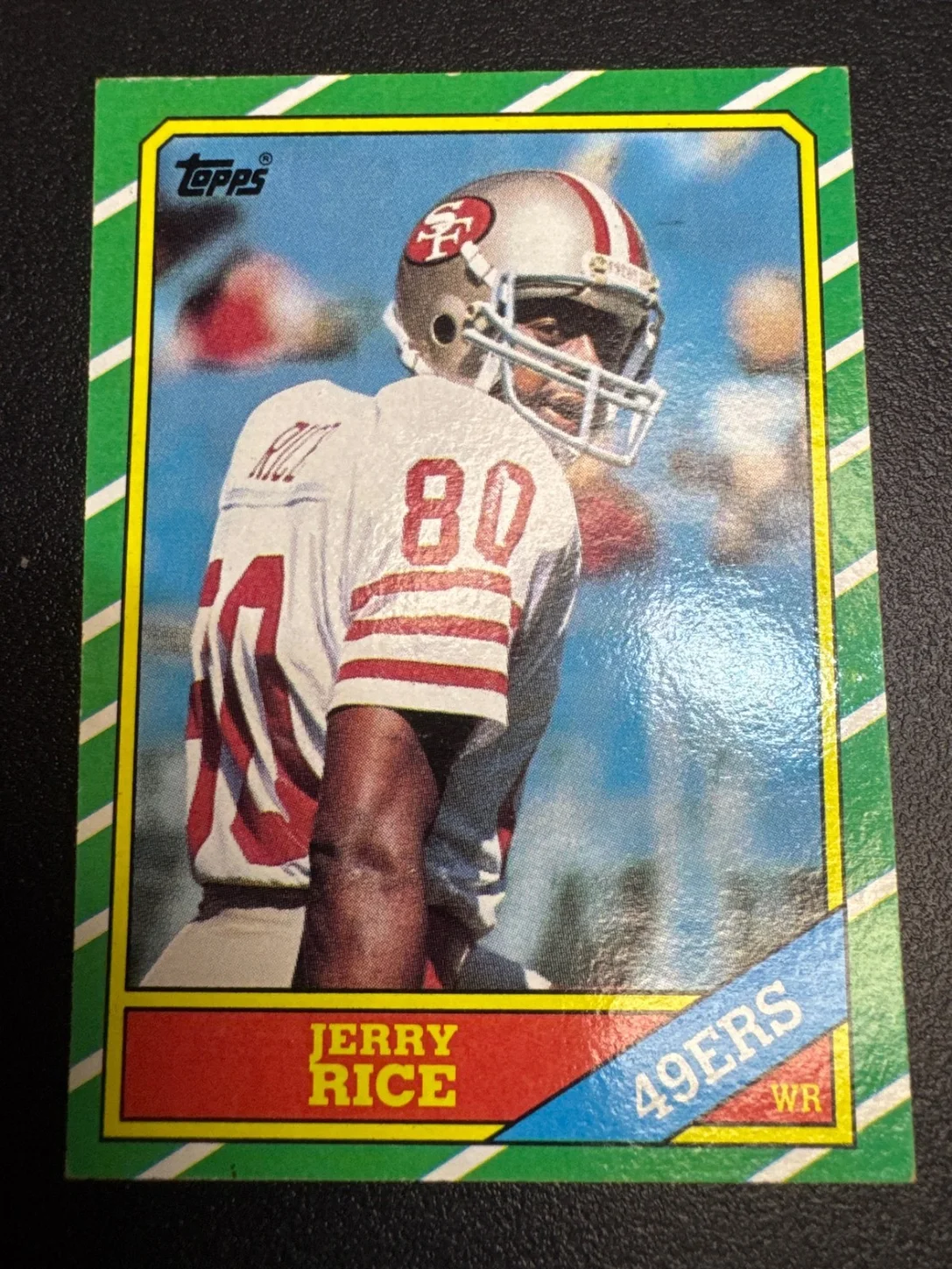
This is the card. The 1986 Topps #161 is Jerry Rice's only recognized rookie, printed in a 396-card set on mid-1980s Topps stock with a green border designed to look like a football field. Raw copies are listing between $55 and $200, with the better-centered examples clustering near $120.
The raw card is the best value in the entire GOAT market because the condition penalty is so severe. A card that looks perfectly fine in a photo will grade a 6 or a 7 because of a chipped corner or a centering drift you cannot see at arm's length. That is bad news for flippers and good news for collectors: you can own a genuine Rice rookie for less than the cost of a modern blaster box case.
Buy the best-centered raw copy you can afford, put it in a sleeve and a top loader, and stop. This is a card to hold, not to flip.
Check recent eBay sold prices for the 1986 Topps #161 →
No. 2 — 1986 Topps #161 in PSA 9
The PSA 9 is the sweet spot for most serious collectors. Listings on 14 November sat at $5,499 and $6,500, and the median across the grade is around $5,000–$6,000. You get a card that is visibly clean, professionally authenticated, and still an order of magnitude below the gem price.
The 9 is also the most liquid grade. PSA 10s essentially never trade; raw copies are a condition lottery; the 9 is the grade that collectors actually buy and sell. If you want one Rice rookie that you can enjoy and later exit without a year-long wait, this is it.
Watch the centering. A PSA 9 with 60/40 centering still sells, but a 9 with 55/45 will command a premium. On a card with a striped border, centering is the first thing buyers see.
Check recent eBay sold prices for the PSA 9 #161 →
No. 3 — 1986 Topps #161 Signed
A signed Rice rookie is the most emotionally satisfying card in this guide. Listings on 14 November ranged from $500 to $1,500, with PSA/DNA-authenticated copies around $600 and inscribed examples at the top of the range.
The autograph market for Rice is deep because he signed a lot, and that is also the risk. An unauthenticated signature on a $100 card is worth roughly the price of the card. An authenticated signature multiplies it five to ten times. The difference is a plastic holder with a cert number.
Buy signed copies only with PSA/DNA, JSA or BAS authentication, and prefer a card where the signature sits in a clean area rather than across the photo. The best examples pair a sharp card with a bold blue or black signature.
Check recent eBay sold prices for a signed 1986 Topps #161 →
No. 4 — 1987 Topps All-Pro #115
The 1987 Topps All-Pro #115 is Rice's second-year card, and it is almost free. Raw copies list at $2.58 to $3.99, and a PSA 9 sells for about $149.99. For the price of a coffee you can own a 1987 card of the best receiver who ever played.
This is a set-building card, not an investment. The print run is enormous, the design is plain, and the card is everywhere. But it belongs in a Rice collection because it captures him before the 1987 strike season and before the 1988 Super Bowl run that made him a household name.
If you are introducing a kid to vintage football cards, start here. It is cheap enough to handle, old enough to feel special, and it teaches the lesson that not every card needs to be a grail.
Check recent eBay sold prices for the 1987 All-Pro #115 →
- Sports Card Auto and Mem and Graded cards pack — $10.00 on eBay →
- sports cards graded 10 — $150.00 on eBay →
- $100 Sports Mystery Graded Card | NFL, NBA, or MLB — $100.00 on eBay →
- sports card singles graded — $35.00 on eBay →
Ad · Listings shown are from eBay. We may earn a commission when you buy through these eBay links. Prices and availability are set by eBay sellers and change often.
No. 5 — 1988 Topps #43
The 1988 Topps #43 is the cheapest Rice card in this guide and one of the most attractive. Raw copies list at $1.25 to $2.09, and the 1988 Record Breakers subset card (#6) sells for about $25 in a graded 9.
The 1988 set arrived the year before Rice's iconic Super Bowl XXIII performance, so it is a snapshot of him on the edge of greatness. The base card is common; the Record Breakers subset is slightly scarcer and more interesting. If you want one cheap card that looks good in a binder page, pick the Record Breaker.
There is no investment case here at all, and that is the point. A collection needs affordable cards that make the expensive ones feel earned.
Check recent eBay sold prices for the 1988 Topps #43 →
No. 6 — Bonus: 1986 Topps #161 in PSA 10
The bonus card is the one almost nobody owns. PSA's set registry profile for 1986 Topps listed 14,669 submissions and just 49 PSA 10s, and one of those gems sold for $4,026 in October 2012. Published values for a PSA 10 now sit in the $50,000–$80,000 range, and genuine examples rarely come to market.
This is why the “Gem 10” listings you see on eBay for $199–$499 are a trap. On 14 November, a search for a gem-mint Rice rookie returned several “GEM 10” cards in the $200–$500 range — every one of them was either a reprint, a different grader, or a modern tribute card. A real PSA 10 is a five-figure card in a PSA holder with a verifiable cert number.
If you ever buy at this level, verify the cert on PSA's site, confirm the holder style matches the era, and pay through an escrow or auction house. A fake gem is the most expensive mistake in vintage football cards.
Check recent eBay sold prices for a PSA 10 #161 →
How to Buy Jerry Rice Cards Without Getting Burned
Rice is the easiest GOAT to collect badly, because the cheap cards are everywhere and the expensive card is a minefield. The rule is simple: buy the cheap cards raw and the expensive card graded.
For most budgets the plan is one raw #161 for the collection, one PSA 9 if you want a real asset, and a signed copy if you care about autographs. Skip the mid-grade slabs unless the price is clearly below market; a PSA 7 at $200 is fine, a PSA 8 at $1,500 is not.
The second rule is about fakes. Rice's rookie is one of the most reprinted cards in football. A reprint can look convincing in a photo, especially once it is inside a generic “gem” holder. If the price is too good for a 10, it is not a 10.
- Check the border: green-border chipping is the grade killer on #161 — look at all four corners under a loupe.
- Centering first: the striped border makes off-centering obvious, and buyers pay for 55/45 or better.
- Authenticate autographs: PSA/DNA, JSA or BAS only. An unauthenticated signature adds almost nothing.
- Distrust generic gems: “GEM 10” in a no-name holder is not a PSA 10, and on this card it usually means reprint.
- Verify certs: any five-figure card must be checked on the grader's own lookup before payment.
- Buy raw to collect, graded to hold: raw for fun, PSA 9 for value, PSA 10 only with expert help.
Run a free AI pre-grade on your card →
Watch & Learn: Jerry Rice's Career Highlights
The NFL's official Rice highlight reel is the fastest way to understand why a 1986 base card outsells most modern rookie autographs.
Video: Jerry Rice Career Highlights | NFL — NFL
The Full NFL Card Series
The modern side of the series starts with the 2026 rookie class. If you want to compare a $120 Rice rookie against a $40 Mendoza base card, the hub has the full ladder.


Ad · Listings shown are from eBay. We may earn a commission when you buy through these eBay links. Prices and availability are set by eBay sellers and change often.
Frequently Asked Questions
What is Jerry Rice's rookie card?
The 1986 Topps #161 is his only recognized rookie card. It was printed in a 396-card set with a green border that chips easily.
How much is a Jerry Rice rookie card worth in 2026?
Raw copies list at $55–$200. PSA 9 copies list at $5,499–$6,500. A PSA 10 is a $50,000–$80,000 card, with just 49 gems in PSA's long-running census.
Is it worth grading a raw Jerry Rice rookie?
Only if the card is genuinely sharp. The 9-to-10 gap is enormous, but green-border chipping means most raw copies grade 6–8, where the value barely covers the fee.
Why are there so many fake Jerry Rice gem mint cards on eBay?
Because the real PSA 10 is a five-figure card. Cheap “GEM 10” listings are usually reprints or no-name graders. Always check the holder and verify the cert.
What is the most valuable Jerry Rice card?
A genuine PSA 10 of the 1986 Topps #161. Published values sit at $50,000–$80,000, and examples rarely trade.
Sources & Further Reading
- PSA Set Registry — 1986 Topps Football
- PSA Card Facts — 1986 Topps Jerry Rice #161
- eBay sold listings — Jerry Rice rookies
- Rookie Sports Cards — Jerry Rice rookie guide
- CardValueFinder — most valuable football cards 2026
- NFL — Jerry Rice career profile
Create a free account and get 1.5 free credits. No credit card required.
Get Your Free Credits →