The Short Answer
- Raw 1981 Topps #216 copies list at $130–$150; the card is thin on eBay but not rare in absolute terms.
- PSA 8 copies list around $760, and PSA 9 copies at $4,500–$5,495 — the 9 is the volume grade for serious collectors.
- A PSA 10 is a $40,000–$70,000 card. The gem premium is roughly ten times the PSA 9 price.
- Signed rookies trade around $1,278, and authentication is the difference between a $200 card and a $1,300 one.
- The 1982 Topps #488 is the “Catch” era card and costs about $36 raw — the cheapest Montana with a real story.
- Montana is 4–0 in Super Bowls with three Super Bowl MVPs; that résumé is why his cards hold value through market cycles.
Why Joe Montana Cards Still Matter
Joe Montana is the only quarterback in NFL history with four Super Bowl wins and zero losses. He won Super Bowl XVI, XIX, XXIII and XXIV with the 49ers, took three Super Bowl MVP awards, and produced the most famous throw in NFL history — “The Catch” to Dwight Clark on 10 January 1982, the play that started a dynasty.
His rookie card is the 1981 Topps #216, and unlike many vintage GOATs it is still approachable. Raw copies list around $130–$150, PSA 8s around $760, and PSA 9s at $4,500–$5,495. That is a fraction of the Brady and Rice ladders, and it is the cheapest way to own a four-ring quarterback from the greatest dynasty of the 1980s.
The catch is supply. The 1981 Topps set is not scarce, but Montana's card is one of its condition-sensitive entries: the colored borders and the dark photo make edge wear and print defects obvious. The result is a steep grade ladder — a PSA 9 is worth six times a PSA 8, and a PSA 10 is worth ten times a PSA 9.
For collectors in 2026, Montana sits in a useful spot: expensive enough to matter, cheap enough that a raw copy is a realistic purchase, and famous enough that liquidity is never a problem.
Joe Montana Card Prices at a Glance
Montana's market is a single card with five grades and a couple of cheap season issues. The 1981 Topps #216 is the only true rookie — do not let a 1982 card be sold to you as one.
| Card | Raw | Graded | Top end | Tier |
|---|---|---|---|---|
| 1981 Topps #216 | $130–$150 | PSA 8 ~$760 | PSA 9 $4,500–$5,495 | Core |
| 1981 Topps #216 signed | — | ~$1,278 | Inscribed higher | Premium |
| 1982 Topps #488 | ~$36 | — | — | Entry |
| 1984 Topps #358 | ~$4.99 | — | — | Entry |
| 1981 Topps #216 PSA 10 | — | — | $40K–$70K | Grail |
Asking prices. The vintage Montana market is thinner than Brady's, so completed sales can land 15–25% under the listed number.
No. 1 — 1981 Topps #216 Rookie (Raw)
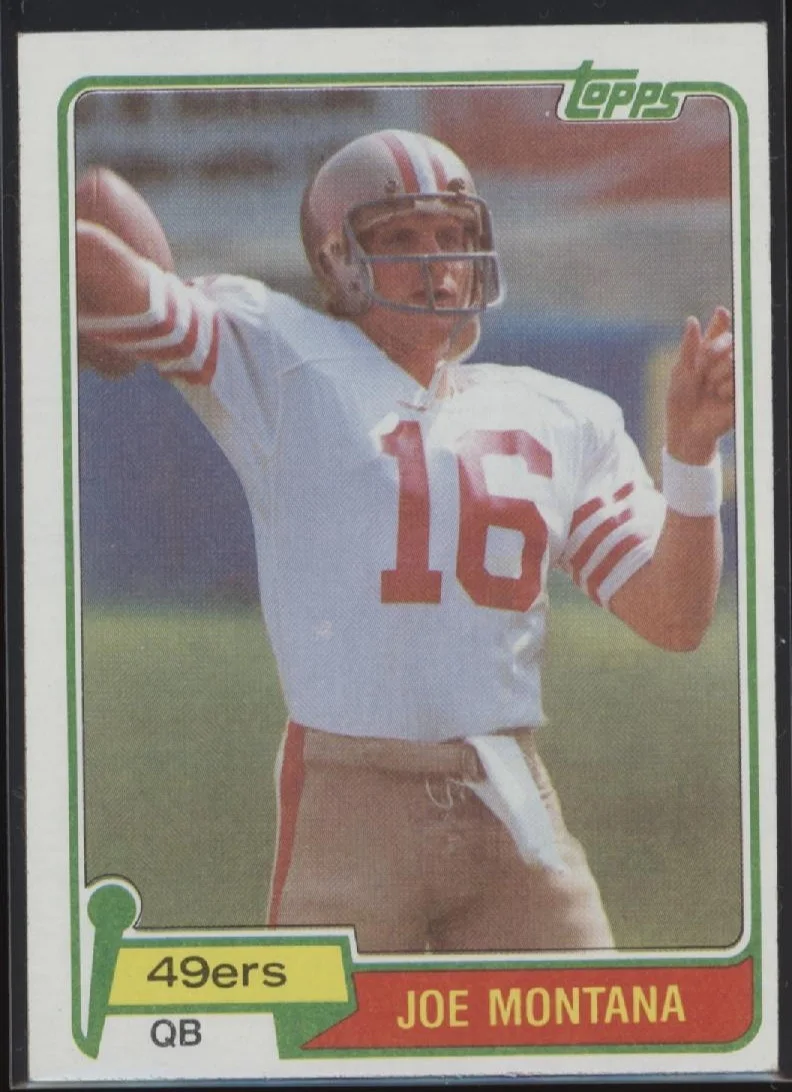
The 1981 Topps #216 is the card to own if you want a Montana rookie without spending four figures. Raw copies are listing at $130–$150, and a clean, well-centered example is a genuinely good-looking card: Montana in a throwing pose, the 49ers helmet, and the simple early-80s Topps design.
The raw market is thin but not dangerous. Unlike the Rice rookie, which is everywhere, Montana's rookie shows up in smaller numbers and most copies have honest wear. That makes it easier to buy a decent card at a fair price — and harder to find a gem, which is exactly what you want in a vintage card.
This is the entry point for a dynasty-quarterback collection. Buy one, hold it, and resist the urge to grade it unless the corners are sharp under a loupe.
Check recent eBay sold prices for the 1981 Topps #216 →
No. 2 — 1981 Topps #216 in PSA 8
The PSA 8 is the value slab. Listings cluster around $760, which is roughly five times a raw copy and one-sixth of a PSA 9. You get authentication, protection and a card that presents well, without paying the mint premium.
This is the grade most collectors should buy if they want a Montana rookie in a holder. It is liquid, recognizable, and cheap enough that a market dip will not hurt. The 8 also tends to be the grade with the best centering for the money, because buyers chasing 9s leave well-centered 8s behind.
If you are building a set of 1980s GOAT rookies — Montana, Rice, Marino — the PSA 8 tier is where the set actually comes together.
Check recent eBay sold prices for a PSA 8 #216 →
No. 3 — 1981 Topps #216 in PSA 9
The PSA 9 is the collector's grade. Listings on 14 November sat at $4,500, $4,695 and $5,495, and the grade trades often enough that you can find a copy with a verifiable cert and good eye appeal.
Nine is where the Montana market gets serious. The card is 45 years old, printed on stock that was never designed to survive, and most survivors have soft corners. A 9 means the card beat the odds. That is why it costs six times an 8 and why it will hold value if the broader market softens.
Buy the 9 if you want one Montana rookie that functions as both a collection centerpiece and a store of value. Verify the cert, check the holder for scratches, and ask for a photo of the card outside the glare.
Check recent eBay sold prices for a PSA 9 #216 →
No. 4 — 1981 Topps #216 Signed
A signed Montana rookie is one of the most desirable autographed football cards of the 1980s, and it is still affordable relative to Brady. Listings cluster around $1,278, with premium inscriptions and high-grade autos pushing higher.
Montana signs in a clean, legible signature, which makes his autographed cards look good. The risk is the same as every signed vintage card: authentication. A raw signature on a $140 card is worth about $140. A PSA/DNA or JSA-authenticated example is worth ten times that.
If you buy one signed card in this guide, make it this one. It pairs the most famous quarterback of the 1980s with the card that started his legend, and it displays better than a slabbed base card.
Check recent eBay sold prices for a signed 1981 Topps #216 →
- 1981 Topps Joe Montana Rookie PSA 4 #216 San Francisco 49ers — $99.00 on eBay →
- 1981 Topps - Joe Montana #216 Rookie - San Francisco 49ers PSA 6 — $190.00 on eBay →
- Topps 1981 Joe Montana 49ers Rookie Card #216 Base Set Football — $250.00 on eBay →
- 1981 Topps #216 Joe Montana Rookie Card RC HOF San Francisco 49ers Clean & Sharp — $149.95 on eBay →
Ad · Listings shown are from eBay. We may earn a commission when you buy through these eBay links. Prices and availability are set by eBay sellers and change often.
No. 5 — 1982 Topps #488
The 1982 Topps #488 is the “Catch” era card. It was printed the year after Montana's drive against Dallas ended with Dwight Clark in the end zone, and it remains the cheapest way to own a Montana card with a real story attached. Raw copies list at about $36.
The 1982 set is also where the 49ers dynasty starts showing up across multiple cards, which makes it a fun set to build. The Montana base card is the anchor, and the In Action #489 is a nice companion piece.
There is no investment case. There is a collection case: a 1982 Montana is the card that explains why the 1981 rookie matters.
Check recent eBay sold prices for the 1982 Topps #488 →
No. 6 — Bonus: 1981 Topps #216 in PSA 10
The bonus card is the one that turns a collection into an asset. Published PSA 10 values for the 1981 Topps #216 sit at $40,000–$70,000, roughly ten times a PSA 9. Genuine examples are scarce because the card is 45 years old and the dark border shows every flaw.
At this level you are buying a certified asset. Use a major auction house or a specialist dealer, verify the cert on PSA's site, and confirm the holder is the correct generation for the grade date. A reholdered card with a mismatched label is a red flag.
Most collectors will never own this card, and that is fine. It exists to explain the ladder: the 9 is expensive because the 10 is rare, and the 8 is cheap because the 9 is the collector's target.
Check recent eBay sold prices for a PSA 10 #216 →
How to Buy Montana Rookies Without Overpaying
Montana's market rewards patience. The raw card is cheap, the PSA 8 is fair value, and the PSA 9 is the grade that most collectors eventually want. The mistake is paying a 9 price for an 8 with good photos, or paying a gem price for a raw card with a story.
A sensible plan: one raw #216 for the collection, one PSA 8 if you want a slab, and a PSA 9 only if you are building a serious 1980s GOAT set. Skip the signed card unless you already own the base rookie — authentication costs can eat the premium on a cheap card.
The second rule is about the rookie designation. Montana has no 1979 or 1980 Topps card. If a listing calls a 1982 or 1984 card his rookie, walk away.
- 1981 Topps #216 is the only rookie: no Montana card exists in 1979 or 1980 Topps.
- Check the corners: the dark border and photo make edge wear obvious, and corners are the first thing a grader downgrades.
- Centering drives the grade: a 60/40 card caps at an 8 even with sharp corners.
- Verify PSA certs: at $4,500+ a mismatched cert is the main risk.
- Authenticate autographs: PSA/DNA, JSA or BAS only.
- Do not crack slabs: the regrade math is negative at every tier.
Run a free AI pre-grade on your card →
Watch & Learn: Joe Cool's Greatest Moments
The NFL's Montana retrospective is the best short primer on why four rings and zero losses still command a premium.
Video: Joe "Cool" Montana Career Highlights | NFL Legends — NFL Throwback
The Full NFL Card Series
If you want the modern market instead of the legends, the hub starts with the 2026 rookie class and works down to $20 base cards.



Ad · Listings shown are from eBay. We may earn a commission when you buy through these eBay links. Prices and availability are set by eBay sellers and change often.
Frequently Asked Questions
What is Joe Montana's rookie card?
The 1981 Topps #216. Montana has no 1979 or 1980 Topps card, so any listing that calls a 1982 or 1984 card his rookie is wrong.
How much is a Joe Montana rookie card worth in 2026?
Raw copies list at $130–$150, PSA 8 around $760, PSA 9 at $4,500–$5,495, and PSA 10 at $40,000–$70,000.
Is it worth grading a raw Joe Montana rookie?
If the card is sharp, yes — the jump from raw to PSA 8 is about five times, and the 9 is thirty times. But most raw copies have soft corners and will grade lower than the fee justifies.
Why is the PSA 9 worth six times the PSA 8?
Because 1981 Topps cards rarely survive with sharp corners and good centering. The 9 is the grade collectors want, and supply is limited by the card's age.
What is the most valuable Joe Montana card?
A PSA 10 of the 1981 Topps #216, published at $40,000–$70,000. Genuine examples rarely come to market.
Sources & Further Reading
- PSA Population Report — football
- eBay sold listings — Joe Montana rookies
- CardValueFinder — most valuable football cards 2026
- Pro Football Hall of Fame — Joe Montana
- NFL — Joe Montana career profile

Create a free account and get 1.5 free credits. No credit card required.
Get Your Free Credits →