2000 Contenders Tom Brady RC Auto
Surface Pitting & Ticket Chipping Under the Lens
A forensic deep-dive into the most valuable modern football card. We examine the microscopic surface evidence that separates a $3.1 million Gem Mint from a six-figure PSA 8.

The 2000 Playoff Contenders Tom Brady RC Auto under forensic examination — surface pitting and foil integrity under inspection light.
Year: 2000
Set: Playoff Contenders
Card #: 144
Print Run: /100 (Championship Ticket)
Magnification: Macro / Surface Scan
Primary Target: Surface Pitting & Ticket Chipping
Risk Level: High
The GOAT's Rookie Auto
The 2000 Playoff Contenders Tom Brady Championship Ticket RC Auto #144 is limited to just 100 copies and features Brady's on-card autograph. A PSA 10/BGS 9.5 copy sold for $3.107 million in June 2021, making it the most expensive football card ever sold. Even lower-grade copies command six figures — a PSA 8 recently sold for $400,000.
The card's silver foil "ticket" design is both its visual signature and its forensic challenge. The foil layer is inherently fragile, prone to microscopic damage that is invisible to casual inspection but devastating under grading-level scrutiny.
Forensic Target #1: Surface Pitting
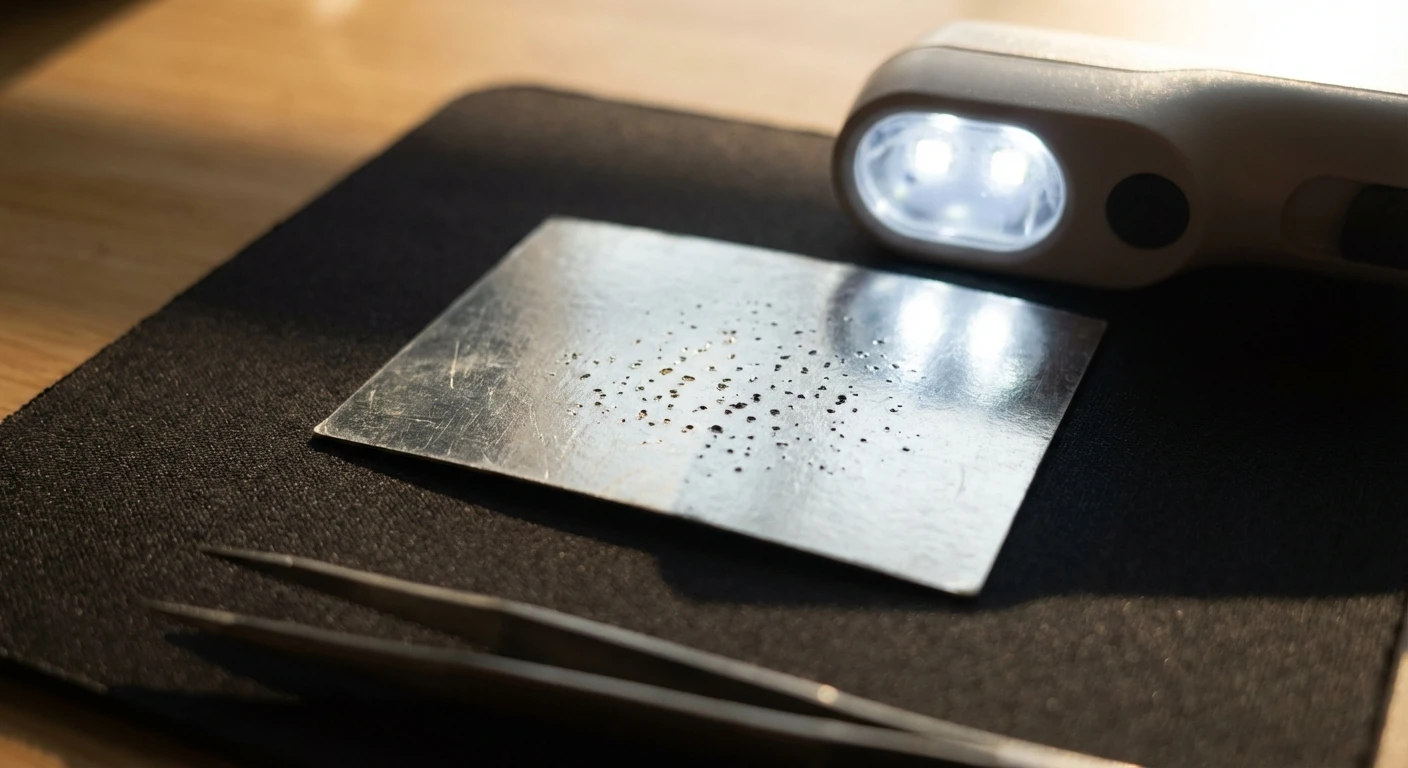
Under blue-spectrum light, microscopic surface pits in the silver foil become visible as tiny dark spots — factory defects that cap the surface grade.
Surface pitting on the 2000 Contenders occurs during the foil stamping process. Microscopic debris particles on the press create tiny depressions in the foil layer — essentially miniature craters that are invisible to the naked eye but glow under blue-spectrum light. Our PGC forensic audit uses spectral analysis to detect these pits at the sub-millimeter level.
Critical: One Major Pit = Surface Cap at 8.0
A single major surface pit (visible without magnification under directed light) caps the surface sub-grade at 8.0. Since the surface grade is weighted heavily in the overall assessment, this effectively limits the card to PSA 8 or BGS 8.5 at best. Multiple pits can push the surface grade to 7.0 or lower.
Forensic Target #2: Ticket Chipping
The silver foil "ticket" area extends to the card's edges, creating a vulnerable transition zone where the foil meets the card stock. This zone is prone to:
Foil Flaking
The silver foil layer separates from the card stock along the edges, creating visible flakes or chips. This is the most common defect and is often caused by the card shifting inside a sleeve or top loader.
Edge Delamination
The foil layer begins to separate from the card stock along the edge, creating a visible gap or lift. Under magnification, the separation appears as a thin dark line between the foil and the card stock.
Autograph Ink Migration
Over time, the autograph ink can migrate or bleed into the foil surface, creating a halo effect around the signature. This is a natural aging process but affects the auto sub-grade at BGS.
Autograph Authentication
The on-card autograph is a critical component of the card's value. Brady's early autograph style on the 2000 Contenders is distinctive — a flowing "Tom Brady" with a characteristic loop on the "T" and "B". Key authentication markers:
- Ink consistency — The autograph should show consistent ink flow throughout. Stops, starts, or ink pooling may indicate a forged signature.
- Pressure patterns — Under magnification, genuine signatures show natural pressure variation — heavier on downstrokes, lighter on upstrokes. Forged signatures often show uniform pressure.
- Ink type — The original signing event used a specific blue Sharpie. The ink should show the characteristic sheen and absorption pattern of that marker type on the foil surface.
- Placement — Brady's signature on the 2000 Contenders is typically centered in the lower portion of the ticket area. Unusual placement may indicate a replacement autograph.
Grade Impact Summary
Analyze Your Brady Before Grading
Our AI surface scan detects pitting, foil damage, and edge issues invisible to the naked eye. Protect your investment before spending on professional grading.
Start Forensic Scan