1979 O-Pee-Chee Wayne Gretzky RC
The OPC Rough Cut — Authenticity in the Fibers
A forensic examination of hockey's holy grail. We analyze the edge fiber evidence that proves authenticity — where a rough edge is worth millions and a smooth edge means fraud.

The 1979 O-Pee-Chee Wayne Gretzky #18 under forensic examination — edge fiber analysis reveals the distinctive OPC rough cut.
Year: 1979-80
Set: O-Pee-Chee Hockey
Card #: 18
Player: Wayne Gretzky RC
Magnification: Macro / Edge Analysis
Primary Target: OPC Rough Cut vs. Hand-Cut
Risk Level: High — Trimming Risk
Hockey's Holy Grail
The 1979-80 O-Pee-Chee Wayne Gretzky #18 is the most valuable hockey card in existence and one of the most significant sports cards ever produced. A PSA 10 Gem Mint copy sold for $3.75 million in 2020. The card captures "The Great One" at the beginning of his legendary NHL career with the Edmonton Oilers.
What makes this card forensically unique is the O-Pee-Chee cutting process. Unlike modern precision die-cutting, OPC used a wire-blade system in 1979 that produced a distinctively rough, fibrous edge. This manufacturing artifact has become the card's most important authentication marker — and the key to detecting trimmed specimens.
The OPC Edge: Authenticity in the Fibers
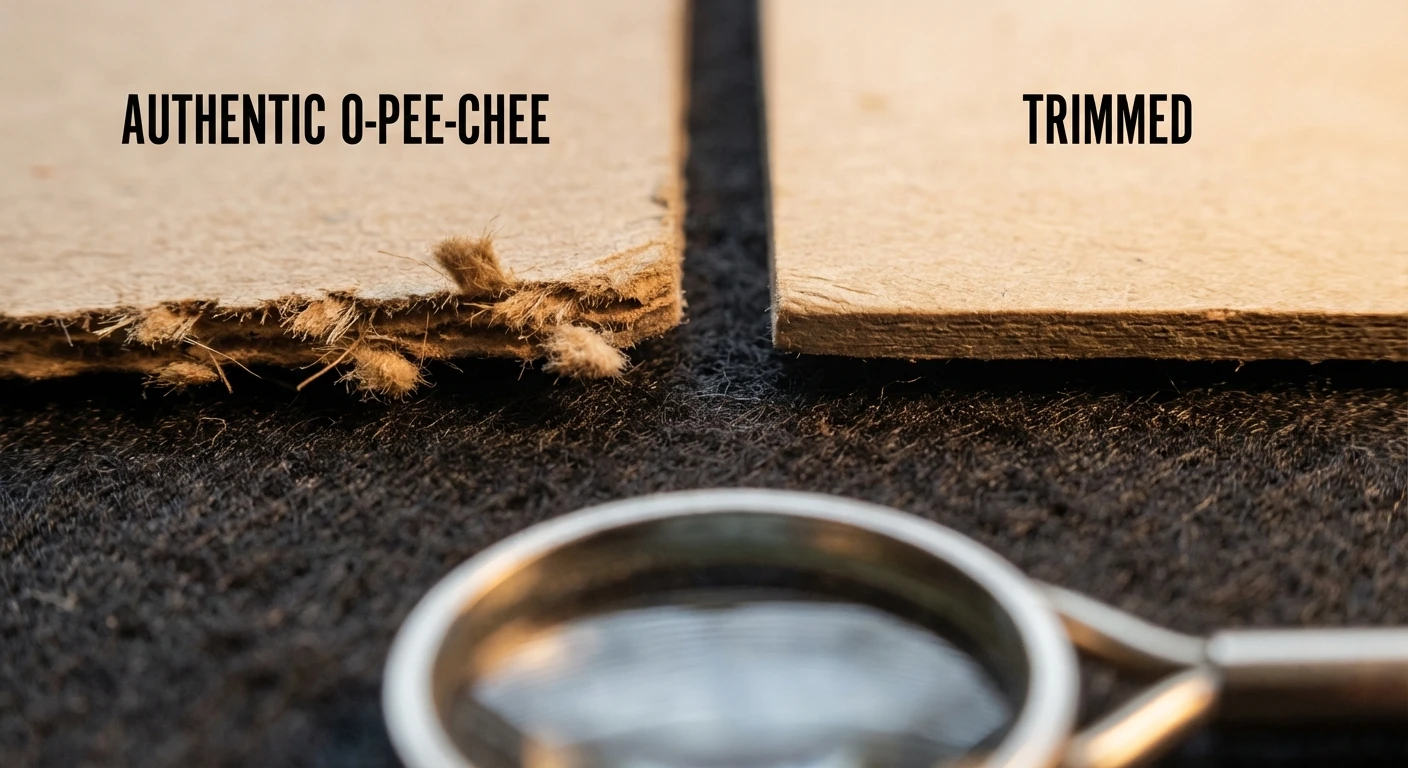
Authentic OPC rough-cut edge (left) shows loose, fuzzy paper fibers from the wire-blade system. A trimmed edge (right) shows unnaturally smooth, compressed fibers.
The wire-blade cutting system used by O-Pee-Chee in 1979 tore through the card stock rather than slicing it cleanly. Under magnification, this produces a distinctive "fuzzy" edge with loose, randomly oriented paper fibers extending slightly beyond the cut line. These fibers are the card's fingerprint — proof that it was cut at the OPC factory in London, Ontario.
Counterintuitive Truth: Rough Edges = Mint Eligible
Unlike virtually every other card in the hobby, a rough edge on a 1979 OPC card is a positive indicator. Grading companies recognize the OPC rough cut as a factory characteristic, not a defect. A card with natural OPC rough edges can still achieve Mint 9 or even Gem Mint 10 status. Conversely, a perfectly smooth edge is a red flag for trimming.
Trimming Detection: The Smooth Edge Problem
Given the extreme value difference between grades, trimming is a persistent threat to the OPC Gretzky market. Trimmers target cards with edge wear, chipping, or poor centering, cutting away the damaged areas to create cleaner edges. The forensic evidence is clear:
Smooth Edge on All Four Sides
Definitive trimming indicator. No genuine 1979 OPC card has perfectly smooth edges on all four sides. The wire-blade system always leaves some degree of roughness. Result: Authentic Altered designation.
Smooth Edge on One or Two Sides
Highly suspicious. While factory variation can produce slightly smoother cuts on individual edges, a completely smooth edge on any side warrants fiber analysis under 30x magnification. If fibers show compression patterns consistent with mechanical cutting, the card is flagged.
Consistent Rough Cut on All Edges
Authentic OPC factory cut confirmed. The rough fibers should be present on all four edges with natural variation in fiber length and direction. This is the expected condition for a genuine, unaltered specimen.
OPC vs. Topps: Key Differences
The 1979-80 Topps Wayne Gretzky #18 is a separate card from the OPC version, printed in the United States. Key forensic differences:
| Feature | OPC (Canadian) | Topps (American) |
|---|---|---|
| Back Text | French & English | English only |
| Edge Quality | Rough (wire-blade) | Cleaner (die-cut) |
| Card Stock | Slightly thinner, grayer | Slightly thicker, whiter |
| PSA 10 Value | $3.75M+ | $1.5M+ |
| PSA 10 Pop | ~2 copies | ~4 copies |
Additional Forensic Markers
- Centering — OPC cards from 1979 are notoriously off-center. A perfectly centered copy is actually more suspicious than one with slight centering variance, as it may indicate trimming to correct centering.
- Color saturation — Genuine OPC Gretzky cards have a slightly muted color palette compared to the Topps version. Overly vibrant colors may indicate a reprint or color-enhanced copy.
- Back printing — The French/English text on the back should show consistent ink density and registration. The OPC logo and copyright text are key authentication points.
- UV fluorescence — Genuine 1979 OPC card stock fluoresces a specific dull yellow under UV light. Modern reprints and counterfeits typically fluoresce bright white due to optical brightening agents in modern paper.
Grade Impact Summary
Verify Your Gretzky's Edge Integrity
Our AI edge analysis detects the difference between authentic OPC rough cuts and mechanical trimming. Protect your investment before submission.
Start Forensic Scan