1952 Topps Mickey Mantle #311
Paper Fiber Integrity & Trimming Detection
A forensic examination of the most valuable baseball card in history. We analyze the paper fiber evidence that separates a $12.6 million Mint from an "Authentic Altered" rejection worth a fraction of its potential.

The 1952 Topps Mickey Mantle #311 under forensic examination — digital calipers and precision ruler verify dimensions and detect potential trimming.
Year: 1952
Set: Topps Baseball
Card #: 311 (High Number Series)
Player: Mickey Mantle
Magnification: Macro – 30x
Primary Target: Paper Fiber Integrity (Trimming)
Risk Level: Maximum — AA Risk
The $12.6 Million Card
The 1952 Topps Mickey Mantle #311 holds the record as the most expensive sports card ever sold — $12.6 million in August 2022 for a PSA 9.5 (the only copy at that grade). The card's extreme value creates an equally extreme incentive for alteration. A raw, ungraded copy in VG-EX condition is worth $100,000–$200,000. If trimming could elevate it to an EX-MT or NM grade, the value jumps to $500,000+. This financial incentive makes trimming detection the single most critical forensic skill for vintage card authentication.
Forensic Target: Paper Fiber Analysis
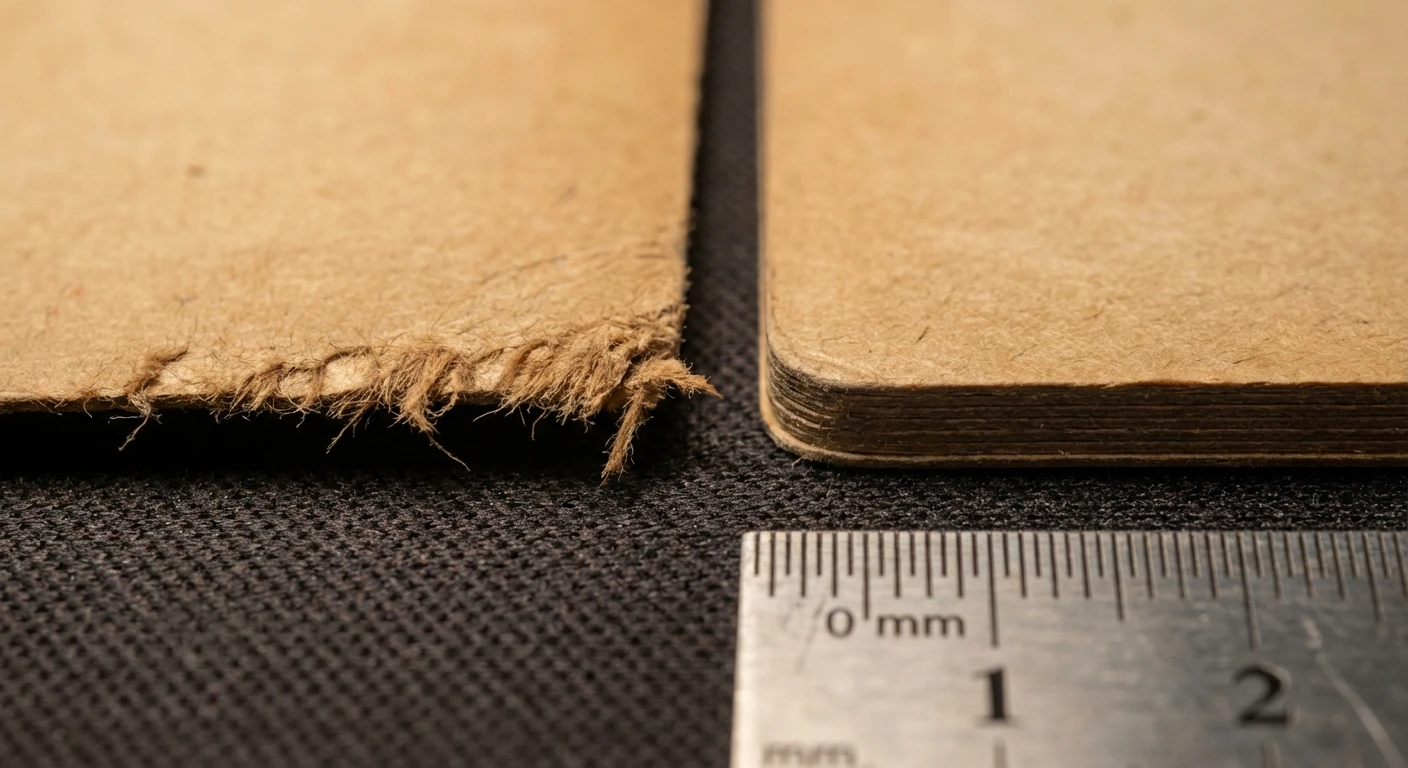
Factory rough-cut edge (left) shows loose, irregular paper fibers. Mechanically trimmed edge (right) shows compressed, sheared fibers — the definitive sign of alteration.
Vintage card stock from the 1950s is significantly more porous and fibrous than modern card stock. Under 30x magnification, the edge of a factory-cut 1952 Topps card reveals loose, irregular paper fibers — the natural result of the industrial guillotine cutting process used at the Topps factory. These fibers are randomly oriented, varying in length and direction.
A mechanically trimmed card tells a completely different story. The trimming blade compresses and shears the paper fibers into a smooth, flattened wall. Under the same magnification, the trimmed edge appears unnaturally clean — the fibers are uniformly compressed and aligned in the direction of the cut. This compression pattern is the definitive forensic signature of trimming.
Authentic Altered = Zero Value Grade
If a grading company detects trimming on a 1952 Topps Mantle, the card receives an "Authentic Altered" (AA) designation. This is the worst possible outcome — the card is encapsulated with an AA label, permanently marking it as altered. An AA-designated Mantle is worth a fraction of even a low-grade genuine copy. The stigma is permanent and irreversible.
Dimensional Analysis
The standard dimensions for 1952 Topps cards are 2-5/8" × 3-3/4" (66.7mm × 95.3mm). However, factory cutting tolerances in the 1950s were wider than modern standards. A genuine, untrimmed card may measure anywhere from 2.600" to 2.660" in width and 3.720" to 3.770" in height.
Width Below 2.590"
Strong indicator of trimming. The card has lost more than 0.035" from the standard width, which is outside normal factory tolerance. Requires fiber analysis confirmation.
Height Below 3.710"
Suspicious but not definitive. Some factory sheets produced slightly shorter cards. Cross-reference with edge fiber analysis and centering measurements.
Asymmetric Reduction
If one dimension is within tolerance but the other is short, this strongly suggests targeted trimming on specific edges to improve centering or remove edge damage.
Additional Vintage Forensic Markers
- Wax staining — Genuine 1952 Topps cards from wax packs often show faint wax residue on the surface, particularly on the back. This is a positive authenticity marker.
- Toning and yellowing — Natural aging produces even, consistent yellowing across the card back. Uneven toning may indicate chemical treatment or partial exposure.
- Print registration — The front and back images should be aligned within 1mm. Significant misregistration is a factory defect, not alteration, but affects grade.
- Card stock thickness — Authentic 1952 Topps stock measures approximately 0.024"–0.026". Reprints and counterfeits typically use different thickness stock.
Grade Impact Summary
Verify Your Vintage Card's Integrity
Our AI forensic scan analyzes edge fiber patterns and dimensional accuracy to flag potential trimming before you submit to a grading company.
Start Forensic Scan