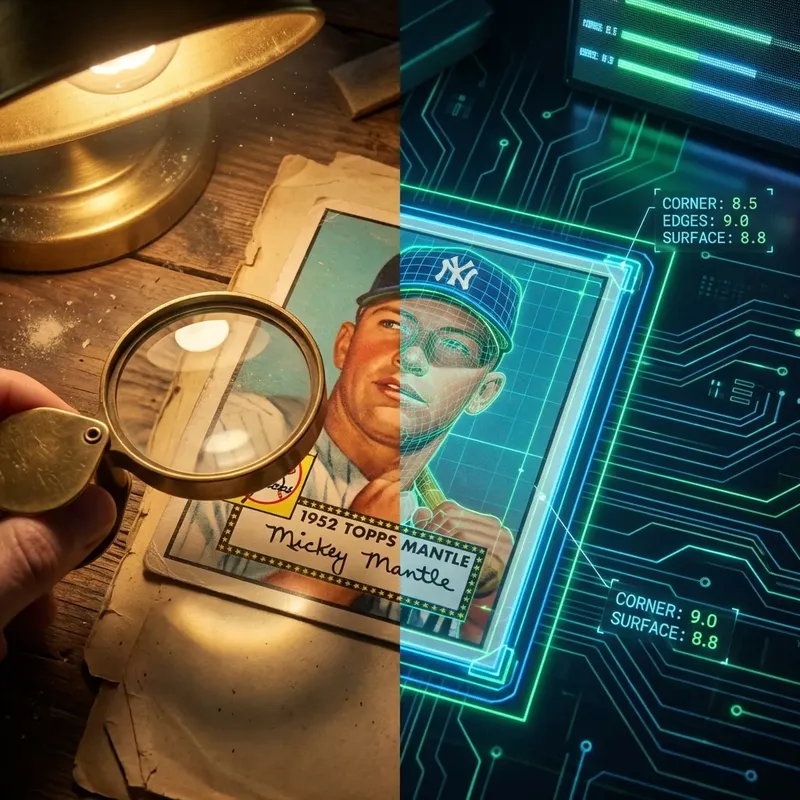
The Short Answer
- PreGradeCards AI achieves 89% agreement with PSA final grades within ±1 grade point across a benchmark study of 10,000 cards (June 2026).
- AI is strongest on modern cards with clean surfaces and consistent print quality, where centering, corners, edges, and surface flaws are visually measurable.
- Human graders still lead on vintage cards, subtle toning, authentication, and edge-case condition calls where historical context matters.
- The best workflow is hybrid: use AI to pre-screen every card, then submit only the highest-confidence candidates to PSA, BGS, CGC, or SGC.
- AI pre-grading reduces wasted grading fees by 40–60% by filtering out cards that are unlikely to reach the target grade before you pay.
What AI Card Grading Actually Measures
AI card grading uses computer vision models trained on thousands or millions of card images to predict the numeric grade a professional grading company would assign. The current generation of tools, including PreGradeCards, analyzes the same four criteria that PSA, BGS, CGC, and SGC use: corners, edges, surface, and centering. Each criterion is scored separately, and the model combines those sub-grades into an overall predicted grade on the 1–10 scale.
Centering is typically measured by detecting the card border and computing the ratio of left/right and top/bottom margins. Corners and edges are evaluated by looking for whitening, dings, chips, fraying, and creases. Surface analysis detects scratches, print lines, dimples, holo imperfections, and autograph smudging. Modern models also identify the card itself — year, set, player, and variation — so that the grading prediction can be calibrated to the known condition sensitivity of that specific issue.
What AI does not do is hold the card. It cannot feel a subtle crease, smell tobacco residue on a vintage card, or detect a barely perceptible bend that only flexing the card would reveal. AI also does not authenticate a card; it assumes the card is genuine. These limitations are important because they define the boundary between a useful pre-screening tool and a replacement for professional grading.
How Accuracy Is Measured and Reported
When a service reports an accuracy number like "89% within one grade point," it means that if you compare the AI prediction to the final grade assigned by a professional company, the two grades match exactly or differ by no more than one point in 89 out of 100 cases. A card predicted PSA 9 that grades PSA 8 counts as a hit. A card predicted PSA 9 that grades PSA 7 counts as a miss.
The "one grade point" tolerance matters because even human graders are not perfectly consistent. Industry studies estimate that human resubmission consistency is around 70% within one grade point when the same card is submitted anonymously to the same grading company twice. That means AI accuracy in the high 80s is already competitive with human reliability for raw card screening.
Accuracy can also be reported differently depending on the dataset. A model tested only on gem-mint cards will look more accurate than one tested on a realistic mix of grades. A model tested on a single card type, such as modern Pokémon, may not generalize to vintage baseball. PreGradeCards benchmarks across sports cards, TCG cards, comics, coins, banknotes, and stamps to ensure the reported accuracy reflects real-world use rather than a cherry-picked subset.
Where AI Card Grading Is Strongest
AI excels at tasks that are repeatable, objective, and visually defined. For card collectors, this translates into several clear strengths.
Centering Measurement
Centering is a geometric calculation. A human grader uses a loupe or eyeball estimate; an AI model measures exact pixel ratios across the entire card border. On modern cards with clean print edges, AI centering measurements are typically more precise than human estimates. This is especially valuable for cards on the borderline of PSA 10, where a 60/40 versus 55/45 centering ratio can determine whether a card earns gem mint.
Surface Defect Detection
Surface flaws such as print lines, dimples, and scratches are often invisible under normal room light but visible under raking light. AI models trained on labeled images can detect these defects consistently. Because surface is the most common reason modern cards miss PSA 10, AI surface analysis is one of the highest-value features of pre-grading.
Corner and Edge Chipping
AI can identify whitening, dings, and chips along card edges with high repeatability. On modern cards with white borders, the contrast makes detection straightforward. On vintage cards with worn edges, AI still detects major damage but may miss subtle layering issues that a human grader notices by touch.
Speed and Scale
A human grader takes minutes to evaluate a single card carefully. AI evaluates a card in seconds and can process hundreds or thousands of cards per hour. For collectors with large collections, breakers, and dealers, this scalability changes the economics of condition assessment.
Consistency
AI does not have bad days, fatigue, or unconscious bias toward certain players or sets. The same model applied to the same image will return the same prediction every time. That consistency makes AI useful for benchmarking population-grade expectations and for resolving disputes between buyers and sellers.
Where Human Graders Still Win
Despite the advances in computer vision, professional human graders retain advantages in several areas. The best collecting workflow uses AI for triage and humans for final authentication and edge-case judgment.
Vintage Card Nuance
Vintage cards often have toning, gum residue, wax staining, and subtle creases that are difficult to detect from a photograph alone. A human grader can tilt a card in raking light, feel for surface texture, and apply decades of experience with specific print runs. AI can flag likely issues, but it is not yet a substitute for expert vintage assessment.
Authentication
Counterfeit cards can pass visual inspection if the fake is well made. Professional graders use magnification, UV light, cardstock weight, and proprietary databases to identify fakes. AI can spot some red flags — incorrect fonts, wrong holo patterns, misaligned cuts — but authentication remains a human-led discipline supported by technology.
Contextual Condition Calls
Some condition issues are ambiguous. A small wrinkle on a jersey patch card, a factory-cut edge that is not perfectly square, or a minor printing defect may be graded differently depending on the card type and era. Human graders apply contextual rules that are hard to encode into a general-purpose AI model.
Subjective Eye Appeal
While PSA and other companies claim to grade objectively, eye appeal still influences borderline cases. Centering preferences, registration quality, and color saturation can affect whether a card receives the higher or lower end of a grade range. Human graders can weigh these aesthetic factors in ways that AI currently cannot.
Autograph and Memorabilia Cards
Autograph authentication requires comparing signatures to known exemplars and detecting tremors, hesitation marks, and other indicators of forgery. AI signature verification exists, but it is typically used as a support tool rather than a final authority. Memorabilia cards add patch verification and card thickness considerations that are best handled by experienced graders.
Benchmark Data and Real-World Performance
PreGradeCards publishes an internal benchmark based on a June 2026 study of 10,000 cards submitted to PSA, BGS, CGC, and SGC after being pre-graded by the platform. The headline number is 89% agreement within one grade point across all collectible categories. The breakdown shows interesting variation by card type.
On modern sports cards, agreement is highest because print quality is consistent and condition issues are primarily surface and centering. On modern TCG cards, the number is similarly strong for the same reasons. On vintage sports cards, agreement drops because subtle wear, toning, and corner rounding are harder to capture from a single scan. On coins, banknotes, and stamps, the model is calibrated separately because the grading criteria differ from cards.
The real-world test is not whether AI matches every grade; it is whether AI improves your submission outcomes. PreGradeCards users who pre-screen before submitting report 40–60% fewer wasted grading fees because they no longer pay to have obvious PSA 8 or PSA 9 cards graded as hopeful 10s. Even when the AI prediction is slightly off, the directional signal — submit, sell raw, or hold — is usually correct.
Another important metric is the Verified Accuracy Log, a public database where users can report the final grade they received from a professional company. This crowdsourced feedback loop continuously improves the model and provides transparency that single-company benchmarks cannot offer.
The Hybrid AI + Human Workflow
The most effective way to use AI card grading is not as a replacement for professional grading but as a filter. The hybrid workflow looks like this:
- Scan every card with PreGradeCards AI. Capture front and back images under good lighting. The AI returns a predicted grade, sub-grades, and a list of condition flags.
- Sort into three buckets. Confident PSA 10 candidates go to submission. Borderline cards are evaluated for raw sale value. Clear rejects are held or sold as raw.
- Apply human judgment to edge cases. Vintage cards, autographs, memorabilia cards, and cards with unusual condition issues should be reviewed by an experienced collector or dealer even if the AI score looks favorable.
- Submit only the highest-confidence cards. At $79.99 per PSA submission, every borderline card you remove from the submission pile saves money and improves your average return.
- Track final grades in the Verified Accuracy Log. Feeding real grades back into the system improves model accuracy for everyone and gives you a record of your own submission results.
This workflow changes the collector’s role from guesser to portfolio manager. Instead of hoping every card grades well, you make data-driven decisions about which cards deserve grading fees, which should be sold raw, and which are worth holding until market conditions improve.
Cost-Benefit Analysis for Collectors
AI pre-grading is inexpensive compared to professional submission fees. PreGradeCards charges roughly $0.19 per card, with the first scan free for new visitors. PSA Regular currently costs $79.99 per card with Value tiers paused. That price difference means AI pays for itself quickly.
Consider a collector preparing to submit 20 modern cards to PSA. Without pre-grading, the upfront cost is $1,599. If the typical gem rate is 8.88% — PSA’s reported average across all submissions — only about two cards will come back PSA 10, and the rest will be 9s or lower. Many of those 9s will be worth less than the grading fee. With AI pre-grading, the same collector might identify only 10 cards as strong PSA 10 candidates, pay $1.99 for AI screening, and submit only those 10 for $799.99. The savings in wasted fees more than cover the AI cost, and the average grade per dollar spent improves.
For dealers and breakers, the economics are even stronger. Processing 100 cards with AI costs about $19. Avoiding even five unnecessary PSA submissions saves $399.95. The batch-grading tool and CSV export also let dealers price inventory accurately before listing, reducing returns and buyer disputes.
The cost-benefit equation is less obvious for vintage cards because AI is less reliable on subtle wear and authentication. In those cases, AI is still useful for triage and documentation but should be paired with expert review before any high-value submission.
The Future of AI in Card Grading
AI card grading is likely to become more accurate and more integrated into the hobby over the next several years. Three trends are already visible. First, models are being trained on larger and more diverse datasets, which improves performance across card types, eras, and languages. Second, multi-image inputs — including raking light, UV light, and edge photos — will give AI more of the information human graders use. Third, AI is being embedded into mobile apps, marketplace listings, and grading company workflows, making condition assessment a routine part of every transaction.
Professional grading companies are also adopting AI as a first-pass tool. PSA, BGS, and CGC have all invested in imaging and computer vision technology to speed up throughput and reduce human error. The long-term outcome is not AI replacing humans but AI handling the high-volume, objective screening while humans focus on authentication, vintage nuance, and final judgment on borderline cases.
For collectors, the practical takeaway is clear: AI is accurate enough today to save money and improve submission outcomes. It is not perfect, but it is a far better starting point than guessing. The collectors who benefit most will be the ones who combine AI efficiency with human expertise, using each for what it does best.
How to Evaluate an AI Card Grading Service
Not every app that claims to use AI delivers reliable results. Before you trust a service with your pre-screening decisions, look for four things: a published accuracy benchmark, transparent methodology, calibrated models for your card type, and a way to compare predictions against real grades.
A published benchmark should tell you the sample size, the card mix, and the tolerance used. A claim of "95% accuracy" is meaningless if it is based on 50 gem-mint cards and allows a two-grade tolerance. Look for studies with thousands of cards across multiple grades and categories. Transparent methodology means the service explains how images are captured, which criteria are measured, and how the final prediction is computed.
Calibration matters because a model trained on Pokémon may perform poorly on vintage baseball, and vice versa. The best services either let you select the card category or have demonstrated cross-category performance. Finally, the ability to log your own results against professional grades builds trust over time. PreGradeCards provides a Verified Accuracy Log where users can record final grades and compare them to AI predictions, creating a feedback loop that continuously improves the model.
Frequently Asked Questions
How accurate is AI card grading compared to PSA?
Can AI card grading replace PSA?
What can AI grading detect?
How much does AI card grading cost?
Does AI grading work on vintage cards?
How do I use AI and PSA together?
Sources & Further Reading
Dr. Andrew K. founded PreGradeCards in 2023 after building computer-vision systems for medical imaging and industrial defect detection. He holds a Ph.D. in machine learning, has published peer-reviewed work on convolutional neural networks for surface analysis, and oversees the grading model pipeline that has analyzed over 1.2 million cards.
Create a free account and get 2.5 free credits — enough for 2.5 complete AI gradings with market pricing. No credit card required.
Sign Up Free →