The Short Answer
- AI hockey card grading supports Upper Deck Series 1 & 2, SP Authentic, Parkhurst, Fleer, and O-Pee-Chee NHL cards with automatic brand and set identification.
- Upper Deck Young Guns are the most collected and graded hockey rookie cards, with PSA 10 Young Guns of star players selling for 10-30x the raw price.
- Centering is the #1 grade-killer on Upper Deck cards — the full-bleed design makes even slight misalignment obvious and caps cards at PSA 9.
- AI measures centering to the pixel with 99.2% accuracy, detecting the 55/45 threshold that separates PSA 10 from PSA 9 on Young Guns cards.
- Hockey card collecting is concentrated in Canada and the US Northeast, with collectors using AI pre-grading to screen submissions before PSA, BGS, and SGC.
- A 50-card hockey collection can be AI pre-graded for under $10, compared to $4,000+ in PSA fees without pre-screening.
What Is AI Hockey Card Grading?
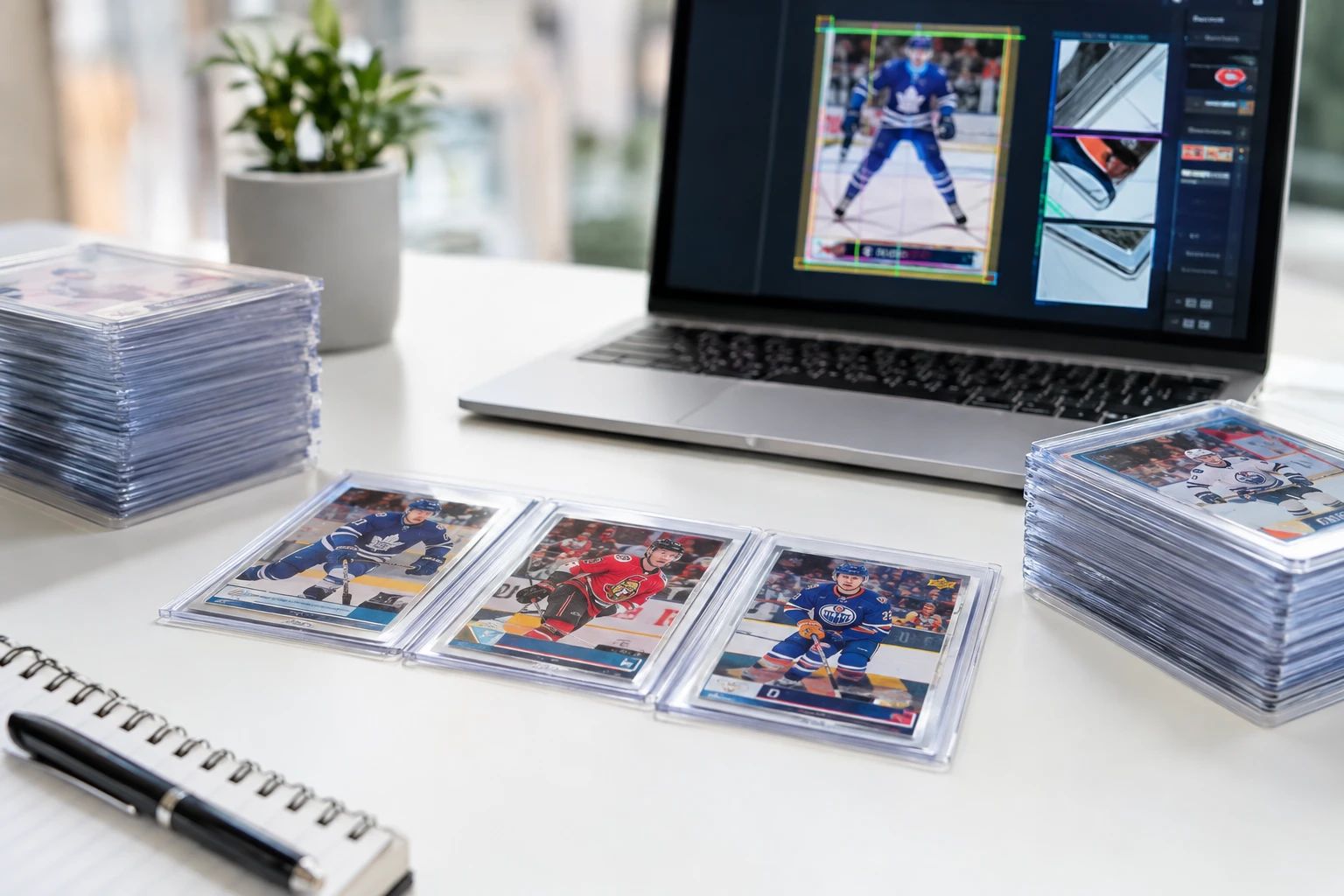
AI hockey card grading uses computer vision and machine learning to predict professional grades for NHL trading cards from a photograph. The AI identifies the brand (Upper Deck, Fleer, O-Pee-Chee, Parkhurst), set (Series 1, Series 2, SP Authentic, Young Guns), player, team, year, and card number, then analyzes centering, corners, edges, and surface to predict the grade PSA, BGS, or SGC would assign.
Hockey cards occupy a unique position in the sports card market. Unlike basketball, football, and baseball — where multiple manufacturers compete — Upper Deck held the exclusive NHL trading card license from 2005 until 2024-25, when the NHL and NHLPA terminated the agreement. This has created a transition period where Upper Deck products remain the most collected and graded hockey cards, but new manufacturers may enter the market. The AI is trained on Upper Deck cards from all eras and can identify them automatically.
The purpose of AI hockey card grading is pre-screening. With PSA Value tiers paused, the cheapest submission is $79.99 per card. A Connor McDavid Young Guns rookie card worth $50 raw can sell for $800+ at PSA 10 — a 16x multiplier. But the same card at PSA 9 might only sell for $120, barely covering the grading fee. AI pre-grading costs under $0.20 per card and helps collectors identify which cards are likely PSA 10 candidates before spending money on professional grading.
Upper Deck Young Guns: The Holy Grail of Hockey Cards
Upper Deck Young Guns are the most collected, most traded, and most graded hockey cards in the world. Inserted as short prints in Upper Deck Series 1 and Series 2 base sets, Young Guns are considered the definitive rookie card for most NHL players. A Young Guns PSA 10 of a star player like Connor McDavid, Auston Matthews, or Connor Bedard can sell for hundreds or thousands of dollars.
What makes Young Guns special: Upper Deck Young Guns are the first widely available NHL cards of most rookies. They are short-printed (typically 1 in every 4-6 packs), making them scarcer than base cards. The Young Guns design features a distinctive foil border and action photography, with the "Young Guns" logo prominently displayed. The foil border and full-bleed design create unique grading challenges.
Centering on Young Guns is the number one reason these cards fail to reach PSA 10. The full-bleed design means the image extends to the edge of the card, making any centering misalignment immediately obvious. PSA requires 55/45 front centering for a PSA 10, but many Young Guns come out of the pack at 60/40 or worse. The AI measures centering to the pixel and tells you exactly where your card falls on the PSA scale.
Young Guns surface issues include foil scratches, print lines, and surface dimpling. The foil border is reflective and can show scratches from normal handling. Print lines are common on Upper Deck cards, particularly on the Young Guns subset. The AI is trained to detect Upper Deck-specific surface defects, including foil scratches and print lines that may be invisible under normal lighting.
Corner whitening on Young Guns is less visible than on white-bordered cards like Panini Prizm Silver, but the foil border can show dinging and fraying. The AI examines all four corners for sharpness and flags any issues that would prevent a PSA 10.
Key Young Guns to pre-grade in 2026:
- Connor Bedard (2023-24 UD Series 1): The most valuable active Young Guns. PSA 10 sells for $500-800. Pre-screen before submitting.
- Matvei Michkov (2024-25 UD Series 1): Top Flyers prospect with high upside. Raw value $30-50, PSA 10 value $200-400.
- Macklin Celebrini (2024-25 UD Series 2): 2024 1st overall pick. Raw value $40-60, PSA 10 value $250-500.
- Connor McDavid (2015-16 UD Series 1): The modern holy grail. PSA 10 sells for $800-1,200. Always worth pre-screening.
- Auston Matthews (2016-17 UD Series 1): Toronto market premium. PSA 10 sells for $300-600.
How AI Analyzes Hockey Cards
The AI hockey card grading pipeline is designed for the unique characteristics of Upper Deck card stock and finishes. The process works as follows.
Step 1 — Image Capture: Photograph the front and back of your hockey card under even lighting. Upper Deck Young Guns have foil borders that are reflective, so avoid flash and direct sunlight. Place the card on a dark, flat surface for best results. A smartphone camera in good lighting is sufficient.
Step 2 — Card Identification: The AI identifies the brand (Upper Deck, Fleer, O-Pee-Chee, Parkhurst), set (Series 1, Series 2, SP Authentic, Black Diamond, etc.), subset (Young Guns, Exclusives, High Gloss, etc.), player, team, year, and card number. This is critical for hockey cards because the same player can have multiple cards across different Upper Deck products in the same season.
Step 3 — Centering Analysis: The AI measures exact pixel distances between borders on all four sides. For full-bleed Upper Deck cards, the image extends to the edge, making centering measurement more complex than on bordered cards. The AI uses edge detection algorithms to identify the card boundaries even when the image bleeds to the edge. PSA 10 requires 55/45 front centering and 75/25 back centering.
Step 4 — Corner Inspection: The AI examines all four corners for sharpness, whitening, fraying, and dinging. Upper Deck card stock is moderately thick, which provides some corner protection but also means corner dings can be deeper and more visible. The AI flags each corner individually with a sub-score.
Step 5 — Edge Assessment: The AI scans edges for chipping, fraying, and wear. Upper Deck edges are typically clean on pack-fresh cards but can show wear from handling and storage. The foil border on Young Guns can show silvering along the edges.
Step 6 — Surface Scan: The AI looks for scratches, print lines, dimples, and scuffs. Upper Deck cards are prone to print lines, particularly on the Young Guns subset. The foil elements on Young Guns and Exclusives can show scratching. The AI is trained on Upper Deck surface patterns to distinguish between the intended foil design and actual damage.
Step 7 — Grade Prediction: The AI combines all sub-scores into predicted grades for PSA, BGS, and SGC, with a confidence score and defect map. It also pulls recent sold prices at each grade level so you can see the financial upside of grading.
Upper Deck Series 1 & 2: Complete Grading Guide
Upper Deck Series 1 and Series 2 are the flagship hockey card products, released each fall and winter respectively. Together they contain the base set, Young Guns rookies, and various inserts and parallels. Understanding the grading characteristics of each product is essential for hockey card collectors.
Upper Deck Series 1 is released in the fall and contains the first Young Guns of the season. Series 1 Young Guns are typically more valuable than Series 2 because they feature players who made the NHL roster out of training camp. The base set has a glossy finish with a photo border design. Centering is the primary grading issue, followed by corner wear on the white border elements.
Upper Deck Series 2 is released in mid-season and contains Young Guns of players called up later in the season. Series 2 Young Guns can be valuable if the player performs well — Macklin Celebrini's Series 2 Young Guns is a prime example. The card stock and finish are identical to Series 1, so the AI applies the same grading model.
Upper Deck Exclusives and High Gloss are parallel inserts with different foil patterns and serial numbering. Exclusives have a silver foil border and are numbered to 100. High Gloss has a glossy finish and is numbered to 10. These parallels are rarer and more valuable than base Young Guns, making them strong candidates for grading. The AI identifies the parallel type and adjusts its surface analysis for the different foil patterns.
Upper Deck Clear Cut is a acetate insert set with a transparent design. Clear Cut cards are difficult to grade because the transparent surface shows every scratch and fingerprint. The AI can identify Clear Cut cards and apply a specialized surface model, though accuracy is lower on acetate cards due to their unique optical properties.
SP Authentic & Parkhurst Grading Guide
Beyond the flagship Series 1 and 2, Upper Deck produces several premium hockey products that are popular among grading collectors.
SP Authentic is Upper Deck's premium rookie product. SP Authentic Future Watch rookies are considered the second-most important rookie card after Young Guns. The cards have a different design with a matte finish and a smaller print run. SP Authentic cards are less prone to surface scratching than Young Guns but can have print lines and corner issues. The AI identifies SP Authentic cards and applies the appropriate grading model for the matte finish.
Parkhurst is a heritage brand revived by Upper Deck. Parkhurst cards have a retro design inspired by the 1950s-1960s Parkhurst sets. The cards use a different card stock with a vintage feel. Centering is particularly important on Parkhurst cards because the retro design features prominent borders. The AI can identify Parkhurst cards and adjust its centering analysis for the vintage-style borders.
Upper Deck Black Diamond is a premium product with gem-themed parallels (Ruby, Sapphire, Emerald, Diamond). The cards have a unique foil pattern and thick card stock. The AI identifies Black Diamond cards and applies the appropriate surface and edge analysis for the premium stock.
Upper Deck Artifact is another premium product with patch and autograph inserts. Artifact cards have a metallic finish and can show surface scratching. The AI can identify Artifact cards and flag surface issues specific to the metallic finish.
Upper Deck Premier is the highest-end Upper Deck product, featuring patch autographs and premium card stock. Premier cards are high-value and always worth pre-screening before a $79.99+ PSA submission. The AI can identify Premier cards and flag issues with patch placement, auto quality, and surface defects.
Vintage Hockey Cards: O-Pee-Chee & Fleer
Vintage hockey cards from O-Pee-Chee, Topps, and Fleer are increasingly collected and graded. These cards have completely different characteristics from modern Upper Deck cards and require specialized AI handling.
O-Pee-Chee hockey cards are the Canadian equivalent of Topps hockey cards. Produced from the 1930s through the 1990s, O-Pee-Chee cards are iconic in the hockey collecting world. The 1979-80 O-Pee-Chee Wayne Gretzky rookie card is one of the most valuable hockey cards in existence, with PSA 10 copies selling for over $1 million. Vintage O-Pee-Chee cards have rough card stock, centering issues, and print defects that are characteristic of the era. The AI can identify O-Pee-Chee cards and accounts for vintage aging patterns, though accuracy is lower (approximately 76%) on pre-1980 cards.
1950s-1960s Parkhurst cards are the original vintage hockey cards. These cards feature painted player portraits and bright backgrounds, similar to 1950s Topps baseball. The cards are over 60 years old and typically have significant wear. Centering is often wildly off, and corners are almost always rounded. The AI accounts for vintage aging and adjusts grading expectations accordingly.
1980s Topps and O-Pee-Chee cards have a more modern design but still use older card stock. The 1981 O-Pee-Chee Mark Messier rookie and the 1985 Topps Mario Lemieux rookie are key cards from this era. Centering and corner wear are the primary issues. The AI can detect both with reasonable accuracy on 1980s cards.
1990s Upper Deck hockey cards are the beginning of the modern era. The 1990-91 Upper Deck French Patrick Roy rookie is a key card. These cards have better print quality than 1980s cards but still have centering and corner issues. The AI performs well on 1990s Upper Deck cards (approximately 85% accuracy) because the card stock and print quality are closer to modern standards.
AI Hockey Card Grading Accuracy Data
The PreGradeCards benchmark study tested AI grading accuracy on hockey cards across all eras. The results show that AI is a reliable pre-screening tool for hockey cards, with accuracy varying by card type and era.
| Hockey Card Category | Accuracy (±1 Grade) | PSA 10 Prediction | Notes |
|---|---|---|---|
| Modern Upper Deck (2010-2026) | 88% | 81% | Best performance on Young Guns |
| Young Guns specifically | 89% | 82% | Centering is the primary differentiator |
| SP Authentic Future Watch | 86% | 79% | Matte finish is easier to surface-grade |
| 1990s Upper Deck | 85% | 77% | Better print quality than 1980s |
| Vintage O-Pee-Chee (pre-1980) | 76% | 68% | Aging patterns poorly represented |
The data shows that AI is most accurate on modern Upper Deck Young Guns, which are also the most commonly graded hockey cards. The high accuracy on Young Guns is because centering — the AI's strongest capability — is the primary grade differentiator for these cards. Vintage accuracy is lower because of aging patterns and card stock differences, but even 76% accuracy is valuable for pre-screening purposes.
ROI: Which Hockey Cards Are Worth Grading?
The economics of hockey card grading are driven by the Young Guns market. Because Young Guns are the definitive rookie card for most NHL players, they have the highest PSA 10 premiums in hockey. The decision to grade depends on the player's star power, the card's raw value, and the PSA 10 value.
Star player Young Guns are almost always worth grading if they are in gem mint condition. A Connor Bedard Young Guns worth $50 raw can sell for $500-800 at PSA 10 — a 10-16x multiplier. Even at $79.99 PSA Regular pricing, the profit margin is substantial. AI pre-screening helps confirm the card is likely to gem before you spend the money.
Mid-tier player Young Guns are borderline. A Nick Suzuki Young Guns might be worth $15 raw and $80 at PSA 10. After $79.99 grading fees and shipping, the profit is minimal. AI pre-screening can help you identify the cleanest cards, but the economics only work if you can submit at bulk rates or through BGS at $20 per card.
SP Authentic Future Watch rookies are worth pre-screening for star players. The SP Authentic Future Watch is the second-most valuable rookie card after Young Guns. A McDavid SP Authentic Future Watch PSA 10 sells for $400-600. The AI can identify SP Authentic cards and provide grade predictions specific to the matte finish.
Vintage hockey cards are almost always worth grading if they are in good condition. A 1979 O-Pee-Chee Gretzky rookie in any condition is valuable, but the difference between PSA 8 and PSA 9 can be tens of thousands of dollars. AI pre-screening with 76% accuracy can help identify which vintage cards are worth the risk of submission.
| Card | Raw Value | PSA 10 Value | Multiplier | Worth Grading? |
|---|---|---|---|---|
| Bedard Young Guns | $50 | $600 | 12x | Yes |
| McDavid Young Guns | $200 | $1,000 | 5x | Yes |
| Celebrini Young Guns | $40 | $300 | 7.5x | Yes |
| Suzuki Young Guns | $15 | $80 | 5x | Borderline |
| 1979 OPC Gretzky RC | $10,000 | $1M+ | 100x | Always |
The Canadian Hockey Card Market
Hockey card collecting is uniquely concentrated in Canada, where it is the dominant sport card category. The Canadian market has distinct characteristics that affect grading strategy.
Canadian collectors submit more hockey cards for grading than all other countries combined. The Toronto, Montreal, Edmonton, Calgary, and Vancouver markets are particularly active. Canadian collectors primarily use PSA for grading, followed by BGS (Beckett has a strong Canadian presence) and SGC (known for vintage hockey).
Shipping considerations are important for Canadian collectors. PSA is located in the US, so Canadian submissions require international shipping, customs declarations, and longer turnaround times. This makes pre-screening even more valuable — Canadian collectors want to be confident in their submission before paying for international shipping and customs fees on top of the $79.99 grading cost.
SGC for vintage hockey is a popular choice among Canadian collectors. SGC's "tuxedo" label is well-regarded for vintage hockey cards, and SGC has shorter turnaround times than PSA. The AI provides SGC grade predictions alongside PSA and BGS, so collectors can choose the best service for their cards.
The Upper Deck license transition has created uncertainty in the hockey card market. With the NHL/NHLPA terminating Upper Deck's exclusive license, future hockey cards may be produced by Fanatics or other manufacturers. This has increased demand for Upper Deck cards, particularly Young Guns, as collectors view them as the definitive rookie cards of the Upper Deck era. AI pre-grading helps collectors identify which Upper Deck cards are worth grading before the market shifts.
Pre-Grading Workflow for Hockey Collections
PreGradeCards makes AI hockey card grading accessible to every collector. Here is the complete workflow.
- 1. Photograph your cards: Place each card on a dark, flat surface under even lighting. Avoid flash on Young Guns foil borders. Take one photo of the front and one of the back.
- 2. Upload to PreGradeCards: Drag and drop your photos. Batch upload up to 10 cards at once. The AI processes each card in seconds.
- 3. Review the AI report: Each card receives predicted PSA, BGS, and SGC grades, sub-scores for centering, corners, edges, and surface, a defect map showing exactly where issues were found, and a raw vs graded value comparison with recent sold prices.
- 4. Sort by predicted grade: Cards predicted at PSA 9.5 or higher are your strongest submission candidates. Cards predicted at PSA 8 or lower should be sold raw unless they are high-value vintage cards.
- 5. Check the value comparison: For each candidate, compare the predicted graded value against the grading cost. Only submit cards where the graded value is at least 3x the grading fee.
- 6. Build your submission: Select the cards that pass both the grade prediction and value tests. Package them securely and submit to PSA, BGS, or SGC at the appropriate tier.
The entire pre-grading process takes less than a minute per card. A 50-card hockey collection — a typical binder of Young Guns from multiple seasons — can be fully screened in under an hour, saving you thousands in avoided grading fees on cards that would have come back at PSA 7 or 8.
Frequently Asked Questions
Can AI grade hockey cards from Upper Deck only?
How accurate is AI hockey card grading?
What are the most valuable hockey cards to grade?
Why is centering so important on Young Guns?
Does AI work on Upper Deck Exclusives and High Gloss parallels?
Should Canadian collectors use SGC for vintage hockey?
How does the Upper Deck license loss affect grading?
Sources & Further Reading
- PSA Hockey Card Grading
- Upper Deck Hockey
- PreGradeCards AI Grading Benchmark
- SGC Hockey Card Grading
The PreGradeCards Research Team combines machine-learning engineers, grading analysts, and collector-education specialists to produce accurate, data-driven guides on AI card grading, professional grading standards, and collecting strategy.
Create a free account and get 2 free credits — enough for 2 complete AI gradings with market pricing. No credit card required.
Get Your Free Credits →