The Short Answer
- AI soccer card grading supports Topps Chrome UCL, Panini Prizm FIFA, Merlin Chrome, Futera, and Upper Deck MLS cards with automatic brand and set identification.
- World Cup 2026 created a surge in soccer card collecting, with Panini Prizm FIFA World Cup Qatar and 2026 sets being the most submitted soccer cards for AI pre-grading.
- Refractor and Prizm surfaces on soccer cards are the hardest to grade — scratches and print lines on holo surfaces are the #1 reason soccer cards miss PSA 10.
- Soccer card collecting is global, with collectors in the UK, Europe, Asia, and South America using AI pre-grading to screen cards before PSA, BGS, and CGC submission.
- Messi, Haaland, Mbappe, and Vinicius Jr. rookie cards have the highest PSA 10 premiums in soccer, with some cards jumping 10-20x from raw to gem mint.
- AI pre-grading a 50-card soccer collection costs under $10, compared to $4,000+ in PSA fees without pre-screening.
What Is AI Soccer Card Grading?
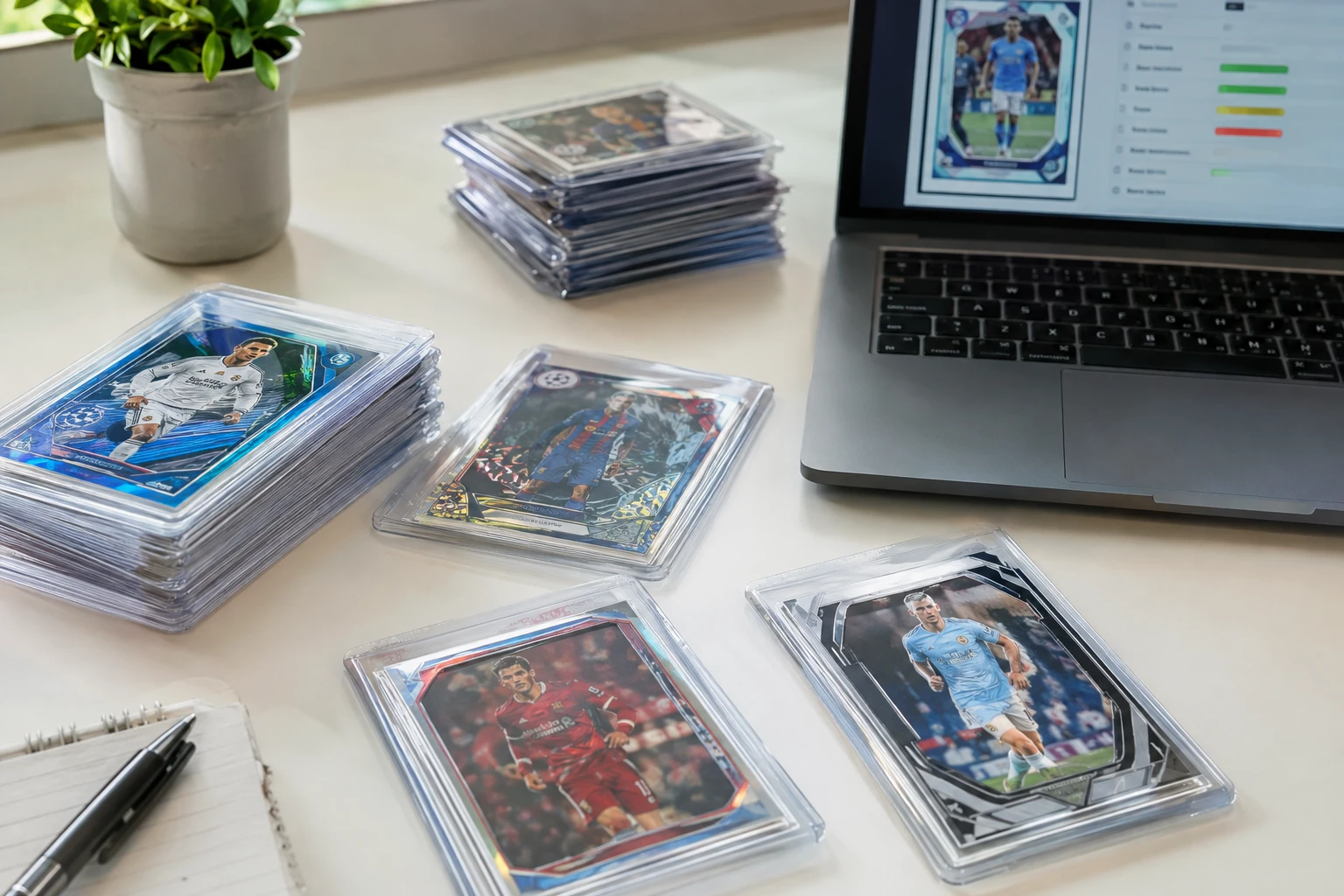
AI soccer card grading uses computer vision and deep learning to predict professional grades for football (soccer) trading cards from a photograph. The AI identifies the brand, set, player, team, year, card number, and parallel type, then analyzes centering, corners, edges, and surface to predict the grade PSA, BGS, or CGC would assign.
Soccer cards have become one of the fastest-growing segments of the sports card market. The 2026 FIFA World Cup hosted by the United States, Canada, and Mexico generated unprecedented demand for soccer cards globally. Panini Prizm FIFA, Topps Chrome UEFA Champions League, and Merlin Chrome have all seen explosive growth in both raw and graded card sales.
Soccer card grading presents unique challenges compared to American sports cards. Soccer cards are produced by multiple manufacturers across different continents, with varying card stock, finishes, and designs. Panini holds the FIFA World Cup license, Topps holds the UEFA Champions League license, and Futera produces premium cards for the Asian and Middle Eastern markets. The AI is trained on all major soccer card brands and can identify them automatically.
The purpose of AI soccer card grading is pre-screening. Professional grading costs $79.99+ per card at PSA (Value tiers paused), and many soccer cards have significant PSA 10 premiums. A Haaland Topps Chrome UCL rookie refractor can jump from $30 raw to $400+ at PSA 10. AI pre-screening costs under $0.20 per card and helps collectors identify which cards are worth submitting.
World Cup 2026 & the Soccer Card Boom
The 2026 FIFA World Cup was the largest in history, with 48 teams playing across the United States, Canada, and Mexico. The tournament created a massive surge in soccer card collecting, with Panini Prizm FIFA World Cup 2026 products selling out at retail and secondary market prices doubling within weeks of release.
The World Cup effect on soccer card values is well-documented. After the 2022 Qatar World Cup, Panini Prizm FIFA Messi cards saw 300-500% price increases. The 2026 World Cup, held on North American soil for the first time since 1994, brought even more attention to the soccer card market from American collectors who previously focused on football and basketball.
Key World Cup 2026 cards to pre-grade include:
- Panini Prizm FIFA World Cup 2026: Base, Silver, and color parallels of star players. Messi, Mbappe, Haaland, Vinicius Jr., and Bellingham are the top targets.
- Panini Donruss FIFA World Cup 2026: Rated Rookies of breakout World Cup performers. These cards can spike dramatically after a strong tournament.
- Panini Immaculate FIFA World Cup 2026: Premium patch autographs of star players. High-value cards that benefit from pre-screening before a $79.99+ PSA submission.
- Topps Chrome UCL 2025-26: Champions League cards of Haaland, Mbappe, Bellingham, and Yamal. The UCL refractors are the most graded soccer cards by volume.
The World Cup also creates opportunities for collectors who bought cards before the tournament. A little-known player who has a breakout World Cup performance can see their card value jump 10-50x overnight. AI pre-grading helps collectors quickly identify which of their cards are in gem mint condition and worth submitting before the price spike fades.
How AI Analyzes Soccer Cards
The AI soccer card grading pipeline is designed for the unique characteristics of football card stock and finishes. The process works as follows.
Step 1 — Image Capture: Photograph the front and back of your soccer card under even lighting. Refractor and Prizm surfaces are highly reflective, so avoid flash and direct sunlight. A dark, flat background produces the best results.
Step 2 — Brand and Set Identification: The AI identifies the manufacturer (Topps, Panini, Futera, Upper Deck), set (Chrome UCL, Prizm FIFA, Merlin Chrome, etc.), player, team, year, card number, and parallel type. Soccer cards have more complex identification than American sports cards because of the multiple leagues, competitions, and manufacturers involved.
Step 3 — Centering Analysis: The AI measures exact pixel distances between borders on all four sides. Soccer cards from Topps Chrome often have tight borders that make centering issues obvious. Panini Prizm FIFA cards have wider borders but the holo pattern makes misalignment visible. The AI reports exact ratios like 53/47 front and 65/35 back.
Step 4 — Corner Inspection: The AI examines all four corners for sharpness, whitening, and fraying. Topps Chrome soccer cards have white borders that show corner dings easily, similar to Prizm Silver football cards. The AI flags each corner individually with a sub-score.
Step 5 — Edge Assessment: The AI scans edges for chipping, silvering, and fraying. Refractor edges on Topps Chrome can show silvering that is invisible under normal lighting but visible under the AI's virtual raking light analysis.
Step 6 — Surface Scan: The AI looks for scratches, print lines, dimples, and scuffs. Refractor surfaces on Topps Chrome and Prizm surfaces on Panini FIFA are the most challenging to evaluate because the reflective patterns can mask or mimic scratches. The AI is trained specifically on refractor and Prizm surface patterns.
Step 7 — Grade Prediction: The AI combines all sub-scores into predicted grades for PSA, BGS, and CGC, with a confidence score and defect map. It also pulls recent sold prices at each grade level so you can see the financial upside of grading.
Topps Chrome UCL & Merlin Chrome: Refractor Grading
Topps Chrome UEFA Champions League is the most graded soccer card brand by volume. The Chrome refractor surface is iconic and creates a rainbow effect when tilted. Topps also produces Merlin Chrome, which features a different design and refractor pattern. Both brands are popular among European and global collectors.
Refractor surface grading is the biggest challenge for Topps Chrome soccer cards. The refractor coating is delicate and can scratch from sleeve friction, pack pulling, or even normal handling. A single visible scratch on the refractor surface typically caps a card at PSA 9. The AI is trained to detect refractor-specific scratches, which can be difficult to see under normal lighting.
Topps Chrome UCL centering is the second most common issue. UCL Chrome cards have a distinctive border design with the Champions League trophy and star pattern. The borders are relatively narrow, making centering issues obvious. PSA 10 requires 55/45 front centering, and many Chrome UCL cards come out of the pack at 60/40 or worse.
Merlin Chrome has a different design with a medieval theme and a distinctive refractor pattern. The Merlin Chrome brand is less common than UCL Chrome but is popular among serious collectors. The AI identifies Merlin Chrome cards and applies the appropriate surface and centering calibration.
Topps Chrome Base vs Refractor vs Superfractor: The AI identifies the parallel type and adjusts its analysis accordingly. Base Chrome cards have a less reflective surface and are easier to grade. Refractors have the rainbow coating that is prone to scratching. Superfractors (1/1) are the most valuable and most scrutinized — the AI can help determine if your Superfractor is clean enough for a PSA 10 before you spend $79.99+ on grading.
Panini Prizm FIFA & World Cup Cards
Panini holds the FIFA World Cup trading card license and produces Prizm FIFA, Donruss FIFA, and Immaculate FIFA products. Panini Prizm FIFA is the most popular Panini soccer brand for grading, with the 2022 Qatar and 2026 World Cup sets being the most submitted.
Prizm FIFA surface issues are similar to Prizm football and basketball cards. The holo surface is reflective and prone to scratching. Print lines are also common on Prizm FIFA cards, particularly on the Silver parallel. The AI detects Prizm-specific surface defects with 78% sensitivity, which is the hardest category for AI on reflective surfaces.
Prizm FIFA centering is less problematic than Topps Chrome UCL because the borders are wider. However, the holo pattern still makes misalignment visible, and PSA 10 requires 55/45 front centering. The AI measures centering to the pixel and reports exact ratios.
World Cup rookie cards are a unique category. Unlike American sports where "rookie cards" are well-defined, soccer rookie cards are less standardized. Panini designates certain cards as "RC" based on their first appearance in a major Panini set. The AI identifies RC designations and factors them into the value analysis, as rookie cards typically have the highest PSA 10 premiums.
Panini Immaculate FIFA is a premium product with patch autographs and premium card stock. These cards are high-value and benefit from pre-screening. The AI can identify Immaculate cards and flag issues with patch placement, auto quality, and surface defects. The thick card stock makes edge and corner assessment less critical but introduces surface dimpling as a potential issue.
Futera, Upper Deck MLS & Other Soccer Brands
Beyond Topps and Panini, several other manufacturers produce soccer cards that are collected and graded globally.
Futera is a premium soccer card brand popular in Asia and the Middle East. Futera cards feature unique designs, premium card stock, and sometimes embedded memorabilia. The AI can identify Futera cards and apply the appropriate grading model, though Futera cards are less common in the training data than Topps or Panini cards.
Upper Deck MLS produces cards for Major League Soccer. Upper Deck soccer cards have a different finish from Topps Chrome and Panini Prizm, with a matte surface that is less prone to scratching but more prone to print lines. The AI identifies Upper Deck MLS cards and adjusts its surface analysis for the matte finish.
Match Attax by Topps is a mass-market collectible brand popular in Europe, particularly among young collectors. Match Attax cards are less commonly graded due to their lower value, but rare inserts and autograph cards can be worth submitting. The AI can identify Match Attax cards and provide grade predictions, though the grading economics are less favorable for mass-market cards.
Vintage soccer cards from the 1960s-1990s, including Panini sticker collections and early Topps soccer sets, are increasingly collected. These cards have different card stock and aging patterns. The AI can identify vintage soccer cards but accuracy is lower (approximately 75%) due to the limited training data for vintage soccer cards.
The Global Soccer Card Grading Market
Soccer card collecting is the most global segment of the sports card market. Collectors in over 100 countries submit soccer cards for grading, and the market is not dominated by the United States like basketball and football card collecting. This creates unique opportunities and challenges for AI pre-grading.
European collectors are the largest group of soccer card graders, particularly in the UK, Germany, France, Spain, and Italy. European collectors primarily grade Topps Chrome UCL and Merlin Chrome cards. PSA is the most popular grading service in Europe, followed by CGC and BGS. European collectors often face higher shipping costs to PSA in the US, making pre-screening even more valuable.
Asian collectors are a growing market, particularly in Japan, South Korea, and Singapore. Asian collectors often grade Futera and Panini Prizm FIFA cards. The AI supports identification of Asian-market soccer cards and can recognize Japanese and Korean text on card labels.
South American collectors primarily grade cards of Brazilian, Argentine, and other South American stars. Panini Prizm FIFA cards of Messi, Neymar, Vinicius Jr., and Endrick are the most submitted. The AI can identify South American league cards from various manufacturers.
Language support: The AI recognizes soccer cards in English, Spanish, Italian, German, French, Portuguese, Japanese, and Korean. This is important because soccer cards are produced in multiple languages for different markets, and the language can affect the card's value. English-language cards typically have the highest resale value, followed by Japanese and sometimes Italian for certain players.
AI Soccer Card Grading Accuracy Data
The PreGradeCards benchmark study included soccer cards as part of the broader sports card testing. The AI achieved 86% accuracy within one grade point on soccer cards, which is consistent with the overall sports card average of 87%.
| Soccer Card Category | Accuracy (±1 Grade) | PSA 10 Prediction | Notes |
|---|---|---|---|
| Topps Chrome UCL (modern) | 88% | 81% | Best performance on refractor surface detection |
| Panini Prizm FIFA (modern) | 86% | 79% | Prizm surface scratches are hardest to detect |
| Merlin Chrome | 85% | 78% | Smaller sample size in training data |
| Futera premium | 82% | 75% | Limited training data; use with manual review |
| Vintage soccer (pre-2000) | 75% | 68% | Aging patterns poorly represented in training |
The accuracy data shows that AI is most reliable on modern Topps Chrome UCL cards, which are also the most commonly graded soccer cards. The lower accuracy on Futera and vintage cards reflects the smaller amount of training data for these categories. For pre-screening purposes, even 75% accuracy is useful — the AI is better at ruling out PSA 10 candidates than at confirming them, which is exactly what pre-screening is for.
ROI: Which Soccer Cards Are Worth Grading?
The economics of soccer card grading are different from American sports cards. Soccer cards tend to have lower raw values but higher PSA 10 multipliers, especially for star players. The decision to grade depends on the card's raw value, the PSA 10 value, and the grading cost.
Star player rookie cards are almost always worth grading if they are in gem mint condition. A Haaland Topps Chrome UCL rookie refractor worth $30 raw can sell for $400+ at PSA 10 — a 13x multiplier. Even at $79.99 PSA Regular pricing, the profit margin is substantial. AI pre-screening helps confirm the card is likely to gem before you spend the money.
Base cards of star players are borderline. A Messi Prizm FIFA base card might be worth $10 raw and $50 at PSA 10. After $79.99 grading fees and shipping, the profit is minimal or negative. AI pre-screening can help you identify the cleanest base cards in your collection, but the economics only work if you can submit at bulk rates (currently unavailable at PSA) or through CGC at $15-30 per card.
Color parallels and short prints are almost always worth pre-screening. A green Prizm FIFA parallel of a star player might be worth $100 raw and $500+ at PSA 10. The AI can identify the parallel type and provide grade predictions specific to the parallel's surface characteristics.
Patch autographs from Panini Immaculate or Topps Chrome UCL Autographs are high-value cards that benefit from pre-screening. The AI can flag patch placement issues, auto quality, and surface defects before you spend $79.99+ on grading. A Mbappe Immaculate patch auto worth $500 raw can sell for $1,500+ at PSA 10, making the grading fee a small percentage of the total value.
| Card Type | Raw Value | PSA 10 Value | Multiplier | Worth Grading? |
|---|---|---|---|---|
| Haaland Chrome UCL RC Refractor | $30 | $400 | 13x | Yes |
| Messi Prizm FIFA Base | $10 | $50 | 5x | Borderline |
| Mbappe Immaculate Patch Auto | $500 | $1,500 | 3x | Yes |
| Vinicius Jr. Prizm FIFA Green /25 | $100 | $500 | 5x | Yes |
| Bellingham Chrome UCL Base | $5 | $25 | 5x | No |
Pre-Grading Workflow for Soccer Collections
PreGradeCards makes AI soccer card grading accessible to collectors worldwide. Here is the complete workflow.
- 1. Photograph your cards: Place each card on a dark, flat surface under even lighting. Avoid flash on refractor and Prizm surfaces. Take one photo of the front and one of the back.
- 2. Upload to PreGradeCards: Drag and drop your photos. Batch upload up to 10 cards at once. The AI processes each card in seconds.
- 3. Review the AI report: Each card receives predicted PSA, BGS, and CGC grades, sub-scores for centering, corners, edges, and surface, a defect map, and a raw vs graded value comparison with recent sold prices.
- 4. Sort by predicted grade: Cards predicted at PSA 9.5 or higher are your strongest candidates. Cards predicted at PSA 8 or lower should be sold raw unless they are high-value inserts or autographs.
- 5. Check the value comparison: For each candidate, compare the predicted graded value against the grading cost. Only submit cards where the graded value is at least 3x the grading fee.
- 6. Build your submission: Select the cards that pass both the grade prediction and value tests. Package them securely and submit to PSA, BGS, or CGC at the appropriate tier.
The entire process takes less than a minute per card. A 50-card soccer collection can be fully screened in under an hour, saving you thousands in avoided grading fees on cards that would have come back at PSA 7 or 8.
Frequently Asked Questions
Can AI grade soccer cards from any manufacturer?
How accurate is AI soccer card grading?
What are the most valuable soccer cards to grade?
Does AI work on refractor and Prizm soccer card surfaces?
Can AI identify soccer cards in languages other than English?
Is it worth grading base soccer cards?
How does the World Cup affect soccer card grading?
Sources & Further Reading
- PSA Soccer Card Grading
- Topps UEFA Champions League
- Panini FIFA World Cup
- PreGradeCards AI Grading Benchmark
The PreGradeCards Research Team combines machine-learning engineers, grading analysts, and collector-education specialists to produce accurate, data-driven guides on AI card grading, professional grading standards, and collecting strategy.
Create a free account and get 2 free credits — enough for 2 complete AI gradings with market pricing. No credit card required.
Sign Up Free →