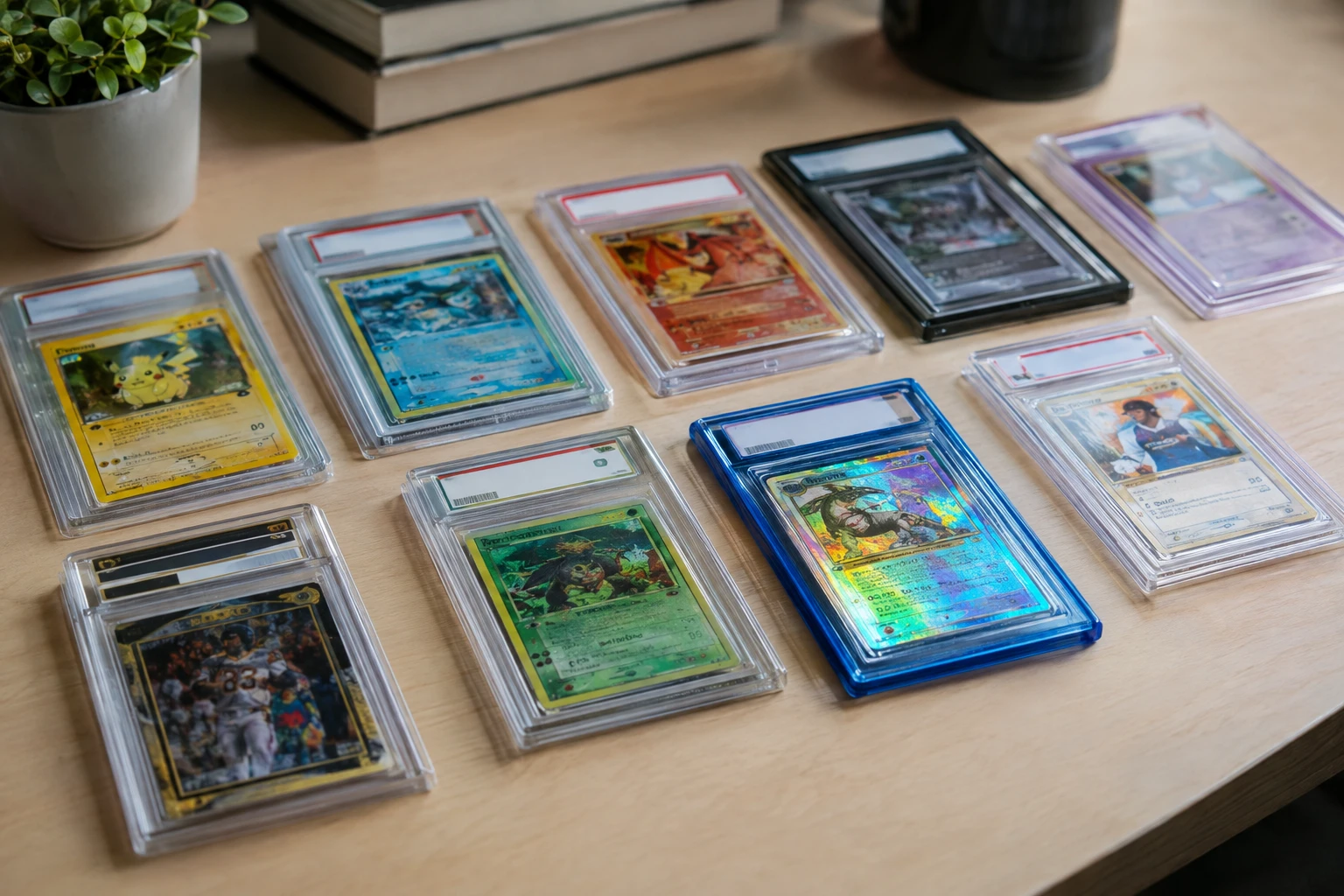
The Short Answer
- PSA, BGS, and SGC are now all owned by Collectors — CGC is the only major independent left, which is exactly why alternatives are getting search volume in 2026.
- The alternative-grader map is regional: GMA, Aura, and FCG in the US; KSA and MNT in Canada; ACE, MGC, and Imperium in the UK; PCA and CollectAura in France; GRAAD in Italy; cardmarket grading in the EU; ARS in Japan.
- Entry prices range from €4.90 (CollectAura pregrade) to CA$150 (KSA same-day) — the cheapest legitimate slabs anywhere are KSA bulk (CA$15), GMA economy (~$10), and CollectAura standard (€9.90).
- Every regional grader shares one rule: their slabs sell at or near label value inside their home market and at a discount everywhere else. Grade where your buyer is.
- Watch the Aura name trap: at least three unrelated graders use 'Aura'-family names — auragrading.com (US), CollectAura (France), and AuraGrade (an AI tool). Check the holder, not the word.
- The 4-test check before using any small grader: public cert lookup, published pricing, real third-party completed-sale data, and an operating history you can verify.
Why Alternative Graders Matter More in 2026
The grading industry consolidated hard in the last twelve months. Collectors — PSA's parent — acquired Beckett in December 2025, putting PSA, BGS, and SGC under a single owner. CGC is now the only major grading company not owned by Collectors. PSA's Value tier and Beckett's budget tiers both spent part of 2026 paused. And HGA — the hobby's most visible 'alternative' grader — suspended submissions entirely after its uCollect acquisition.
The predictable result: collectors went looking for someone — anyone — else to grade their cards. Searches for company names like KSA, GMA, ACE, Aura, PCA, and cardmarket grading are at all-time highs precisely because the big-label lane narrowed.
This directory covers every active alternative we could verify, organized by where they're based — because the single most important fact about an alternative grader is which market its label sells in. Regional slabs are real slabs: sonically sealed, serialized, and worth money to buyers who know them. They just stop being worth much the moment they cross a border.
Already covered elsewhere on this site: BCCG, BVG, and PGS, the five major companies head-to-head, and the budget tier specifically. This guide is everything else.
United States: GMA, Aura, FCG, and the Niche Tier
GMA Grading — the budget king, for better and worse
Entry pricing $8–25/card (Economy ~$10–12, Standard $15, Gold Express $20–25; bulk minimums 10–25 cards, ~$8–18/card at 100+). Turnaround is genuinely fast — the site claims all cards ship back within about 7 business days, and long-time users confirm it's the fastest in the hobby. Jersey/thick cards add $5, autographs add $10.
The catch is resale: the market treats GMA slabs as raw cards in plastic. A GMA 10 routinely sells below a raw near-mint copy of the same card. GMA is for slabs-you-keep — display pieces, organization, protection — never for cards you plan to sell.
Aura Grading (auragrading.com) — the strict American Aura
Flat pricing: $12/card Standard (2–3 weeks), $9 bulk at 50+ (3–4 weeks), $16 expedited (1 week), subgrades included on every tier. Unusually strict methodology — grades off the lowest subgrade and rounds every half-grade up to the next whole number. Cardboard Journal scores it 29/100 (Tier D) — cheap and fast, but buyers treat high-value Aura slabs as crack-and-regrade candidates. Fine for PC slabs.
The rest of the US niche tier
- FCG (Forensic Card Grading) — US-based, positions on forensic/authentication rigor.
- ISA Grading, Diamond Service Grading (DSG), Revolution Card Grading (RCG), Degree Grading, DCI Grading, Rare Edition, GetGraded US — all active US independents per industry datasets; each has a cert lookup and published tiers, but thin third-party resale data. Treat as PC-slab services unless you can verify completed sales in your market.
- Arena Club — AI-assisted grading plus built-in marketplace; semi-paused during restructuring, covered in our budget grader comparison.
Canada: KSA and MNT
KSA Certification deserves the deep dive (we gave it one — see our complete KSA review): founded 1996, the most-established regional grader anywhere. CA$15–30/card bulk-to-regular with 40–75 day turnaround, CA$50–150 express tiers, and a same-day Ontario walk-through that no major grader matches. Its slab genuinely sells — inside Canada, especially hockey. Cross-grades run 1–2 points lower at PSA.
MNT Grading — the other active Canadian independent. Same regional logic applies: domestic shipping, CAD pricing, and a label Canadian buyers recognize more than Americans do. Verify current turnaround and per-card pricing on their site before submitting; smaller ops change tiers often.
United Kingdom: ACE, MGC, RKT, Imperium
ACE Grading — the UK default, post-price-hike
ACE (acegrading.com, operating since 2021, Trustpilot 4.8 across 1,300+ reviews) became the UK's default grader for exactly the reason regional graders exist: your cards never leave the UK — no customs, no transatlantic shipping, no five-week PSA wait. Every cert page shows four subgrades plus millimeter-accurate centering data, and the signature hand-drawn artwork labels are genuinely collectible in their own right.
Pricing after the June 2026 hike: £18 Basic (45 business days), £25 Standard (25), £32 Premier (10), £60 Ultra (5), £120 Luxury (2); ACE Select members (£199/mo commitment) keep £12–15 tiers. The hike was controversial — up to +140% on top tiers — but ACE is transparent: published centering thresholds, declared-value compensation caps by tier (£500–£10,000), payment only after grading completes.
UK resale reality: ACE slabs trade actively inside the UK Pokémon market; to a US buyer they're regional-label cards. Note the 2024 break-in (over $330k of cards stolen) is still in the company's reputation history.
Other UK options
- Majesty Grading Company (MGC), RKT Grading, Imperium Grading, Legacy Grading — active UK independents appearing in industry datasets and UK search results; smaller footprints than ACE but the same domestic-shipping logic. Verify cert lookup and completed sales before committing volume.
Continental Europe: PCA, CollectAura, GRAAD, cardmarket
PCA (France) — the EU veteran
Professional Card Authentication, French, founded 2016 — mainland Europe's most established grader. Grades on a 1–10+ scale (10+ = flawless, above Gem Mint), each card reviewed sequentially by multiple experts. Pricing by speed: Classic €12.90/card (~6 months, €10.90 at 10+), Fast €19.90 (~1 month), Fast+ €49.90 (~1 week), plus declared-value scaling. The EU pitch is decisive: no customs, no transatlantic wait — at the cost of US-market liquidity.
CollectAura (France) — pregrading + art labels
collectaura.com offers a €4.90 pregrading tier (soft sleeve, condition estimate, authentication — closest thing to a human pre-grade in Europe), Standard grading €9.90, Subgrade grading €11.90, booster grading €17.90, five turnaround tiers from 40 business days to 1 day, and 6,000+ artist-designed label options. Two-grader sequential review, HD photos on every cert. Genuinely compelling for EU collectors who want a documented cheap first pass before paying for a global label.
GRAAD (Italy) — the algorithm grader
graad.eu (Grade Authority and Authentication Division) grades all card types and languages via a published weighted-average mathematical grading algorithm — unusual transparency for a small grader, and the closest thing to Europe's 'tech grader.'
cardmarket grading — the marketplace's own service
Cardmarket (Europe's dominant TCG marketplace) operates grading services for EU sellers — the appeal is zero-friction listing flow inside the marketplace EU collectors already use. Like every marketplace-attached label, resale is concentrated where the marketplace is.
Japan & Asia: ARS
ARS (Authentic Rating Service) is Japan's established independent grader, and it plays the KSA role: real trust inside the domestic market — especially for Japanese Pokémon and Japanese-issue sports cards — with thin recognition outside it. For Japanese-language cards staying in Japan, ARS is a legitimate domestic option. For anything you'll sell internationally, PSA and CGC own the Japanese Pokémon market's trust.
Regional note: Japanese cards submitted to US graders have no border problem the other way — PSA/CGC have full submission infrastructure in Japan, which is part of why ARS stays niche even at home.
Suspended and Restructuring: HGA and Arena Club
Two names still get heavy search traffic but aren't currently options:
- HGA — acquired by uCollect.com; submissions suspended pending a 2026 relaunch promising the industry's strictest standards, flat-fee pricing, and free subgrades. Full story in our HGA acquisition guide.
- Arena Club — the AI grading + marketplace startup is in restructuring; verify current submission status before sending anything.
The Aura name trap, restated: 'Aura' on a listing can mean the US grader (auragrading.com), France's CollectAura, or AuraGrade (an AI pre-grading tool that explicitly disclaims the other two). They are unrelated companies. Check the holder and cert lookup, not the name.
Important Distinction: Grading Tools vs. Actual Grading Companies
Half the search results for 'alternative graders' aren't grading companies at all — they're AI grading tools that predict a grade without ever touching your card: apps like AuraGrade, CardGrade.io, MasterGrade, SnapGrade, and browser tools like PreGradeCards. They return an estimated grade and subgrade data from photos — no slab, no certification number, no resale premium. What they replace isn't the grading company; it's the guessing about whether to submit at all.
The distinction matters because collectors regularly confuse the two categories. Paying an app $10 for an 'AI grade' does not get you a slab — it gets you information. That information is genuinely valuable (it's exactly what the whole workflow depends on: pre-grade first, submit only candidates), but an app 'gem score' has zero liquidity. If a seller advertises a card as 'AI graded 10,' treat it as a raw card with a condition opinion attached — which is exactly what it is.
The practical hierarchy: AI tools → decide if grading pays → big four or regional slabber → actual slab → resale premium. Tools sit at step one. Everything else on this page sits at step three. The mistake is paying step-three prices for step-one products — or assuming step-one tools can replace step three.
The 4 Tests Before Using Any Small Grader
However regional a grader is, run it through this checklist before mailing cards:
- Public cert lookup. If a buyer can't verify the cert online, the slab is a sticker, not a grade. KSA, ACE, PCA, CollectAura, Aura, GRAAD all pass. Any grader without a public verification DB fails instantly.
- Published pricing and tiers. 'Contact us for a quote' on a small grader is a warning sign — established regionals publish full price grids.
- Verifiable completed sales. Search eBay sold listings filtered to your card + the grader's name. If completed sales don't exist in your market, you're grading for display, not resale.
- Operating history. KSA's 30 years and ACE's 5+ years are real trust signals. A grader with 18 months of history can still be fine — just don't send it your best card first.
And the universal rule that overrides everything: the label is only worth what your buyer will pay for it. A CA$15 KSA slab that sells like a CA$15 slab in Toronto is a fair trade. The same slab listed to a US buyer at 'PSA-comparable' pricing will sit forever.
The New Entrants Worth Watching (2026-2027)
The consolidation at the top is vacuuming up the middle of the market, which historically means a wave of new launches. A few worth tracking — not necessarily using yet:
- TAG (US) — arguably the most technically credible 'alternative' alive, with a fully digital grading report attached to every slab and a transparency model the majors can't match. If any small US grader breaks into the real premium tier, it's TAG. Watch whether its pop report and eBay sold data start appearing in comparable numbers.
- Arena Club (US) — backed by meaningful venture money and a digital-slab model, but suspended normal grading operations while restructuring. The concept (AI-first grading + vault/marketplace integration) is right; the execution questions mirror HGA's. Watch the relaunch terms.
- cardmarket grading (Europe) — the EU's dominant marketplace launched an in-house grading arm in 2025. If it succeeds, it becomes the template for 'grading that ships with the marketplace' — a structural threat to standalone regional graders more than to PSA.
- UK and EU startups — several smaller services (MGC, Imperium, RKT in the UK; GRAAD in Italy) are building regional liquidity behind local trust. None is close to international premium weight, but all are worth watching as the EU market matures beyond PSA dependence.
The filter for any new entrant is the same four tests from the previous section — pass all four or it doesn't matter how nice the slab looks.
The Verdict
The alternative-grader market is healthier than it's ever been — more countries covered, more cert lookups, more transparent pricing — but the fundamental economics haven't changed. Regional slabs are a great deal when your cards stay regional. They're an expensive sleeve when they don't.
The cleanest decision framework: sell-in-your-country cards → domestic grader; sell-anywhere cards → PSA/CGC/SGC; not-sure cards → pre-grade first. An AI pre-grade costs a fraction of any of these submission fees and tells you which bucket a card actually belongs in — which matters even more when you're deciding whether a regional slab is 'good enough' or a waste of the grading fee entirely.
Frequently Asked Questions
0
1
2
3
4
5
6
7
Sources & Further Reading
- KSA Certification — Pricing & Turnaround
- CardGrade — ACE Grading UK Review
- ACE Grading — Trustpilot Reviews
- Gradelytics/grademate — PCA Grading France Review
- CollectAura — Services & Pricing
- Aura Grading (US) — Official Site
- GRAAD — Certification Method
- GMA Grading — Official Pricing
- Cardboard Journal — Aura Grading Scorecard
- Figoca — GMA Grading Review
- Sports Business Journal — Collectors to Acquire Beckett
Marcus Chen has evaluated over 50,000 sports cards and TCG cards across PSA, BGS, SGC, and CGC standards. Before joining PreGradeCards, he worked as a submission specialist for a major grading company and trained collectors and dealers on condition assessment.
Create a free account and get 1 free credit — enough for 1 complete AI grading with market pricing. No credit card required.
Sign Up Free →