The Short Answer
- KSA is Canada's oldest card grader — operating since 1996, with a 10-point inspection process, sonically sealed UV-protected holders, and a public serial-number cert lookup.
- Pricing is CAD and volume-driven: CA$30 single-card Regular (~40 days) down to CA$15/card at 100+ (~75 days), with CA$50–100 Express tiers and a CA$150 same-day walk-through in Ontario.
- KSA slabs carry a real cross-grade discount: expect KSA grades to come back 1–2 points lower at PSA/BGS, so don't send cards you plan to sell in US dollars.
- Best use case: Canadian collectors grading hockey and personal-PC cards for domestic sale or display — no customs, no US shipping, domestic insurance.
- Worst use case: anything you intend to sell on the US or international market — the label discount usually exceeds the grading cost savings.
What Is KSA Grading?
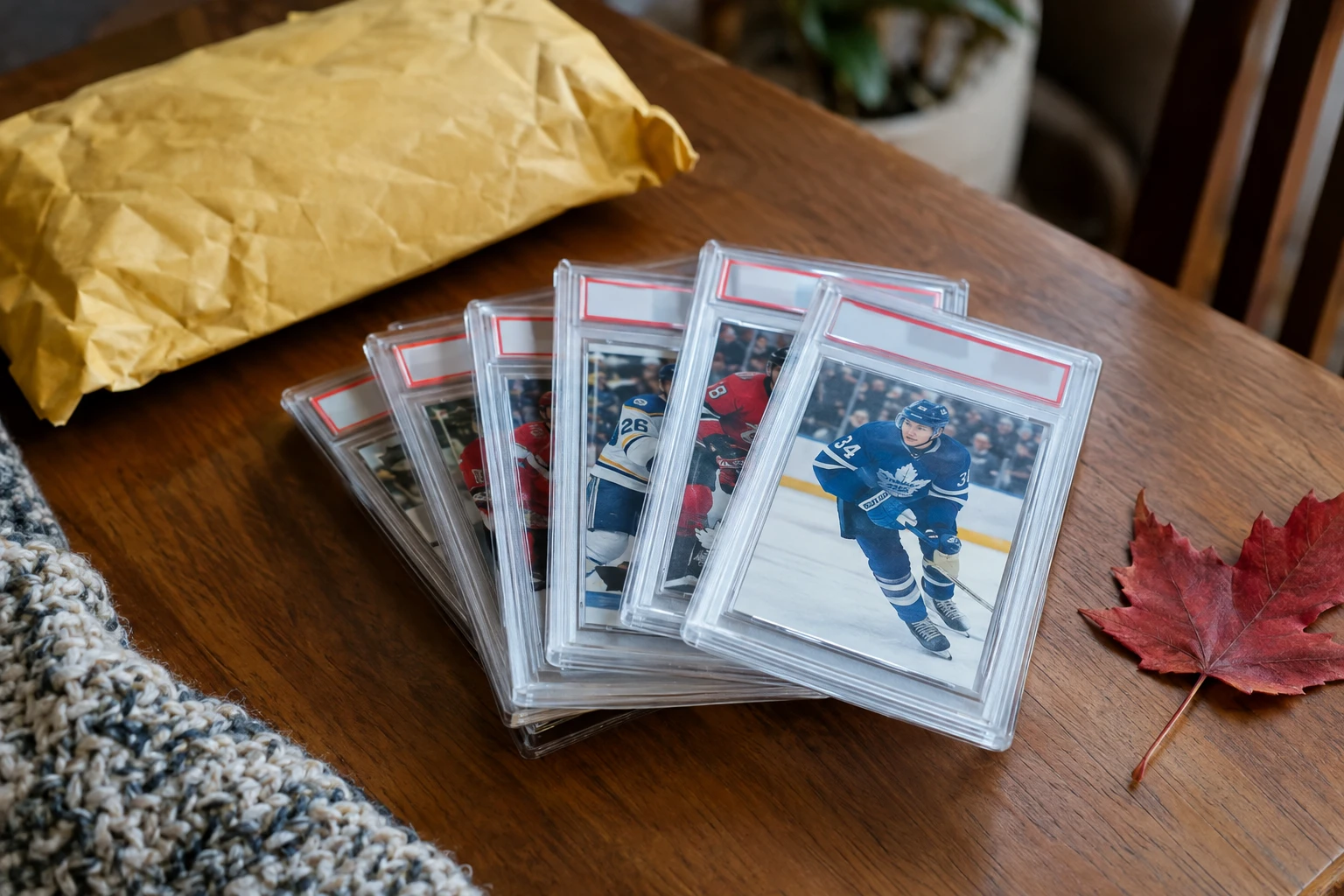
KSA Certification — KSA Grading and Authentication Services — is a Canadian card grading company founded in 1996, which makes it one of the oldest continuously-operating independent graders in the hobby. It runs two offices: the head office in Ontario (which handles mail-in submissions, the same-day walk-through service, and show appearances) and a West office covering BC and Alberta with its own turnaround schedule.
Three decades in, KSA's reputation is regional but real: it's the trusted label in Canadian hockey, where Gretzky, Orr, and Howe in KSA holders move comfortably at domestic shows and on Canadian eBay listings. Outside that niche — and especially outside Canada — buyer recognition drops off sharply, and the rest of this review is mostly about quantifying that trade-off.
Every KSA-slabbed card gets a unique serial number recorded in KSA's online database, verifiable through the company's serial-number lookup — a cert check most small graders still don't offer.
KSA Pricing and Turnaround (Canadian Dollars)
KSA's published price list is volume-oriented — the headline rates are in CAD, which is a genuine saving for Canadian collectors versus USD pricing plus customs friction:
| Service Tier | Cards | Price (CAD) | Stated Turnaround |
|---|---|---|---|
| Same Day (walk-through) | No limit | CA$150/card | Same day — in person, Ontario office, appointment required |
| Express 2 | No limit | CA$100/card | ~2 days |
| Express 1 | No limit | CA$50/card | ~7 days |
| Regular | 1–19 | CA$30/card | ~40 days |
| Bulk | 20–49 | CA$25/card | ~75 days |
| Bulk | 50–99 | CA$20/card | ~75 days |
| Bulk | 100+ | CA$15/card | ~75 days |
| Reholder | No limit | CA$15–25 | 7–40 days |
Two practical notes: posted turnarounds apply to the Ontario office — the West office runs its own schedule, so confirm before mailing there. And BC/Alberta residents are directed to a manual submission form rather than the online checkout. After-market autographed cards require a separate autograph-authentication add-on before grading.
Cards KSA won't grade: metal cards, soccer stickers, 1980s Star Basketball, unlicensed cards, anything thicker than 180pt or larger than 4.25" × 5.75", plus non-card items entirely (packs, tickets, comics, figures).
The 10-Point Certification Process
KSA grades on a 1–10 scale ('10 – Gem Mint' at the top) using a ten-factor inspection: centering, corners, cut, colour, borders, enamel, focus, picture quality, registration, and micro imperfections. Cards are measured, examined under magnification, and checked under special lighting before the grade is assigned.
Slabs are sonically sealed in scratch-resistant, optical-quality, UV-protected holders. Each cert serial is recorded in KSA's online database for verification.
The structural difference versus PSA: the ten factors are inspected but the final published output is a single grade — no subgrades. If you want the corners/edges/surface/centering breakdown that BGS or TAG buyers expect, KSA doesn't provide it, which is part of why its slabs price closer to a simple authentication-and-grade service than a full grading report.
KSA Resale Value: The Honest Math
Here's the part that decides whether KSA makes sense for you. Independent market reviews consistently find the same two facts:
- KSA grades run generous relative to PSA. Crossover submissions typically come back 1–2 points lower at PSA or BGS. A KSA 10 is usually a PSA 8–9 in waiting.
- Liquidity is concentrated in Canadian hockey. Inside Canada, and especially on hockey, KSA slabs sell without a fight. To a US or international buyer, a KSA 10 is treated roughly like a strong raw card with documentation.
Run that math concretely. Say you're holding a card worth CA$80 raw in Canada:
- Grading at KSA Regular costs CA$30 + shipping. If a KSA 9 sells at roughly raw-equivalent or a modest premium, you're spending ~CA$40 all-in for protection and a number — fine for a PC card, a wash for resale.
- The same card at PSA (US$59.99 + international shipping + customs) can cost CA$100+ all-in — but if it's a PSA 10 candidate, the premium is real money internationally.
The dividing line is your buyer's currency, not the grading fee. Selling in CAD to Canadians? KSA's cost advantage is real. Selling in USD to Americans? Pay for the label they trust, or sell raw.
KSA vs PSA vs CGC: The Canadian Decision
For a collector mailing from inside Canada, the honest comparison:
| Factor | KSA | PSA | CGC |
|---|---|---|---|
| Entry price | CA$15–30 | US$59.99+ (Value paused) | ~US$17–22 |
| Customs/shipping | Domestic only | International + customs both ways (or PSA Canada group subs) | International |
| Resale — Canada | Strong (hockey) | Strongest | Good (TCG) |
| Resale — USA/global | Weak | Strongest | Strong on TCG |
| Grade strictness | Generous (crosses −1–2) | Benchmark | Strict |
| Subgrades | No | No | Optional |
| Walk-up service | Same-day Ontario | Shows only | No |
The same-day Ontario walk-through is genuinely unique — no major US grader offers an everyday same-day in-person service, which makes KSA the only real option for a Canadian who needs a card slabbed for a same-week sale.
The Slab Itself — and KSA's Show Presence
KSA's holder is a clean, scratch-resistant sonic-sealed case with UV protection — functionally comparable to mainstream slabs, though the label design is more utilitarian than TAG's data-rich report or ACE's artwork labels. The card info, grade, and serial print on a standard white label; the holder takes standard thicknesses up to 180pt, which covers most jersey/patch cards but rules out the thickest memorabilia stock.
Where KSA earns real credibility is the Canadian show circuit. KSA staffs booths at major Canadian events — the Toronto Sportscard Expo and regional shows — accepting submissions in person and, periodically, offering show-only pricing. For a Canadian collector, a show submission cuts out outbound shipping entirely: hand the cards across a table, get the receipt, pick up or receive the slabs weeks later.
The show presence also matters for a subtler reason: it keeps the label visible where Canadian buyers actually transact. A grader's resale premium is partly a function of how often buyers see the holder — and at a Canadian card show, KSA slabs are simply normal in a way they never will be at a US table.
When to Use KSA (and When Not To)
Use KSA when:
- You're grading Canadian hockey for the domestic market — it's the label that niche actually knows.
- The cards are personal-collection slabs — protection, display, and a documented grade at CA$15–30 is legitimately good value.
- You need same-day turnaround and can get to Ontario — there's no comparable walk-up service anywhere else.
- You're submitting volume — the CA$15 bulk rate is among the cheapest legitimate grading anywhere.
- You want to avoid customs risk entirely — your card never leaves Canada.
Skip KSA when:
- You're going to sell the slab internationally — the cross-grade discount usually eats more than the fee savings.
- The card is a high-value gem candidate — a card with real PSA 10 potential should go where the 10 pays.
- You want subgrades for buyer confidence — KSA publishes a single number.
- Your buyer base is TCG-heavy outside Canada — CGC is the label that audience trusts.
One more smart use: KSA's CA$15–30 fee is cheap enough to function as a second opinion. If a card pre-grades borderline, a KSA submission is a low-cost way to get a human eye on it before committing to a four-figure declared-value PSA submission. Though honestly, an AI pre-grade gives you that first filter for a fraction of even KSA's bulk rate.
How to Submit to KSA
The submission flow is old-school but straightforward:
- Create the order on ksagrading.com (Ontario submissions) — BC and Alberta residents use the manual submission form instead of online checkout.
- Pick your tier by turnaround and volume — Regular CA$30 for under 20 cards, bulk tiers below that.
- Add autograph authentication if any card has an after-market auto — required before grading.
- Pack properly: penny sleeve + semi-rigid holder (Card Saver), team bag, box with padding. KSA won't grade damaged-in-transit cards and neither will anyone else.
- Ship to Ontario with tracking and insurance sized to declared value.
- Or walk it in: book the same-day appointment at the Ontario office if you need cards back immediately.
Cards are returned sonically sealed with the serial number live in KSA's database — verify it on their cert lookup before you list anything.
Common KSA Submission Mistakes
- Mailing to the West office on Ontario expectations. The posted turnarounds are Ontario's — the West office runs a separate schedule. Confirm before shipping; BC/Alberta residents use the manual form anyway.
- Skipping the autograph add-on. An after-market auto without the authentication service blocks grading — KSA won't grade the card until it's added, which can stall a whole submission.
- Sending borderline cards expecting a strict grade. KSA's generous reputation means a card that needs a tough grade to pay won't get rescued — and a soft KSA 10 still sells at regional-label prices. Pre-grade candidates first so you're not paying CA$30 to learn what a photo could have told you.
- Grading for a US eBay audience. The single most common error: grading cheap-domestic then listing internationally, where the label reads as unknown. If the buyer is American, the card should carry a label they already trust.
- Ignoring the 180pt limit. Thick patch/memorabilia cards over the limit come back ungraded — check thickness before paying.
KSA's Grading Scale and What Its Sub-Grades Actually Tell You
KSA grades on the familiar 1–10 scale with half-point increments (8.5, 9, 9.5, 10), and — the feature most collectors overlook — it prints four sub-grades on every standard slab: centering, corners, edges, and surface. That puts its data density in the same class as BGS and TAG rather than PSA (which shows a single number).
The sub-grades matter for two reasons:
- They tell you why the grade is what it is. A KSA 9 with a surface sub of 8.5 but 9.5s elsewhere is a very different card than a flat-9 across the board — and a smarter buyer can read which pillar held the grade back.
- They expose cross-grading candidates. A KSA 9 with 9.5s in all four sub-grades is arguably under-graded — exactly the profile that cracks out for a PSA resubmission shot at a 10, or that sells at a premium to another KSA 9 because the sub-grades document the card's true condition.
Where KSA diverges from the majors is at the top of the scale: its 10 is not a 'gem mint' the way PSA's is. KSA's published standard treats 10 as 'perfect' in a more literal sense, and the community's consistent observation — repeated across Canadian collector forums and show-floor consensus — is that KSA awards 10s more generously than PSA, with a meaningfully higher share of top grades. That's not an accusation; it's the reason a KSA 10 carries less market weight than a PSA 10, and the reason a PSA 10 bought at KSA-10 prices is a bargain only if the card actually earns it on a resubmission.
For submitters, the practical read is this: a KSA 9.5 with strong subs is the honest sweet spot — it's where the grade is believable, the sub-grades are documented, and the resale story writes itself for the right audience.
The Verdict
KSA is the rare 'small' grader that isn't actually small in its lane — thirty years of continuous operation and genuine trust inside Canadian hockey is more track record than most majors had at their peak. The catch is the same catch every regional grader has: your buyer has to know the label.
For Canadian collectors grading for Canadian buyers — especially hockey, especially PC cards, especially anything you want back fast — KSA is the obvious play: domestic shipping, CAD pricing, a CA$15 floor, and a same-day option nobody else offers. For anything destined for the international market, the math still says pay for a label with global liquidity. Know your exit market first, then pick the slab.
Frequently Asked Questions
0
1
2
3
4
5
6
7
Sources & Further Reading
- KSA Certification — Card Grading Service, Prices & Turnaround
- KSA Certification — Official FAQ
- Cardboard Journal — KSA Scorecard (43/100, Tier C)
- Card Source Canada — Card Grading Compared, August 2026
- PreGradeCards — Card Grading Prices 2026: Every Company Compared
JT Thompson has focused on vintage sports cards (pre-1980) for more than 20 years. He is a regular contributor to vintage collector forums, has consulted on authentication issues for high-value pre-war cards, and teaches collectors how to spot trimming, recoloring, and restoration on classic cardboard.
Create a free account and get 1 free credit — enough for 1 complete AI grading with market pricing. No credit card required.
Sign Up Free →