The Short Answer
- Pre-grading = estimating a card's grade before paying for real grading — it's the filter between a card you own and a submission fee you'll never see again.
- It exists because grading only pays at the top: a modern card needs a 9 or 10 to beat the fee, and only ~8-9% of blind submissions get the 10.
- AI pre-graders photograph-measure the four grading pillars — centering to the millimeter, surface flaws, corner wear, edge condition — and return an estimated grade plus subgrade detail.
- Accuracy is real but bounded: ~89% of AI predictions land within one grade point; ~82% on the binary will-it-PSA-10 call. It's a screening tool, not a guarantee.
- The economics are one-sided: a few dollars of pre-grading replaces a $25-60 submission that would have returned a 7 — the losers you don't submit are where the money is saved.
- Pre-grade when: deciding to submit, buying graded-raw flips, triaging bulk lots, choosing between grading companies. Skip when: the card is obviously flawless, obviously damaged, or obviously worthless.
Pre-Grading, Defined
Pre-grading is the condition assessment a collector performs on a raw card before submitting it to a professional grading company. The output is an estimated grade — 'this card would probably come back a PSA 9' — used to decide whether the card is worth the submission fee at all.
It exists in two eras:
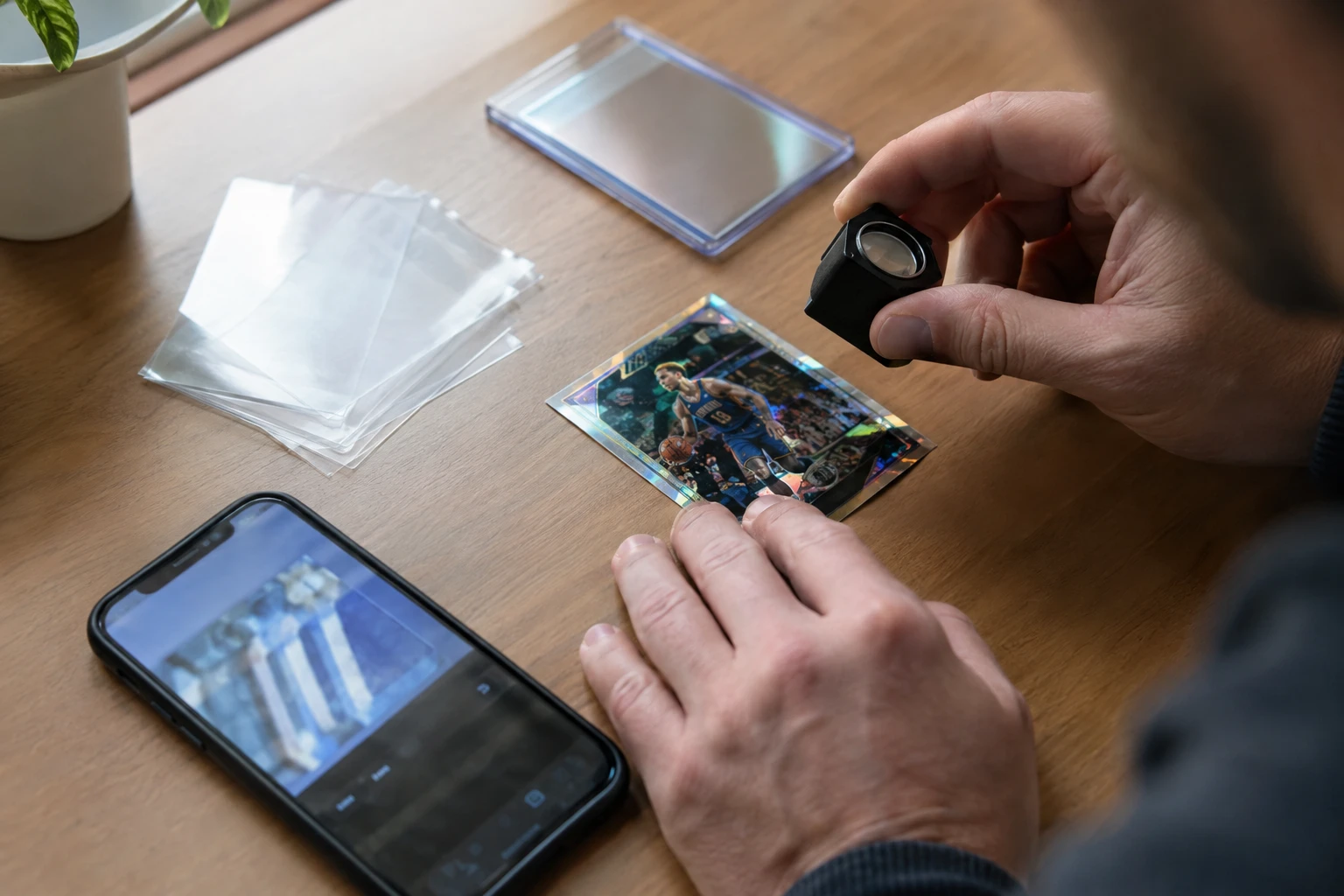
- Manual pre-grading — the loupe-and-light-era method. Centering by eye or ruler, surface checked under angled light, corners inspected under magnification. Works, but slow, skill-dependent, and blind to flaws that only show under a grader's lighting rig.
- AI pre-grading — photograph the card, let a trained model measure centering to the millimeter, scan the surface for print lines and scratches, evaluate corner and edge condition, and return an estimated grade with subgrade-level detail in seconds. This is what 'pregrading' means to most collectors in 2026.
The term covers a range of tools: simple centering checkers, full four-pillar AI graders like PreGradeCards, camera-guided phone apps, and the human 'pre-screen' tiers some grading companies offer. What they share is the same job: answer 'should I pay to grade this?' before the fee is spent.
Why Pre-Grading Exists: The Submission Math
Professional grading is a bet with asymmetric odds, and pre-grading is the card-counter:
- Fees are real money. $25–60 per card at mainstream tiers, before shipping both ways — call it $40–80 all-in per submission.
- The payoff is grade-dependent. A modern card at PSA 9 might carry a 20-50% premium over raw; at PSA 10, often 2–5x. At PSA 8 or below, the slab usually sells at or under raw value — you paid $60 to make the card worth less.
- Blind submissions mostly lose. The overall PSA 10 rate is roughly 8-9% across all submissions. Even accounting for selection bias, most cards shipped without a condition check come back below the grade that pays.
So pre-grading exists to flip the asymmetry: spend a few dollars (or cents) to learn the probable grade, submit only the winners. The cards you don't submit aren't a missed opportunity — they're the margin. Every collector who's been in the hobby two years has a drawer of sub-9 slabs that collectively cost them real money; pre-grading is how you never build that drawer.
How AI Pre-Grading Actually Works
A modern AI pre-grader runs the same four-pillar evaluation a human grader does — it just does it on pixels, in seconds, with measurements instead of eyeballs:
- Centering. The system detects the card's border edges and computes left/right and top/bottom ratios to sub-millimeter precision — the single most measurable grade factor, and the one humans estimate worst by eye. A 60/40 front vs a 55/45 is the difference between 'submit' and 'don't.'
- Surface. The model scans for print lines, scratches, holo scuffs, ink spots, and texture anomalies — the flaws invisible face-on that graders catch under angled light. Surface is the most deceptive pillar: a card can look perfect and carry a fatal print line.
- Corners. Each corner is analyzed for whitening, softness, dings, and factory press-cut defects — a single weak corner caps the grade regardless of everything else.
- Edges. Chipping, silvering, rough cuts, and chrome-layer fraying — edge flaws are the silent killers on chrome and dark-bordered stock.
The output isn't just a number: better pre-graders return per-pillar findings, measured centering ratios, defect locations, and a confidence range — the detail a collector needs to argue the estimate or understand it. The AI card-grading pipeline then combines the four pillars into an estimated grade calibrated against real PSA/BGS/CGC outcomes, plus the market context that says whether the grade is even worth chasing at the card's current price.
Under the hood, serious systems don't rely on one model — multiple engines (vision models, specialized card-image networks, web-verification checks) arbitrate the card's identity and condition, flagging contested cases instead of guessing confidently wrong. That arbitration layer is what separates a lab-grade tool from a novelty camera filter.
How Accurate Is AI Pre-Grading, Honestly?
The honest numbers, from benchmark testing on real graded cards:
- Within-one-grade accuracy: ~89%. Nine times out of ten, the AI's estimate lands within a single grade point of the professional outcome — close enough to make a sound submit/skip decision.
- Will-it-get-PSA-10 binary accuracy: ~82%. On the question that actually decides money ('is this card a 10 candidate?'), the model is right about four times in five — dramatically better than the ~9% base rate of blind submission.
- Where it's weakest: the hardest calls — distinguishing a strong 9 from a weak 10 on borderline cards (the exact boundary where graders themselves disagree), heavily textured or unusually-finished cards, and damage types that photograph poorly (subtle creases, wax stains under certain lighting).
- Where it's strongest: the objective pillars — centering measurement is near-exact, and obvious defect detection on corners/edges approaches human reliability.
Read those numbers correctly: an 82% will-it-10 filter doesn't mean one-in-five mistakes ruin you — it means you submit the flagged candidates knowing most will pay, instead of shipping a box where 91% mathematically can't. Even a modest-accuracy filter beats blind submission by an order of magnitude, because the alternative is the raw base rate.
The Economics: Where the Money Actually Gets Saved
Run the arithmetic on a realistic 25-card stack:
| Approach | Submission Cost | Likely Outcome |
|---|---|---|
| Blind-submit all 25 | ~$1,250+ (25 × $50) | ~2-3 hit 10, several hit 9, ~15+ come back below grade — most fees produce slabs worth ≤ raw |
| Pre-grade first | ~$250-350 (5-7 candidates) + pre-grade cost on all 25 | Same 10s captured, zero donation fees — save ~$900+ per stack |
The saved fees are the visible win. The quieter win: pre-grading tells you the ceiling before you buy. Checking a raw card's likely grade before purchasing it on eBay or at a show reprices the card instantly — a 'mint' raw that pre-grades to an 8 was never worth the seller's price. And it works in reverse for sellers: a pre-grade report attached to a raw listing answers the buyer's biggest doubt, which is why graded-sale spreads on verified-condition raw cards beat unverified ones.
When to Pre-Grade (and When It's a Waste)
Pre-grade when:
- You're deciding whether to submit — the canonical use. Any card you can't grade by eye with confidence.
- You're triaging a bulk lot or collection — 100 raw cards can't all be graded; pre-grading finds the five that should be.
- You're buying raw — check before you pay 'mint' prices for a card that would grade 8.
- You're choosing between graders — a card that pre-grades 9 goes where 9s pay; a 10-candidate goes where the 10 premium lives.
- You're prepping for a show — walk-up submissions carry the highest per-card stakes; pre-grade before the booth line, not after.
Skip pre-grading when:
- The card is obviously flawless — pack-to-sleeve moderns where you watched the sleeve close. Grade it or don't; a pre-grade adds nothing.
- The card is obviously damaged — visible creases, whitening, stains don't need a scan to disqualify.
- The card is too cheap to grade anyway — a $6 common isn't a submission candidate at any condition score.
- You'd grade it regardless of the number — authentication-first cards (legend autos, SSPs, heirlooms) get graded for the slab itself.
How to Pre-Grade a Card Right Now
- Handle it like the grader will. Clean hands or gloves, good lighting, the card out of its sleeve — fingerprints on chrome read as surface flaws to any eye, human or machine.
- Photograph straight-on, both faces. Flat, full-frame, no glare — angled shots break centering measurement and hide edge condition. Natural diffused light beats flash.
- Run the AI pre-grade. Upload to PreGradeCards and get the estimated grade plus per-pillar findings: measured centering, surface flags, corner and edge analysis.
- Spot-check the result with your eyes. The AI catches what you miss; you catch what photography misses. If it flags a print line, tilt the card under light and find it — now you know what the grader sees.
- Decide. Estimate ≥ the grade that pays for your card's market? Submit. Below it? Sell raw, trade, or hold — and pocket the fee you almost spent.
Manual Pre-Grading Methods Still Worth Knowing
AI does the heavy lifting, but the old-school manual methods still earn their place — partly as a sanity check on the AI's output, and partly because they catch the things a photograph can't:
- The tilt test. Rotate the card slowly under a single light source and watch the surface sweep. Print lines, roller marks, and wax stains appear as moving disruptions in the reflection — this catches the surface flaws that hide in flat photos and is the single highest-value manual check.
- The border ruler. Measure left vs right and top vs bottom border widths with a ruler (or free centering tools online). On a standard 2.5"-wide card, a 1mm asymmetry is roughly a 57/43 centering split — right at the border of '10-worthy' on most grading scales.
- The corner loupe. A 10x loupe on each corner reveals whitening and micro-dings invisible to the naked eye. Graders use exactly this — if you can see corner wear at 10x, so can they.
- The finger-drag. Slowly run a clean fingertip across edges feeling for roughness — edge chipping you can't see is still chipping you can feel.
- The 'would I slab it' test. Hold the card at arm's length like it's already in a case on a shelf. If anything makes you say 'hmm,' a grader will say it louder.
The right workflow isn't AI or manual — it's AI first (fast, measures what eyes can't), then manual verification of whatever the AI flagged. The two methods cross-check each other's known blind spots.
Pre-Grading for Sellers: The Report as a Listing Asset
The least-discussed use of pre-grading is on the sell side. A raw card listed with an independent condition report converts differently than one without:
- It answers the buyer's only real question. Every raw-card buyer is silently asking 'what would this grade?' A pre-grade report attached to the listing answers it with measured centering, surface findings, and an estimated grade — before they have to ask, doubt, or lowball.
- It reprices 'near-mint' honestly. eBay's raw market runs on vague condition words ('NM-MT', 'pack fresh') that mean nothing. A documented estimate cuts through the inflation — which is precisely why it raises prices on genuinely nice cards and kills the fantasy premium on bad ones.
- It converts 'raw vs grade' browsers. A buyer weighing a raw card against an equivalent slab is doing mental break-even math. Your pre-grade report does the math for them — 'pre-graded 9-10 candidate' at raw price undercuts the slab it would become.
- It builds seller trust on volume. Sellers who consistently attach condition data to raw listings get return buyers — the market remembers who showed their work.
The asymmetry is the point: a pre-grade costs a few dollars, and on any card where the estimate comes back strong it pays for itself in the final sale price. On the ones where it comes back weak, it saves you the reputation cost of overselling a card that grades 7.
The Verdict
Pre-grading isn't a product category — it's the missing step that makes grading rational. Submitting without it is paying $40-80 to ask a question you could have answered for pocket change: 'is this card a 10?'
The collectors who grade profitably aren't luckier — they're filtered. They know which cards deserve the fee because they measured first, and the rest of their stack sells raw while everyone else's comes back as an expensive drawer of 7s. That's the entire case for pre-grading, and it's why 'pregrade' has become a verb.
Frequently Asked Questions
0
1
2
3
4
5
6
7
Sources & Further Reading
- PreGradeCards — AI Card Grading Service
- PreGradeCards — AI Accuracy Benchmark
- PreGradeCards — PSA 10 Odds & Gem Rates
- PSA — Trading Card Grading
- PreGradeCards — Is Card Grading Worth It? ROI Break-Even

The PreGradeCards Research Team combines machine-learning engineers, grading analysts, and collector-education specialists to produce accurate, data-driven guides on AI card grading, professional grading standards, and collecting strategy.
Create a free account and get 1 free credit — enough for 1 complete AI grading with market pricing. No credit card required.
Sign Up Free →