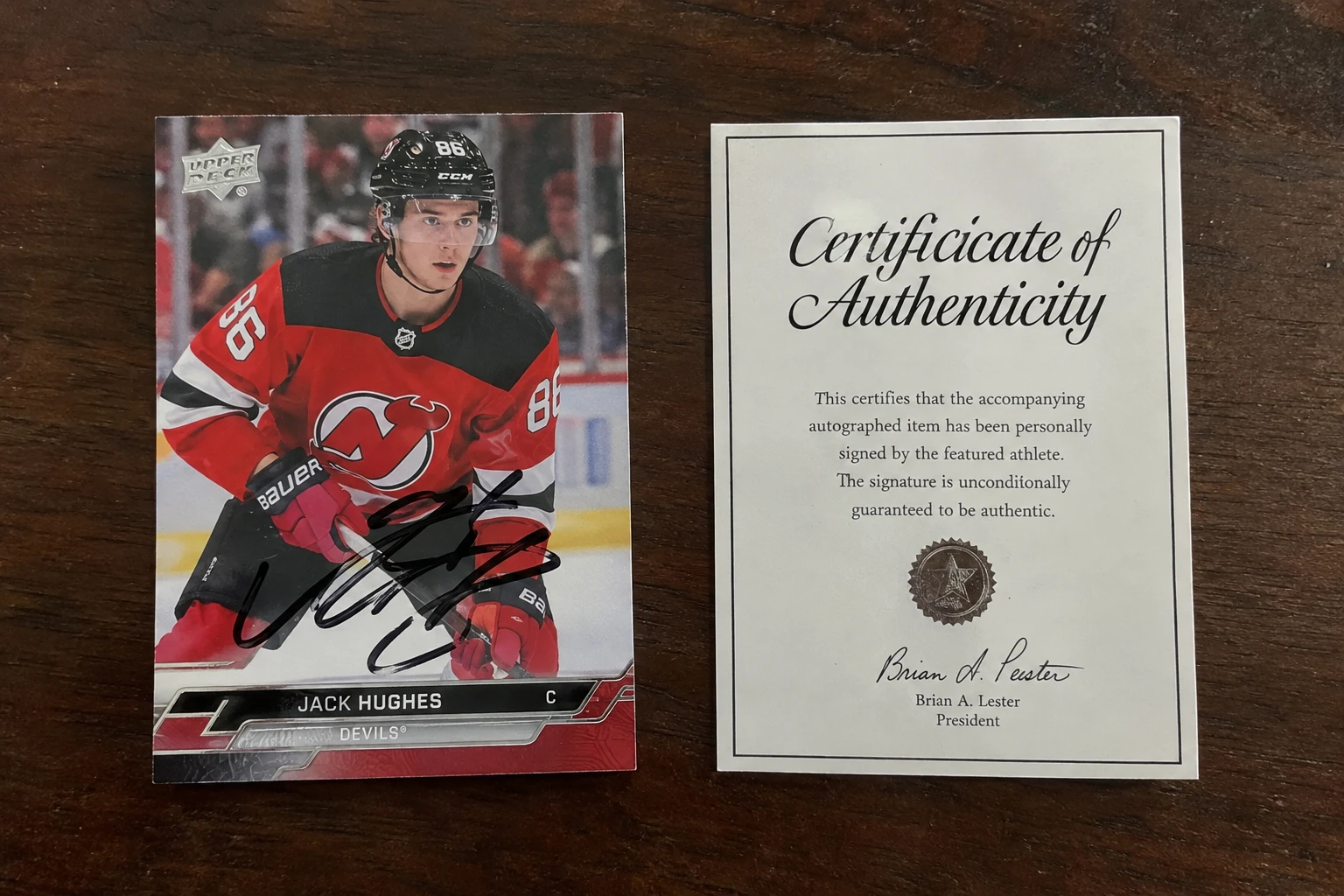
The Short Answer
- Card grade ≠ autograph authentication — they're separate services with separate fees.
- Authentication (PSA/DNA, JSA, Beckett) verifies the signature is real — that's the primary value on most autos.
- The card's condition grade matters less than the auto grade on most signed cards.
- An auto grade (1–10) scores the signature's quality — boldness, completeness, ink condition.
- On sticker autos vs on-card autos, the card grade means different things.
The difference nobody explains: grade ≠ authentication
Most collectors submit an autographed card expecting “a grade” and get back two numbers they didn't plan for. Here's what actually happens: an autographed card can receive a card condition grade (the 1–10 scale that scores centering, corners, edges, surface) and an autograph authentication (a yes/no plus often a 1–10 quality score on the signature itself). They're separate services, priced separately, and they answer different questions.
The card grade asks: how nice is the cardboard? The authentication asks: is this signature real, and how well did the pen write it? A card can be a PSA 9 with a verified-bold auto 10, or a PSA 10 with a weak authenticated auto 6 — the numbers are independent. Most collectors conflate them and pay for the wrong service.
AI pre-grade tells you the card condition before the auth fee.
The three services an autographed card can get
PSA, CGC and the authentication services offer these separately or bundled:
- Authentication only — verifies the signature is genuine. PSA/DNA, JSA and Beckett all do this. The card comes back slabbed with an “Authentic” or numbered autograph label. This is the cheapest path and the primary value on most autos.
- Card grade only — the card gets a 1–10 condition grade; the autograph is noted but not authenticated or scored. Cheaper than dual grading, but leaves the signature unverified.
- Dual grading — card grade plus autograph grade, both on the label. Most expensive, and the right choice on high-value cards where both numbers matter to a buyer.
The fee structure reflects this: authentication alone runs ~$15–30 depending on the card's declared value; dual grading runs the card fee plus the auto fee. On a valuable signed card, dual grading is the full package; on a mid-value card, authentication alone is usually where the money is.
What an autograph grade actually measures
When a service assigns an autograph grade (1–10), it's scoring the signature's quality, not the card's:
- Boldness/clarity — how strong the ink is, whether it skipped or faded.
- Completeness — whether the signature is fully formed or a rushed scrawl.
- Ink condition — whether the signature has faded, smudged or bled since signing.
- Placement — whether the auto is positioned well on the card (this is subjective and minor).
Why it matters: two identical signed cards can differ in value by hundreds of dollars based on the auto grade. A bold, clean signature in a 10-grade auto is worth meaningfully more than the same signature as a faded 7. On modern sticker autos — where the player signed a sticker sheet that was later applied to cards — the auto grade is often the only grade that matters, because the card itself is usually mint out of the pack.
Sticker autos vs on-card autos
The card industry quietly shifted to sticker autographs over the last decade — the player signs sheets of stickers, which Panini/Topps then applies to cards. It changed what the card grade means:
- On-card auto: the player signed the actual card. The card's condition matters more because it's the surface the auto sits on, and the auto grade reflects the signature on that card.
- Sticker auto: the auto was signed on a sticker and applied to a card produced later. The card is usually pack-fresh (so the condition grade is near-guaranteed high), and the auto grade is the variable — the same signature could be applied to a mint card or a slightly-flawed one.
For grading, that means: on a sticker auto, the auto grade is almost everything; on an on-card auto, both grades matter because the card condition isn't guaranteed mint. The market prices them accordingly — on-card autos carry a premium over sticker autos of the same player.
There's also a practical reason the sticker-vs-on-card distinction matters at submission: on a sticker auto, you can often skip the card grade and save money because the card is almost always mint anyway — the value is the signature. On an on-card auto, the card condition is part of what you're paying to verify. Know which kind of auto you're grading before you pick a service tier.
Which service your card actually needs
Decision framework:
- Authentication only: most signed cards where the signature is the value and the card is mid-tier. The auth proves it's real; the card condition is secondary.
- Dual grading: high-value signed cards — star players, on-card autos, cards where both the signature quality and the card condition affect the price. The buyer pays for both numbers.
- Card grade only: almost never the right call on a signed card — an unverified signature on a graded card is worth less than the same card authenticated.
The pre-grade step works on autographed cards too: run the card condition check before deciding between authentication and dual grading, because a card that grades a 7 doesn't justify the card-grade fee on a mid-value auto where authentication alone suffices.
Real scenarios: which service on which card
Concrete cases make the service choice obvious:
- A $200 jersey-auto of a star player: authentication is the value — buyers want to know the signature is real. Dual grade it if the card condition is premium; otherwise authentication-only is the right call.
- A $40 sticker-auto of a mid-tier player: authentication, probably skip the card grade — the auto is the value and a 9-vs-10 card grade won't move the price on a $40 card.
- A $1,500 on-card rookie patch auto: dual grade everything — the card grade, the auto grade and the authentication all matter to a buyer spending that money.
- A vintage signed card (1980s star): authentication first, card grade only if the card condition is also premium — vintage signed cards sell on the signature more than the slab.
- A personal-collection signed card you'll keep: authentication-only — you want the signature verified, not a card grade you'll never sell.
The pattern: the signature's value decides whether you need dual grading. On a card where the auto is the whole value, authentication-only is often enough; on a card where both the card and the auto carry real money, dual grade both.
The bottom line
An autographed card is really two collectibles — the card and the signature — and grading treats them that way. Authentication proves the signature is real; the card grade proves the cardboard is nice. Most signed cards need the authentication, not the card grade; high-value on-card autos want both. Know which you're buying before the fee decides for you.
Know the card's condition before paying for dual grading.
Frequently Asked Questions
0
1
2
3
4
5
6
7
8
9
10
11
Sources & Further Reading

Emily Rodriguez analyzes grading cost, population, and pricing data across PSA, BGS, SGC, CGC, and TAG. She built the PreGradeCards ROI calculator and submission planner, and her market reports on grading backlog, turnaround times, and slab premiums are cited by collectors and dealers worldwide.
Create a free account and get 2 free credits — enough for 2 complete AI gradings with market pricing. No credit card required.
Get Your Free Credits →