The Short Answer
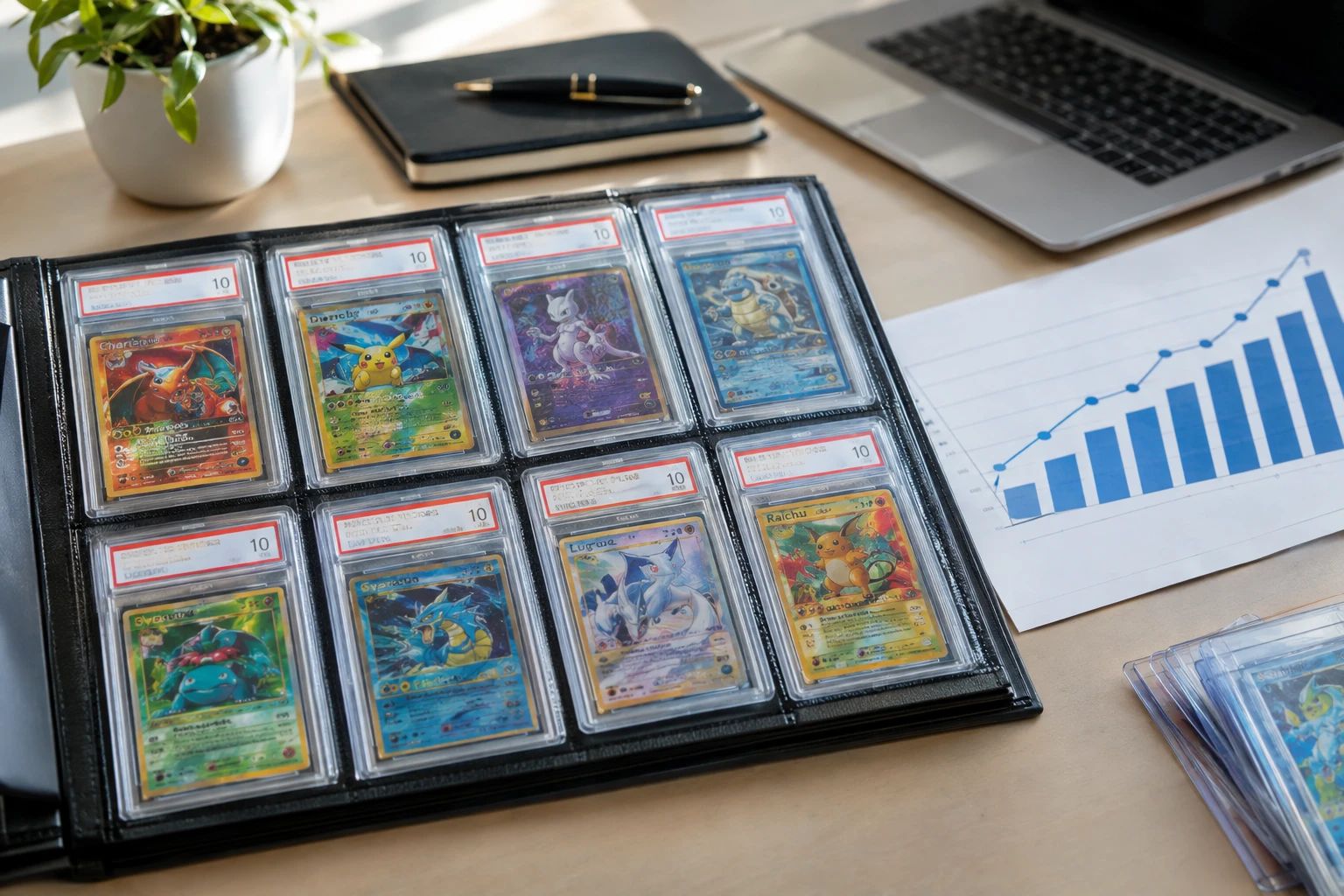
- Card Ladder's Pokémon index shows 3,821% cumulative returns since 2004 vs 483% for the S&P 500, making Pokémon cards one of the best-performing alternative assets of the past two decades.
- Vintage blue-chips (1st Ed Base Charizard, Gold Stars, e-Series crystals) offer the lowest risk and highest long-term returns. Modern chase cards (Moonbreon, Sunbreon) offer the best liquidity and medium-term upside.
- Sealed product is the safest investment — supply only decreases. Sealed Evolving Skies booster boxes climbed from $140 MSRP to $800+ in 2026. Terastal Festival ex boxes are up 22% since Q1 2025.
- Character selection matters more than set selection. Charizard, Pikachu, Umbreon, and the Eeveelutions consistently outperform other Pokémon by 50-200% at the same rarity tier.
- Use free AI pre-grading from PreGradeCards before buying raw cards for grading flips. The AI predicts PSA grades with 89% accuracy, helping you identify PSA 10 candidates before spending $79.99 per card on grading fees.
Short Answer: Best Pokémon Cards to Invest In
The best Pokémon cards to invest in for 2026 fall into three tiers: vintage blue-chips (lowest risk, highest long-term returns), modern graded singles (best liquidity, medium-term upside), and sealed product (safest, supply-driven appreciation). The specific cards to buy depend on your budget, time horizon, and risk tolerance.
For investors with $500+ to deploy, the highest-conviction picks are: 1st Edition Base Set Charizard (PSA 8-9 for long-term holds), Umbreon VMAX Alt Art "Moonbreon" PSA 10 (the modern king with 129 real comps), sealed Terastal Festival ex Japanese booster boxes (still in distribution, 22% appreciation since Q1 2025), and Gold Star cards (Mew, Umbreon, Pikachu — the class that repriced in 2026 with four record sales in five months).
The Pokémon TCG market reached $2.2 billion in 2024 and continues to grow in 2026, driven by the 30th Anniversary celebration, the record $16.49 million Pikachu Illustrator sale, and the return of Mega Evolution in the TCG. Card Ladder's Pokémon index shows 3,821% cumulative returns since 2004 — outperforming the S&P 500 by nearly 8x over the same period.
2026 Pokémon Card Market Overview
The Pokémon card market in 2026 is experiencing a historic moment. Several macro factors are driving demand and price appreciation:
Record-Setting Validation: The $16.49M Pikachu Illustrator sale in February 2026 brought institutional attention and new capital into the hobby. This was not a one-off — four different Gold Star cards set six-figure records in five months (Charizard $100K in February, Pikachu $114K in May, Umbreon $168K in June, Mew $192K in July).
30th Anniversary Celebration: Pokémon's 30th Anniversary in October 2026 is driving unprecedented collector demand. A global Celebration Collection launch is scheduled for October 2, 2026, alongside the Mega Evolution-themed sets (Ascended Heroes in January, Perfect Order in March, Phantasmal Flames and Reality Fracture in October).
Standard Rotation Effects: The April 10, 2026 rotation removed G-regulation sets, creating scarcity-driven upside for remaining playable cards. Cards from rotated sets that are no longer in print are appreciating as supply dries up.
Mega Evolution Return: The Mega Evolution era sets (Ascended Heroes, Perfect Order) have reinvigorated the TCG player base with smaller set sizes and healthier supply dynamics. Mega Dragonite ex SIR and Mega Gengar ex SIR are projected to be the crown jewels of this era.
Outperformance vs Traditional Markets: Card Ladder's Pokémon index shows 3,821% cumulative returns since 2004 vs 483% for the S&P 500. While past performance does not guarantee future results, the multi-decade trend demonstrates that Pokémon cards have established themselves as a legitimate alternative asset class.
Investment Tiers Explained
Successful Pokémon card investors do not put all their money into one card. A diversified portfolio spans three tiers with different risk/reward profiles:
Tier 1 — Vintage Blue-Chip Grails ($500+ per card): These are the cards that act as the "gold standard" of Pokémon investing. They require substantial capital but offer the lowest downside risk. Examples: 1st Edition Base Set Charizard (PSA 7-8: $12,000-$18,000, PSA 9: $35,000-$55,000, PSA 10: $456,000-$528,000), 1st Ed Base Blastoise (PSA 10: $84,000), 1st Ed Neo Genesis Lugia (PSA 10: $45,000). These cards have decades of proven demand and are unlikely to lose value over any 5+ year period.
Tier 2 — Modern Blue-Chips ($200-$5,000 per card): This middle tier offers the best risk/reward balance for most investors. These cards have established price histories, known populations, and cultural staying power. Examples: Umbreon VMAX Alt Art "Moonbreon" PSA 10 ($3,025, 129 comps), Umbreon ex SIR "Sunbreon" PSA 10 ($3,000-$3,850), Giratina V Alt Art PSA 10 ($900-$1,200), Lugia V Alt Art PSA 10 ($650-$850).
Tier 3 — Sealed Product & Speculation ($50-$500 per box): Sealed booster boxes and ETBs are the "real estate" of Pokémon investing. Supply only decreases as boxes are opened. Examples: Sealed Evolving Skies booster box ($800+), sealed Terastal Festival ex Japanese box ($60-$70, still in distribution), sealed Clay Burst Japanese box ($18,000-$22,000, 4x in 30 months). This tier also includes speculative bets on new sets and prospects.
Top Vintage Blue-Chip Picks for 2026
Vintage WOTC-era cards (1999-2003) are the foundation of any serious Pokémon card investment portfolio. Here are the top picks for 2026:
1. 1st Edition Base Set Charizard: The undisputed king. PSA 10 trades at $456,000-$528,000 with ~120 gem mint copies in existence. PSA 8-9 copies ($12,000-$55,000) are the realistic entry points for most investors. Every new Pokémon collector eventually wants one, ensuring permanent demand. The card has tripled from its early-2024 low.
2. Gold Star Class (Mew, Umbreon, Pikachu): Gold Stars were the mid-2000s' rarest pull — roughly once per two booster boxes. 2026 repriced the entire class: Mew Gold Star PSA 10 hit $192,000, Umbreon $168,000, Pikachu $114,000. These are the cards that institutional collectors chase. Lower-grade copies (PSA 7-8) are more accessible at $5,000-$20,000.
3. 1st Edition Base Set Blastoise & Venusaur: The other Base Set grails. Blastoise PSA 10 trades at $84,000, Venusaur at $70,000. These are the "secondary grails" that move with the Charizard but at lower price points, making them accessible entry points into the 1st Ed Base market.
4. 1st Edition Neo Genesis Lugia: The Neo-era grail. PSA 10 holds at $45,000 on thin float. This is the card that anchors the Neo era and benefits from Lugia's enduring popularity.
5. Crystal Charizard (Skyridge): The e-Series trophy. PSA 10 trades at $65,000. Skyridge is one of the most difficult sets to complete, and the Crystal Charizard is its crown jewel. Lower populations than Base Set make this a scarcity play.
6. 1st Edition Fossil Gengar: The cult favorite that ran from $6,000 to $48,000 in a single year. Gengar has a dedicated collector base that drives consistent demand. PSA 9 copies at $3,000-$5,000 offer a more accessible entry point.
Top Modern Blue-Chip Picks for 2026
Modern Pokémon cards (2016-present) offer better liquidity and lower entry costs than vintage. Here are the top modern investment picks:
1. Umbreon VMAX Alt Art "Moonbreon" (Evolving Skies, 2021): The undisputed modern king. PSA 10 trades at $3,025 on 129 real comps — the deepest premium market of the modern era. Evolving Skies has never received a reprint, and the one-in-1,600 pack pull rate creates genuine scarcity. Raw near-mint copies trade at $700-$900. Projected 2-year appreciation: 40-60%.
2. Umbreon ex SIR "Sunbreon" (Prismatic Evolutions, 2025): The counterpart to Moonbreon. Peaked at $19,000 in pre-release speculation, stabilized at $800-$1,000 raw and $3,000-$3,850 PSA 10. Down 30% from peak, which historically represents a buying opportunity. The Eeveelution character appeal should drive long-term collector demand.
3. Lugia V Alt Art (Silver Tempest, 2022): PSA 10 at $650-$850, up over 200% since release. Silver Tempest ended print runs quickly, and the artwork is considered one of the finest in modern Pokémon. Low supply + high demand = continued appreciation.
4. Giratina V Alt Art (Lost Origin, 2022): PSA 10 at $900-$1,200. Relatively low PSA 10 population compared to demand. Giratina is the most popular legendary in competitive collector circles.
5. Charizard VMAX Rainbow Rare (Champion's Path, 2020): PSA 10 at $400-$550, up ~22% YoY. Over 15,000 PSA 10s exist, but demand keeps pace. Pandemic-era nostalgia combined with Charizard's eternal appeal makes this a reliable hold.
6. Iono SAR PSA 10 (Clay Burst, Japanese): The most liquid modern Japanese chase card. Trades at ¥120,000-¥160,000 ($800-$1,070), up from ¥75,000-¥95,000 in May 2025. Iono is the most-recognized SV-era character in the Japanese market and trending in English-language collector communities.
Sealed Product Investment Strategy
Sealed product is the safest way to invest in Pokémon cards. Once a set goes out of print, no new sealed boxes enter the market — supply only decreases as boxes are opened. This creates a one-way supply curve that historically drives 30-50% appreciation in the 12 months after a set exits print.
Top Sealed Product Picks for 2026:
- Sealed Terastal Festival ex (Japanese): The highest-conviction sealed pick of 2026. Still in distribution at ¥9,500-¥11,000 (~$60-$70 USD), up from ¥7,500-¥8,500 at launch. Reprints are slowing, demand is holding. Chase cards (Lillie's Clefairy ex SAR, Terapagos ex UR) are pulling secondary-market attention. Will exit standard supply within 12-18 months.
- Sealed Evolving Skies (English): The undisputed king of modern sealed investing. Booster boxes climbed from $140 MSRP to $800+. The "Moonbreon" makes this set untouchable. No reprint has ever been issued and none is expected.
- Sealed Glory of Team Rocket (Japanese): ¥10,500-¥12,500, up ~18% since release. Slower-burn appreciation than Terastal Festival, but a stronger 5-10 year case. If Pokémon runs a Team Rocket anime arc or game in 2026-2027, sealed prices move sharply.
- Sealed Clay Burst (Japanese): Already done most of its first leg up — from ¥4,950 at launch to ¥18,000-¥22,000 in 2026 (~4x in 30 months). Iono SAR demand is the engine. Lower upside from here but lower risk.
- Sealed Pokémon 151 (Japanese): Nostalgia for the original 151 is priceless. Japanese boxes are the top pick here. English ETBs are also solid holds.
Sealed Product Rules: 1) Never open sealed product you are investing in — opening destroys the scarcity premium. 2) Store in a cool, dry place away from sunlight. 3) Keep original packaging, shrink wrap, and any promotional materials intact. 4) Buy from reputable sources — counterfeit sealed product exists. 5) Japanese sealed product generally outperforms English sealed product due to smaller print runs and higher collector density in Japan.
Grading ROI for Investment Cards
Grading is the single most powerful value-creation tool for Pokémon card investors. A PSA 10 grade can multiply a card's value by 5-25x. Here is how to calculate grading ROI and identify the best candidates:
The Grading ROI Formula:
Net graded profit = (PSA 10 sold price × (1 - 0.13 eBay fee) - $5 shipping) - (raw card cost + $79.99 grading fee + $20 shipping/insurance)
If the result is positive and at least 2x the grading cost, the card is a strong grading candidate.
Real ROI Examples (2026):
- Umbreon VMAX Alt Art: Buy raw at $700, grade PSA 10 at $100 cost, sell at $3,025. Net profit: ~$1,825. ROI: 261%.
- Lugia V Alt Art: Buy raw at $60, grade PSA 10 at $100 cost, sell at $650. Net profit: ~$405. ROI: 675%.
- Charizard ex SIR: Buy raw at $80, grade PSA 10 at $100 cost, sell at $400. Net profit: ~$168. ROI: 210%.
How to identify PSA 10 candidates: Use free AI pre-grading from PreGradeCards before buying. Upload a photo of the card and the AI predicts the PSA grade with 89% accuracy. Only buy cards the AI predicts as PSA 9.5-10. This eliminates the biggest risk in grading flips — buying a card that comes back PSA 8 instead of PSA 10.
Population report strategy: Check PSA population before grading. If there are already 15,000+ PSA 10s, the grading premium will be minimal. Target cards with sub-500 PSA 10 populations for maximum premium preservation. Cards with sub-100 PSA 10s are trophy assets that command the highest premiums.
Portfolio Allocation Strategy
A balanced Pokémon card investment portfolio should span multiple tiers, eras, and characters. Here is the recommended allocation for 2026:
40% Blue-Chip (Vintage + Top Modern): 1st Ed Base Set holos, Gold Stars, Moonbreon PSA 10s, sealed Evolving Skies boxes. These are the foundation — cards with proven multi-year demand and low downside risk.
40% Growth (Modern Chase Cards + Sealed Product): Prismatic Evolutions SIRs, Surging Sparks alt arts, sealed Terastal Festival ex boxes, sealed 151 product. These are cards and product with strong upside potential as sets go out of print.
20% High-Risk/High-Reward (Speculation): New set chase cards (Mega Evolution era), low-population modern secrets, Japanese exclusive promos. These are higher-risk bets that could 5-10x or go to zero.
Character diversification: Do not over-concentrate in a single Pokémon. A balanced character portfolio includes Charizard (the market anchor), Umbreon (the modern king), Pikachu (cultural icon), Mew (cult favorite), and Lugia (Neo-era grail). The Eeveelutions as a group are the strongest character class in modern Pokémon.
Time horizon: Vintage cards are 5-20+ year holds. Modern graded singles are 12-36 month holds. Sealed product is 2-5 year holds. Match your investment timeline to the tier — do not buy vintage if you need liquidity in 12 months, and do not flip sealed product that just released.
Investment Mistakes to Avoid
Pokémon card investing has real risks. Here are the most common mistakes and how to avoid them:
- Buying at peak euphoria: The biggest mistake. Cards peak during hype cycles (release, tournament wins, celebrity endorsements) and correct afterward. Buy during the post-release dip, not during the initial frenzy. Prismatic Evolutions Sunbreon peaked at $19,000 and settled at $800-$1,000 — buying at peak would have been catastrophic.
- Ignoring reprint risk: Some sets get reprinted, which crashes prices. Evolving Skies has never been reprinted — that is why it is a blue-chip. Always check reprint history before investing in a set's cards or sealed product.
- Over-concentrating in one card: Even blue-chips can have bad quarters. Diversify across at least 5-10 different cards and 2-3 sealed products. No single position should exceed 25% of your portfolio.
- Buying cards with 5,000+ PSA 10s: High populations mean low scarcity premiums. A PSA 10 with 15,000 existing copies has minimal room for appreciation. Focus on sub-500 PSA 10 populations for maximum premium preservation.
- Not grading before selling: Selling a $50 raw card that could be a $400 PSA 10 means leaving $250+ on the table. Always check the grading premium before selling raw.
- Speculating on unproven characters: Cards featuring Charizard, Pikachu, Umbreon, and Mew have decades of proven demand. Cards featuring random Pokémon that are currently popular in the meta may not have lasting appeal. Stick to S-tier characters for investment-grade positions.
- Not using AI pre-grading: Buying raw cards for grading flips without pre-screening is gambling. Use PreGradeCards free AI grading to predict the PSA grade before buying. This eliminates the #1 risk in grading flips — buying a card that grades PSA 8 instead of PSA 10.
Frequently Asked Questions
Are Pokémon cards a good investment in 2026?
What are the best Pokémon cards to invest in for 2026?
How much should I invest in Pokémon cards?
Should I buy sealed Pokémon product or singles?
What is the Pokémon card market outlook for 2026?
How do I know if a Pokémon card will go up in value?
Is it better to invest in Japanese or English Pokémon cards?
Sources & Further Reading
- Card Ladder Pokémon Index
- PSA Population Report
- PriceCharting Pokémon Card Prices
- PreGradeCards Free AI Card Grading
- CardboardSniper Pokémon Investment Guide
The PreGradeCards Research Team combines machine-learning engineers, grading analysts, and collector-education specialists to produce accurate, data-driven guides on AI card grading, professional grading standards, and collecting strategy.
Create a free account and get 1 free credit — enough for 1 complete AI grading with market pricing. No credit card required.
Sign Up Free →