The Short Answer
- Headline fees understate reality: $50 becomes ~$70-95 all-in for a single card
- Shipping both directions typically adds $20-45 to a submission
- Upcharges trigger when a card's graded value exceeds your tier cap — budget for the dream outcome
- Membership fees (PSA CC ~$149-199/yr) are a real cost if they gate your preferred tier
- The hidden cost nobody budgets: a returned PSA 8 on a card that needed a 10 is a loss, not a wash
- Cost per card drops 30-50% at volume — single-card submissions are the most expensive way to grade
Why Your $50 Grade Actually Costs $80
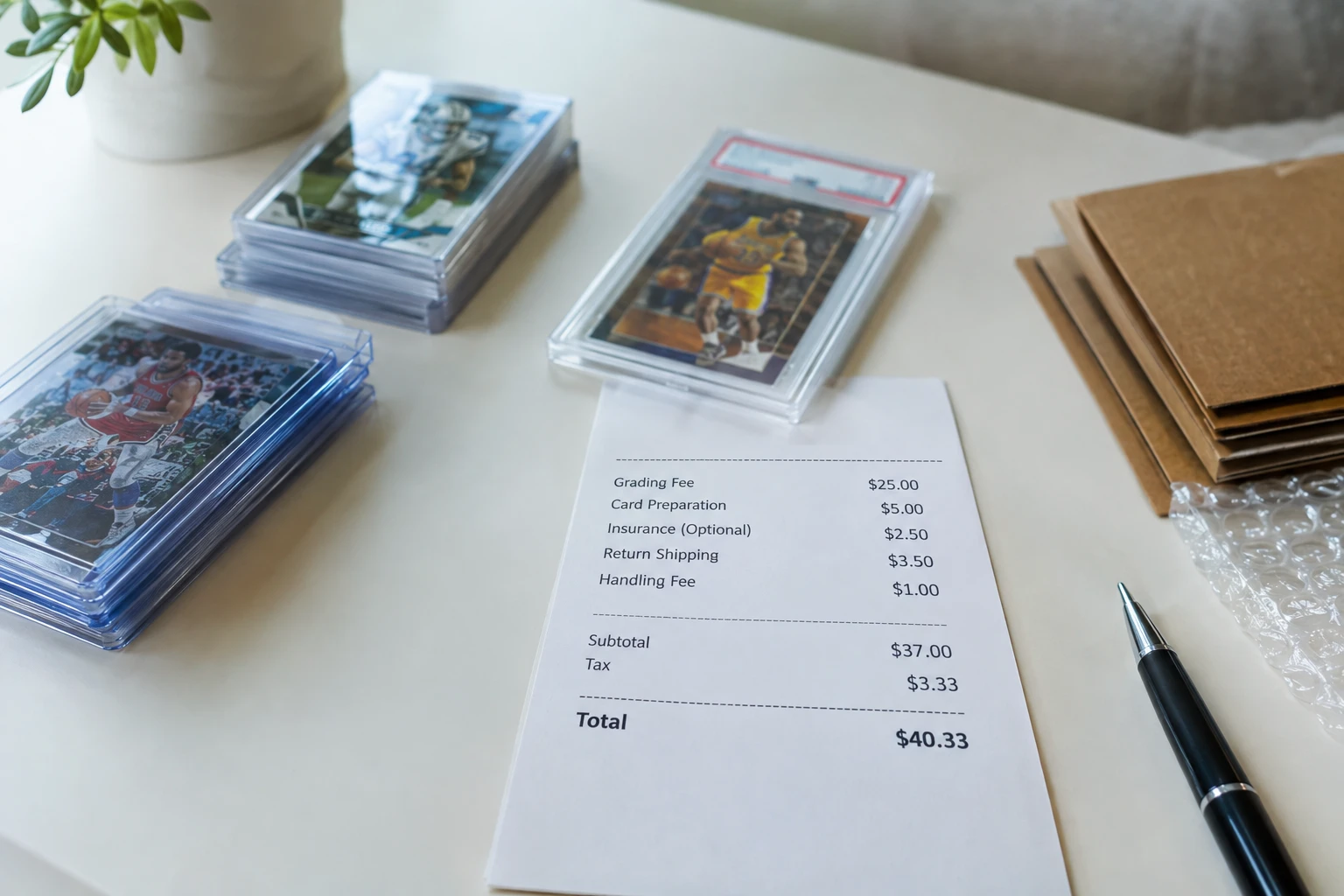
Every grading company advertises a per-card fee. None of them advertise the all-in cost — because once you add shipping both directions, supplies, insurance, and the occasional upcharge, the real number is 40-90% higher than the sticker.
This guide itemizes every cost on a grading submission — the ones on the invoice and the ones hiding in expected value — so you can make honest grade-or-don't decisions. Our grading cost calculator does the math live if you want to skip to numbers.
Anatomy of a Submission Bill
A single-card PSA Standard submission breaks down like this:
| Line Item | Cost | Avoidable? |
|---|---|---|
| Grading fee (PSA Standard) | $59.99 | No — it's the product |
| Inbound shipping (you → PSA) | $8-15 | Partly — bundle more cards |
| Return shipping (PSA → you) | $20-40 | Partly — scales with order value |
| Supplies (sleeves, Card Savers) | $0.50-2 | Bulk-buy only |
| Upcharge risk | $0-130+ | Only by declaring accurately |
| Realistic single-card total | $90-145 |
Compare that to the $59.99 the marketing implies. The gap is why grading a $60 card is almost never profitable — your all-in cost exceeds the card's value before the grade even comes back.
Shipping & Insurance — The Silent 40%
Inbound shipping is entirely yours: tracked, insured postage to the grading facility (~$8-15 for a small box). Cheap out with untracked mail and a lost package is unrecoverable.
Return shipping is charged by the grader and scales with the order's total declared value and destination — $20-40 is typical for modest orders, more for high-value returns requiring upgraded insurance. PSA, CGC, SGC, and BGS all price return shipping this way.
The insurance nuance: declared value covers cards while in the grader's possession — transit is separate. Fully insure both directions; a $2,000 card lost in untracked mail isn't anyone's problem but yours.
Our packing guide covers doing it right without overspending on supplies.
Memberships, Kits & Subscriptions
Several gates sit in front of the cheapest tiers:
- PSA Collectors Club: ~$149-199/year. Required for Value Bulk (when it reopens); unnecessary for Standard and above. Amortized, it's ~$3/card on a 50-card year — worth it only if you use the bulk lane or member specials. Full analysis in our Collectors Club guide.
- CGC memberships: optional — 10-20% fee discounts at ~$25-299/year. Pays for itself only above ~$250-$1,500 in annual fees.
- Submission kits: TAG's $49.95 kit and similar packs are convenient but overpriced if you already own sleeves and Card Savers.
- Middleman/group sub margins: ~$2-5/card on bulk pools, or $25-35/card through full-service submitters.
Upcharges: Paying for Your Own Good News
Declare a card at $900 under PSA Standard ($1,000 cap), it grades a 10 worth $1,800, and PSA moves it to the matching tier — Express at $199 or wherever the value lands — billing you the ~$139 difference before your order ships.
The mechanics and planning math are covered in our declared value guide and upcharge calculator. The cost-control principle: declare at the realistic graded value. Over-declaring pays for a tier you don't need; under-declaring leaves you under-insured and still upcharged.
The Cost Nobody Budgets: The Failed Grade
Every cost guide stops at fees and shipping. The largest hidden cost is the bad outcome:
- A modern card worth $30 raw gets graded at ~$70 all-in, comes back a PSA 8 worth ~$35 → you lost ~$65 on the card.
- At a card's typical 30% gem rate, most unscreened submissions lose money — the hobby's open secret.
This is why professional graders pre-screen ruthlessly and why AI pre-grading exists: submit only cards that plausibly hit the grade where they profit, and the failed-grade cost mostly disappears. The effective economics flip when your conditional success rate is 60%+ instead of the blind 20-30% average.
True Cost Per Card by Order Size
| Scenario | All-In Per Card | Cheapest Viable Card Value* |
|---|---|---|
| 1 card, PSA Standard | ~$95-140 | ~$200+ graded value |
| 10 cards, PSA Standard | ~$75-85 | ~$160+ graded value |
| 25 cards, CGC Bulk | ~$20-22 | ~$80+ graded value |
| 50 cards, PSA Value Bulk (when open) | ~$30-35 | ~$100+ graded value |
*Assumes the card needs roughly a 2x+ premium over all-in cost to compensate for grade-outcome risk.
The takeaway: volume is the biggest lever you control — shipping and the cheapest tiers only unlock at scale. If you can't fill a bulk order, pool with friends or a reputable group sub.
Seven Ways to Cut the Real Cost
- Submit fewer, better cards. The cheapest grade is the one you skip on a card that can't profit.
- Use bulk lanes or group subs for mid-value modern cards.
- Match tier to value honestly — no upcharge surprises.
- Consolidate shipments — one 20-card order beats four 5-card orders.
- Buy supplies in bulk — Card Savers and sleeves are pennies apiece at volume.
- Skip paid memberships unless the math clears your annual volume.
- Pre-grade everything — AI screening costs less than one wasted submission and prevents the most expensive outcome of all.
Frequently Asked Questions
What is the real cost to grade a card?
How much does grading shipping cost?
Are grading memberships worth the cost?
What is a grading upcharge?
How can I grade cards more cheaply?
Sources & Further Reading
- PSA Grading Services & Pricing
- CGC Services and Fees
- SGC Services & Pricing
- PreGradeCards — State of Card Submission 2026

The PreGradeCards Research Team combines machine-learning engineers, grading analysts, and collector-education specialists to produce accurate, data-driven guides on AI card grading, professional grading standards, and collecting strategy.
With submission floors rising, pre-screening is no longer optional. Use our AI Pre-Grade Calculator to score a card's PSA 10 odds before you pay, and the Submission Planner to pick the right tier.