The Short Answer
- Arrive early, stay late — the best deals are found in the first hour (cherry-picking) and the last hour (negotiation).
- Dollar boxes are the highest-ROI zone — dealers put unresearched cards in $1–$5 bins. Some are PSA 10 candidates worth $100+.
- Bring a 10x loupe, centering gauge, and your phone — inspect cards in person and run AI pre-grading on-site before buying.
- Negotiate on Sunday afternoon — dealers do not want to pack up inventory. 30–40% discounts are common.
- Build dealer relationships — regulars get first access to new inventory, better prices, and collection buyout opportunities.
- Never buy a raw card without checking centering — 40–50% of modern cards fail PSA 10 centering. Use AI centering analysis on your phone.
Why Card Shows Are the Best Place to Buy Raw Cards
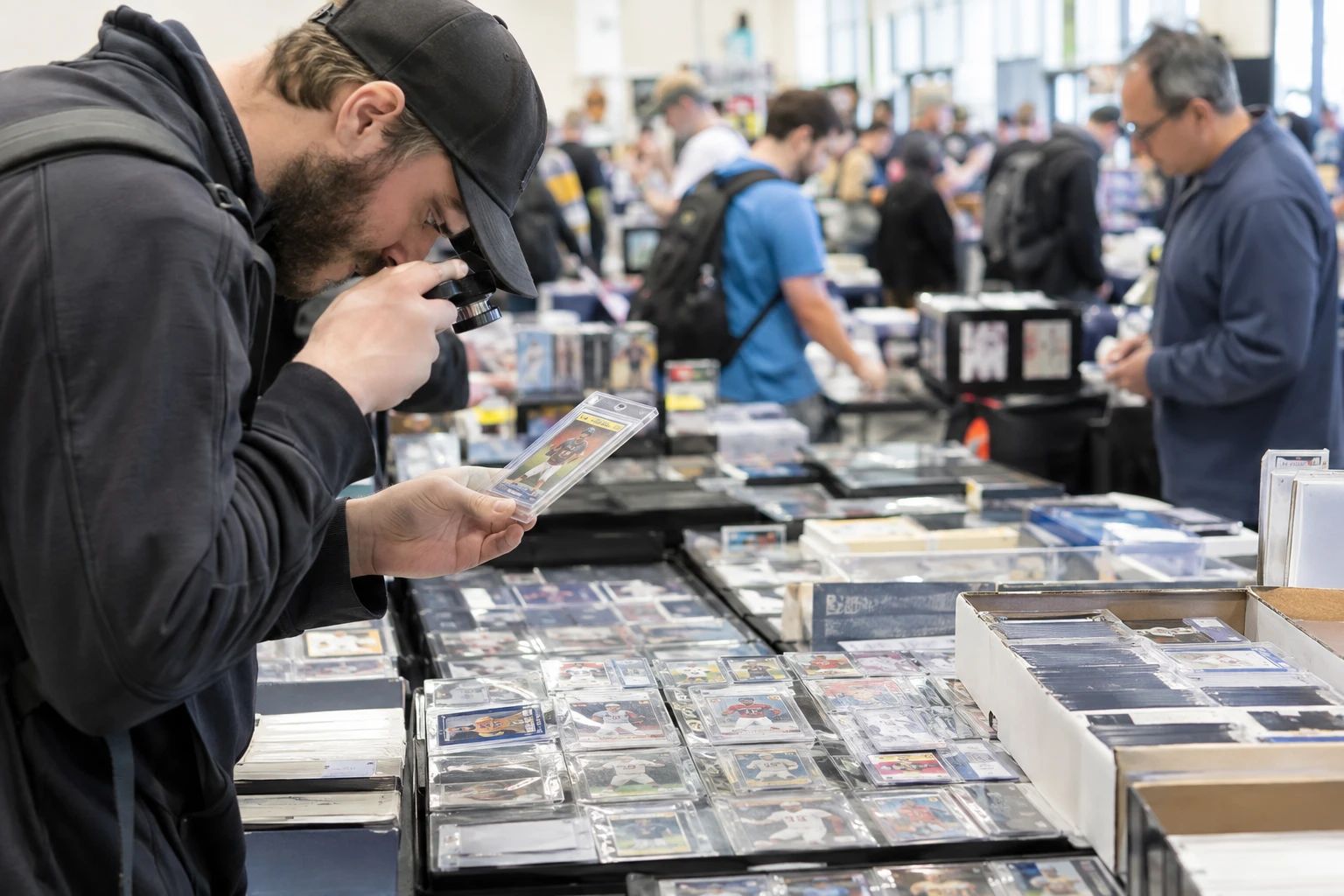
Card shows are in-person events where dealers and collectors set up tables to sell, trade, and buy cards. They range from small local shows (20–50 tables at a hotel or community center) to massive national shows like the National Sports Collectors Convention (500+ tables, 50,000+ attendees). For collectors who grade cards, shows are the single best sourcing channel for three reasons:
- In-person condition inspection — you can hold the card, check centering with a loupe, examine corners under magnification, and angle the card under light to check for surface scratches. No eBay listing can match this.
- Dollar boxes and discount bins — dealers put cards they have not researched in $1–$5 boxes. Some of these are PSA 10 candidates worth $100+ graded. This is the highest-ROI zone at any show.
- Negotiation — face-to-face negotiation produces better prices than eBay. Dealers prefer cash, do not pay eBay fees, and are motivated to sell inventory rather than pack it up.
No other sourcing channel — eBay, Whatnot, Facebook Marketplace, estate sales — combines all three advantages. If you are serious about grading cards for profit or building a valuable collection, card shows should be your primary sourcing channel.
How to Prepare for a Card Show
Preparation is what separates collectors who find great deals from those who wander aimlessly. Before every show:
1. Research the Show
- Check the show's website or Facebook page for table count, dealer list, and special guests
- Look for PSA/BGS/CGC on-site grading — some shows have grading company representatives accepting submissions
- Check if there are breakers, pack wars, or other events that draw specific dealer types
- Note the show hours and plan to arrive 30 minutes before opening
2. Set a Budget
Decide how much you will spend before you walk in. Card shows are designed to create impulse buying — bright displays, "hot" cards, and the fear of missing another collector's deal. A budget prevents emotional decisions. Bring cash — many dealers offer cash discounts of 5–10% to avoid credit card fees.
3. Make a Target List
Before the show, identify 5–10 specific cards or card types you are looking for:
- Specific player rookie cards (e.g., "2025 Prizm Cam Ward Silver")
- Specific sets you are building (e.g., "1986 Fleer Basketball")
- Specific parallels you want to grade (e.g., "Bowman Chrome Misiorowski Green /99")
- Price ranges you are willing to pay (check eBay sold comps beforehand)
Having a target list keeps you focused. When you see a card on your list, you know the market price and can make a fast, informed decision.
4. Check eBay Sold Comps
Before leaving for the show, search eBay for sold listings of your target cards. Screenshot the results. This gives you a reference point for negotiation — if a dealer asks $150 for a card that sells on eBay for $90, you can show the comp and negotiate down.
What to Bring to a Card Show
| Item | Purpose | Cost |
|---|---|---|
| 10x jeweler's loupe | Inspect corners, edges, and surface under magnification | $10–15 |
| Centering gauge or ruler | Measure border ratios on the spot | $5 |
| Smartphone with PreGradeCards app | AI pre-grade cards before buying — check centering, surface, predicted PSA grade | Free app + $0.15/card |
| Cash (small bills) | Most dealers prefer cash; enables negotiation and cash discounts | Your budget |
| Penny sleeves and toploaders | Protect purchases immediately — do not let raw cards rattle in a bag | $10–15 |
| eBay sold comps screenshots | Reference for negotiation — show dealers actual sold prices | Free |
| Notepad and pen | Note dealer names, booth numbers, card details, and prices for follow-up | $2 |
| Comfortable shoes and water | You will be standing and walking for 3–6 hours | — |
The Phone Pre-Grading Setup
Your smartphone is the most powerful tool at a card show. With the PreGradeCards mobile site, you can photograph a card at a dealer's table and get an AI pre-grade in under 30 seconds. This lets you make an informed buying decision without guessing about condition:
- Ask the dealer if you can photograph the card (always ask first)
- Place the card on the dealer's display surface (preferably a dark, matte area)
- Photograph the front and back using the show's overhead lighting
- Upload to PreGradeCards and get the predicted grade
- If the AI predicts 9.5+, negotiate the price and buy
- If the AI predicts 8.5 or below, pass — the card is not a PSA 10 candidate
Show Strategy: First Hour to Last Hour
First Hour: Cherry-Picking (Arrive Early)
Arrive 30 minutes before the show opens. The first hour is for cherry-picking — scanning every dealer's display cases and dollar boxes for high-value cards before other collectors find them. Strategy:
- Walk the entire show floor first — do not stop and buy on the first pass. Note where your target cards are and at what prices.
- On the second pass, hit the dollar boxes and discount bins first. These get picked clean within the first hour.
- Check display cases for cards on your target list. Note the booth number and price.
- Do not negotiate yet — just inventory what is available and where.
Hours 2–3: Targeted Buying and AI Pre-Grading
Once you know what is available, return to the booths with your target cards. This is when you inspect, pre-grade, and buy:
- Ask to inspect cards from the display case. Use your loupe on corners and edges.
- Run AI pre-grading on any card you are seriously considering.
- Buy cards that pass pre-grading (predicted 9.5+) at fair prices.
- Sleeve and topload every purchase immediately.
Hours 4–5: Dollar Box Deep Dive
After the initial rush, go back through the dollar boxes more carefully. The first pass was for obvious hits — the second pass is for cards that require closer inspection. Look for:
- Cards with clean centering that other collectors passed over
- Older products (2010s Prizm, Chrome) that dealers have not repriced
- Player collections from set builders who sold duplicates cheaply
- Vintage cards in dollar boxes — sometimes dealers misidentify or underprice older cards
Last Hour: Negotiation (Sunday Afternoon)
The last hour of a show is the best time for deals. Dealers do not want to pack up unsold inventory. Cards that were $100 on Saturday morning are suddenly negotiable. Strategy:
- Return to booths with cards you noted but did not buy
- Offer 30–40% below the asking price — dealers expect negotiation
- Bundle multiple cards for a better per-card price
- Cash talks — "I will give you $80 cash right now for these three cards" is hard to refuse
- Be polite and respectful — dealers remember rude collectors and will not deal with them next time
Dollar Box Hunting: Finding Hidden Gems
Dollar boxes are the highest-ROI zone at any card show. Dealers fill them with cards they do not want to individually price or research — and some of those cards are PSA 10 candidates worth $100+ graded. The strategy is simple but requires patience and a trained eye.
What to Look For in Dollar Boxes
- Modern Prizm and Chrome rookies of established stars — cards from 2018–2024 of players who became stars. The dealer priced them at $1 before the player broke out.
- Numbered parallels in the wrong box — sometimes a /99 or /50 parallel ends up in a dollar box because the dealer missed the numbering. Always check the back for serial numbers.
- Vintage cards in mixed lots — 1970s–1980s Topps cards sometimes end up in dollar boxes. Even in lower grade, vintage cards of HOFers have value.
- Inserts and short prints — inserts that were popular at release but fell out of the spotlight. Some have low populations and strong PSA 10 premiums.
- TCG cards in sports card boxes — dealers sometimes mix Pokémon, MTG, or Yu-Gi-Oh! cards into sports dollar boxes. A Pokémon alt-art in a $1 sports box is a massive find.
The Dollar Box Workflow
- Flip through quickly — scan for player names you recognize as valuable. Speed is important at busy shows.
- Pull anything interesting — do not inspect in the box. Pull the card and set it aside.
- Inspect pulled cards with your loupe — check corners, edges, and centering.
- AI pre-grade the best candidates — run the card through PreGradeCards on your phone.
- Buy the 9.5+ predictions — at $1–5 per card, even a 20% PSA 10 hit rate produces enormous ROI.
Dollar Box ROI Math
If you buy 20 cards from dollar boxes at $2 each ($40 total), AI pre-grade them all ($3 total), and submit the 4 best candidates to CGC Economy at $20 each ($80 total), your total investment is $123. If 2 of those 4 grade CGC 10 and sell for $75 each, you have made $150 gross on a $123 investment — a 22% return. If one of them is a $200 PSA 10 candidate submitted to PSA Regular ($80), the return is much higher. Dollar box hunting is the highest-ROI activity at card shows.
Negotiation Tactics for Card Shows
Negotiation is expected at card shows. Dealers price cards with negotiation in mind — the asking price is typically 20–40% above what they will accept. Here is how to negotiate effectively:
The Rules of Show Negotiation
- Always be polite — rudeness kills deals and ruins relationships. Dealers talk to each other.
- Know the comp price — show eBay sold listings on your phone. "This card sold for $45 on eBay last week" is more effective than "that's too much."
- Bundle for better pricing — buying 5 cards gets a better per-card price than buying 1. Dealers love moving volume.
- Cash is king — "I will pay cash right now" is a powerful negotiation tool. Dealers save 3% on credit card fees.
- Walk away — if a dealer will not budge, politely thank them and walk away. They may call you back. If not, another dealer may have the same card.
- Negotiate on Sunday — the last few hours of a show are when dealers are most flexible. They want to go home with cash, not inventory.
Negotiation Scripts
- Opening: "I see you have this card at $100. I was hoping to be around $60. Is there any flexibility?"
- Bundle: "If I take these four cards, could you do $150 for all of them?"
- Cash offer: "I can pay cash right now at $70. Does that work?"
- Sunday close: "I know you're packing up. Would you take $80 to move this last card?"
- Counter: "That's more than I was looking to spend. Could we meet at $75?"
What Not to Do
- Do not lowball aggressively — offering $10 for a $100 card is insulting
- Do not negotiate on a card another collector is actively looking at
- Do not tell a dealer their cards are overpriced — show comps instead
- Do not negotiate on the first pass — save it for when you return to buy
- Do not be afraid to pay a fair price — if the card is worth $100 and the dealer asks $90, buy it. You do not need to win every negotiation.
AI Pre-Grading at Shows: Real-Time Decisions
The ability to AI pre-grade cards on your phone at a card show is a game-changer. Instead of buying cards and hoping they grade PSA 10, you can know the predicted grade before you hand over cash. This eliminates the biggest risk in raw card buying: condition uncertainty.
The On-Site Pre-Grading Workflow
- Ask the dealer to inspect the card — "Can I take a closer look at this one?"
- Place the card on a dark surface — the dealer's tablecloth or a dark display mat works. Avoid glossy surfaces that create glare.
- Photograph the front — hold your phone directly above the card, parallel to the surface. Use the show's overhead lighting. Avoid shadows from your phone.
- Photograph the back — same technique, flip the card carefully.
- Upload to PreGradeCards — select the card type (Prizm, Chrome, vintage, etc.) for accurate calibration.
- Review the results — check the predicted grade and sub-grades. Centering is the most important — if centering is worse than 60/40, pass regardless of other sub-grades.
- Make your decision — 9.5+ predicted: buy and submit to PSA. 9.0 predicted: buy if the price is right and submit to CGC Economy. Below 9.0: pass.
Lighting Challenges at Shows
Card show lighting is not ideal for AI pre-grading. Convention centers and hotel ballrooms use overhead fluorescent or LED lighting that can create glare on Chrome and Prizm refractor surfaces. Tips:
- Tilt the card slightly (5–10 degrees) to eliminate direct glare — the AI can adjust for slight angles
- Use your body to block direct light if the card is too reflective
- If the AI gives a low confidence score, ask the dealer if you can step to a different area with better lighting
- For high-value cards, ask the dealer if you can photograph the card near a window with natural light
The ROI of On-Site Pre-Grading
At $0.15–$0.25 per card, pre-grading at a show is the cheapest insurance you can buy. If you are considering a $80 raw card and the AI predicts PSA 8.5, you just saved yourself from a $80 purchase that would never produce a PSA 10. If the AI predicts 9.7, you buy with confidence and submit to PSA knowing you have a strong PSA 10 candidate.
Building Dealer Relationships
The most successful card show collectors are the ones who build long-term relationships with dealers. Relationships produce benefits that one-time transactions never will:
Benefits of Dealer Relationships
- First access to new inventory — dealers call or text regulars when they acquire new collections. You see cards before they hit the display case.
- Better pricing — regulars get "the friend price." Dealers would rather sell to a repeat customer at a lower margin than a stranger at full price.
- Collection buyout opportunities — when a dealer acquires a large collection, they may offer it to a regular before breaking it up. This is how you get bulk pricing on entire collections.
- Set building assistance — dealers will set aside cards from your want list and bring them to the next show.
- Market intelligence — dealers know what is selling, what is cooling, and what products are coming. They share this with trusted regulars.
How to Build Relationships
- Buy from the same dealers regularly — consistency builds trust. Even small purchases matter.
- Be polite and respectful every time — dealers deal with hundreds of collectors. The ones who are pleasant stand out.
- Do not waste their time — if you are just browsing, say so. Do not ask to inspect cards you have no intention of buying.
- Pay fairly — do not aggressively negotiate on every card. Pay full price for some, negotiate on larger purchases.
- Give them your contact info — "If you get any [specific card type], text me. I will buy them at fair prices."
- Follow through — if you say you will buy something next show, actually buy it.
7 Mistakes That Cost Collectors at Card Shows
- Not bringing a loupe. You cannot assess corners and edges with the naked eye. A $10 loupe prevents $100 mistakes.
- Not pre-grading before buying. Buying a raw card for $80 that AI would have predicted as PSA 8.5 is a $80 loss. Pre-grade on your phone for $0.15.
- Buying on the first pass. The first pass should be for inventory — what is available and at what price. Buying on the first pass means you may miss a better deal at the next booth.
- Not checking eBay comps. Without sold comps, you do not know if the dealer's price is fair. "I think this sells for $100" is not the same as "this sold for $65 on eBay last week."
- Ignoring dollar boxes. The dollar boxes are where the highest-ROI finds are. Skipping them because they seem "cheap" is leaving money on the table.
- Not protecting purchases immediately. Raw cards rattling around in a shopping bag get corner and edge damage. Sleeve and topload every purchase at the booth.
- Burning bridges with dealers. Lowballing aggressively, arguing about prices, or being rude ensures that dealer will never give you a good deal again. The hobby is small — reputation matters.
Major Card Shows in 2026
Here are the major card shows to target in 2026. Check our card show calendar for a complete list of local and regional shows.
The National Sports Collectors Convention
The "National" is the largest sports card show in the world. 500+ dealer tables, 50,000+ attendees, all major grading companies on-site, and the highest concentration of high-value inventory anywhere. If you attend only one show per year, make it the National.
Regional Shows
- Chicago Sports Spectacular — 300+ tables, strong Midwest dealer base
- Dallas Card Show — 200+ tables, growing rapidly with Texas collector base
- Shriners Sports Card Show (Northeast) — long-running regional show with strong vintage presence
- Atlanta Sports Card Show — 150+ tables, Southeast's largest
- Los Angeles Card Show — 200+ tables, strong West Coast and TCG presence
Finding Local Shows
- CardShopFinder.com — searchable directory of card shops and shows by location
- Facebook Events — search "card show [your city]" for local events
- Local card shops — ask your LCS about upcoming shows in the area
- Beckett Show Calendar — beckett.com/news/card-show-calendar
Show Preparation Checklist
- Research the show (tables, dealers, grading on-site)
- Set a budget and bring cash
- Make a target list with eBay sold comps
- Pack your loupe, centering gauge, phone, sleeves, toploaders, and notepad
- Wear comfortable shoes
- Arrive 30 minutes before opening
- Plan to stay until the last hour for negotiation
Frequently Asked Questions
What should I bring to a card show?
When is the best time to buy at a card show?
How do I negotiate at card shows?
Can I use AI pre-grading at a card show?
Are dollar boxes worth searching at card shows?
How do I find card shows near me?
Should I get cards graded at card shows?
Sources & Further Reading
- Card Show Calendar 2026 — PreGradeCards
- How to Make Money Grading Cards: Side Hustle Guide — PreGradeCards
- Card Shop Finder — Local Shows and Shops
- Beckett Card Show Calendar
- How to Start Collecting Sports Cards 2026 — PreGradeCards
Marcus Chen has evaluated over 50,000 sports cards and TCG cards across PSA, BGS, SGC, and CGC standards. Before joining PreGradeCards, he worked as a submission specialist for a major grading company and trained collectors and dealers on condition assessment.
Create a free account and get 1 free credit — enough for 1 complete AI grading with market pricing. No credit card required.
Sign Up Free →