The Short Answer
- Pick one sport or player focus first — diversifying across baseball, football, basketball, and hockey as a beginner spreads your knowledge too thin.
- Modern cards are overprinted — target numbered parallels (/99 or less), vintage, and rookie autos for cards that hold value.
- Protect every card from the moment you pull it — penny sleeve, then toploader. No exceptions. Handling damage is the #1 value killer.
- AI pre-grade before submitting to PSA — at $0.15/card vs $79.99 PSA fee, pre-grading saves beginners hundreds of dollars on cards that would not grade 10.
- The PSA 9 to PSA 10 price gap is enormous — a PSA 10 can sell for 5–20x a PSA 9 of the same card. Condition is everything.
- Buy what you love — the collectors who stay in the hobby longest are the ones who collect for passion, not just profit.
Why Start Collecting Sports Cards in 2026
The sports card hobby in 2026 is in a mature, normalized phase after the 2020–2021 pandemic mania. Prices have stabilized, the market is rational, and the infrastructure for collectors has never been better. Here is why 2026 is an excellent time to start:
- AI pre-grading tools — PreGradeCards and similar services let you check card condition for $0.15 before spending $80 on PSA fees. This was not available to beginners in the mania era.
- Stabilized prices — the mania inflated prices 200–500% above sustainable levels. Those prices have corrected. You are buying at rational valuations, not bubble peaks.
- Deep product selection — Topps Chrome, Bowman Chrome, Panini Prizm, Donruss Optic, Select, Contenders, National Treasures, and more. There is a product at every price point.
- Global market access — eBay, TCGplayer, Goldin, Whatnot, and Facebook groups give you 24/7 access to buy, sell, and trade with collectors worldwide.
- Grading infrastructure — PSA, BGS, CGC, SGC, and TAG all accept submissions. Population reports are publicly available. The grading market is competitive, which keeps fees in check.
- Community — YouTube, Instagram, Twitter/X, and Discord have active, welcoming card communities. Breaking content on YouTube and Whatnot has made the hobby more social than ever.
The State of the Hobby in 2026
The PSA 10 price index across the top 100 sports cards is up 3% year-over-year, consistent with long-term trends. Basketball is led by Wembanyama (PSA 10 rookie sold for $5.11M), football by Mahomes and the 2025 rookie class (Cam Ward, Travis Hunter), baseball by Ohtani and emerging stars like Misiorowski and Roman Anthony, and hockey by Bedard. Vintage blue chips (Mantle, Aaron, Jordan) have stabilized and offer consistent 5–8% annual appreciation.
Step 1: Choose Your Sport and Player Focus
The biggest beginner mistake is trying to collect everything. Baseball, football, basketball, hockey, soccer, MMA, golf — each sport has its own card products, grading nuances, market dynamics, and collector community. Spreading your attention across all of them ensures you will never develop deep enough knowledge to make good buying and grading decisions.
Pick One Sport
Choose the sport you are most passionate about. If you watch every NBA game, collect basketball. If you grew up playing baseball, collect baseball. Passion sustains the hobby through market downturns and keeps you engaged when the learning curve gets steep.
Pick a Player or Era Focus
Within your chosen sport, narrow further:
- Current stars — Wembanyama, Ohtani, Mahomes, Bedard. High liquidity, volatile prices, exciting to follow.
- Vintage legends — Jordan, Mantle, Aaron, Gretzky. Stable appreciation, higher cost of entry, lower risk.
- Rookies and prospects — Cam Ward, Cooper Flagg, Misiorowski, Roman Anthony. Highest risk/reward. Cards can 10x or go to zero.
- Team collections — every card of your favorite team. Fun, social, and deep enough to keep you busy for years.
- Set building — completing entire sets (e.g., 2026 Topps Series 1). Structured, satisfying, and some sets appreciate when completed.
The Portfolio Approach
For collectors who also care about financial returns, a balanced allocation is: 50% blue chips (retired legends), 30% proven stars (active veterans), 20% speculative rookies. This ensures that even if a young prospect busts, your total portfolio value remains stable.
Step 2: Understanding Card Types and Products
Sports cards come in many products, formats, and rarity tiers. Understanding the product landscape is essential for knowing what to buy and what to grade.
Major Products by Sport
| Sport | Flagship Product | Chrome/Refractor | Premium/Auto |
|---|---|---|---|
| Baseball | Topps Series 1/2 | Topps Chrome, Bowman Chrome | Bowman Chrome Auto, Topps Tier One |
| Football | Panini Score, Mosaic | Panini Prizm, Donruss Optic | Contenders, National Treasures |
| Basketball | Panini Hoops | Panini Prizm, Donruss Optic | National Treasures, Flawless |
| Hockey | Upper Deck Series 1/2 | Upper Deck Young Guns | Upper Deck SP Game Used, The Cup |
Card Types Within a Product
- Base card — the standard card in a set. Not numbered, no special finish. Least valuable. Good for set building.
- Refractor/Prizm — a chromium finish card with a rainbow light effect. The most popular modern card type for grading.
- Parallel — a version of a base or refractor card with a color tint and a print run number (e.g., Blue /150, Green /99, Gold /50, Red /5, Superfractor 1/1). Lower print runs = higher value.
- Autograph card — a card with the player's signature. On-card autos (signed directly on the card) are more valuable than sticker autos (signature on a sticker affixed to the card).
- Relic/Memorabilia card — contains a piece of game-used or player-worn material (jersey, bat, patch). Patch autos (auto + relic) are the most valuable modern cards.
- Short Print (SP) / Super Short Print (SSP) — rare base card variations with different images. Harder to pull and more valuable than standard base cards.
- Insert — a themed subset within a product (e.g., "Radiating Rookies," "Illumination"). Inserts can be valuable if they are short-printed or popular with collectors.
Product Formats
- Hobby box — sold at card shops and online. Best hit rates, guaranteed autographs. Most expensive per pack.
- Jumbo box — more cards per pack, more hits per box. Best value for serious collectors.
- Mega box — retail product with exclusive parallels. Good middle ground between hobby and retail pricing.
- Blaster box — retail product from Target, Walmart. Lower hit rates, exclusive parallels. Cheapest entry point.
- Hanger pack / retail pack — individual packs at retail. Fun for beginners but lowest probability of valuable hits.
Step 3: Where to Buy Sports Cards
Retail (Target, Walmart, Meijer)
The cheapest entry point. Blaster boxes and hanger packs are $20–50. Hit rates are low — you are unlikely to pull a card worth more than the pack price. But retail is fun, accessible, and a great way to learn pack-opening technique and card handling. Retail exclusive parallels (like Topps Chrome Mega Box exclusives) can be valuable.
Local Card Shops (LCS)
Your local card shop is the heart of the hobby. Shops sell hobby boxes at MSRP, host pack wars and breaks, and have display cases of graded slabs for sale. Build a relationship with your shop owner — they will call you when new product arrives, let you know about deals, and connect you with other local collectors.
Online Retailers
For hobby boxes, online retailers often have better prices than local shops:
- Blowout Cards — large online retailer, competitive pricing, wide selection
- Dave & Adam's Card World — one of the oldest online card retailers
- Steel City Collectibles — popular for pre-orders and new releases
- Topps.com — direct from manufacturer, exclusive online products
- Fanatics — growing card retail presence after acquiring Topps
eBay
eBay is the largest marketplace for individual cards and slabs. For beginners, eBay is the best place to buy specific cards you want without gambling on packs. Key tips:
- Always filter by "Sold Items" to see actual sale prices, not asking prices
- Only buy from sellers with 99%+ feedback
- Require photos with 6+ images for raw cards
- For graded cards, verify the cert number on the PSA/BGS/CGC website
Card Shows
Card shows are weekend events where dealers and collectors set up tables to sell, trade, and buy. Shows range from small local events (20–50 tables) to massive national shows (500+ tables). Shows are the best place to:
- Inspect cards in person before buying
- Negotiate prices face-to-face
- Find dollar boxes and discount bins
- Meet other collectors and build your network
- Get cards graded on-site (some shows have PSA/BGS representatives)
Whatnot
Whatnot is a live-streaming marketplace where "breakers" open card packs in real-time and sell the hits to viewers. It is the fastest-growing card buying platform. Beginners should watch several streams before buying to understand the format and pricing. Set a budget before joining a stream and do not exceed it.
Step 4: Card Protection and Storage
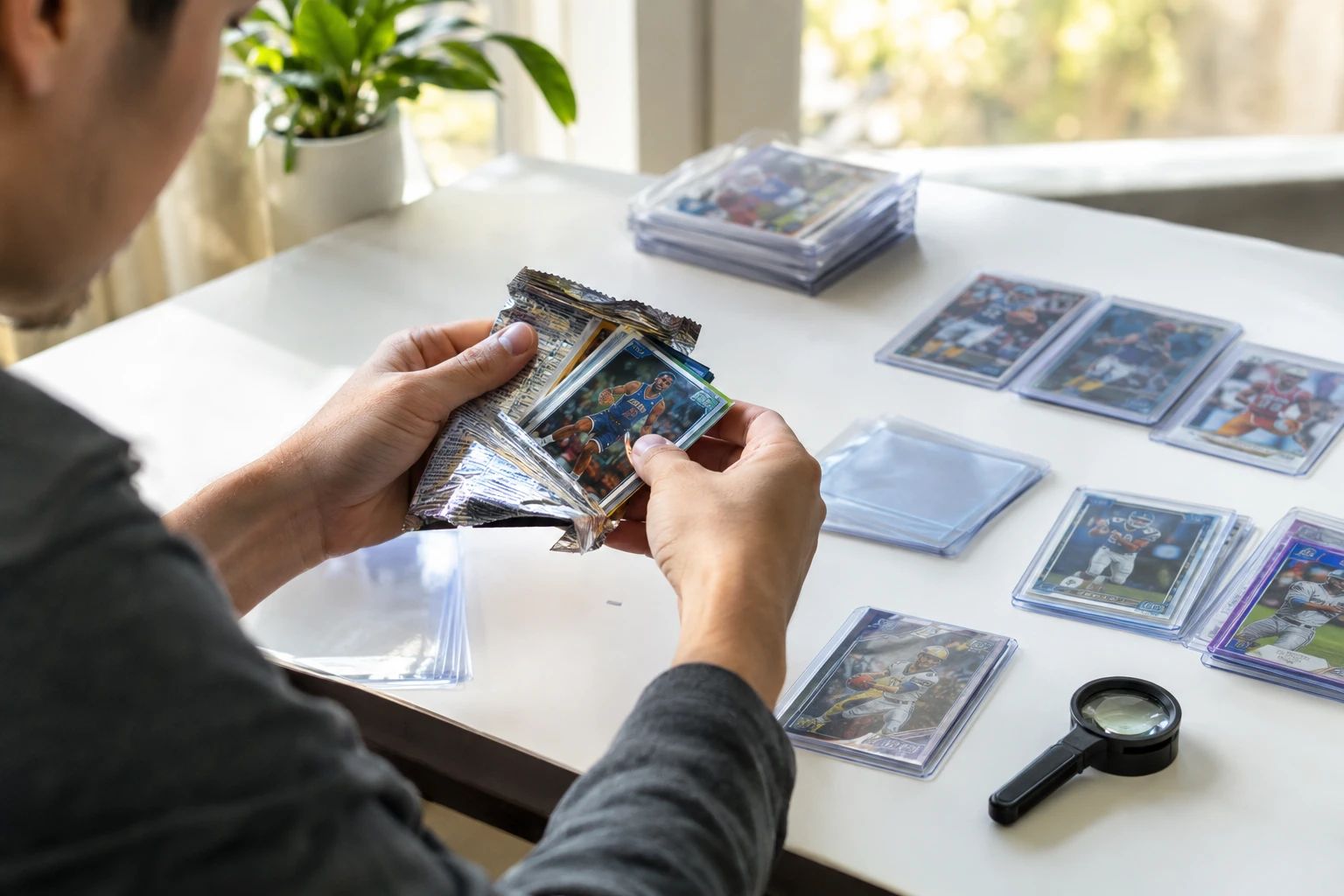
Every card should be protected from the moment it leaves the pack. Handling damage is the #1 preventable value killer in the hobby. A card that would have graded PSA 10 can become a PSA 8 from a single careless touch.
The Protection Chain
- Penny sleeve — a thin, clear polypropylene sleeve that costs about $0.01. Goes on every card, immediately. Prevents surface scratches and edge wear.
- Toploader — a rigid plastic holder (35pt for standard cards, 55–130pt for thicker cards). The penny-sleeved card slides inside. Prevents bending and corner damage.
- Team bag — a resealable plastic sleeve that goes over the toploader. Prevents dust and moisture from entering.
- Storage box or binder — the final destination. Use side-loading binders with PVC-free pages, or BCW storage boxes for bulk.
Recommended Supplies for Beginners
- Ultra Pro Penny Sleeves — $10/1,000. The baseline sleeve.
- Ultra Pro 3x4 Toploaders (35pt) — $15/100. Standard size for most modern cards.
- Ultra Pro Team Bags — $5/100. Resealable bags for toploaders.
- Vault X Exo-Tec 9-Pocket Binder — $30–50. Side-loading, zipper closure, PVC-free. The collector standard.
- BCW 3200 Count Storage Box — $8. For bulk storage of penny-sleeved cards.
Climate Control
Store cards in a climate-controlled environment: 65–75°F, 40–60% relative humidity. Avoid attics, basements, and garages. Direct sunlight fades ink and holofoils. A $15 hygrometer will tell you if your storage area is in the safe range.
Handling Rules
- Always handle cards by the edges, never touch the surface
- Wash and dry your hands before handling — skin oils damage surfaces
- Use nitrile gloves for cards worth $100+
- Never set a raw card on a table without a sleeve — table surfaces scratch
- Never stack raw cards on top of each other without sleeves
Step 5: Learning to Assess Card Condition
Card condition is everything. The difference between a PSA 10 (Gem Mint) and a PSA 9 (Mint) can be a 5–20x price difference. Learning to assess condition is the most important skill in the hobby.
The Four Pillars of Card Grading
PSA, BGS, CGC, and SGC all evaluate cards on the same four criteria:
- Centering — the balance of borders on opposite sides of the card. PSA 10 requires 55/45 or better on the front (meaning one border is no more than 55% of the total border width). This is the #1 reason cards do not grade PSA 10. 40–50% of modern cards fail centering.
- Corners — all four corners must be sharp. Even microscopic fuzzing visible only under 10x magnification drops a card from PSA 10 to PSA 9. "Touch-cap" damage — a small ding from a single careless touch — is the most common corner defect.
- Edges — checked for chipping, fraying, and rough factory cuts. Dark-bordered cards (1971 Topps, modern Topps Chrome black borders) are notoriously condition-sensitive because edge whitening is immediately visible.
- Surface — print lines, scratches, indentations, stains, gloss wear, and surface texture. The hardest pillar to assess with the naked eye and the most common "silent killer" of PSA 10 grades.
The PSA Grading Scale
| Grade | Label | Description |
|---|---|---|
| PSA 10 | Gem Mint | Virtually perfect. Four sharp corners, perfect centering (55/45), no surface damage. |
| PSA 9 | Mint | One minor flaw — slight off-centering or one microscopic corner issue. |
| PSA 8 | NM-MT | Slight fraying on one or two corners, minor printing imperfection, or slightly off-center. |
| PSA 7 | NM | Minor surface wear, small printing blemish, visible off-centering. |
| PSA 5–6 | EX–EX+ | Visible wear, rounded corners, surface scratches. Common for vintage. |
| PSA 3–4 | VG–Good | Significant wear, creasing, discoloration. Typical for heavily played vintage. |
| PSA 1–2 | Poor–Fair | Heavy damage, major creasing, missing pieces. Still has value for extremely rare cards. |
Tools for Condition Assessment
- 10x jeweler's loupe — $10–15 on Amazon. Essential for inspecting corners and edges.
- Centering gauge or ruler — measure border ratios. Or use AI centering analysis for 95%+ accuracy.
- Bright LED light at an angle — reveals surface scratches and print lines invisible under direct light.
- AI pre-grading — upload photos to PreGradeCards for a complete condition assessment at $0.15/card.
Step 6: When to Grade Your Cards
Not every card should be graded. Grading costs $20–$80 per card, and many cards are worth less than the grading fee. The decision framework is simple:
Grade When:
- The card is worth $100+ raw — the grading fee is a reasonable percentage of card value
- The PSA 10 multiplier is 4x or higher — a $50 raw card that sells for $200 as a PSA 10 justifies the $80 grading fee
- The card is a key rookie of a star player — rookie cards of established stars have the strongest graded premiums
- The card is vintage and rare — even lower-grade vintage slabs can be worth significantly more than raw
- You plan to sell — graded cards sell faster and for more than raw cards
- You want long-term protection — a slab is the best physical protection for a valuable card
Do Not Grade When:
- The card is worth less than $50 raw — grading fees exceed the value added
- The PSA 10 multiplier is less than 2x — not enough margin to cover fees and selling costs
- The card has visible damage — a PSA 7 or 8 may not be worth the slab
- The card is a common with thousands of PSA 10s in the pop report — no scarcity premium
- PSA Value tiers are paused and the card is mid-value — at $79.99 Regular, the math does not work for $50–100 cards. Use CGC Economy at $20 instead.
Current Grading Costs (2026)
| Company | Cheapest Active Tier | Cost/Card | Turnaround |
|---|---|---|---|
| PSA | Regular | $79.99 | ~65 business days |
| BGS | Express | $79.95 | 10–15 days |
| CGC | Bulk (25+ cards) | $17 | ~5 months |
| CGC | Economy | $20 | 30–45 days |
| SGC | Economy | $25 | 20–30 days |
Step 7: AI Pre-Grading for Beginners
AI pre-grading is the most important tool for a new collector. It costs $0.15–$0.25 per card and tells you whether a card is worth spending $80 to grade professionally. For a beginner, this tool prevents the most common and most expensive mistake: submitting cards to PSA that come back PSA 8 or 9.
How It Works
- Photograph your card — front and back. Use even lighting (two lights at 45 degrees for Chrome/refractor cards, single diffuse light for regular cards).
- Upload to PreGradeCards — specify the card year, product, and player for accurate calibration.
- Get your results — the AI returns a predicted PSA grade (e.g., "PSA 9.2") with sub-grade breakdowns for centering, corners, edges, and surface.
- Make your decision — cards predicted 9.5+ are strong PSA 10 candidates. Cards predicted 8.5 or below should be kept raw or sold raw.
Why Beginners Need AI Pre-Grading
Beginners cannot reliably assess card condition with the naked eye. A card that looks perfect to a new collector may have microscopic corner fuzzing, a print line, or 58/42 centering — any of which would prevent a PSA 10 grade. AI pre-grading provides an objective assessment that is calibrated to the same standards PSA uses.
The math is compelling: if AI pre-grading costs $0.15 and prevents you from submitting one card to PSA Regular at $79.99 that would have come back PSA 8, you have saved $79.84. That is a 532x return on the AI cost.
Free Credits for Beginners
PreGradeCards offers a free sign-up bonus of credits that lets you pre-grade several cards at no cost. This is the best way to try the service before committing. Sign up, upload 5–10 cards from your collection, and see the results for yourself.
Step 8: Selling and Trading Cards
At some point, every collector sells or trades cards. Whether upgrading your collection, taking profits, or liquidating duplicates, knowing how to sell effectively maximizes your return.
Selling Channels
- eBay — the largest marketplace. 13% fee. Best for individual cards and slabs. Use "Buy It Now" with Best Offer for high-value cards, auction format for mid-value cards.
- Whatnot — live auction format. 8% fee. Best for volume selling and building a following. Fun and social but requires being on camera.
- Facebook groups — no fees but no buyer protection. Best for established collectors with group reputation. Risk of scams and chargebacks.
- Goldin Auctions — 5–10% seller premium. Best for high-value slabs ($500+). Reaches serious collectors. 60–90 day cycle.
- COMC — hands-off selling. Higher fees (~20%) but they handle everything. Good for volume.
- Local card shop — instant cash but 30–50% below FMV. Good for quick liquidation of commons and mid-value cards.
Trading Etiquette
Trading is a core part of the hobby. Whether at card shows or online, follow these rules:
- Always use current sold comps to establish fair trade value
- Be honest about card condition — disclose any flaws before agreeing to trade
- Ship first if you have lower feedback/reputation
- Use tracked shipping with insurance for trades over $100
- Document the trade agreement in writing (DM, email, or group post)
10 Mistakes That Cost Beginners the Most
- Submitting cards to PSA without pre-grading. The #1 mistake. $80 per card on cards that come back 8 or 9. AI pre-grading at $0.15 prevents this.
- Buying base cards of hyped rookies at peak. Post-draft hype inflates prices 50–200%. Buy during the offseason or after a slump.
- Not protecting cards immediately. A single careless touch can drop a PSA 10 to a PSA 8 — a 5–20x value loss. Penny sleeve every card the moment you pull it.
- Grading cards worth less than $50. Grading fees exceed the value added. Sell raw or hold until the card appreciates.
- Ignoring centering. 40–50% of modern cards fail PSA 10 centering. If borders look uneven to the naked eye, it is already a PSA 9.
- Storing cards in a garage, attic, or basement. Temperature swings and humidity destroy cards. Store indoors at 65–75°F, 40–60% RH.
- Using top-loading binder pages. Cards slide out and corners catch on rings. Use side-loading binders only.
- Trusting eBay listing photos for raw card condition. Sellers often use flattering angles that hide flaws. Demand angled photos and high-resolution images.
- Buying "investment" cards without understanding the market. The hobby is full of "can't miss" prospects who missed. Research pop reports, sold comps, and player fundamentals before buying.
- Not tracking purchases and sales. Without records, you cannot calculate ROI, track your cost basis for taxes, or learn from your mistakes. Use a spreadsheet from day one.
Resources and Tools for New Collectors
Essential Tools
- PreGradeCards AI pre-grading — card grading, centering analysis, condition check, batch grading. $0.15–$0.25/card.
- 10x jeweler's loupe — $10–15 on Amazon. For corner and edge inspection.
- PSA Population Report — free at psacard.com/pop. Check how many of your card exist at each grade.
- Card Ladder — $15/month. Price tracking and portfolio management.
- 130point.com — free eBay sold listing search.
Communities
- Sports Card Forum — sportscardforum.com. One of the oldest and most active forums.
- Blowout Cards Forum — blowoutcards.com/forums. Active community with breaking and trading sections.
- Reddit r/sportscards — 200K+ members. Active discussion and market analysis.
- YouTube — Sports Card Nation, MojoBreak, Jabsy Breaks. Great for learning about products and market trends.
- Whatnot — watch breaks to learn about products and see what cards look like before you buy packs.
Key Articles for Beginners
- Card Grading ROI 2026: When Is It Worth Grading?
- How to Make Money Grading Cards: Side Hustle Guide
- Card Collection Appraisal Guide
- Card Show Buying Guide 2026
Final Advice for New Collectors
The sports card hobby rewards patience, knowledge, and discipline. The collectors who stay in the hobby for decades are the ones who collect what they love, learn continuously, protect their cards, and make decisions based on data rather than hype. Start small, focus on one sport or player, use AI pre-grading before submitting to PSA, and track everything. The hobby will give back what you put into it.
Frequently Asked Questions
How much money do I need to start collecting sports cards?
What sport should I collect?
Should I grade my cards?
What is the difference between a PSA 9 and PSA 10?
Where is the best place to buy sports cards?
What is AI pre-grading and do I need it?
How do I protect my card collection?
Sources & Further Reading
- Sports Card Investing in 2026 — Athlon Sports
- Trading Card Market Analysis 2026 — CardMarks
- PSA Grading Standards — PSA
- Card Grading ROI 2026 — PreGradeCards
- How to Make Money Grading Cards — PreGradeCards
JT Thompson has focused on vintage sports cards (pre-1980) for more than 20 years. He is a regular contributor to vintage collector forums, has consulted on authentication issues for high-value pre-war cards, and teaches collectors how to spot trimming, recoloring, and restoration on classic cardboard.
Create a free account and get 1 free credit — enough for 1 complete AI grading with market pricing. No credit card required.
Sign Up Free →