The Short Answer
- Whatnot charges ~8% seller fee — lower than eBay's 13%, but live auction format creates urgency that can push prices above market.
- Personal Your Team (PYT) breaks are the safest format — you know exactly which team you are buying and what cards you could receive.
- Check breaker reputation before buying — Whatnot ratings, break history, and community reputation matter. Avoid breakers with under 100 sales or below 4.8 stars.
- The 2025 repack scandal exposed breakers who seeded repack products with fake hits — buy from established breakers and avoid "repack" or "repack-style" breaks.
- AI pre-grade every card you win before submitting to PSA — $0.15 pre-grade vs $79.99 PSA fee. Not every hit is worth grading.
- Set a hard budget before joining a stream — live auction format is designed to create impulse buying. Discipline is essential.
What Is Whatnot and How Does It Work?
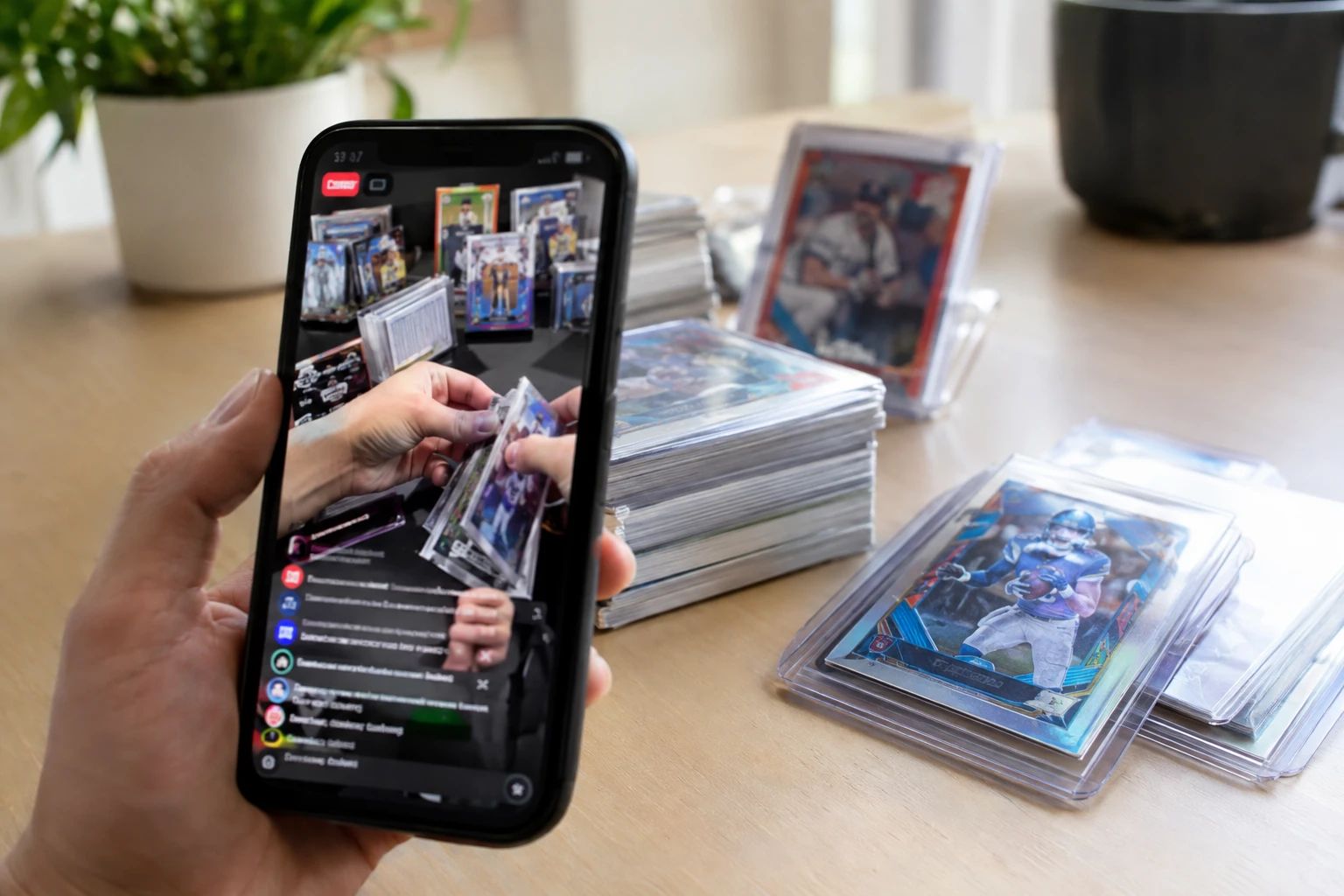
Whatnot is a live-streaming marketplace where sellers (called "breakers" in the card community) open card packs in real-time while viewers watch and bid on the results. It is the fastest-growing card buying platform in the hobby, with millions of active users and thousands of live breaks happening at any given moment.
How Whatnot Works for Card Buyers
- Download the app — Whatnot is primarily a mobile app (iOS and Android). The web version exists but most breaks happen through the app.
- Browse live breaks — search by sport (NFL, NBA, MLB, NHL), product (Prizm, Topps Chrome, Bowman Chrome), or breaker name.
- Join a stream — enter the breaker's live stream. You can watch, chat, and bid in real-time.
- Buy a spot or bid on a card — depending on the break format, you either buy a "spot" (a team or a tier) before the break starts, or bid on individual cards as they are pulled.
- Watch the break — the breaker opens packs live on camera. If a card from your team/tier is pulled, you win it.
- Receive your cards — the breaker ships your cards after the stream. Shipping is typically $5–10 per break.
Why Whatnot Is Popular
- Entertainment — watching packs opened live is exciting. The social aspect of chatting with other collectors during a break is a big draw.
- Access to high-end products — a $1,000 hobby box is unaffordable for most individuals, but a $50 spot in a group break gives you a chance at the hits.
- Community — regulars in a breaker's stream build relationships with each other and the breaker. It is a modern card shop atmosphere.
- Lower fees than eBay — Whatnot charges sellers ~8% vs eBay's 13%. This can translate to better prices for buyers.
- Immediate gratification — you know what you won within minutes, not days after an eBay auction ends.
Card Break Formats Explained
Understanding break formats is essential for making informed buying decisions on Whatnot. Each format has different risk profiles and pricing structures.
1. Pick Your Team (PYT)
Each NFL/NBA/MLB team is assigned a price based on the quality of rookies and players on that team. You pick and pay for a specific team. Any card pulled of a player from your team goes to you. This is the safest format because you know exactly what you are buying:
- High-value teams (Cowboys, Lakers, Yankees) cost more but have more potential hits
- Low-value teams (Jaguars, Pistons, Marlins) cost less but have fewer hits
- You keep every card from your team, including base cards and inserts
- Best for collectors who follow a specific team
2. Random Team (RT)
All teams are assigned the same price. Buyers are randomly assigned a team after all spots sell. This is a gamble format — you could get the Cowboys or the Jaguars for the same price. Best for collectors who enjoy the randomness and want a lower entry price.
3. Tiered Random
Teams are grouped into tiers (Tier 1: top 8 teams, Tier 2: middle 16, Tier 3: bottom 8). You buy a spot in a specific tier and are randomly assigned a team within that tier. This reduces the randomness — you will not get the worst team if you buy Tier 1.
4. Hit Draft
After the break, all hits (autographs, memorabilia cards, low-numbered parallels) are lined up. Buyers draft picks in order — the first buyer picks their favorite hit, the second buyer picks from the remaining, and so on. Draft order is random. This format is good for collectors who want specific cards rather than specific teams.
5. Division/Conference
Instead of individual teams, you buy a division (e.g., NFC East) or conference. Any card from any team in your division goes to you. More coverage than PYT but less targeted.
6. Pack Wars / Box Wars
Two or more buyers each purchase a box. The breaker opens both boxes live, and the buyer with the highest-value hit wins both boxes' contents. This is a high-risk, high-reward format — you could double your money or lose everything.
7. Pick a Player
Specific players are priced individually. You buy a specific player, and any card of that player goes to you. Best for player collectors who only want one specific player's cards.
How to Identify Fair Break Pricing
The biggest challenge for Whatnot buyers is knowing whether a breaker's pricing is fair. Unlike eBay, where you can compare sold comps, break pricing involves multiple variables: box cost, number of spots, hit rates, and team values. Here is how to evaluate fair pricing:
The Box Cost Formula
Every break has a box cost that the breaker needs to recover. For a PYT break:
Total spot prices should = Box cost × 1.3 to 1.5
The 1.3–1.5 multiplier covers the breaker's fees (Whatnot 8%, payment processing 3%), shipping supplies, and profit margin. If a hobby box costs $200 and the breaker is selling 30 team spots that total $400, the multiplier is 2.0x — that is overpriced. If the spots total $260–300, the multiplier is 1.3–1.5x — that is fair.
Per-Spot Value Calculation
For a specific team spot, calculate the expected value:
- Identify the rookies/star players on that team in the product being broken
- Estimate the number of hits per box (e.g., 2 autographs + 2 refractors per hobby box)
- Calculate the probability of your team getting a hit (roughly: your team's players on the checklist ÷ total players on the checklist × number of hits)
- Estimate the value of potential hits — check eBay sold comps for the team's top rookies in that product
- Expected value = probability × average hit value
If the spot price is less than the expected value, it is a good buy. If the spot price exceeds the expected value, you are overpaying.
Red Flags in Pricing
- Spot prices total more than 2x box cost — the breaker is overcharging
- "Hot" teams priced 5–10x more than "cold" teams — the breaker is pricing based on hype, not hit probability
- Shipping charged per spot rather than per break — if you buy 3 spots, shipping should be one fee, not three
- "Bonus" cards promised but not specified — vague promises of "extra hits" are a red flag
Spotting Scam Breakers and Red Flags
While most Whatnot breakers are honest, the live format and real-time bidding create opportunities for scams. Here are the red flags to watch for:
Breaker Red Flags
- New account with few sales — breakers with under 100 sales or less than 4.8 stars are higher risk. Stick to established breakers with thousands of sales and 4.9+ ratings.
- No physical box shown — the breaker should show the sealed box on camera before opening. If they open packs from an already-opened box, the box may have been searched.
- Camera quality issues — if the camera is so blurry you cannot read card names, the breaker may be hiding something. Clear, well-lit streams are the standard.
- Reluctance to show card backs — the breaker should show both sides of every hit. If they only show the front, they may be hiding condition issues.
- Shilling — fake bids from friends or alternate accounts to drive up prices. Watch for bidders who never win but always bid, or bids that come in suspiciously fast increments.
- Delayed shipping — if the breaker has a pattern of shipping weeks after the break, they may be holding cards hostage or have cash flow problems. Check reviews for shipping complaints.
- "Repack" or "repack-style" breaks — breaks where the breaker claims to have "repacked" hits into new packs. This was the basis of the 2025 repack scandal. Avoid these entirely.
How to Verify a Breaker's Reputation
- Check Whatnot ratings — look at the breaker's overall rating, number of sales, and read recent reviews.
- Watch previous streams — Whatnot allows you to view past streams. Watch how the breaker handles cards, ships, and interacts with buyers.
- Search the breaker's name on social media — Twitter, Instagram, and Reddit for complaints or praise from the community.
- Ask other buyers in the stream — "Has anyone bought from this breaker before? How was shipping?" Regulars will share their experience.
- Check if they are a registered business — established breakers often have a business name, website, and social media presence beyond Whatnot.
The 2025 Repack Scandal and What Changed
In 2025, a major scandal rocked the Whatnot card breaking community. Several breakers were caught selling "repack" products — supposedly random repacked packs that contained "guaranteed hits" — where the hits were either fake, severely damaged, or far below the advertised value. The scheme worked because buyers could not verify the contents before buying, and the live format created urgency that prevented careful evaluation.
What Happened
The breakers purchased cheap base cards and low-value inserts, repacked them into "mystery packs" with high advertised values ("$500 in cards guaranteed!"), and sold the packs at $50–100 each. The actual contents were worth $5–15. When buyers received their cards and compared to what was advertised, the fraud was exposed. Several breakers were banned from Whatnot, and some faced legal action.
What Changed on Whatnot
- Whatnot implemented stricter verification for breakers selling repack-style products
- Buyer protection policies were strengthened — refunds are now easier to request for misrepresented products
- Community reporting — buyers can report suspicious breakers directly through the app
- Breaker rating transparency — ratings and reviews are more prominent and harder to fake
Lessons for Buyers
- Avoid "repack" or "mystery pack" breaks entirely — only buy breaks where sealed, factory boxes are opened on camera
- Only buy from established breakers with verifiable histories
- If a deal seems too good to be true ("$500 in cards for $50"), it is
- Document the stream — screen record the break if you win, so you have evidence of what was pulled
- Report any suspicious behavior to Whatnot support immediately
For a full account of the scandal, read our detailed Whatnot repack scandal analysis.
Whatnot Buying Strategy for Card Graders
If your goal on Whatnot is to acquire cards for professional grading, your strategy should be different from a casual collector. You are not buying for fun — you are buying for PSA 10 potential. Here is the grading-focused buying strategy:
1. Target Products with High PSA 10 Potential
Not all products produce PSA 10s at the same rate. Focus on breaks of:
- Panini Prizm — the most liquid product, but 40–50% fail centering. Buy teams with rookies who have clean centering in recent products.
- Topps Chrome / Bowman Chrome — refractor surface issues are common, but clean copies grade well. Buy teams with top prospects.
- Donruss Optic — generally better centering than Prizm, lower submission volume means lower pop reports.
- Upper Deck Young Guns — hockey's most valuable rookie card. Low pop, high PSA 10 premium.
2. Buy Teams With High-Value Rookies
In a PYT break, buy teams with the best rookie class in that product. Research the checklist before the break:
- Which teams have multiple rookies in the product?
- Which rookies have the highest PSA 10 comps on eBay?
- Which teams have veteran stars who also have valuable cards?
3. Calculate Grading ROI Before Buying
Before buying a spot, estimate the grading ROI:
- Estimate the number of gradable cards you might receive (rookies, refractors, autos)
- Estimate the PSA 10 hit rate for that product (~30–50% for pack-fresh modern cards)
- Estimate the PSA 10 value of potential hits (check eBay sold comps)
- Subtract grading fees ($80/card PSA Regular or $20/card CGC Economy)
- If the expected net profit exceeds the spot price, it is a good buy
4. Avoid High-Risk Formats
For grading purposes, avoid Pack Wars and Random Team formats. PYT is the best format because you can calculate expected value based on the team's checklist presence. Hit Draft is second-best because you can target specific cards with known PSA 10 potential.
AI Pre-Grading Cards You Win on Whatnot
When you win cards on Whatnot, they arrive in the mail a few days later. Before submitting any of them to PSA at $79.99/card, AI pre-grade every hit. This is the same workflow as any other raw card purchase:
The Post-Break Pre-Grading Workflow
- Open the package carefully — do not damage cards while opening shipping materials.
- Sleeve every card immediately — penny sleeve first, then toploader for cards worth $20+.
- Photograph each card — front and back, using the proper lighting setup (two softbox lights at 45 degrees for Chrome/Prizm, single diffuse light for base cards).
- Upload to PreGradeCards — specify the card year, product, and player for accurate calibration.
- Filter by predicted grade — only submit cards predicted 9.5+ to PSA. Cards predicted 9.0 can go to CGC Economy at $20. Cards below 9.0 should be sold raw or kept.
- Use batch grading for volume — if you won 20+ cards in a break, batch pre-grade them all at once for $3–5 total.
Why Pre-Grading Matters for Whatnot Wins
Cards from Whatnot breaks have been handled by the breaker — opened from packs, displayed on camera, placed in sleeves, and shipped. Each handling step introduces potential damage. A card that was PSA 10 when pulled may have acquired a touch-cap corner during shipping. AI pre-grading catches this before you waste $80 on PSA fees.
The math: if you win 10 cards in a break and pre-grade them all for $1.50, the AI might identify that only 3 are PSA 10 candidates. You submit those 3 to PSA ($240) instead of all 10 ($800). You save $560 in grading fees on cards that would have come back PSA 8 or 9.
Breaker Handling Quality
Some breakers handle cards more carefully than others. Watch how the breaker handles cards during the stream:
- Good breakers wear gloves, sleeve cards immediately after pulling, and use toploaders for high-value hits
- Bad breakers handle cards with bare hands, stack raw cards on top of each other, and throw hits into penny sleeves without care
- Track which breakers deliver cards in the condition you expect — this informs future buying decisions
Selling Graded Cards on Whatnot
Whatnot is not just for buying — it is also a selling platform. If you grade cards and want to sell the slabs, Whatnot offers a unique live auction format that can produce strong results.
Why Sell Graded Cards on Whatnot?
- Lower fees than eBay — 8% vs 13%. On a $500 sale, that is $25 more in your pocket.
- Live auction urgency — multiple bidders competing in real-time can push prices above eBay comps.
- Building a following — regular Whatnot sellers build a loyal audience that returns for every stream. This is more valuable than any single sale.
- Fast sales — cards sell in minutes, not days. No waiting for eBay auctions to end.
Selling Strategy for Graded Slabs
- Build inventory first — have 10–20 graded slabs ready before your first selling stream. A stream with only 3 slabs will not attract enough viewers.
- Set fair starting prices — start auctions at 60–70% of eBay sold comp. The live format will push the final price toward or above comp.
- Show the slab clearly — use a high-quality camera, show the front and back of the slab, and read the label aloud. Buyers need to see the grade and cert number.
- Verify cert numbers — some buyers will ask you to verify the PSA cert number on psacard.com. Have your phone ready to look it up.
- Ship quickly — ship within 48 hours of the stream. Fast shipping builds reputation and repeat buyers.
- Run regular streams — consistency builds audience. Same day, same time, every week.
Whatnot vs eBay for Selling Slabs
| Factor | Whatnot | eBay |
|---|---|---|
| Seller fee | ~8% | ~13% |
| Sale speed | Minutes (live auction) | 1–7 days (auction) or instant (BIN) |
| Audience size | Smaller, more engaged | Largest marketplace |
| Price ceiling | Can exceed comps with bidding wars | Capped at BIN or auction close |
| Effort required | High (live streaming, on camera) | Low (create listing, ship) |
| Best for | Mid-value slabs ($50–500), volume selling | All values, especially high-end ($500+) |
10 Safety Rules for Whatnot Buyers
- Set a hard budget before joining a stream. Live auction format is designed for impulse buying. Decide your max spend and do not exceed it, no matter how exciting the break gets.
- Only buy from established breakers. Minimum 500 sales, 4.9+ rating. Check reviews for shipping speed and card condition complaints.
- Only buy breaks that show sealed factory boxes. The breaker must show the sealed box on camera before opening. No pre-opened boxes, no "repacks."
- Screen record the break. If you win a card, record the moment it is pulled. This is your evidence if there is a dispute about what was pulled or its condition.
- Calculate expected value before buying a spot. Research the checklist, estimate hit probability, and compare to the spot price. Do not buy spots where the expected value is below the price.
- AI pre-grade every card you win before submitting to PSA. $0.15 pre-grade vs $79.99 PSA fee. Not every Whatnot win is a PSA 10 candidate.
- Check shipping policies before buying. How much is shipping? When do they ship? Do they combine shipping for multiple spots? Avoid breakers who charge per-spot shipping when you buy multiple spots.
- Do not bid against yourself. If you are the high bidder and no one else is bidding, do not raise your own bid. Wait for the timer to expire.
- Report suspicious behavior. If you see shilling, fake bids, or misrepresented products, report to Whatnot support and warn other buyers in the chat.
- Do not chase losses. If you spent your budget and did not get a good hit, do not buy more spots hoping to win it back. That is gambling behavior, not collecting behavior. Stop, evaluate your results, and return another day.
Final Thoughts on Whatnot
Whatnot is a powerful platform for card collectors and graders. It provides access to products and cards that might otherwise be out of reach, and the live format is genuinely entertaining. But the platform's design — real-time bidding, social pressure, and the excitement of live pack openings — creates unique risks that eBay and other static marketplaces do not have. Discipline, research, and AI pre-grading are your three tools for using Whatnot profitably and safely.
For more on card buying and selling strategy, read our card grading side hustle guide and our card show buying guide.
Frequently Asked Questions
Is Whatnot safe for buying cards?
How much does it cost to buy cards on Whatnot?
What is the best break format for card graders?
Should I grade cards I win on Whatnot?
What was the Whatnot repack scandal?
Can I sell graded cards on Whatnot?
How do I avoid scams on Whatnot?
Sources & Further Reading
- Whatnot Repack Scandal 2025 — PreGradeCards
- Sports Card Breaking Sites Compared 2026 — PreGradeCards
- How to Make Money Grading Cards: Side Hustle Guide — PreGradeCards
- How to Flip Trading Cards for Profit — WinnersAndWhiners
- How to Flip Trading Cards for Profit 2026 — WeirdWealth
Create a free account and get 1 free credit — enough for 1 complete AI grading with market pricing. No credit card required.
Sign Up Free →