The Short Answer
- Cricket cards span 130 years, and the value story changes completely by era: pre-war scarcity, 1990s signed inserts, then modern numbered parallels and patches.
- Most cricket cards are worth cents to a few dollars. Value concentrates in early Bradman issues, signed Futera and Weet-Bix pieces, low-numbered modern parallels and on-card autographs.
- Published example valuations in September 2026 put a 1930s Wills Bradman near US$895 and a 1994 Futera Shane Warne near US$650, against about US$90 for a Cricket Australia Traders rookie.
- Futera's 2025-26 Cricket FX Edition 1 packs 79 autographs and 160 relics into a 907-card release, with most inserts foil-numbered and 1-of-1 Diamond chases.
- The modern Australian line is TLA's Cricket Australia Traders, with a 153-card base set for 2025-26 plus silver and MoJo parallels, tiered signatures and match-worn patches.
- Grading pays on thin, high-spread cards only when the card is authenticated and the grade is likely to be 9 or better; the cost stack is A$50 to A$200 per card from Australia.
Which cricket cards are worth grading?
Cricket card values are concentrated, not evenly spread. The cards worth grading are early Don Bradman cigarette and trade issues, signed 1990s Futera and Weet-Bix pieces, low-numbered modern parallels and on-card autographs or match-worn patches of current internationals. Everything else, which is the overwhelming majority of what is printed, is worth less than the cost of a slab.
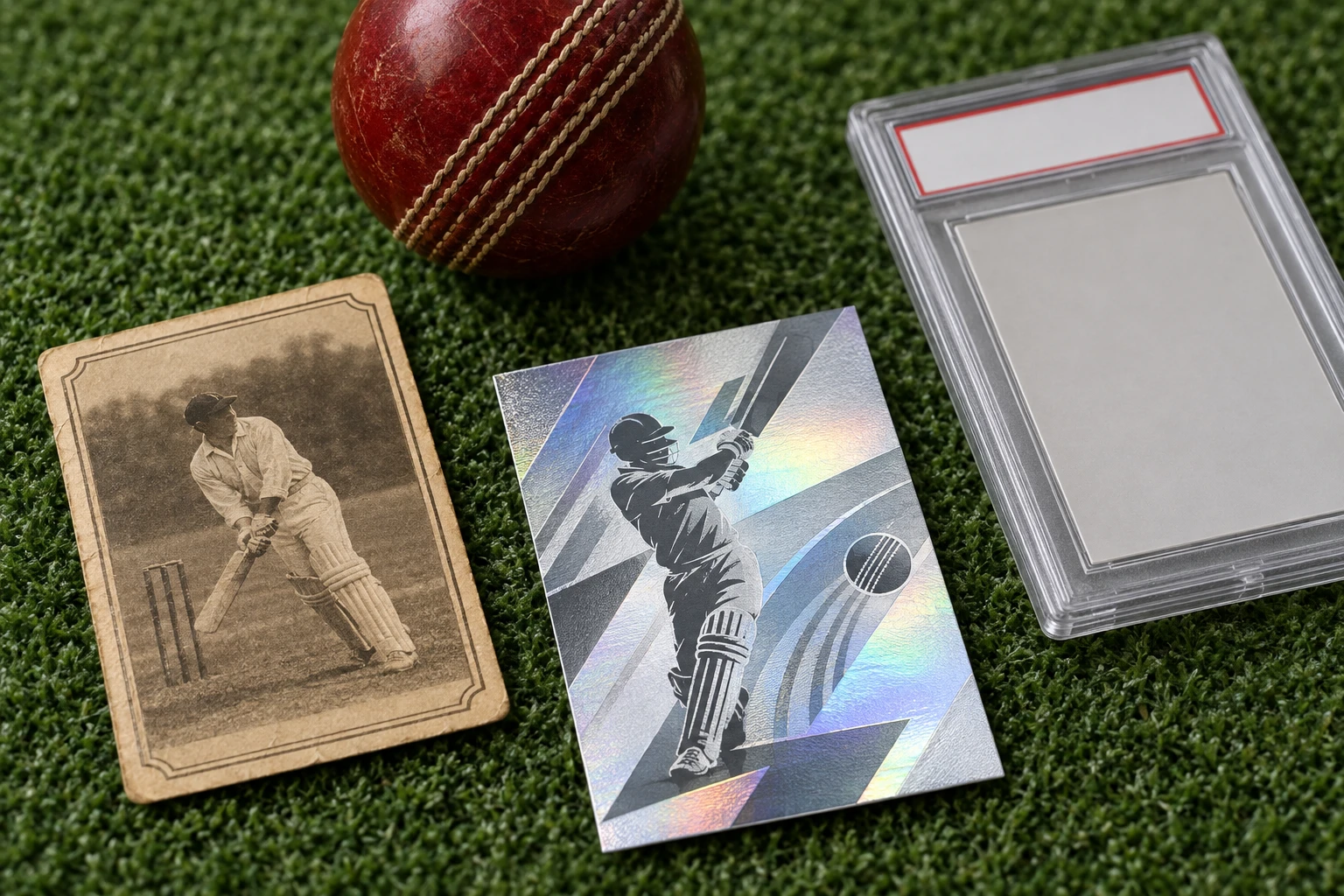
Cricket is unusual because the market is thin and the history is long. A 1932 Friends' Temperance Union Bradman card is one of six or seven known examples and belongs at auction. A 2026 Cricket Australia Traders base card of the same kind of player is worth cents. Between those extremes sit the 1990s Futera era and today's numbered inserts, where most collectors actually operate.
The practical test is the same as in any sport: identify the exact card, find several completed sales, subtract the full grading cost, and only submit when the expected gain is large enough to cover a one-grade miss. What changes in cricket is that the comp set is smaller, so precision matters more and a wrong identification can double or halve the answer.
Values and fees checked November 2026. Card values are published medians or example valuations, not appraisals.
The cricket card universe: eras and makers
Cricket cards are easier to reason about once you know which era a card comes from, because each era has its own makers, print quality and failure modes.
1896 to 1939: cigarette and trade cards. Wills issued the first sporting cigarette set in 1896, and a wave of tobacco and confectionery makers followed. Bradman's earliest cards come from the 1928-29 Ogden's and early-1930s Sweetacres issues. These cards are small, fragile and often trimmed, and condition dominates value.
1940s to 1980s: the quiet decades. Production thinned out. Post-war trade sets exist, but the hobby's centre of gravity moved to other sports, and surviving cricket material from this period is sparse.
1990s: Futera and Weet-Bix. This is the high point of Australian cricket cards. Futera's 1995 Heritage Collection carried on-card autographs of Bradman, Lindwall and Harvey, and Sanitarium and Weet-Bix issues of the same era are still chased. Signed cards from this window are the modern blue chips.
2011 to now: Traders, Futera FX and Cricket Attax. TLA's Cricket Australia Traders line covers Test, Big Bash and the women's game. Futera returned with premium cricket releases, and Topps India's Cricket Attax built a mass-market audience. This is where numbered parallels, patch cards and tiered signatures live.
Values by era and card type
Cricket card values are best read as bands rather than single numbers, because the sold sample for any one card is small and condition moves the answer by multiples.
| Card type | Typical band | What moves it |
|---|---|---|
| Common cigarette and modern base | Cents to a few dollars | Set completion, player |
| Vintage set singles, common | A few to tens of dollars | Condition, scarcity |
| Numbered modern parallels | US$20 to US$200 | Serial number, player |
| On-card signatures and patches | US$200 to thousands | Player, print run, condition |
| Early Bradman and rare issues | Hundreds to auction records | Authenticity, survival, grade |
Published example valuations give a sense of scale. CardLoft's cricket price pages list a 1930s Wills Bradman at about US$895 and a 1994 Futera Shane Warne at about US$650, against roughly US$90 for a Cricket Australia Traders rookie card of Pat Cummins. Those are asking-based market readings from 2026, not auction records, and each would move with condition and grade.
Two structural points matter more than any single number. First, cricket production has had real gaps, so modern sets are not a continuous line and a card from a skipped year can be genuinely scarce. Second, the buyer pool is concentrated in cricket-playing countries, which means liquidity varies by where the card is offered and a US or UK auction can beat a local listing.
Raw vs PSA 8, 9 and 10: the grade premium
The grade premium in cricket is real but uneven, and it behaves differently by era.
Vintage. Survivors are scarce and fragile, so the spread between a worn card and a clean one is enormous. A slab that certifies authenticity and a numerical grade can move a card from an uncertain private sale into an auction result. At the top end, the difference between a 4 and a 7 can be a multiple rather than a percentage. The card condition guide explains what each grade step actually allows.
1990s signed inserts. The premium is driven by authentication as much as condition. A signed Futera card with a verified autograph and a high grade removes two buyer objections at once, which is why slabbed examples of the Heritage Collection era trade at a persistent premium.
Modern. Modern print quality is high and gem rates are generous, so a 10 is common and a 9 is not a premium. The value sits in the serial number and the signature, not the grade. Slabbing a modern base card or a common insert usually destroys value because the cost exceeds the uplift.
Thin comps cut both ways. A single high sale can make a grade look transformative, and a single low sale can do the opposite. Use at least three completed sales for the same card and grade before assuming a premium exists. Where the sample is smaller, treat the number as a range.
| Era | Raw to 9 | 9 to 10 | What drives it |
|---|---|---|---|
| Pre-1940 vintage | Large | Very large | Survival and authenticity |
| 1990s signed inserts | Moderate to large | Large | Autograph verification |
| Modern 2011 and later | Small | Small | Serial number and signature, not the grade |
Cricket-specific grading problems
Cricket cards fail in particular ways, and knowing them changes which cards you buy and which you submit.
Trimming. Vintage cigarette cards are small and were often trimmed to fit albums or mounts. A trimmed card can be rejected as altered rather than graded, which is the worst possible outcome for a submission. Measure the borders against a known example before you send anything.
Album damage. Cards stored in period albums pick up corner rub, surface abrasion and glue residue on the reverse. Reverse damage is easy to miss and is fully visible to a grader.
Fading and foxing. Paper stock from the 1920s and 1930s is sensitive to light and humidity. Foxing, the brown spotting caused by mould and moisture, is common in collections stored in garages and tropical climates, and it caps a grade hard.
Modern surface and centering. Foil and chromium surfaces scratch, and cricket cards are often handled at matches. Print lines and roller marks show up under raking light. Centering on modern sets is generally good, but die-cut and patch cards create their own edge problems.
Autograph condition. On-card ink can fade or smudge, and a signature that has been enhanced or traced is a rejection. If a signed card is the reason for the submission, authenticate that first.
Population and gem rates
Cricket population data is sparse compared with basketball, football or Pokémon, and that scarcity is itself information.
What to check. Search the grader's population report by set and card, not by player name, because cricket cards are often catalogued under the issuer and set rather than a modern brand. If a card has a handful of submissions and two 10s, the census is thin enough that a new 10 is a meaningful supply increase.
Why gem rates mislead. A high gem rate on modern cricket cards usually reflects easy grading and careful submitters, not easy cards. Modern cards are printed well and most people only submit the best copies, so the population is a self-selected sample. A high percentage of 10s does not mean a 9 is worth grading.
Vintage is the opposite. Few vintage cricket cards are graded at all, and the ones that are tend to be the best survivors. A high-grade vintage census is therefore both small and strong, and a mid-grade example sits in a much thinner field than the raw supply suggests.
Use population as a tie-breaker. Between two similar cards, the one with a thinner high-grade population has more upside if it grades well. It is not a value estimate on its own, and no population report is a price guide.
The cricket cards that justify a submission
Narrow the shortlist to these categories before you spend anything.
- Early Bradman issues. 1928-29 Ogden's, early-1930s Sweetacres and genuine rarities. Authenticate first, then grade.
- Signed 1990s Futera and Weet-Bix. Particularly the 1995 Heritage Collection and any on-card legend autograph.
- Low-numbered modern parallels. MoJo and silver parallels of current internationals, with the serial visible and ideally single-digit or jersey-matched.
- On-card signatures and match-worn patches from TLA Traders and premium Futera releases, where the player is a current star.
- Key rookie cards of established internationals, in clean condition, where the graded comp set already exists.
Everything else should stay raw. A common cigarette single, a modern base card, a team checklist or an unsigned insert rarely clears the cost stack, and a slab does not create demand for a card nobody is looking for. If the card is not in one of the five categories above, the honest answer is usually to sell it as it is.
For a worked cost model by country, see the Australia grading routes guide; the arithmetic is the same, only the freight changes.
Where to grade from the UK, Australia, India and NZ
Where you are changes the cost stack far more than which grader you choose.
Australia. No PSA office, and direct individual submissions have been closed since April 2025, so Australian collectors use a middleman. Published starting rates sit between A$110 and A$172 for PSA Standard before GST, with CGC from about A$40 and domestic graders from about A$30.
United Kingdom. UK collectors can submit to PSA in the United States or use the Frankfurt facility through a European route, though a UK-to-EU shipment is an export and a re-import. UK middlemen consolidate and handle the paperwork; the UK and Europe guide covers the detail.
India. No PSA or CGC office, and the return leg is assessed at about 30.98% of the CIF value on a paid personal import. Indian submission services bundle the customs exposure into a rupee price, which is usually the simplest route for a single card.
New Zealand. No local PSA option; cards go through Australian or direct international routes, which adds a Pacific leg on both ends. Insurance and declared value matter more than the fee.
Whichever country you are in, the landed-cost guide is the right next read, and a free AI pre-grade should come before any submission.
| Country | PSA access | Published price signal | Customs note |
|---|---|---|---|
| Australia | Middleman only | A$110-172 Standard before GST | GST, plus A$3-12 per card on return |
| United Kingdom | US direct or EU route | Middleman quote | Export and re-import if routed via the EU |
| India | Middleman or direct | INR 1,499-2,499 Value tier | About 30.98% of CIF on a paid import |
| New Zealand | Via Australia or direct | Quote only | Pacific leg in both directions |
Frequently Asked Questions
Are old cricket cards worth anything?
What is the most valuable cricket card?
Is it worth grading cricket cards?
What is the best cricket card set for collectors?
How much does it cost to grade a cricket card?
Do PSA and CGC grade cricket cards?
What condition problems matter most on cricket cards?
Should I grade a modern cricket base card?
Where can I find cricket card values?
How long does cricket card grading take?
Sources & Further Reading
- CardLoft: cricket card values 2026
- CardLoft: value your cricket cards
- Fanter: 2025-26 Futera Cricket FX Edition 1 checklist and counts
- GTS Distribution: 2026 Futera Cricket FX Series 1 product detail
- WorthPoint: Futera trading cards history
- PSA pricing and service levels
- Card Revive: Australian submission pricing
- Maalavya: PSA grading India pricing
Create a free account and get 2 free credits — enough for 2 complete AI gradings with market pricing. No credit card required.
Get Your Free Credits →