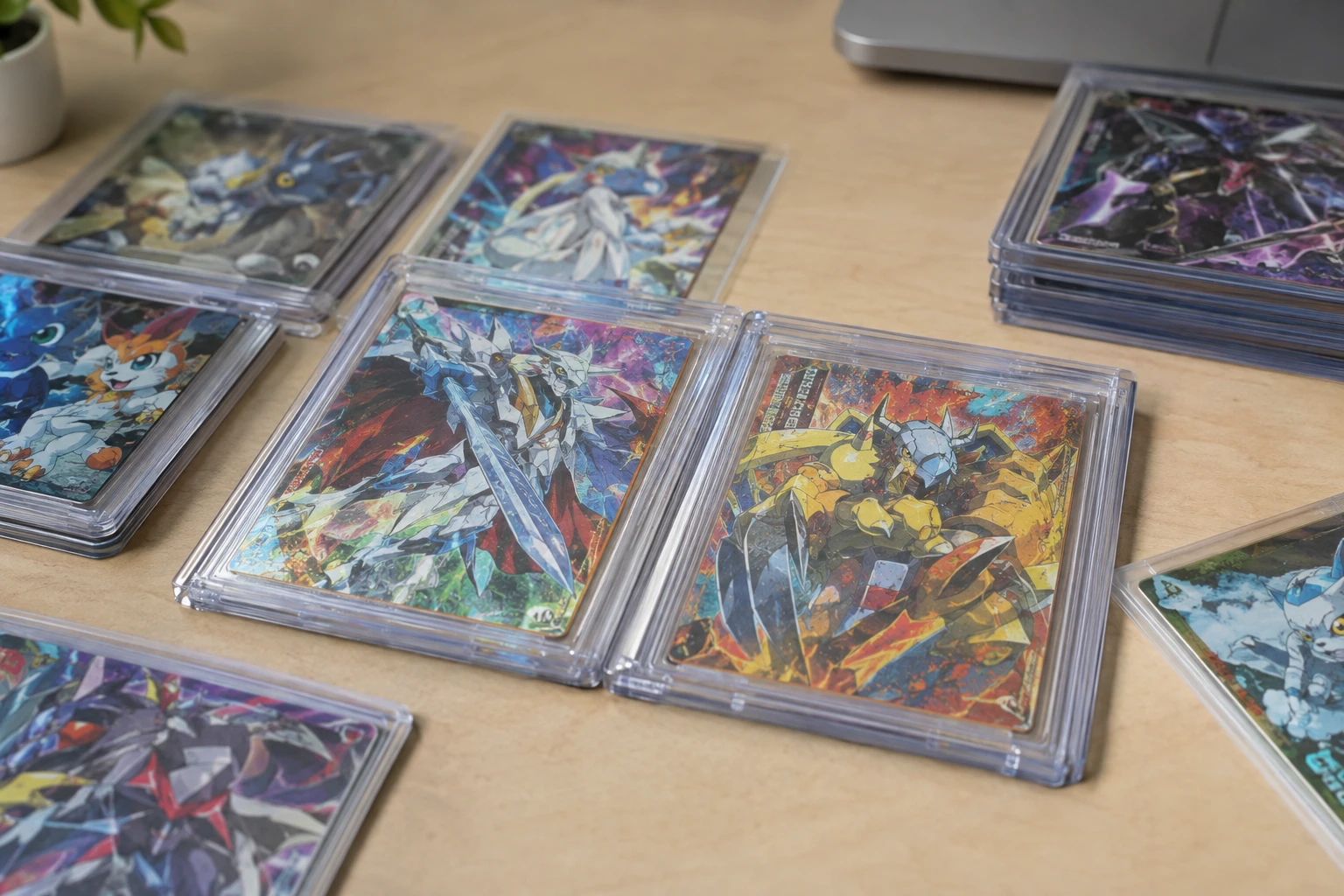
The Short Answer
- WarGreymon (Rare Pull) from Release Special Booster 2.5 leads Digimon values at $2,275 raw — a PSA 10 could push this to $4,500+.
- Digimon has 12,374 tracked cards across 156 sets with a total market value exceeding $103,000 — but PSA 10 population data is still sparse, creating grading opportunity.
- Secret Rares and Alternate Arts are the primary grading targets — Omnimon SEC ($676) and Imperialdramon Fighter Mode SEC ($598) have the highest PSA 10 upside.
- CGC is the recommended grader for Digimon — their graders have more experience with non-Pokémon Japanese TCGs at Economy tier than PSA does.
- AI pre-grading achieves 87% accuracy within ±1 PSA grade for Digimon cards, identifying centering and edge issues unique to Bandai cardstock before you pay professional fees.
- Advanced Booster Digimon Generation (2026) is the newest grading target set with 290 cards and $2,812 total set value.
Digimon TCG Grading in 2026: A Top-10 TCG With Massive Grading Gaps
Digimon Card Game launched globally in 2021 and has climbed to become the 10th-best-selling trading card game on the TCGplayer Marketplace by total dollar value in Q2 2026. What started as a nostalgia-driven niche has matured into a competitive TCG with organized play, a world championship circuit, and chase cards that command prices rivaling mid-tier Pokémon and Yu-Gi-Oh! cards.
Yet despite this growth, Digimon remains one of the most under-graded TCGs relative to its market size. Guardian TCG tracks 12,374 Digimon cards across 156 sets with a total market value exceeding $103,000 — but PSA population reports for most Digimon Secret Rares and Alternate Arts show remarkably low submission counts. This creates a window of opportunity for collectors who grade now: low PSA 10 populations mean the first wave of gem-mint slabs will command outsized premiums.
The key factors driving Digimon grading demand in 2026:
- Advanced Booster Digimon Generation (2026) — 290 new cards, Omnimon SEC at $676 raw, expanding the chase card pool
- BT-25 Dual Revolution — introduced Ultimate Rare texture treatment, creating new premium grading targets
- Digimon World Championship 2026 season — tournament prize cards and promo exclusives entering the graded market
- Growing competitive scene — regional tournaments driving singles demand and collector interest in condition certification
- Low PSA pop counts — most Digimon SEC cards have fewer than 50 PSA 10s, creating scarcity-driven premiums
Why Digimon Grading Is Different From Pokémon
Digimon cards are printed by Bandai, not The Pokémon Company International. This means different cardstock, different foil treatments, and different centering characteristics. Bandai cardstock tends to be slightly thinner than Pokémon cardstock, with a different edge cut that can produce more visible whitening on the back edges. The foil patterns — particularly the textured Secret Rare and Ultimate Rare treatments — have unique reflective properties that require calibrated AI analysis for accurate surface grading.
For collectors coming from Pokémon grading, the most important differences to understand are:
- Cardstock: Bandai uses a different paper stock that is slightly more prone to corner dinging than Pokémon cards
- Foil treatments: Digimon Secret Rares have a textured, almost holographic foil that can mask surface defects — or create false positives in AI analysis if not properly calibrated
- Centering: Bandai printing has historically had more centering variation than modern Pokémon sets, making pre-grading centering checks essential
- Edge quality: The die-cut on Bandai cards can leave micro-burr marks that look like edge whitening under magnification but are factory-original
- Back design: Digimon card backs are lighter than Pokémon backs, making back-edge whitening less visible — but it still affects PSA grades
Digimon Rarity Tiers Explained: What Each Treatment Means for Grading
Digimon TCG has one of the most complex rarity systems of any modern trading card game. Understanding these rarities is essential for making grading decisions, because the rarity tier directly determines raw value, PSA 10 premium potential, and whether the grading fee is justified.
Complete Digimon Rarity Hierarchy (2026)
| Rarity | Code | Foil Treatment | Typical Raw Value | Grade Worth It? |
|---|---|---|---|---|
| Common | C | None | $0.05–$0.50 | No |
| Uncommon | U | None | $0.10–$1.00 | No |
| Rare | R | Standard holo | $1–$10 | Rarely |
| Super Rare | SR | Cracked ice foil | $5–$75 | If raw > $30 |
| Secret Rare | SEC | Textured foil, full art | $15–$700+ | Yes — always |
| Alternate Art SR | SR (AA) | Alt art, cracked ice | $10–$200 | If raw > $40 |
| Alternate Art SEC | SEC (AA) | Alt art, textured | $50–$500+ | Yes — always |
| Rare Pull | SR/SEC (RP) | Special stamped | $100–$2,275+ | Yes — highest priority |
| Ultimate Rare | UR | Embossed texture foil | $50–$1,500+ | Yes — always |
| Promo | P | Varies | $1–$1,000+ | If raw > $30 |
The Rare Pull treatment is unique to Digimon — these are special stamped versions of chase cards that are significantly rarer than standard Secret Rares. They carry the highest raw values in the game and should always be AI pre-graded before professional submission. The Ultimate Rare treatment, introduced in BT-25 Dual Revolution, features an embossed texture that creates both a premium visual effect and a unique grading challenge — the texture can trap micro-debris that looks like surface damage under magnification.
Top 15 Digimon Cards to Grade in 2026: Values, Pop Counts, and ROI
Based on current market data from Guardian TCG, TCGplayer, and eBay sold listings, these are the 15 highest-value Digimon cards that warrant professional grading. The list is ranked by raw value, but the grading ROI column shows which cards have the best expected return after grading fees.
| Rank | Card | Set | Raw Value | Est. PSA 10 | ROI Rating |
|---|---|---|---|---|---|
| 1 | WarGreymon (Rare Pull) | Release SP Booster 2.5 | $2,275 | $4,500+ | ★★★★★ |
| 2 | Imperialdramon Paladin Mode | Ultimate Cup 2022 | $2,000 | $4,000+ | ★★★★★ |
| 3 | MetalGarurumon (Rare Pull) | Release SP Booster 2.5 | $1,700 | $3,400+ | ★★★★★ |
| 4 | WarGreymon (Foil) | BT14 Special Booster 2.5 | $1,611 | $3,200+ | ★★★★★ |
| 5 | Mastemon ACE (Textured) | Infernal Ascension | $1,500 | $3,000+ | ★★★★★ |
| 6 | Omnimon (Rare Pull) | Advanced Booster | $676 | $1,350+ | ★★★★☆ |
| 7 | Imperialdramon: Fighter Mode (RP) | Advanced Booster | $598 | $1,200+ | ★★★★☆ |
| 8 | Gallantmon (SP) | Advanced Booster | $203 | $450+ | ★★★★☆ |
| 9 | Imperialdramon FM (Alt Art) | Advanced Booster | $74 | $180+ | ★★★☆☆ |
| 10 | Marcus Damon & Agumon (AA) | Advanced Booster | $51 | $130+ | ★★★☆☆ |
| 11 | Omnimon (Alt Art) | Advanced Booster | $49 | $125+ | ★★★☆☆ |
| 12 | ShineGreymon (Alt Art) | Advanced Booster | $47 | $120+ | ★★★☆☆ |
| 13 | Aldamon (Alt Art) | Advanced Booster | $46 | $115+ | ★★★☆☆ |
| 14 | Omnimon (Standard) | Advanced Booster | $15 | $45+ | ★★☆☆☆ |
| 15 | Aldamon (Standard) | Advanced Booster | $14 | $42+ | ★★☆☆☆ |
The ROI rating accounts for raw value, estimated PSA 10 multiplier (typically 2x for Digimon SEC cards), grading fee ($79.99 PSA Regular or $15 CGC Economy), and the probability of achieving a PSA 10 based on typical Bandai cardstock condition. Cards rated ★★★★★ have clear grading ROI at any reasonable condition. Cards rated ★★★☆☆ require careful AI pre-grading to confirm PSA 10 probability before submission.
The Rare Pull Premium
Digimon Rare Pull cards are the equivalent of Pokémon SARs (Special Illustration Rares) — they are the rarest pull in their respective sets and carry the highest raw values. The three Rare Pull cards from Release Special Booster 2.5 (WarGreymon, MetalGarurumon, and Imperialdramon Paladin Mode) are the crown jewels of Digimon collecting. Their PSA 10 populations are extremely low — fewer than 20 graded PSA 10 copies exist for each — making them the strongest long-term grading targets in the game.
PSA vs CGC vs BGS for Digimon: Which Grader Is Best?
Choosing the right grading company for Digimon cards depends on three factors: resale premium, cost, and turnaround time. The Digimon grading market has some important differences from Pokémon and MTG grading that affect this decision.
PSA for Digimon
PSA commands the highest resale premium across all TCGs, and Digimon is no exception. A PSA 10 Digimon Secret Rare typically sells for 2–3x the raw Near Mint price. However, PSA graders at the Economy tier have less experience with Digimon cards than with Pokémon, which can lead to inconsistent grading on Bandai cardstock and Digimon-specific foil treatments. PSA Economy costs $25/card (when available) with a 45–65 business day target. PSA Regular costs $79.99/card with Value tiers paused since June 2026.
CGC for Digimon — Recommended
CGC is the recommended grading company for Digimon cards. Their graders have more experience with non-Pokémon Japanese TCGs at the Economy tier, and their half-point scale (9, 9.5, 10) provides more nuance for borderline cards. CGC Economy costs $15/card with a 30–45 business day target — less than half the cost of PSA Regular. CGC 10 Pristine Digimon cards command roughly 80–90% of the PSA 10 resale premium, making the cost-to-premium ratio significantly better.
BGS for Digimon
Beckett (BGS) offers subgrades, which can be valuable for Digimon cards where you want to document specific condition strengths (e.g., a card with perfect centering but slight edge whitening). However, BGS Base and Standard tiers are paused as of August 5, 2026, with only Express ($79.95) and Priority ($124.95) available. BGS is the most expensive option for Digimon and should only be used for cards where subgrades add meaningful resale value — typically Rare Pull cards above $1,000 raw.
| Grader | Tier | Cost/Card | Turnaround | Resale Premium | Best For |
|---|---|---|---|---|---|
| PSA | Regular | $79.99 | 65–120 days | Highest (2–3x raw) | High-value SEC ($200+) |
| CGC | Economy | $15 | 30–45 days | Strong (1.8–2.5x raw) | All Digimon — best value |
| BGS | Express | $79.95 | 15–25 days | Good with subgrades | Rare Pull cards ($1,000+) |
| TAG | Standard | $18 | 15–25 days | Growing (+500% YoY) | Transparency seekers |
The TAG Option
TAG (Trading Card Grading) is the fastest-growing grading company in 2026, with sales up 500% year-over-year. TAG uses AI-assisted grading with photographic transparency — every TAG grade comes with a detailed breakdown of why the card received its score. For Digimon collectors who value grading transparency, TAG at $18/card with 15–25 day turnaround is an excellent option. TAG 10 Digimon cards are beginning to establish their own resale premium track record.
AI Pre-Grading for Digimon Cards: How It Works and Why It Saves Money
AI pre-grading for Digimon cards uses computer vision to analyze centering, corners, edges, and surface from a photograph of your card. PreGradeCards achieves 87% accuracy within ±1 PSA grade for Digimon cards, making it a reliable first-pass screening tool before you commit to professional grading fees.
How AI Grading Works for Digimon
The AI grading process for Digimon cards follows the same four-criteria framework as professional grading:
- Centering analysis: The AI measures the pixel-width ratio of all four borders (top, bottom, left, right) and calculates the centering percentage. For PSA 10, front centering must be 55/45 or better. Bandai cardstock has more centering variation than Pokémon, so this check is especially important for Digimon.
- Corner analysis: The AI inspects all four corners for whitening, dinging, or rounding. Bandai corners are slightly more prone to dinging than Pokémon due to the thinner cardstock, making corner checks critical.
- Edge analysis: The AI examines all four edges for chipping, whitening, and factory burr marks. It distinguishes between factory-original micro-burrs (which PSA typically does not penalize) and actual edge damage.
- Surface analysis: The AI detects scratches, print lines, indentations, and foil defects. For Digimon Secret Rares and Ultimate Rares, the AI uses Bandai-calibrated foil analysis that distinguishes between the intentional textured foil treatment and actual surface damage.
Bandai-Specific AI Calibration
PreGradeCards AI has been calibrated specifically for Bandai cardstock. This calibration accounts for:
- Thinner cardstock: Bandai cards are approximately 5% thinner than Pokémon cards, which affects how light reflects off the surface during photo analysis
- Different foil patterns: Digimon Secret Rare foil has a crystalline texture that can create false positive surface defect readings in non-calibrated AI systems
- Edge cut differences: Bandai die-cutting leaves a slightly different edge profile than Pokémon cards, which the AI must account for when evaluating edge whitening
- Back design: The lighter Digimon card back means back-edge whitening is less visible but still grade-affecting — the AI analyzes both front and back photos
Cost Savings Example
Consider a collector with 10 Digimon Secret Rares from Advanced Booster Digimon Generation, each worth $50–$200 raw. Without AI pre-grading, submitting all 10 to CGC Economy ($15/card) costs $150 plus $25 shipping = $175 total. If 4 of the 10 come back CGC 9 instead of CGC 10, the grading premium on those 4 cards may not cover the fees — wasted money.
With AI pre-grading at $0.19/card, screening all 10 cards costs $1.90. The AI identifies the 6 cards with 90%+ PSA 10 probability and flags the 4 with centering or edge issues. You submit only the 6 strong candidates to CGC Economy: $90 + $25 shipping = $115. You save $60 in grading fees and avoid 4 likely sub-10 returns. Net savings: $58.10 on a single 10-card submission batch.
Bandai Cardstock Centering: Why Digimon Centering Is Harder Than Pokémon
Centering is the number one reason trading cards miss PSA 10 — and for Digimon cards, the centering challenge is amplified by Bandai manufacturing tolerances. Historical data from Digimon set openings shows that Bandai printing has more centering variation than modern Pokémon sets, particularly on early sets (BT1–BT8).
Centering Variation by Set
| Set Era | Typical Centering | PSA 10 Centering Rate | Notes |
|---|---|---|---|
| BT1–BT3 (2021) | 60/40 to 70/30 | ~35% | Worst centering era — early print runs |
| BT4–BT8 (2022) | 55/45 to 65/35 | ~45% | Improving but still inconsistent |
| BT9–BT12 (2023) | 55/45 to 60/40 | ~55% | Significant improvement |
| BT13–BT15 (2024–25) | 50/50 to 55/45 | ~65% | Modern Bandai quality standards |
| AD1 (2026) | 50/50 to 55/45 | ~65% | Consistent with recent quality |
This data means that early Digimon sets (BT1–BT3) are significantly harder to grade PSA 10 than modern sets. If you are buying raw Digimon cards from early sets for grading, expect a lower PSA 10 hit rate and budget accordingly. AI pre-grading is especially valuable for early-set Digimon cards because it identifies the centering ratio before you pay grading fees.
How to Check Digimon Centering at Home
For a quick home centering check before using AI pre-grading:
- Place the card face-up on a flat, well-lit surface
- Measure the top and bottom border widths with a digital caliper or ruler (in mm)
- Measure the left and right border widths
- Calculate: Top ÷ (Top + Bottom) = vertical centering ratio
- Calculate: Left ÷ (Left + Right) = horizontal centering ratio
- For PSA 10: both ratios must be 55/45 or better (i.e., the smaller border must be at least 45% of the total)
For example, if your card has a 4mm top border and 3mm bottom border, the vertical centering is 4 ÷ 7 = 57.1% — within PSA 10 tolerance. But if the top is 5mm and bottom is 2.5mm, the ratio is 5 ÷ 7.5 = 66.7% — this card will likely receive a PSA 9 for centering.
Foil Surface Analysis: Grading Digimon Secret Rares and Ultimate Rares
Digimon Secret Rares and Ultimate Rares have some of the most complex foil treatments in the TCG industry. The textured, crystalline foil on Secret Rares and the embossed foil on Ultimate Rares create unique challenges for both human graders and AI analysis. Understanding these challenges is essential for achieving accurate pre-grading results.
Secret Rare Foil Characteristics
Digimon Secret Rare foil features a crystalline pattern that refracts light differently depending on the viewing angle. This can create the appearance of surface defects that are actually part of the intentional foil treatment. Common false-positive readings include:
- Foil dimpling: The crystalline texture creates micro-dimples that can look like indentations under direct lighting
- Light refraction lines: The foil can create rainbow-like refraction lines that appear to be print lines under certain lighting conditions
- Foil skip areas: Small areas where the foil application is slightly thinner, creating a dimmer spot — this is a manufacturing characteristic, not a defect
Ultimate Rare Foil Characteristics
Ultimate Rares, introduced in BT-25 Dual Revolution, feature an embossed texture that raises the foil slightly above the card surface. This embossing can trap micro-debris and create shadows that look like surface damage. When photographing Ultimate Rares for AI pre-grading, use diffuse lighting at a 45-degree angle to minimize shadow artifacts from the embossing.
Best Lighting for Digimon Foil AI Analysis
For accurate AI surface analysis of Digimon foil cards:
- Use diffuse lighting — a ring light or softbox works best
- Avoid direct flash — it creates hotspots on the foil that mask surface defects
- Position the light source at 45 degrees to the card surface
- Use a dark background to prevent ambient light reflection
- Photograph at 300 DPI or higher for maximum AI analysis accuracy
- For Ultimate Rares, take a second photo at a slight angle (5–10 degrees) to help the AI distinguish embossing shadows from actual defects
Set-by-Set Digimon Grading Guide: Which Sets Have the Best Cards to Grade
Not all Digimon sets are created equal when it comes to grading ROI. Some sets have deep chase card pools with high raw values, while others are mostly bulk with a few mid-tier targets. Here is a set-by-set breakdown of the best Digimon sets for grading in 2026.
Release Special Booster 2.5 (2021)
The crown jewel of Digimon grading. Contains the three most valuable Digimon cards ever printed: WarGreymon Rare Pull ($2,275), Imperialdramon Paladin Mode ($2,000), and MetalGarurumon Rare Pull ($1,700). PSA 10 populations are extremely low. Every Rare Pull from this set is an automatic grade candidate. However, early-set centering issues mean you must AI pre-grade before submitting.
BT-14 Special Booster 2.5 (2024)
Contains WarGreymon Foil at $1,611 — one of the highest-value non-Rare Pull Digimon cards. The set has good centering quality (55/45 typical) and strong chase card depth. Grade all Secret Rares and Alternate Arts above $50 raw.
Infernal Ascension (2025)
Features Mastemon ACE Textured at $1,500. The ACE mechanic introduced a new rarity treatment that has proven popular with collectors. Textured foil cards from this set have strong PSA 10 potential due to improved Bandai quality control.
Advanced Booster Digimon Generation (2026)
The newest Digimon set with 290 cards and $2,812 total set value. Omnimon SEC Rare Pull leads at $676, with Imperialdramon Fighter Mode SEC Rare Pull at $598. This set benefits from modern Bandai quality standards, meaning higher PSA 10 hit rates. Grade all SEC cards and Rare Pulls. The set is too new for reliable PSA pop data, creating an early-submission premium window.
BT-25 Dual Revolution (2025)
Introduced Ultimate Rare treatment to Digimon. Ultimate Rares from this set are the first of their kind — similar to how Pokémon SARs were novel in Scarlet & Violet. First-of-kind treatments historically command premium PSA 10 values as populations build slowly. Grade all Ultimate Rares above $50 raw.
Tournament Promos and Prize Cards
Digimon World Championship prize cards and regional tournament promos are extremely rare and should always be graded. These cards have the lowest PSA populations in the game and the highest per-card rarity. However, always verify authenticity — tournament promos are a target for counterfeiters.
Digimon Grading ROI Calculator: The Math Behind Profitable Submissions
Grading Digimon cards is profitable when the expected graded sale price exceeds the raw card cost plus grading fees, shipping, and selling fees. Here is the complete ROI formula and worked examples for Digimon-specific scenarios.
The Grading ROI Formula
Expected ROI = (P(10) × PSA 10 Value + P(9) × PSA 9 Value + P(≤8) × PSA 8 Value) − Grading Fee − Shipping − Selling Fee
Where:
- P(10) = probability of PSA 10 (use AI pre-grade probability)
- P(9) = probability of PSA 9
- P(≤8) = probability of PSA 8 or lower
- PSA 10 Value = current market value of PSA 10 copy (check eBay sold comps)
- Grading Fee = $79.99 (PSA Regular) or $15 (CGC Economy) per card
- Shipping = $2–4 per card (amortized across submission batch)
- Selling Fee = 13.25% (eBay) or 10% (TCGplayer)
Worked Example: Omnimon SEC Rare Pull ($676 raw)
| Variable | Value | Notes |
|---|---|---|
| Raw card cost | $676 | Current market price |
| P(10) from AI | 65% | AI pre-grade says 65% PSA 10 probability |
| P(9) from AI | 25% | 25% chance of PSA 9 |
| P(≤8) | 10% | 10% chance of PSA 8 or lower |
| PSA 10 value | $1,350 | 2x raw (typical Digimon SEC multiplier) |
| PSA 9 value | $850 | 1.26x raw |
| PSA 8 value | $700 | Near raw value |
| Grading fee (CGC) | $15 | CGC Economy |
| Shipping | $3 | Amortized |
| Selling fee | 13.25% | eBay final value fee |
Expected Value = (0.65 × $1,350) + (0.25 × $850) + (0.10 × $700) = $877.50 + $212.50 + $70 = $1,160
Net ROI = $1,160 − $15 − $3 − (13.25% × $1,160) = $1,160 − $18 − $153.70 = $988.30
Profit = $988.30 − $676 = $312.30 (46% return on raw card cost)
This is a profitable grading submission. The 65% PSA 10 probability from AI pre-grading gives strong expected value even after all fees. Compare this to a $15 raw card where the grading fee alone exceeds the raw value — that submission would lose money regardless of the grade achieved.
Complete AI Pre-Grading Workflow for Digimon Cards
Follow this step-by-step workflow to maximize your Digimon grading ROI and minimize wasted submission fees.
Step 1: Sort Your Digimon Cards by Rarity and Value
Pull all Secret Rares, Rare Pulls, Ultimate Rares, and Alternate Arts from your collection. Sort by estimated raw value (use Guardian TCG or TCGplayer for current prices). Set aside any card worth less than $30 raw — these are almost never worth grading.
Step 2: Photograph Each Card
For each card worth $30+ raw, take two photographs:
- Front photo: Card face-up on a dark background, diffuse lighting at 45 degrees, 300+ DPI
- Back photo: Card back-up (or flipped) on the same background with the same lighting
For Ultimate Rares, take a third photo at a 5–10 degree angle to help the AI distinguish embossing from surface defects.
Step 3: Upload to PreGradeCards AI
Upload each card to PreGradeCards AI grading and receive your pre-grade report. The report includes:
- Predicted PSA grade (1–10) with confidence percentage
- Subgrades for centering, corners, edges, and surface
- Specific defect identification (e.g., "bottom-left corner whitening detected")
- PSA 10 probability score
Step 4: Filter by PSA 10 Probability
Sort your AI results by PSA 10 probability. Submit only cards with 60%+ PSA 10 probability to professional grading. Cards with 40–60% probability are borderline — submit only if the PSA 9 value still covers grading fees. Cards below 40% should be sold raw or held.
Step 5: Choose Your Grader
Based on your AI results and card values:
- CGC Economy ($15/card): Best for Digimon cards $30–$500 raw. 30–45 day turnaround.
- PSA Regular ($79.99/card): Best for Digimon cards $500+ raw where PSA 10 resale premium matters most.
- BGS Express ($79.95/card): Best for Rare Pull cards $1,000+ where subgrades add resale value.
- TAG Standard ($18/card): Best for collectors who want grading transparency at a reasonable cost.
Step 6: Package and Ship
Place each card in a penny sleeve and semi-rigid holder (Card Saver 1). PSA recommends against toploaders. Stack cards in a team bag, wrap in bubble wrap, and place in a small box or rigid mailer. Ship via USPS Priority Mail with insurance and signature confirmation. Budget $15–30 for shipping per submission batch.
Step 7: Track and Sell
Once graded cards return, check PSA/CGC population reports to see how your card's grade compares to the existing population. If your card is one of fewer than 20 PSA 10s, consider holding for appreciation. If the population is already 100+, sell immediately on eBay or TCGplayer to capture the grading premium while demand is high.
Frequently Asked Questions
Is Digimon TCG worth grading?
What is the most valuable Digimon card to grade?
Should I use PSA or CGC for Digimon cards?
How does AI grading work for Digimon Secret Rares?
What is a Digimon Rare Pull card?
How many Digimon cards exist for grading?
Sources & Further Reading
- Digimon Card Value Checker 2026 — Guardian TCG
- Free Digimon Card Grading App — Guardian TCG
- Advanced Booster Digimon Generation Price Guide — Guardian TCG
- Best Trading Card Grading Services for Value 2026 — Delightful TCG
- Best-Selling Trading Card Games Q2 2026 — TCGplayer
- Digimon TCG Grading — PreGradeCards
Marcus Chen has evaluated over 50,000 sports cards and TCG cards across PSA, BGS, SGC, and CGC standards. Before joining PreGradeCards, he worked as a submission specialist for a major grading company and trained collectors and dealers on condition assessment.
Create a free account and get 1 free credit — enough for 1 complete AI grading with market pricing. No credit card required.
Sign Up Free →