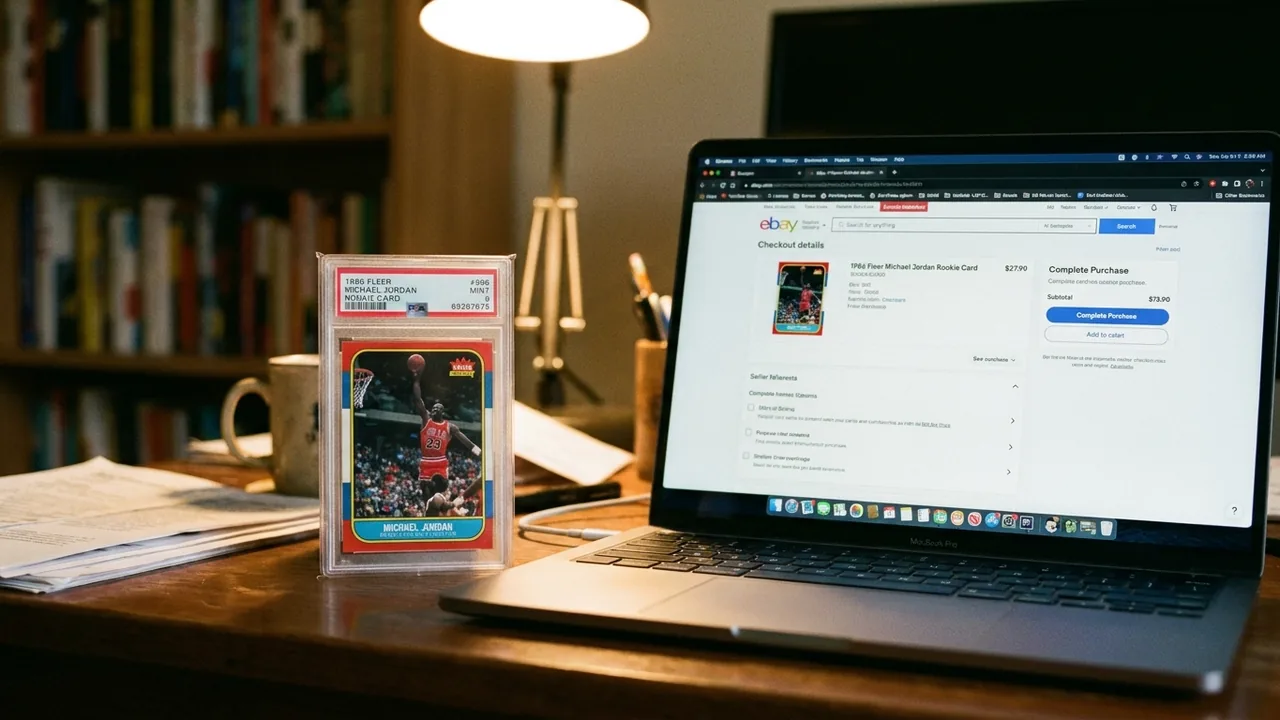
The Short Answer
- eBay checkout grading is real and live: eligible listings (raw, non-autographed, $250+, at least two photos, U.S. buyers) can be sent to PSA without the buyer ever handling the card.
- The card routes through eBay's Authenticity Guarantee first — PSA experts verify it's genuine and matches the listing before grading begins; if it fails, you get a full refund including grading fees.
- Pricing follows PSA's Value Plus tier — ~$40/card at launch with $500 max insured value and a ~20-business-day estimate; check the checkout screen for current pricing.
- No PSA account required — one is auto-created from your eBay email, and tracking happens in PSA's My Orders.
- Once graded, the sale is final — no returns. You're committing the grading fee before anyone has evaluated whether the card is worth slabbing.
- The smart play is upstream: evaluate the listing photos (or request more) before opting in. Blind-grading a card sight-unseen is how buyers turn a good deal into a fee.
How eBay's PSA Checkout Grading Actually Works
The feature launched at the end of March and it's genuinely frictionless — arguably too frictionless. When you buy an eligible raw card on eBay, a grading option appears at checkout. Opt in, and this is the journey your card takes:
- You pay for the card plus grading at checkout. One transaction — no separate PSA invoice, no forms.
- The seller ships to eBay's Authenticity Guarantee hub, not to you.
- PSA authenticators inspect the card on eBay's behalf — verifying it's genuine and accurately described in the listing. If it fails authentication or condition accuracy, you get a full refund, grading fee included.
- The card transfers directly into PSA grading — graders evaluate it on the standard 1–10 scale.
- PSA slabs it and ships it to you — encapsulated, with standard imaging and cert.
Behind the scenes, eBay auto-creates a PSA account tied to your eBay email if you don't have one (matching emails link automatically). You track the order through PSA's "My Orders" once you claim the account. The total pipeline removes three friction points — the PSA account signup, the submission form, and the extra shipping leg from you to PSA.
Which Cards Qualify
The eligibility net is deliberately narrow — this is a mid-to-high-end buyer feature, not a bulk-submission channel:
- Raw (ungraded) single cards only — no lots, no already-slabbed items.
- $250 minimum price — based on final sale price before fees and taxes. This is the gate that matters most.
- Non-autographed — autographed items are excluded.
- At least two listing photos — the listing must show enough of the card for the authenticity check to be meaningful.
- U.S. buyers and sellers — the Authenticity Guarantee hub is domestic.
The $250 floor is doing quiet work here: eBay and PSA are targeting the exact purchase size where buyers start thinking "should I grade this?" — the modern chase-card and vintage-star range where a PSA 9 or 10 meaningfully changes value.
Cost and Turnaround
At launch, checkout grading was priced through PSA's Value Plus service level at $39.99/card, with a $500 max insured value and an estimated 20-business-day grading turnaround — plus PSA ran free return shipping for the launch window. PSA's pricing schedule has shifted since (Value Plus moved to $49.99 in the February 2026 update), so always confirm the live price on the checkout screen — the fee shown there is what you'll pay.
| Component | eBay checkout grading | Traditional route |
|---|---|---|
| Grading fee | Value Plus tier (~$40–50) | Same tier, $49.99 |
| Shipping legs | Seller→hub→PSA→you (bundled) | Seller→you, you→PSA, PSA→you |
| PSA account | Auto-created / auto-linked | Required |
| Submission form | None | Full form + packaging rules |
| Authenticity check | Included (eBay AG) | None until PSA grades it |
| Returns after grading | None — sale is final | Normal eBay return rules apply |
One honest benefit buried in the flow: the card never detours to your house first. Buying raw, receiving it, then mailing to PSA adds 1–2 weeks and two extra handling/transit risks. The checkout route skips both — the card goes from authentication straight into the grading queue.
Why eBay and PSA Built This (Follow the Incentives)
Understanding the feature's design tells you who it's really for. eBay's trading card category is one of its largest collectible verticals, and raw cards at $250+ sit in an awkward spot: too expensive for casual buyers to feel safe, too niche to justify a full vault-and-consignment model. Attaching PSA grading at checkout solves eBay's problem on both ends — buyers get a slabbed, authenticated card delivered to their door, and eBay deepens the Authenticity Guarantee relationship it already runs on graded cards.
For PSA, the play is volume capture at the moment of intent. Before this feature, the grading funnel had a leak: a buyer would win a raw card intending to grade it, then procrastinate, change their mind, or discover the card wasn't gem-worthy on arrival. By embedding the option at checkout, PSA captures the submission before any of that can happen — the fee is committed at the emotional peak of the purchase.
Neither incentive is sinister — a streamlined path to grading has real value for buyers who would have graded anyway. But notice what's deliberately absent: any step that asks whether grading this specific card is a good idea. The feature optimizes for submissions completed, not submissions won. Keeping that framing in mind is the whole reason the math section below exists.
What the $250 threshold tells you
The eligibility floor wasn't chosen randomly. Below ~$250, grading fees are proportionally ruinous — a $50 fee on a $150 card needs a near-certain premium to break even. Above it, the PSA 9/10 premiums on modern chase and vintage stars can absorb the fee with room. The feature is tuned to the value band where grading is plausible — not where it's guaranteed to pay.
The Catch: You're Grading Blind
Here's the structural problem nobody at eBay or PSA will tell you: the convenience exists to get more cards graded — not to help you grade the right cards. At checkout, you're committing a $40+ grading fee on the basis of two listing photos taken to sell the card, not to reveal its flaws.
What the authenticity inspection actually covers: is the card real, and does it match the listing description. What it does not cover: whether the centering passes 55/45, whether there's a hairline print line across the chrome, whether the top-right corner has whitening the seller's lighting conveniently hid. Nobody in the pipeline scores the card's grade-worthiness before your $40–50 is committed.
The asymmetry is brutal. If the card comes back PSA 9 instead of 10 — common on modern stock even when it looks clean — you've paid the fee, you can't return it, and on a $250–400 card the PSA 9 may sell for less than raw-plus-fee. PSA wins the fee either way; eBay wins a stickier transaction; the only unprotected party is you.
The Math: When Opting In Actually Pays
Run this three-question check before clicking the grading option:
- What does this card sell for at each grade? Look up recent eBay sold comps at PSA 8, 9, and 10 — not the listing's implied value. If PSA 9 comps sit below your purchase price plus ~$50, the only profitable outcome is a 10.
- What are the realistic odds of a 10? Modern print runs gem at well under 10% at PSA across the hobby. Photos alone can't confirm centering ratios or surface flaws — and sellers of raw $250+ cards who knew it would gem usually already graded it themselves.
- Would the graded card at the likely grade cost less than this raw + fee? If a PSA 9 of the card sells for $320 and you're paying $275 + $50 fee, buying the slab directly is the same price with zero risk.
When it makes sense: the rare cases where listing photos are genuinely high-res enough to verify centering and surface, the card's PSA 10 premium dwarfs the fee (think $250 raw → $1,500+ gem), or the card is a personal-collection keeper where the grade is secondary to authentication and encapsulation.
When it doesn't: any card where a 9 kills the deal — which, honestly, is most modern $250–500 raw listings.
A worked example
Say you're buying a modern basketball parallel at $290 raw, and checkout offers grading at $49.99:
| Outcome | Slab sells for | Your all-in cost | Result |
|---|---|---|---|
| PSA 10 | $800 | $340 | +$460 |
| PSA 9 | $310 | $340 | −$30 |
| PSA 8 or lower | $180–240 | $340 | −$100+ |
If this card gems, say, one time in four — a generous rate for modern chromium — the expected value of opting in is negative. The eBay feature doesn't change that math; it just makes ignoring the math easier. The threshold question is never "is this card nice?" It's "does this specific copy clear centering, surface, and corners at PSA 10 standards often enough that the EV works?"
Smarter Alternatives to Blind Checkout Grading
Option 1 — screen the listing first. Ask the seller for straight-on, high-resolution photos of front and back. If they decline or stall on a $250+ card, that's your answer. Run what you can see through an AI pre-grade — even listing photos reveal centering ratios, edge whitening, and obvious surface issues well enough to flag a likely sub-9.
Option 2 — buy raw, grade after inspection. Skip the checkout option, receive the card, evaluate it in hand (or pre-grade it), and only then submit — through PSA direct, GameStop's drop-off, or wherever fits the card's value. You lose a week and gain full information. If the card's a dud, normal eBay return protection still applies — a door that closes permanently once checkout grading runs.
Option 3 — skip raw entirely. If the goal is a graded copy, compare raw+fee against buying the slab directly. At the $250–500 band this is frequently the better deal — the seller of a raw card is often betting you'll pay for the lottery ticket they didn't want to buy.
The grade calculator does this exact math — plug in raw price, grading fee, and grade-level comps and it returns the break-even grade you need. Thirty seconds of arithmetic is the whole edge here.
Frequently Asked Questions
How does eBay PSA grading at checkout work?
When you buy an eligible raw card ($250+, non-autographed, 2+ photos, U.S.), you can add PSA grading at checkout. The seller ships to eBay's Authenticity Guarantee hub, PSA authenticates it, then grades and slabs it before shipping to you — the card never passes through your hands ungraded.
How much does eBay PSA grading cost?
It launched through PSA's Value Plus tier at $39.99/card with a $500 max insured value and ~20 business day turnaround. PSA raised Value Plus to $49.99 in February 2026, so confirm the live price shown at checkout — that's the price you'll pay.
Do I need a PSA account to grade through eBay?
No. If your eBay email doesn't match an existing PSA account, one is created automatically and you'll get claim instructions. After that, tracking appears in PSA's My Orders.
Can I return a card after eBay checkout grading?
No — once the card is authenticated and graded, the transaction is final. The only exit is a full refund if the card fails authentication or doesn't match the listing before grading begins.
What cards are eligible for eBay PSA grading?
Individual raw (ungraded), non-autographed trading cards priced at $250 or more before fees, with at least two photos in the listing, purchased by U.S. buyers from U.S. sellers.
Is eBay checkout grading worth it?
Only when the math works: the card's realistic grade (verified from photos) must produce a graded premium larger than the ~$50 all-in fee, and a sub-9 result must not wipe out your purchase value. For most modern cards, pre-screening the photos first or buying the already-graded copy is the safer play.
Sources & Further Reading
- PSA: PSA Grading — Now Built Into eBay Checkout
- All Vintage Cards: New eBay Feature Lets You Grade Raw Cards with PSA at Checkout
- Every Card a Story: You Can Now Send Cards Directly from eBay for Grading
- PSA Service Levels & Pricing
- PSA Pricing and Turnaround Updates (February 2026)
Emily Rodriguez analyzes grading cost, population, and pricing data across PSA, BGS, SGC, CGC, and TAG. She built the PreGradeCards ROI calculator and submission planner, and her market reports on grading backlog, turnaround times, and slab premiums are cited by collectors and dealers worldwide.
With submission floors rising, pre-screening is no longer optional. Use our AI Pre-Grade Calculator to score a card's PSA 10 odds before you pay, and the Submission Planner to pick the right tier.