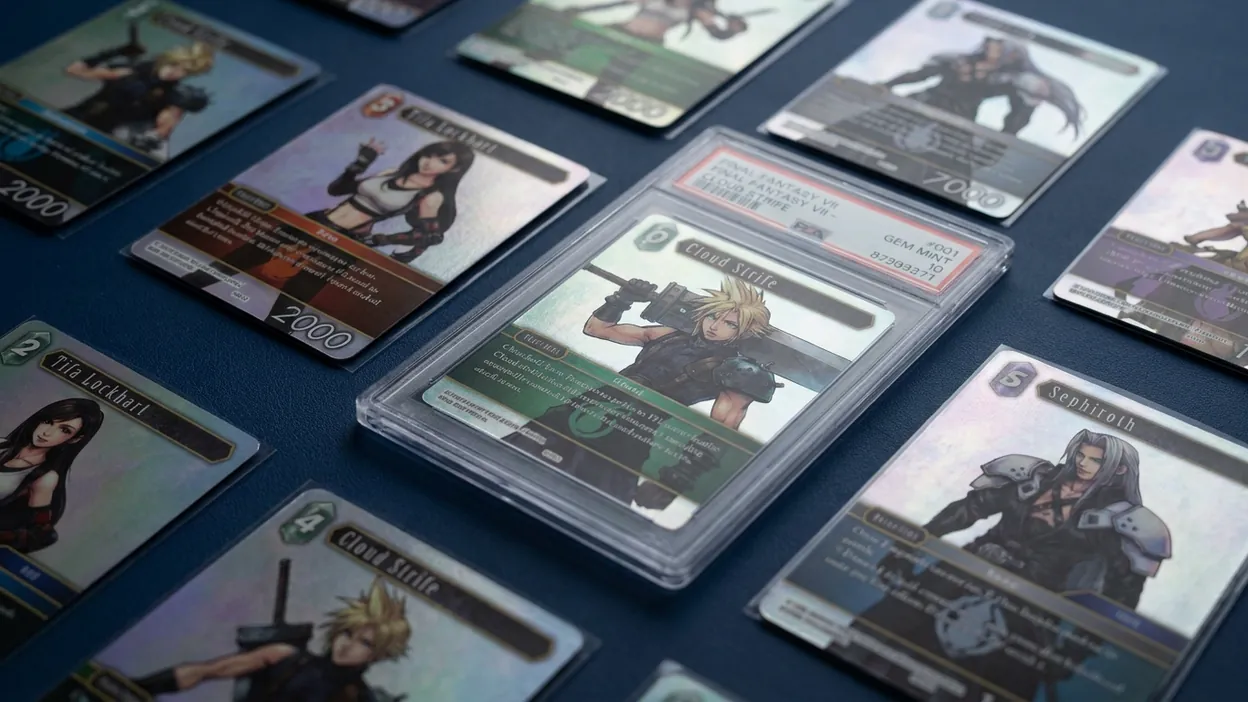
The Short Answer
- Treatment beats rarity in FFTCG — the #1 card is a Signature Hero at ~$1,168, while median Legends sit near $3.
- Full Art foils are the set chases — Yuffie Full Art Legend ~$800, Terra Full Art Signature ~$672.
- Opus I (2016) foils carry vintage premiums — the launch set's foil Legends are increasingly scarce in high grade.
- One foil per pack — foil Rare/Hero/Legend versions are the grading population that matters.
- Worlds/Nationals trophy cards are the game's grails — stamped 2017–2018 championship cards are effectively priceless.
- CGC fits most FFTCG submissions — Square Enix stock grades consistently; reserve PSA for $400+ signature-tier cards.
Final Fantasy TCG Grading in 2026: A Decade-Old Game With Modern Chase Cards
The Final Fantasy Trading Card Game launched in October 2016 from Square Enix, and a decade later it remains a steady, nostalgia-driven market. With 38+ sets (the Opus series plus special releases) and more than 5,200 tracked singles, FFTCG has one of the deepest card pools of any anime-style TCG.
What makes FFTCG unusual for grading: the rarity stamp barely predicts value. Market analysis shows the rarity ladder is nearly flat — Common $0.11, Rare $0.18, Hero $0.33, Legend $2.94 median — yet a Signature Hero tops $1,168 and a signed Rare outsells nearly every Legend. Value lives in the treatments: Full Art, Signature, stamped promos, and foils of popular characters.
This means FFTCG grading decisions are character-and-treatment-driven, not rarity-driven. Cloud, Sephiroth, Tifa, Lightning, Y'shtola, Terra, and Yuna cards in premium treatments are the grading population — everything else is bulk.
Why FFTCG Grading Makes Sense Now
- 74% of singles trade under $1 — the value is extremely concentrated, so correct card selection is everything
- Opus I foils are drying up — 2016 first-print foils in gem condition are genuinely scarce
- Signature/Full Art treatments command graded premiums — high-value treatments benefit most from slab authentication
- Low graded populations — FFTCG never had a grading boom, so PSA 10 pops are small relative to demand
- Character collectors, not players — buyers want display-grade slabs of their favorite characters
FFTCG Rarities and Treatments Explained
FFTCG prints a base rarity on every card — C, R, H (Hero), or L (Legend) — plus Starter (S) and Promo (PR) marks. But the real value drivers are the treatments: foil versions, Full Art editions, and Signature variants.
Base Rarity Ladder
| Rarity | Median | Ceiling | Grade Worth It? |
|---|---|---|---|
| Common (C) | $0.11 | $150 | Only signature/FA treatments |
| Rare (R) | $0.18 | $568 | If signed or top character foil |
| Hero (H) | $0.33 | $1,168 | Full Art / Signature versions |
| Legend (L) | $2.94 | $800 | Foils of top characters + Full Arts |
| Starter (S) | $0.66 | $148 | Rarely |
| Promo (PR) | $1.26 | $199+ | Event-stamped promos — always |
The Treatments That Actually Matter
- Foil: Every card has a non-foil and foil version — one foil per pack. Foil Legends of marquee characters are the baseline grading tier ($20–$200+).
- Full Art: Edge-to-edge alternate artwork, typically on Legend/Hero cards. The chase of most modern sets — Yuffie FA ~$800, Tifa FA ~$332.
- Signature: Stamped character-signature treatments on select cards. Yuna Signature Hero ~$1,168, Terra FA Signature ~$672 — the absolute top of the regular market.
- Stamped promos: Nationals/Worlds/Fan Fair stamped prize cards. The 2018 Worlds Cloud winner card and Sephiroth finalist card are unique trophy items.
Reading FFTCG Card Codes
FFTCG codes encode set and rarity: 1-186L = Opus I, card 186, Legend. The first number is the Opus set, the letter is the rarity. Knowing this lets you instantly place any card in its set context — critical for spotting Opus I foils in unsorted collections.
Which Final Fantasy TCG Cards Deserve Grading
With 74% of the market under $1, discipline matters. These are the grading populations:
Automatic Grade Candidates
- Signature treatments — Yuna Signature ($1,168), Terra FA Signature ($672), any signed variant $100+.
- Full Art Legends of marquee characters — Yuffie FA ($800), Tifa FA ($332), and similar.
- Opus I foils of iconic characters — Lightning, Cloud, Sephiroth foil Legends from the 2016 launch set.
- Stamped event promos — Nationals, Worlds, Fan Fair, and convention-exclusive cards.
- Foil staples $30+ — tournament-playable foil Legends and Heroes.
Conditional Candidates
- Non-foil Legends of A-list characters — grade only if pack-fresh and $15+ raw.
- Full Art non-foil versions — worth it above $40–$50 raw.
- Misprints and early-run errors — Opus I wave-1 full-art foil errors are documented rarities; authentication adds real value.
Skip
- All non-foil C/R bulk and most non-foil H
- Modern-set foils of minor characters under $30
- Starter-deck cards (S) unless exceptionally scarce
PSA vs CGC vs BGS for Final Fantasy TCG
FFTCG is standard Square Enix TCG stock — well within every major grader's comfort zone.
| Grader | Tier | Cost | Best For |
|---|---|---|---|
| CGC | Economy | $15 | Most FFTCG $30–$400 |
| PSA | Regular | $79.99 | Signatures / Opus I foils $400+ |
| BGS | Express | $79.95 | High-value where subgrades help |
| TAG | Standard | $18 | Digital report + speed |
CGC Economy covers the bulk of grading-worthy FFTCG cards. Reserve PSA for Signature-tier and Opus I foil chase cards where the PSA label captures the widest buyer pool — character collectors shopping eBay default to PSA slabs for four-figure purchases.
AI Pre-Grading for Final Fantasy TCG Cards
PreGradeCards AI pre-grading analyzes FFTCG cards with treatment-aware surface detection — critical for a game where the grading-worthy cards are nearly all foils.
FFTCG-Specific Analysis Points
- Full Art borderless layouts: FA cards have no frame border — the AI measures centering against the printed edge trim rather than a border margin.
- Foil curvature: FFTCG foils can bow slightly. The AI weighs surface flatness appropriately and flags curl that would draw a grade penalty.
- Signature stamp detection: stamped signature elements are recognized as print features, not surface marks.
- Print-quality variance: early Opus sets show occasional print dots and foiling inconsistencies that the AI distinguishes from handling wear.
Cost Savings Example
You inherit an FFTCG collection and pull 20 foil Legends/Heroes of popular characters. Blind CGC Economy submission: 20 × $15 + $20 = $320. AI pre-grading all 20 at $0.19: $3.80. Suppose the AI flags 11 with centering, edge, or surface issues — you submit 9: $135 + $20 = $155. Net savings ~$165 and you avoid 11 likely sub-10 returns.
FFTCG Cardstock and Centering: What to Check Before Grading
Final Fantasy TCG cards are printed on standard TCG stock with a smooth semi-gloss finish. Quality is consistent in modern sets; early Opus sets (I–IV) show more variance.
Common Issues
- Centering: Modern sets typically 50/50–55/45; early Opus sets run wider. Always measure — FFTCG's colored frame borders make off-center cards obvious to graders.
- Foil bow: the single most common FFTCG defect. Check cards face-down on a flat surface — visible curl can cost a full grade.
- Edge whitening: dark frame colors make any edge wear conspicuous; inspect all four edges under angled light.
- Surface scratches on foils: FFTCG foil surfaces scratch more readily than average — check under raking light before assuming mint.
- Print defects on early sets: Opus I–II cards occasionally show print dots and roller marks; document anything unusual.
Photography Tips
Diffuse lighting, overhead 90-degree angle, dark background. For foils, add a tilted shot so the AI can map reflectivity — FFTCG's foil layer is thin and shows scratches clearly only at angle. Never use flash directly on a foil.
FFTCG Grading ROI: The Math Behind Profitable Submissions
Worked example: a Full Art Legend of a marquee character.
Worked Example: Full Art Legend ($80 raw)
| Variable | Value |
|---|---|
| Raw card cost | $80 |
| P(10) from AI | 55% |
| P(9) from AI | 30% |
| P(≤8) | 15% |
| CGC 10 value | $190 (2.4x) |
| CGC 9 value | $105 (1.3x) |
| CGC 8 value | $82 (1.0x) |
| Grading + shipping | $18 |
| Selling fee | 13.25% |
Expected Value = (0.55 × $190) + (0.30 × $105) + (0.15 × $82) = $104.50 + $31.50 + $12.30 = $148.30
Net = $148.30 − $18 − (13.25% × $148.30) = $148.30 − $18 − $19.65 = $110.65
Profit = $110.65 − $80 = $30.65 (38% return)
Profitable — driven entirely by AI-confirmed gem probability. At a blind 30% P(10) the same math goes negative. For Signature-tier cards ($500+), switch to PSA and the multiples grow: a $1,168 Signature Hero in PSA 10 can reach $2,000+.
Complete AI Pre-Grading Workflow for FFTCG Cards
Follow this step-by-step workflow for Final Fantasy TCG grading ROI.
Step 1: Sort by Treatment, Not Rarity
Pull all foils, Full Arts, Signatures, and stamped promos. Base non-foil cards below $30 are bulk regardless of the rarity stamp.
Step 2: Decode and Price
Use the card code (set-number-rarity, e.g. 1-141L) to identify the exact version. Check TCGplayer/eBay solds for the specific treatment — foil vs non-foil vs Full Art prices differ wildly.
Step 3: Check for Foil Bow
Lay each foil face-down on a flat surface. Visible curl is the #1 FFTCG grade-killer — flag it before spending on grading.
Step 4: AI Pre-Grade
Run each candidate through PreGradeCards AI grading — front and back photos, diffused light, plus a tilted shot for foils.
Step 5: Submit by Tier
- CGC Economy ($15): foils and Full Arts $30–$400
- PSA Regular ($79.99): Signatures and Opus I chase foils $400+
- BGS Express: subgrade-sensitive four-figure candidates
Step 6: Sell to Character Collectors
List graded FFTCG cards with the character name first ("PSA 10 Yuna Signature") — buyers search by character, not set. FFTCG's low graded populations mean patience usually beats quick-flipping.
Frequently Asked Questions
Is Final Fantasy TCG worth grading?
What is the most valuable Final Fantasy TCG card?
What does the card code mean on FFTCG cards?
Should I use PSA or CGC for Final Fantasy TCG?
Why is foil bow such a big deal for FFTCG?
Are Opus I Final Fantasy cards worth grading?
Sources & Further Reading
- Final Fantasy TCG Official Site — Square Enix
- FFTCG Treatment Value Analysis — Foilio
- Final Fantasy TCG Cards on TCGplayer
- FFTCG Set Lists — Trading Card Dex
Marcus Chen has evaluated over 50,000 sports cards and TCG cards across PSA, BGS, SGC, and CGC standards. Before joining PreGradeCards, he worked as a submission specialist for a major grading company and trained collectors and dealers on condition assessment.
Create a free account and get 1 free credit — enough for 1 complete AI grading with market pricing. No credit card required.
Sign Up Free →