The Short Answer
- Alpha and Beta cards are the most valuable vintage Magic cards.
- Foil cards are prone to curling, clouding, and surface scratches.
- Borderless and showcase cards require the same centering standards as regular cards.
- Reserved List cards have the strongest grading ROI due to supply caps.
- The Power Nine and dual lands are the most important Magic cards to grade.
- AI pre-screening can identify edge whitening, surface clouding, and centering issues.
Magic: The Gathering Grading Market in 2026
Magic: The Gathering is the oldest and most valuable trading card game in the world. Created by Richard Garfield and published by Wizards of the Coast in 1993, Magic has produced more than 25,000 unique cards across dozens of sets. The grading market for Magic cards is unique because it spans true vintage cards from 1993 to modern sets released every few months. The most valuable cards are from the earliest print runs and the Reserved List.
PSA, CGC, and BGS all grade Magic cards, but the market has different preferences than Pokémon or sports cards. CGC has become the dominant brand for Magic grading because of its strict standards and detailed labels. PSA is popular for collectors who want the most recognized brand. BGS is used for high-value cards because of its sub-grades. The total graded Magic card population is smaller than Pokémon but the average value per card is higher.
The Magic grading market is driven by the Reserved List, a policy that prevents Wizards of the Coast from reprinting certain cards. Reserved List cards have a fixed supply and are essential for the competitive Legacy and Vintage formats. The Power Nine and dual lands are the most important Reserved List cards. Grading these cards preserves them and makes them easier to trade in high-end transactions.
Alpha, Beta, and Unlimited Grading
The first three Magic sets are Alpha, Beta, and Unlimited. Alpha was the first print run in August 1993, with approximately 2.6 million cards printed. Beta followed a few months later with the same cards but with less rounded corners and a slightly larger print run. Unlimited was the third set and had white borders instead of black borders. Alpha and Beta are the most valuable because they are the earliest printings and have the iconic black borders.
Alpha cards have rounded corners that are different from all later Magic cards. This is a defining feature and not a defect. Beta cards have the same black borders as Alpha but with the standard corner radius. Beta cards are actually more valuable than Alpha cards for play because they can be used with card sleeves that match modern cards. However, Alpha cards are rarer and often command higher prices.
Unlimited cards are white-bordered versions of the same cards. They are more common than Alpha and Beta and are generally less valuable. However, Unlimited cards in high grades can still be valuable because the print quality in 1993 was inconsistent. Arabian Nights, Antiquities, and Legends followed Unlimited and are also considered vintage sets with significant value.
Vintage Magic cards are graded with era-appropriate standards. The 1993 card stock was thin and prone to edge wear. The black borders show corner whitening very easily. Centering was inconsistent. A PSA 8 Beta Black Lotus is considered a strong grade, while PSA 9 and 10 are extremely rare and valuable.
Power Nine and Reserved List Cards
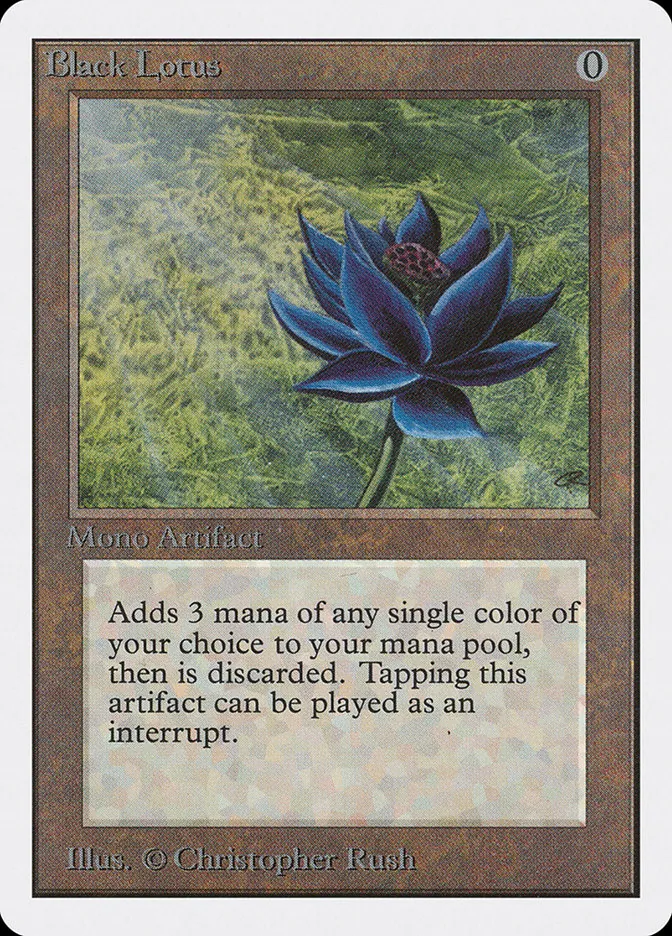
The Power Nine are the nine most powerful cards in Magic: Black Lotus, Ancestral Recall, Time Walk, Timetwister, Mox Pearl, Mox Sapphire, Mox Jet, Mox Ruby, and Mox Emerald. These cards are banned or restricted in most formats but are highly collectible. Black Lotus is the most iconic and valuable card, often called the holy grail of Magic.
The Power Nine are all on the Reserved List, which means they will never be reprinted in their original form. This supply cap drives their value. A Beta Black Lotus in PSA 9 can trade for $100,000-$500,000, and PSA 10 copies can reach seven figures at auction. Alpha Black Lotus is even rarer, and high-grade copies are among the most valuable TCG cards ever sold.
Reserved List dual lands are the next tier of valuable Magic cards. The original dual lands include Tropical Island, Underground Sea, Badlands, Taiga, Savannah, Scrubland, Volcanic Island, Bayou, Plateau, and Tundra. These cards are essential for Legacy and Vintage and are on the Reserved List. Graded dual lands in high grades are popular with collectors and players who want preserved copies for their decks.
Other important Reserved List cards include Gaea's Cradle, Mox Diamond, Lion's Eye Diamond, and Wheel of Fortune. These cards have strong demand from competitive players and collectors. The value of Reserved List cards has appreciated steadily over the past decade, making them attractive for long-term investment.
Most Valuable Magic Cards to Grade
The most valuable Magic cards are the earliest and most powerful cards. The table below shows estimated 2026 market ranges for the most important Magic cards to grade. These ranges are based on auction results and population data and can fluctuate significantly based on market trends.
| Card | Set | PSA 9 Range | PSA 10 Range | Premium |
|---|---|---|---|---|
| Black Lotus | Beta | $100,000 - $500,000 | $500,000 - $2,000,000 | ~4x |
| Ancestral Recall | Beta | $20,000 - $60,000 | $100,000 - $300,000 | ~5x |
| Mox Sapphire | Beta | $15,000 - $40,000 | $80,000 - $200,000 | ~5x |
| Tropical Island | Beta | $8,000 - $20,000 | $30,000 - $80,000 | ~4x |
| Gaea's Cradle | Urza's Saga | $2,000 - $5,000 | $8,000 - $20,000 | ~4x |
| Mana Crypt | Book Promo | $1,000 - $3,000 | $4,000 - $10,000 | ~4x |
The Beta Black Lotus is the grail of Magic card collecting. High-grade copies are extremely rare and trade for life-changing amounts. The Power Nine and dual lands are the foundation of the graded Magic market. Modern chase cards can also be valuable, but they rarely reach the heights of the vintage Reserved List staples.
PSA, CGC, and BGS Magic Grading Standards
Magic cards are graded by PSA, CGC, and BGS. The standards are the same four pillars: centering, corners, edges, and surface. However, the market has different preferences for each grader. CGC has become the most popular brand for Magic cards because of its strict standards and the detailed information on its labels. PSA is popular for collectors who want the most recognized brand. BGS is used for high-value cards because of sub-grades.
CGC is known for being strict on centering and surface. This makes CGC 10 Magic cards highly respected. Many collectors prefer CGC for vintage Magic because the strict standards match the premium nature of the cards. PSA is also widely accepted, especially for international buyers. BGS is less common but the 10 Black Label is the most valuable Magic grade when it appears.
The grading standards for Magic cards account for the unique features of vintage cards. Alpha rounded corners are not defects. Beta cards are graded on the same standard as modern cards for corners. Old card stock is expected to show some edge wear. The back of the card is evaluated but is often more forgiving than the front for vintage cards.
Centering and Corners on Magic Cards
Centering is a major issue for Magic cards. Vintage Alpha, Beta, and Unlimited cards were printed with inconsistent centering. Modern Magic cards have better quality control but still have issues. The 55/45 front centering standard for PSA 10 is the same as other TCGs, but the narrow borders on Magic cards make centering deviations very visible.
Magic cards have a black border on the front and a white border on the back for vintage cards. The black border on the front shows corner whitening very easily. A small amount of whitening on a black-bordered corner can drop the grade from PSA 10 to PSA 9. The corners on Alpha cards are rounded by design, which is not a defect but is noted by graders. Beta and later cards have the standard sharp corners that are expected to be perfect for high grades.
Edge wear is extremely common on vintage Magic cards because the 1993 card stock was thin and prone to whitening. The edges of Beta cards often show white marks even on cards that are otherwise clean. This is why high-grade Beta cards are so rare and valuable. Modern Magic card stock is thicker and more durable, but edge wear can still occur from handling and storage.
Foil, Borderless, and Showcase Cards
Magic foil cards are notorious for condition issues. The foil layer can curl, cloud, and scratch. Curling is caused by humidity and is a common problem with older foils. Clouding is a hazy appearance on the foil surface that can prevent high grades. Surface scratches are visible under direct light and are common on foils because the reflective surface shows every imperfection.
Modern Magic sets have introduced many special treatments including borderless, showcase, extended art, and textured foils. These treatments look beautiful but are often more condition-sensitive than regular cards. Borderless cards have artwork that extends to the edge, which means there is no border to protect the artwork from damage. Extended art cards have the same issue. Textured foils have raised surfaces that can be damaged by handling.
AI pre-screening is ideal for Magic foils because the surface issues can be subtle. The AI can detect curling by analyzing the card edges, clouding by analyzing the foil reflection, and scratches by analyzing the surface texture. This is especially valuable for expensive foils like serialized cards and secret lair treatments.
Modern Magic Card Grading
Modern Magic cards include everything from the 1990s through today. The most valuable modern cards are usually Reserved List staples, rare foils, and special treatments. The Commander format has driven demand for many cards that are not on the Reserved List but are popular in casual play. Cards like Rhystic Study, Smothering Tithe, and Dockside Extortionist have high demand and are worth grading in high grades.
Modern Magic cards are graded more strictly than vintage cards because the print quality is higher. A PSA 10 modern Magic card should have perfect centering, sharp corners, clean edges, and a flawless surface. The premium for PSA 10 over PSA 9 is typically 3-5x for modern chase cards. The premium is highest when the card is scarce in high grade and has strong demand.
Serialized cards are a new trend in Magic. These cards are individually numbered and have unique treatments. They are highly collectible and worth grading regardless of condition because the base value is high. The AI can identify serialized cards and account for their rarity when making grading predictions.
ROI and Investment Outlook for Graded Magic Cards
Magic card grading has strong investment characteristics because of the Reserved List and the long-term popularity of the game. Vintage Reserved List cards have appreciated steadily over the past decade. The Beta Black Lotus has increased from tens of thousands of dollars to hundreds of thousands of dollars for high grades. Dual lands and other Reserved List staples have also performed well.
The best investment strategy for Magic cards is to focus on Reserved List staples, high-end foils, and the Power Nine. These cards have a fixed supply and strong demand from both players and collectors. Modern chase cards can also be profitable but carry more risk because their long-term demand is uncertain. The Commander format has created demand for many cards that are not on the Reserved List, making the format important for modern card values.
AI pre-screening improves Magic ROI by helping collectors submit only the best cards. Because the value gap between grades is large on expensive cards, even a small improvement in submission accuracy can have a big financial impact. A collector who submits 10 Beta dual lands without pre-screening might get 3 PSA 10s. With AI pre-screening, the same collector might identify 5 strong candidates and sell the rest, improving the average grade and reducing wasted fees.
What to Submit for Magic Card Grading
Use this checklist to decide which Magic cards are worth grading in 2026.
- Submit: Power Nine, dual lands, and other Reserved List staples.
- Submit: High-grade Alpha, Beta, and Unlimited cards.
- Submit: Modern foils, borderless cards, and serialized cards of popular cards.
- Submit: Commander staples and Modern staples in high grades.
- Do not submit: Common cards or bulk cards, even in good condition.
- Do not submit: Cards with visible curling, clouding, edge wear, or corner whitening.
- Pre-screen first: Use AI or a magnifier to check surface and centering before paying grading fees.
The Magic market is relatively stable compared to sports cards and Pokémon. It does not have the same seasonal spikes, but it does react to new set releases, banned list changes, and major tournament results. Reserved List cards tend to appreciate steadily over time, while modern cards can be more volatile.
Frequently Asked Questions
What are the most valuable Magic cards to grade?
Why do MTG foils curl and cloud?
Are borderless cards harder to grade?
Can AI identify MTG set symbols and foils?
How much does it cost to grade a Magic card?
What is the PSA 10 premium for Magic cards?
Sources & Further Reading
The PreGradeCards Research Team combines machine-learning engineers, grading analysts, and collector-education specialists to produce accurate, data-driven guides on AI card grading, professional grading standards, and collecting strategy.
With submission floors rising, pre-screening is no longer optional. Use our AI Pre-Grade Calculator to score a card's PSA 10 odds before you pay, and the Submission Planner to pick the right tier.