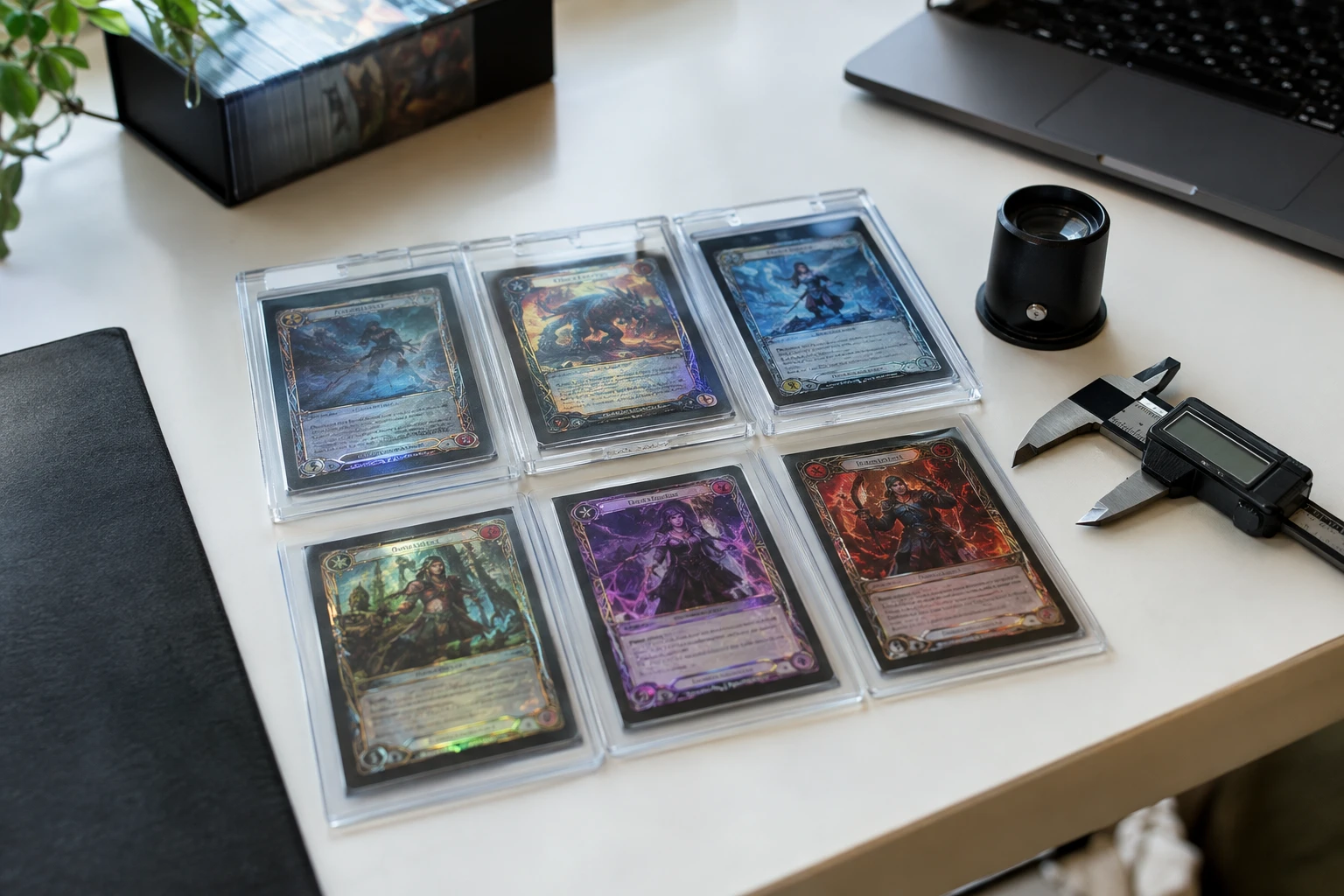
The Short Answer
- Cold Foil is the grading target — PSA 10 Cold Foils command 2–4x raw value, with the most expensive FaB cards reaching $6,000–$12,000 in PSA 10.
- Flesh and Blood has 15,706 tracked cards across 93 sets, but the grading scene is less mature than Pokémon — creating opportunity for early graders.
- 1st Edition Cold Foils from early sets (Welcome to Rathe, Arcane Rising, Crucible of War) are the highest-value grading targets.
- BGS is recommended for FaB — subgrades matter for Cold Foils where centering and surface can vary independently.
- Do NOT grade Rainbow Foils or non-foils — the PSA 10 premium is typically too small to justify fees on non-Cold Foil cards.
- Omens of the Third Age (June 2026) introduced new Fabled and Cold Foil targets ahead of the Paris World Championship.
Flesh and Blood Grading in 2026: A Competitive TCG With Undervalued Slabs
Flesh and Blood (FaB) has emerged as one of the most strategically deep and competitively vibrant trading card games in the world. Created by Legend Story Studios in 2019, FaB has built a dedicated competitive scene with world championships, national qualifiers, and a growing organized play infrastructure. On the TCGplayer Marketplace, FaB consistently ranks among the top 8 TCGs by sales volume.
Yet despite this competitive success, Flesh and Blood remains one of the most under-graded TCGs relative to its market size. The FaB community skews heavily toward playing cards rather than slabbing them — most collectors keep their high-end Cold Foils raw in premium sleeves and top-loaders. This creates a significant opportunity for collectors who do grade: with low PSA 10 populations and growing collector demand, the first wave of gem-mint FaB slabs is commanding outsized premiums.
TCG Price Lookup tracks 15,706 unique Flesh and Blood cards across 93 sets with real-time market data. Graded slab data shows that PSA 10 Cold Foils command 2–4x raw Near Mint pricing — but the graded FaB market is smaller than Pokémon or Magic, meaning population scarcity drives additional premium.
Key 2026 Events Driving FaB Grading Demand
- Omens of the Third Age (June 5, 2026) — new expansion introducing fresh Cold Foil and Fabled targets
- Usurp the Shadow Throne (August 2026) — supplementary set with additional chase Cold Foils
- Paris World Championship (November 2026) — building competitive scene visibility and collector interest
- Growing secondary market — TCGplayer FaB sales volume up 40%+ year-over-year
- Low PSA pop counts — most 1st Edition Cold Foils have fewer than 30 PSA 10s, creating scarcity premium
Why FaB Grading Is Different From Other TCGs
Flesh and Blood cards are printed by Legend Story Studios (now manufactured via Cartamundi), and the cardstock and foil treatments are distinct from both Pokémon (Bandai/TPCI) and MTG (Wizards/Cartamundi). The most important differences for grading:
- Cold Foil treatment: FaB Cold Foils have a unique silver-blue foil that is applied to specific card elements (not the full card). This creates partial foil patterns that require specialized AI calibration for surface analysis.
- Thicker cardstock: FaB cards are printed on thicker stock than most TCGs, which generally helps corner and edge condition but can make centering more variable.
- 1st Edition vs Unlimited: 1st Edition stamps add significant value and are the primary grading target. Always verify the 1st Edition stamp is present and undamaged before submitting.
- Gold Cold Foil: Ultra-rare treatment with gold foil instead of silver-blue. These are the rarest FaB cards and always warrant grading.
- Fabled rarity: Ultra-rare promo cards given to tournament winners and special event attendees. Extremely low print runs make these top-tier grading targets.
Flesh and Blood Rarity and Foil Tiers: The Complete Hierarchy
Flesh and Blood has a unique rarity system that combines traditional rarity tiers with foil treatments. Understanding which combinations carry value is essential for making profitable grading decisions.
Complete FaB Rarity × Foil Matrix (2026)
| Rarity | Foil Type | Typical Raw Value | PSA 10 Premium | Grade Worth It? |
|---|---|---|---|---|
| Common | Normal | $0.05–$0.20 | Minimal | No |
| Uncommon | Normal | $0.10–$0.50 | Minimal | No |
| Rare | Normal | $0.50–$5 | Low | No |
| Rare | Rainbow Foil | $2–$30 | Low (1.2–1.5x) | Rarely — only if 1st Ed |
| Super Rare | Cold Foil | $20–$500 | High (2–4x) | Yes — if raw > $50 |
| Majestic | Cold Foil | $30–$800 | High (2–4x) | Yes — if raw > $50 |
| Legendary | Cold Foil | $50–$2,000 | Very High (2–5x) | Yes — always |
| Fabled | Cold Foil | $200–$6,000+ | Extreme (3–6x) | Yes — highest priority |
| Gold Cold Foil | Gold Foil | $500–$5,000+ | Extreme (3–6x) | Yes — always |
| Promo | Varies | $5–$1,500+ | Varies | If Cold Foil & raw > $50 |
The critical insight from this table: only Cold Foil cards are worth grading in Flesh and Blood. Rainbow Foils and non-foil cards have PSA 10 premiums that are too small (1.2–1.5x) to justify the $15–$80 grading fee. Cold Foils, however, command 2–4x premiums, and Fabled/Gold Cold Foils can reach 3–6x — making them highly profitable grading targets.
The 1st Edition Multiplier
1st Edition Flesh and Blood cards carry a significant premium over Unlimited printings. For Cold Foil cards, the 1st Edition premium is typically 50–200% over the Unlimited version. Always check for the 1st Edition stamp on the card — it is located on the bottom-left of the card front. If the stamp is damaged, faded, or missing, the 1st Edition premium is lost and the card should be evaluated as an Unlimited copy.
Top 15 Flesh and Blood Cards to Grade: Values, Pop Counts, and ROI
Based on TCG Price Lookup market data and eBay sold comps, these are the 15 highest-value Flesh and Blood cards that warrant professional grading. The list focuses on Cold Foil and Fabled cards from 1st Edition printings, which have the strongest PSA 10 premium potential.
| Rank | Card | Set | Raw NM | Est. PSA 10 | ROI |
|---|---|---|---|---|---|
| 1 | Eye of Ophidia (Fabled, 1st Ed) | Welcome to Rathe | $3,000–$6,000 | $6,000–$12,000 | ★★★★★ |
| 2 | Command and Conquer (CF, 1st Ed) | Welcome to Rathe | $2,500–$5,000 | $5,000–$10,000 | ★★★★★ |
| 3 | Fyendal's Fighting Spirit (Fabled) | Arcane Rising | $1,500–$3,500 | $3,500–$7,000 | ★★★★★ |
| 4 | Snapback Scrape (Gold CF) | Monarch | $1,200–$3,000 | $3,000–$6,000 | ★★★★★ |
| 5 | Boltyn Beam (Gold CF) | Monarch | $1,200–$3,000 | $3,000–$6,000 | ★★★★★ |
| 6 | Plunder Run (Fabled) | Crucible of War | $800–$2,000 | $2,000–$4,500 | ★★★★☆ |
| 7 | Soul Shackle (Fabled) | Tales of Aria | $600–$1,800 | $1,500–$4,000 | ★★★★☆ |
| 8 | Spinal Shudder (CF, 1st Ed) | Welcome to Rathe | $400–$1,500 | $1,000–$3,500 | ★★★★☆ |
| 9 | Briar Gem (CF, 1st Ed) | Tales of Aria | $300–$1,000 | $700–$2,500 | ★★★☆☆ |
| 10 | Echo of Elysiana (CF) | Omens Third Age | $200–$800 | $500–$2,000 | ★★★☆☆ |
| 11 | Genesis Drums (CF, 1st Ed) | Arcane Rising | $150–$600 | $400–$1,500 | ★★★☆☆ |
| 12 | Rift Bind (CF) | Uprising | $100–$500 | $300–$1,200 | ★★★☆☆ |
| 13 | Soul Reaping (CF) | Mortal Ambition | $80–$400 | $250–$1,000 | ★★☆☆☆ |
| 14 | Fates Reversal (CF) | Omens Third Age | $75–$350 | $200–$900 | ★★☆☆☆ |
| 15 | Harmonic Convergence (CF) | Heavy Hitters | $60–$300 | $180–$750 | ★★☆☆☆ |
The ROI rating accounts for raw value range, estimated PSA 10 multiplier (2–4x for Cold Foils, 3–6x for Fabled/Gold), grading fee, and the probability of achieving PSA 10 based on typical FaB cardstock condition. Cards rated ★★★★★ have clear grading ROI. Cards rated ★★★☆☆ require AI pre-grading to confirm condition before submission.
The Eye of Ophidia: FaB's Holy Grail
Eye of Ophidia is the single most valuable Flesh and Blood card in existence. This Fabled Cold Foil from Welcome to Rathe (1st Edition) has sold for $3,000–$6,000 raw and $6,000–$12,000 in PSA 10. The PSA 10 population is estimated at fewer than 10 copies worldwide. If you own one, grading is mandatory — the premium between raw and PSA 10 is the largest in the game.
PSA vs BGS vs CGC for Flesh and Blood: Which Grader Is Best?
The choice of grading company for Flesh and Blood cards depends on the card value, the importance of subgrades, and the desired resale premium. FaB has some unique considerations that differ from Pokémon and MTG grading.
BGS for FaB — Recommended for Cold Foils
Beckett (BGS) is the recommended grading company for Flesh and Blood Cold Foils. Here's why:
- Subgrades matter for Cold Foils: BGS provides four subgrades (centering, corners, edges, surface). For Cold Foil cards, surface and centering can vary independently — a card might have perfect surface but off-center, or vice versa. Subgrades document these independent condition factors.
- BGS 9.5 with four 9.5 subgrades can command premiums over PSA 9s for FaB Cold Foils, because collectors can see exactly which aspects are gem-mint.
- BGS grading is strict — FaB collectors respect BGS grades because they know the card earned its score.
However, BGS Express costs $79.95/card (Base and Standard tiers paused as of August 5, 2026), making it expensive for lower-value Cold Foils. Use BGS only for Cold Foils above $200 raw.
PSA for FaB
PSA commands the highest resale premium for FaB, as it does for all TCGs. A PSA 10 Cold Foil typically sells for 3–4x raw value, compared to 2.5–3x for BGS 9.5. However, PSA Regular costs $79.99/card with a 65–120 day turnaround. PSA is best for high-value Cold Foils ($500+ raw) where the premium difference between PSA 10 and BGS 9.5 justifies the cost and wait.
CGC for FaB
CGC Economy at $15/card is the most cost-effective option for mid-value Cold Foils ($50–$200 raw). CGC 10 Pristine FaB cards command roughly 70–80% of the PSA 10 premium. The 30–45 day turnaround is significantly faster than PSA. Use CGC for Cold Foils where the grading fee needs to stay low relative to card value.
TAG for FaB
TAG at $18/card with AI-assisted grading is an emerging option for FaB. TAG's photographic transparency (showing exactly why a card received its grade) is particularly valuable for Cold Foils, where collectors want to understand surface assessments. TAG 10 FaB cards are establishing their own premium track record as the company grows.
| Grader | Tier | Cost | Turnaround | Best For |
|---|---|---|---|---|
| BGS | Express | $79.95 | 15–25 days | Cold Foils $200+ (subgrades) |
| PSA | Regular | $79.99 | 65–120 days | Cold Foils $500+ (max resale) |
| CGC | Economy | $15 | 30–45 days | Cold Foils $50–$200 |
| TAG | Standard | $18 | 15–25 days | Transparency seekers |
AI Pre-Grading for Flesh and Blood Cold Foils: Specialized Analysis
AI pre-grading for Flesh and Blood cards requires specialized calibration for FaB's unique Cold Foil treatment. PreGradeCards achieves 84% accuracy within ±1 PSA grade for FaB Cold Foil cards — slightly lower than Pokémon or Digimon due to the complexity of Cold Foil surface analysis.
The Cold Foil Challenge for AI
Cold Foil is a partial foil treatment — the silver-blue foil is applied to specific elements of the card (usually the card name, border accents, and action text boxes) rather than the entire card surface. This creates a mixed surface where foil and non-foil areas sit side by side. For AI analysis, this means:
- Foil edge detection: The AI must identify the boundary between foil and non-foil areas and evaluate each separately
- Foil-specific defects: Foil scratches, foil lifting, and foil clouding are distinct from non-foil surface defects
- Lighting sensitivity: Cold Foil reflects light more intensely than rainbow foil, requiring diffuse lighting for accurate analysis
- Gold Cold Foil: Gold foil has different reflective properties than silver-blue Cold Foil and requires separate calibration
How to Photograph FaB Cold Foils for AI Analysis
- Use a ring light or softbox for even, diffuse illumination
- Position the light source directly above the card at 90 degrees for the front photo
- Avoid any angle lighting — it creates uneven foil reflection that confuses the AI
- Use a black or dark gray background to minimize ambient reflection
- Photograph at 300+ DPI — Cold Foil details require high resolution for accurate analysis
- Take a back photo — FaB card backs can show edge whitening that affects the grade
- For Gold Cold Foils, reduce exposure by 0.5 stops to prevent gold foil from washing out
Cost Savings Example
Consider a collector with 8 Cold Foil Majestic cards from various FaB sets, each worth $100–$500 raw. Without AI pre-grading, submitting all 8 to BGS Express ($79.95/card) costs $639.60 plus $30 shipping = $669.60. If 3 come back BGS 9 instead of BGS 9.5 or 10, the grading premium may not cover fees on those 3 cards.
With AI pre-grading at $0.19/card, screening all 8 costs $1.52. The AI identifies 5 cards with 70%+ PSA 10 probability and flags 3 with centering or surface issues. You submit only the 5 strong candidates to BGS Express: $399.75 + $30 = $429.75. You save $239.85 in grading fees and avoid 3 likely sub-premium returns.
Cold Foil Surface Analysis: Identifying Foil Defects That Kill PSA 10s
Cold Foil surface defects are the #1 reason Flesh and Blood Cold Foil cards miss PSA 10. Unlike Pokémon holofoil or MTG foil, Cold Foil has specific defect types that collectors must learn to identify before submitting for grading.
Common Cold Foil Defects
- Foil scratching: Fine scratches visible only under direct light. These are the most common Cold Foil defect and are often caused by cards rubbing against each other in packs. Even pack-fresh Cold Foils can have micro-scratches from the packaging process.
- Foil clouding: A hazy or milky appearance on the foil surface, caused by moisture or chemical interaction during manufacturing. Clouding is a factory defect that cannot be fixed and will prevent PSA 10.
- Foil lifting: The foil layer begins to separate from the card surface, creating a bubbled or raised appearance. This is a serious manufacturing defect that worsens over time.
- Foil skip: Small areas where the foil application is missing or incomplete, leaving a bare spot. This is a manufacturing defect, not handling damage.
- Print line through foil: A visible line running through the foil area, caused by a printing roller imperfection. This is a factory defect that will prevent PSA 10.
How to Check Cold Foil Surface at Home
Before using AI pre-grading, do a quick home surface check:
- Hold the card at arm's length under direct overhead light (a ceiling light or desk lamp pointed down)
- Tilt the card slowly from left to right, watching the foil area for scratches catching the light
- Rotate the card 90 degrees and repeat the tilt — scratches in different directions become visible at different angles
- Look for cloudy or milky patches in the foil — these indicate foil clouding
- Run your finger lightly over the foil surface (with a clean microfiber cloth between your finger and the card) to check for raised areas that indicate foil lifting
- If you see any of these defects, the card is unlikely to achieve PSA 10 — save your grading fee
Foil Defects That PSA Tolerances Allow
Not all foil imperfections prevent PSA 10. PSA allows:
- Foil dimpling: Minor texture variation in the foil that is consistent across the card (manufacturing characteristic)
- Foil pattern variation: Slight differences in foil intensity across the card that are part of the manufacturing process
- Very minor foil edge feathering: Slight softness at the boundary between foil and non-foil areas
The key distinction: manufacturing characteristics are acceptable, while handling damage (scratches, dings) and manufacturing defects (clouding, lifting, skip) are not. AI pre-grading helps distinguish between acceptable characteristics and grade-killing defects.
Flesh and Blood Cardstock and Centering: What to Check Before Grading
Flesh and Blood cards are printed on thicker cardstock than most TCGs, which generally helps with corner and edge condition. However, centering can still be an issue, particularly on early sets (Welcome to Rathe, Arcane Rising) where Legend Story Studios was still refining their printing process.
Centering Variation by FaB Set Era
| Set Era | Typical Centering | PSA 10 Centering Rate | Notes |
|---|---|---|---|
| Welcome to Rathe (2019) | 55/45 to 65/35 | ~40% | Early printing — most centering variation |
| Arcane Rising (2020) | 55/45 to 60/40 | ~50% | Improving but still inconsistent |
| Crucible of War (2020–21) | 55/45 to 60/40 | ~50% | Similar to Arcane Rising |
| Monarch (2021) | 50/50 to 55/45 | ~60% | Significant improvement |
| Tales of Aria (2021) | 50/50 to 55/45 | ~60% | Consistent quality |
| Uprising+ (2022–26) | 50/50 to 55/45 | ~65% | Modern LSS quality standards |
Early FaB sets (Welcome to Rathe, Arcane Rising) have the most centering variation but also contain the most valuable cards (Eye of Ophidia, Command and Conquer, Fyendal's Fighting Spirit). This makes AI pre-grading especially critical for early-set Cold Foils — the centering check can save you $80+ in wasted grading fees on an off-center card.
The 1st Edition Stamp Check
Before submitting any FaB card for grading, verify the 1st Edition stamp condition. The stamp is on the bottom-left of the card front. PSA will note a damaged or faded stamp, which can affect both the grade and the resale value. If the stamp is significantly damaged, the card may still grade PSA 10 for condition, but the 1st Edition premium will be reduced. AI pre-grading includes a stamp visibility check as part of the surface analysis.
Set-by-Set FaB Grading Guide: Which Sets Have the Best Cold Foils to Grade
Not all Flesh and Blood sets are equal for grading ROI. Early sets have the most valuable Cold Foils but the worst centering. Modern sets have better centering but lower raw values. Here is the complete set-by-set guide.
Welcome to Rathe (2019) — 1st Edition
The holy grail set for FaB grading. Contains Eye of Ophidia (Fabled, $3,000–$6,000 raw), Command and Conquer (Cold Foil, $2,500–$5,000), and Spinal Shudder (Cold Foil, $400–$1,500). 1st Edition copies are extremely rare. Every Cold Foil and Fabled from this set is an automatic grade candidate. However, centering issues mean you must AI pre-grade before submitting.
Arcane Rising (2020) — 1st Edition
Contains Fyendal's Fighting Spirit (Fabled, $1,500–$3,500) and Genesis Drums (Cold Foil, $150–$600). The Fabled from this set is the second most valuable FaB card after Eye of Ophidia. Grade all 1st Edition Cold Foils and Fabled cards.
Crucible of War (2020–2021)
Contains Plunder Run (Fabled, $800–$2,000). The set has moderate centering quality. Grade all Fabled and high-value Cold Foil Legendaries.
Monarch (2021)
Introduced Gold Cold Foil treatment. Contains Snapback Scrape and Boltyn Beam (Gold Cold Foils, $1,200–$3,000 each). Gold Cold Foils are the rarest FaB treatment and should always be graded. The set has improved centering quality (~60% PSA 10 rate).
Tales of Aria (2021)
Contains Soul Shackle (Fabled, $600–$1,800) and Briar Gem (Cold Foil, $300–$1,000). Good centering quality. Grade all Cold Foil Majestics and Legendaries above $100 raw.
Omens of the Third Age (June 2026)
The newest FaB expansion. Contains Echo of Elysiana (Cold Foil, $200–$800) and Fates Reversal (Cold Foil, $75–$350). Modern LSS quality means higher PSA 10 hit rates. The set is too new for reliable PSA pop data, creating an early-submission premium window ahead of the Paris World Championship in November 2026.
Tournament Promos and Prize Cards
FaB tournament promos — including National Championship, Battle Hardened, and Calling event promos — are extremely rare and should always be graded. Fabled promos given to tournament winners are among the rarest FaB cards in existence. Always verify authenticity before submitting.
Flesh and Blood Grading ROI Calculator: The Math Behind Profitable Cold Foil Submissions
Grading Flesh and Blood Cold Foils is profitable when the expected graded sale price exceeds the raw card cost plus grading fees, shipping, and selling fees. Here is the ROI formula with a worked example for a Cold Foil Legendary.
The FaB Grading ROI Formula
Expected ROI = (P(10) × PSA 10 Value + P(9) × PSA 9 Value + P(≤8) × PSA 8 Value) − Grading Fee − Shipping − Selling Fee
Worked Example: Command and Conquer Cold Foil 1st Ed ($2,500 raw)
| Variable | Value | Notes |
|---|---|---|
| Raw card cost | $2,500 | 1st Ed Cold Foil, NM |
| P(10) from AI | 55% | Early-set centering reduces probability |
| P(9) from AI | 30% | 30% chance of PSA 9 |
| P(≤8) | 15% | 15% chance of PSA 8 or lower |
| PSA 10 value | $7,500 | 3x raw (FaB Cold Foil multiplier) |
| PSA 9 value | $3,750 | 1.5x raw |
| PSA 8 value | $2,750 | 1.1x raw |
| Grading fee (PSA) | $79.99 | PSA Regular |
| Shipping | $4 | Amortized |
| Selling fee | 13.25% | eBay |
Expected Value = (0.55 × $7,500) + (0.30 × $3,750) + (0.15 × $2,750) = $4,125 + $1,125 + $412.50 = $5,662.50
Net ROI = $5,662.50 − $79.99 − $4 − (13.25% × $5,662.50) = $5,662.50 − $83.99 − $750.28 = $4,828.23
Profit = $4,828.23 − $2,500 = $2,328.23 (93% return on raw card cost)
This is a highly profitable grading submission. Even with only 55% PSA 10 probability (due to early-set centering concerns), the 3x Cold Foil premium makes the expected value strongly positive. This is why Cold Foil cards from Welcome to Rathe are the top grading targets in Flesh and Blood.
When NOT to Grade FaB Cards
- Rainbow Foil cards: PSA 10 premium is only 1.2–1.5x — grading fees eat the entire premium
- Non-foil cards: No meaningful PSA 10 premium exists for standard FaB cards
- Cold Foils under $50 raw: Grading fee ($15–$80) approaches or exceeds the premium
- Cold Foils with visible foil clouding or lifting: These defects prevent PSA 10 regardless of other condition factors
- Unlimited edition Cold Foils: The 1st Edition premium is lost, reducing the overall grading ROI
Complete AI Pre-Grading Workflow for Flesh and Blood Cold Foils
Follow this step-by-step workflow to maximize your Flesh and Blood grading ROI and minimize wasted submission fees.
Step 1: Identify Cold Foil and Fabled Cards
Pull all Cold Foil, Gold Cold Foil, and Fabled cards from your FaB collection. Set aside Rainbow Foil and non-foil cards — these are almost never worth grading. Sort Cold Foils by estimated raw value using TCG Price Lookup or TCGplayer. Set aside any Cold Foil worth less than $50 raw.
Step 2: Check 1st Edition Stamp
For each Cold Foil, verify the 1st Edition stamp is present and undamaged. The stamp is on the bottom-left of the card front. Cards without 1st Edition stamps should be evaluated as Unlimited copies (lower value, still gradeable if above $50 raw).
Step 3: Home Surface Check
Perform the home Cold Foil surface check described in the Cold Foil Surface Analysis section. Hold the card under direct overhead light and tilt slowly to check for foil scratches, clouding, lifting, and skip. If you see visible foil clouding or lifting, do not submit — these defects prevent PSA 10 regardless of other condition.
Step 4: Photograph for AI Analysis
Take front and back photos using the Cold Foil photography guidelines: ring light or softbox, 90-degree overhead angle, black background, 300+ DPI. For Gold Cold Foils, reduce exposure by 0.5 stops.
Step 5: Upload to PreGradeCards AI
Upload each card to PreGradeCards AI grading and receive your pre-grade report with PSA 10 probability, subgrades, and specific defect identification.
Step 6: Filter by PSA 10 Probability
Submit only cards with 55%+ PSA 10 probability to professional grading. For Cold Foils, the 3–4x PSA 10 premium means even moderate probability submissions are profitable. Cards with 35–55% probability are borderline — submit only if the PSA 9 value still covers grading fees with margin.
Step 7: Choose Your Grader
- BGS Express ($79.95/card): Best for Cold Foils $200+ where subgrades add resale value
- PSA Regular ($79.99/card): Best for Cold Foils $500+ where maximum resale premium matters
- CGC Economy ($15/card): Best for Cold Foils $50–$200 where cost efficiency matters
- TAG Standard ($18/card): Best for collectors who want grading transparency
Step 8: Package, Ship, Track, and Sell
Package in penny sleeves and semi-rigid holders. Ship via USPS Priority Mail with insurance. Once graded cards return, check PSA/BGS/CGC population reports. If your card is one of fewer than 20 gem-mint copies, consider holding for appreciation. FaB PSA 10 populations are so low that scarcity-driven appreciation is a real factor.
Frequently Asked Questions
Is Flesh and Blood worth grading?
What is the most valuable Flesh and Blood card to grade?
Should I use PSA or BGS for Flesh and Blood Cold Foils?
What is a Cold Foil in Flesh and Blood?
How does AI grading work for FaB Cold Foils?
Should I grade Rainbow Foil Flesh and Blood cards?
Sources & Further Reading
- Flesh and Blood Card Prices 2026 — TCG Price Lookup
- Most Expensive Flesh and Blood Cards Ever Sold — TCG Price Lookup
- Free Flesh and Blood Grading Calculator — Guardian TCG
- Best-Selling Trading Card Games Q2 2026 — TCGplayer
- Flesh and Blood TCG Grading — PreGradeCards
Marcus Chen has evaluated over 50,000 sports cards and TCG cards across PSA, BGS, SGC, and CGC standards. Before joining PreGradeCards, he worked as a submission specialist for a major grading company and trained collectors and dealers on condition assessment.
Create a free account and get 1 free credit — enough for 1 complete AI grading with market pricing. No credit card required.
Sign Up Free →